
Gold panning laws by state vary dramatically across the United States, creating a complex legal landscape for recreational prospectors.
Some states welcome recreational prospecting on public land with no permit required, while others restrict where you can pan, what equipment you can use, and how much you can keep.
This complete directory covers gold panning laws by state, providing essential legal information to help you prospect safely and legally no matter where your adventures take you.
TL;DR – Gold Panning Laws by State
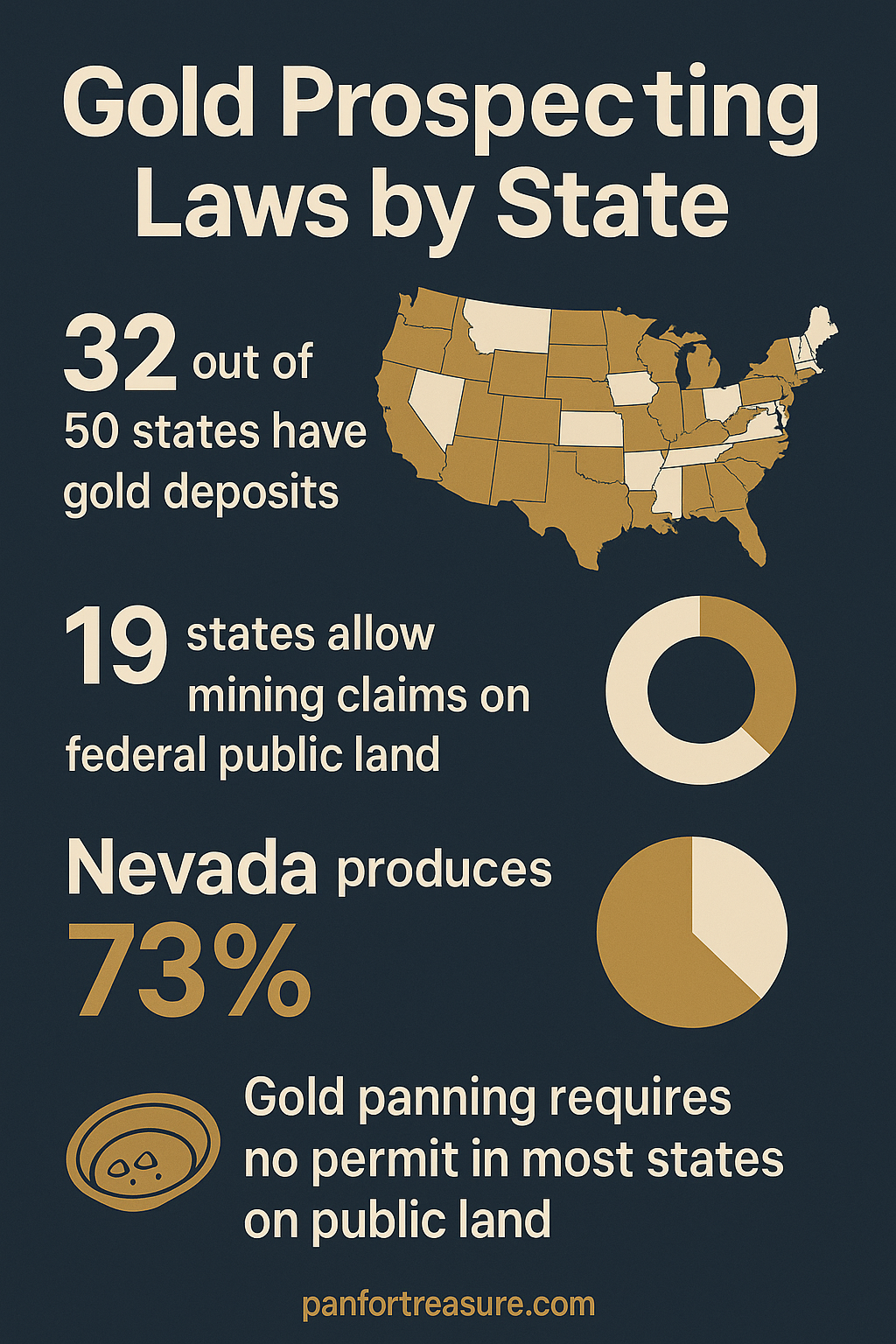
- Most permissive states: Alaska, Nevada, California, Arizona allow extensive recreational panning
- Federal restrictions: National Parks and Monuments prohibit all gold panning nationwide
- Common requirements: Hand tools only, no motorized equipment, respect private claims
- Permit costs: Range from free (most states) to $100+ for commercial operations
- BLM and Forest Service lands: Generally allow recreational panning with basic rules
- State parks: Rules vary widely – some allow panning, others prohibit entirely
- Bottom line: Always check current state and local regulations before you pan – laws change frequently
Complete Directory of Gold Panning Laws by State
Before you head out, check the rules for your state below. Each guide covers permit requirements, public vs private land access, BLM and state park regulations, and any restrictions on motorized equipment.




Understanding State vs Federal Jurisdiction
Federal Laws That Apply Everywhere
No matter which state you pan in, federal regulations still apply across all 50 states:
- National Parks and Monuments: Gold panning prohibited entirely
- BLM Land: Recreational panning generally allowed with hand tools
- National Forests: Usually permitted but may require permits for anything beyond basic panning
- Military Installations: Prohibited on all military land nationwide
- Indian Reservations: Requires specific tribal permission
State-Specific Variations
States regulate gold panning differently based on their geological history, environmental concerns, and mining traditions:
- Western mining states: Generally more permissive with established mining law frameworks
- Eastern states: Often more restrictive due to environmental protections and limited public land
- Great Lakes states: Mixed regulations depending on historical mining activity
- Southern states: Varied approach based on individual state mining history
The Federal Mining Law Foundation
Before state rules even apply, three federal pillars shape prospecting rights on public land in every state.
General Mining Law of 1872
The General Mining Law of 1872 is the foundation of American mining law. It gives citizens the right to explore for minerals on open federal lands and to stake mining claims – a framework that, with environmental amendments layered on over the decades, still governs claim staking today.
Casual Use vs. Notice-Level Operations
Federal land agencies distinguish between two tiers of activity, and knowing which tier you fall into determines whether you need to file anything at all:
- Casual use: Low-impact activity like hand panning and metal detecting that causes no significant surface disturbance – no notice or permit required on most BLM land
- Notice-level operations: Activity involving mechanized equipment or meaningful surface disturbance – requires filing a notice with the managing agency and may require reclamation bonding
| Agency | What It Manages | Permit Requirements |
|---|---|---|
| Bureau of Land Management (BLM) | Public lands across the West | Casual use free; notice/permit for significant operations |
| U.S. Forest Service | National Forests | Casual panning usually allowed; requirements vary by forest |
| National Park Service | National Parks and Monuments | All prospecting prohibited |
Equipment Restrictions by Region
Generally Allowed Equipment
- Gold pans: All sizes permitted in recreational use
- Hand shovels: Non-motorized digging tools
- Classifiers and screens: For separating different sized materials
- Snuffer bottles and tweezers: For collecting fine gold
- Small sluice boxes: Non-motorized stream sluices (state-dependent)
Commonly Restricted Equipment
- Suction dredges: Banned or heavily regulated in most states
- Highbankers: Motorized equipment requiring permits in many areas
- Metal detectors: Allowed for gold prospecting in most states, restricted in some parks
- Motorized wash plants: Commercial-scale equipment requiring mining claims
Rules by Prospecting Method
The same stretch of river can be legal for one technique and off-limits for another. Here’s how regulation typically scales with method:
Hand Panning
The least regulated method everywhere. Panning in public waterways is legal in most states with no permit, subject to environmental rules and claim boundaries. When a state restricts prospecting, hand panning is almost always the last method affected.
Sluicing and Highbanking
Because these methods move more material and use flowing water, several states require permits – especially for highbankers with pumps. Water-use and discharge rules apply to protect habitat.
Suction Dredging
The most heavily regulated method. Expect permit requirements with environmental review, dredge-size limits, seasonal windows, and outright bans in protected areas. California’s suction dredge restrictions are the best-known example.
Metal Detecting
Generally allowed for prospecting on BLM and Forest Service land as casual use, but restricted around historical sites and prohibited in National Parks. Rules vary by land manager – see our metal detecting laws guide for state-by-state rules.
Permit Requirements and Costs
States Requiring Permits
- New Mexico: Mining registration required for certain activities
- Washington: Hydraulic project approval for water-related mining
- Oregon: Permits required for motorized equipment
- Idaho: Stream alteration permits for some activities
States with Free Recreational Panning
- California: Hand panning allowed on most public land
- Nevada: Extensive BLM land open for recreational prospecting
- Arizona: Hand panning permitted in most areas
- Colorado: Recreational panning allowed with basic restrictions
Environmental and Seasonal Considerations
Fish and Wildlife Protections
Many states impose seasonal restrictions to protect spawning fish and sensitive wildlife:
- Pacific Northwest: Salmon spawning season restrictions (typically September-May)
- Rocky Mountain states: Trout spawning protections (varies by elevation and species)
- Great Lakes region: Seasonal restrictions around fish migration periods
Water Quality Regulations
- Sediment disturbance limits: Minimize impact on water clarity
- Chemical prohibitions: Mercury and other toxic substances banned
- Restoration requirements: Fill holes and restore natural appearance
Private Property and Mining Claims
Understanding Mining Claims
- Active claims: Exclusive rights granted to claim holders
- Claim boundaries: Must be marked and recorded with county/state
- Claim databases: Most states maintain online claim location systems
- Penalties for trespassing: Fines and potential legal action
Staking and Maintaining a Claim
Under the 1872 framework, staking your own claim involves marking the boundaries on the ground, recording the claim with the county and the BLM, and paying the required fees. Keeping a claim active requires annual maintenance fees (or a small-miner waiver) and ongoing filings – let those lapse and the ground reopens to anyone.
Private Land Access
- Permission required: Always get written permission from landowners
- Fee-based operations: Commercial pay-to-pan locations
- Liability considerations: Understand insurance and safety responsibilities
Enforcement and Penalties
Common Violations
- Unpermitted dredging: Using motorized equipment without proper permits
- Claim jumping: Prospecting on active mining claims
- Environmental damage: Excessive disturbance or failure to restore areas
- Park violations: Panning in prohibited areas like National Parks
Typical Penalties
- Warning citations: First-time minor violations
- Fines: Range from $100-$10,000 depending on severity and state
- Equipment confiscation: Illegal dredges or other prohibited equipment
- Court proceedings: Serious violations may result in criminal charges
Gold Dredging Laws and Regulations by State
Dredging is the most heavily regulated form of recreational prospecting, and the gold dredging laws and regulations by state vary more than any other rule on this page.
A suction dredge vacuums gravel directly from the streambed, which puts it under water quality and fish habitat laws that don’t apply to a pan or hand sluice.
Nearly every state requires a permit for any motorized dredge, and the details – nozzle size limits, seasonal windows, and which waterways are open – are set state by state.
The strictest states have banned suction dredging outright or suspended permits entirely, with California being the best-known example.
Western states like Idaho, Oregon, and Washington allow dredging but tie it to seasons designed around fish spawning, often with a 4 or 5 inch nozzle cap for recreational use.
Eastern states are a mixed bag: Maine allows motorized dredging with a Department of Environmental Protection permit, Georgia requires authorization for any mechanized equipment in state waters, and Illinois restricts dredging under its water use permitting rules.
Before you buy or run a dredge, check three things: your state’s environmental agency rules, the specific waterway’s status, and whether federal land managers require separate authorization on top of the state permit.
Each state guide below notes the dredging and motorized equipment rules where they apply, and when in doubt, call the state agency directly – dredging violations carry the heaviest penalties in recreational prospecting.
Best Practices for Legal Compliance
Before You Go
- Research current regulations: Laws change frequently, verify current rules
- Check land ownership: Use online mapping tools to verify public access
- Contact local authorities: When in doubt, call local ranger or mining offices
- Join local clubs: Prospecting groups provide current legal information
While Prospecting
- Carry permits: Keep required documentation easily accessible
- Respect boundaries: Stay within legal boundaries and marked areas
- Follow equipment rules: Use only permitted tools and techniques
- Practice Leave No Trace: Restore areas to natural condition
Regional Legal Summaries
Western States
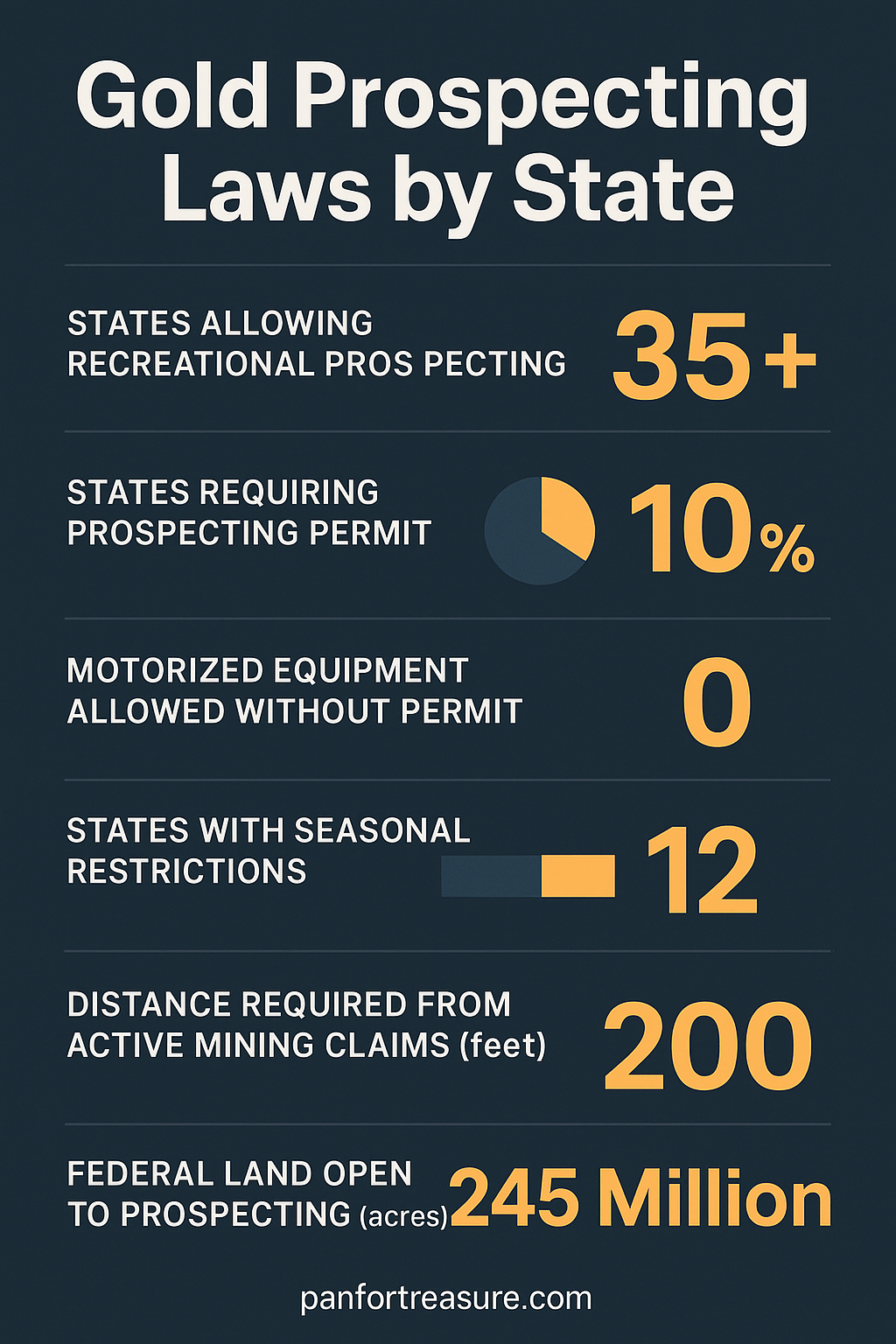
Generally the most permissive for recreational gold panning due to mining heritage and extensive public lands. Most allow hand panning on BLM and Forest Service land.
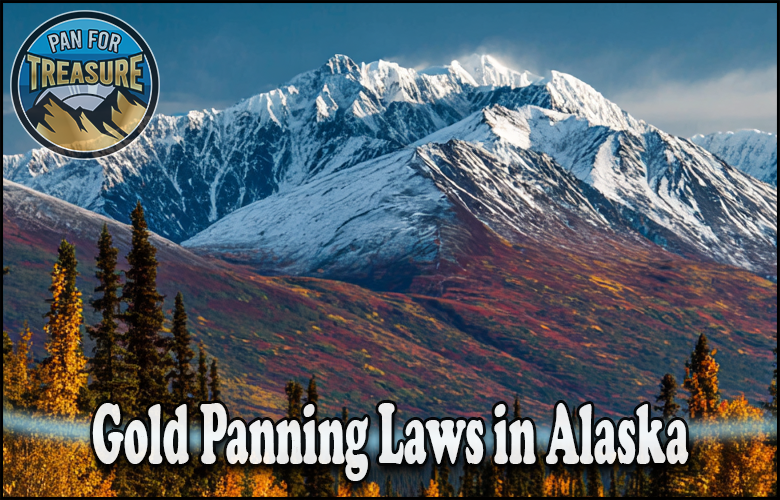
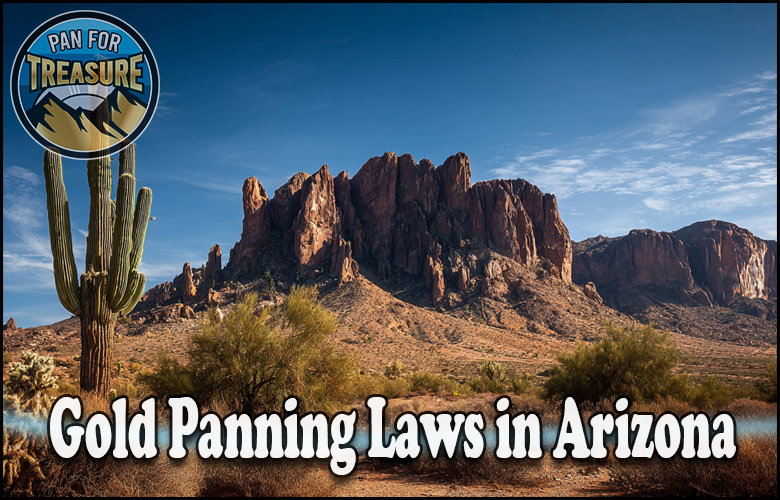
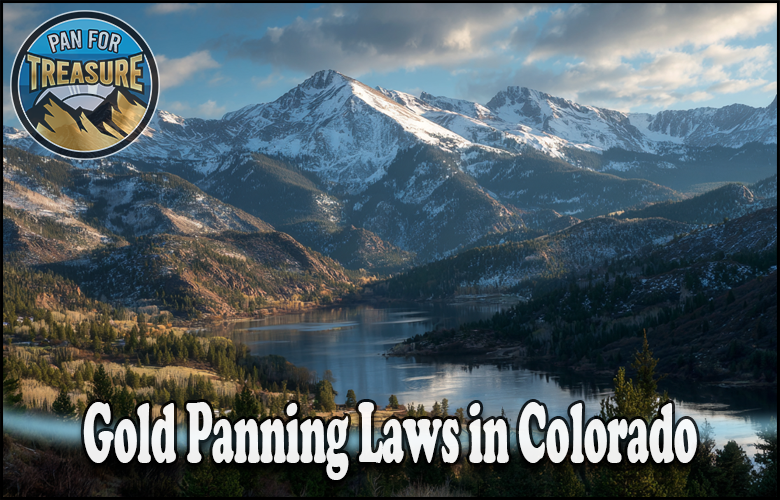
California pairs famous gold country with the strictest suction-dredge rules in the nation – hand panning stays broadly legal, but dredging requires permits with size and location limits. Alaska remains the most open state for prospectors, with vast accessible land and lighter regulation. Colorado, Nevada, and Arizona all welcome recreational panning under the federal framework, with Nevada’s claim-dense public land requiring extra care checking claim maps. Oregon, Washington, and Idaho allow panning but require permits for suction dredging and other in-stream equipment.
Eastern States
More restrictive due to limited public land access and stronger environmental protections. Several states require permits or restrict panning locations.
Georgia and North Carolina – the heart of America’s first gold rush – require permission or permits for prospecting on state lands and restrict motorized equipment. Virginia is protective around its many historical sites, and New York has the region’s most unusual wrinkle: state law dating to colonial times claims found gold for the state. Pennsylvania, Maryland, and Vermont allow small-scale panning in places but expect landowner permission and hand tools only.
Southern States
Mixed regulations with some states very welcoming to prospectors while others have significant restrictions on public land access. Tennessee allows prospecting in designated areas like Coker Creek, and Kentucky and Alabama permit recreational panning with environmental limits and landowner permission.
Great Lakes Region
Limited gold potential in most areas, with regulations focused more on general mineral collecting than specific gold panning rules. Michigan allows panning and non-motorized sluicing in most streams without a permit, Wisconsin permits panning under water-protection rules, and Minnesota is the most restrictive of the three, with permits needed for dredges and highbankers.
Resources for Staying Current
Government Sources
- State mining offices: Primary source for current regulations and permits
- BLM field offices: Information on federal land access and restrictions
- Forest Service districts: National Forest prospecting rules and permits
- State park services: Individual park regulations and seasonal restrictions
Prospecting Organizations
- Local prospecting clubs: Current information and group knowledge
- State mining associations: Advocacy and legal update resources
- National organizations: Broader policy information and legal challenges
Frequently Asked Questions
Do gold panning laws by state really vary that much?
Yes, significantly. Western mining states like California and Nevada have well-established frameworks allowing extensive recreational panning, while some eastern states have much more restrictive approaches or require permits for any prospecting activity.
Can I pan for gold in any state park?
No, state park regulations vary dramatically. Some states allow panning in designated areas, others prohibit it entirely, and some require special permits. Always check with individual park offices before visiting.
What happens if I accidentally pan on a mining claim?
Penalties vary by state but can include fines, equipment confiscation, and legal action by claim holders. Always verify claim status using online databases before prospecting in any area.
Are there any states where gold panning is completely illegal?
No state completely prohibits gold panning, but some have very restrictive regulations that limit where and how you can prospect. The challenge is usually access to legal locations rather than outright bans.
How often do gold panning laws by state change?
Mining and environmental regulations can change annually or even seasonally. Environmental protections, fish and wildlife seasons, and permit requirements are updated regularly, making it essential to verify current rules before each prospecting trip.
Can I use a metal detector while gold panning in all states?
Metal detector regulations vary by state and land management agency. While generally allowed for prospecting, some areas restrict their use, and National Parks typically prohibit metal detecting entirely.
What is the General Mining Law of 1872?
It’s the federal law that still forms the foundation of American mining rights, allowing citizens to explore for minerals on open federal lands and stake claims. Modern environmental laws layer additional requirements on top of it.
What’s the difference between casual use and notice-level operations?
Casual use – hand panning, metal detecting, and other low-impact activity – requires no filing on most federal land. Notice-level operations involve mechanized equipment or significant disturbance and require filing with the BLM or Forest Service, often with reclamation bonding.
How do I stake my own mining claim?
Mark the claim boundaries on the ground, record the claim with the county recorder and the BLM, and pay the location and maintenance fees. Claims must be maintained with annual fees or filings to stay valid.
Conclusion
Understanding gold panning laws by state is essential for safe, legal, and successful prospecting adventures across the United States.
While the legal landscape can seem complex, most states welcome recreational gold panning when done responsibly and within established guidelines. The key is staying informed about current regulations, respecting private property and mining claims, and following environmental protection requirements.
Gold panning laws by state will continue to evolve as environmental awareness grows and mining regulations adapt to modern concerns. By staying current with legal requirements and practicing responsible prospecting, you can enjoy this historic hobby while protecting the natural resources that make it possible for future generations of treasure hunters.
Sources and References
- Bureau of Land Management – Mining and Mineral Resources
- U.S. Forest Service – Special Uses and Mineral Activities
- National Park Service – Regulations and Policies
- Environmental Protection Agency – Mining and Water Quality
- Office of Surface Mining Reclamation and Enforcement
- U.S. Department of the Interior – Mining and Mineral Policy
Information verified as of February 2026. State and federal regulations subject to change.

Subscribe to Our Newsletter