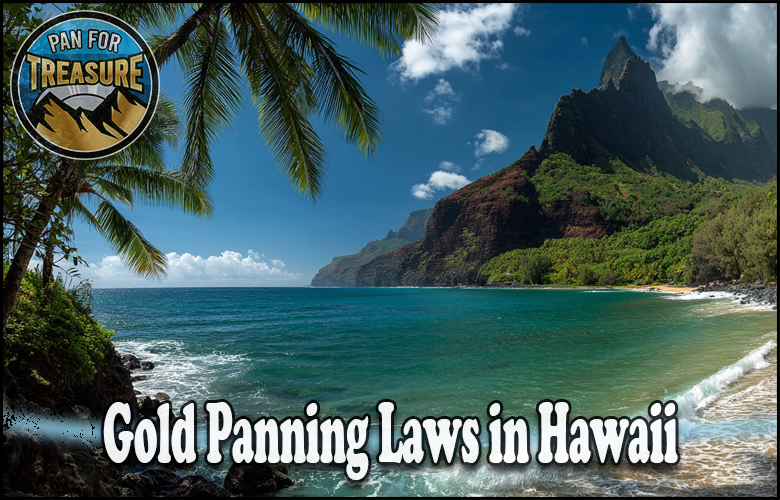
The gold panning laws in Hawaii are among the most restrictive in the country, and the geology makes the point academic. Hawaii’s volcanic islands are composed almost entirely of basaltic rock, which does not produce gold deposits the way mainland metamorphic and sedimentary formations do. There are no known placer gold deposits, no gold mines, and no history of gold production in Hawaii.
On top of the geology, Hawaii’s legal framework is strict. All minerals on state land are reserved to the State of Hawaii under HRS Section 182-2. The state constitution mandates that natural resources are held in public trust. State parks, beaches, and conservation lands have strong protections against removing any natural materials. There is no BLM land and no National Forest in Hawaii.
This guide covers what the laws actually say and what alternatives exist for treasure hunting in the islands. If you’re looking for productive gold panning destinations, start with our gold panning laws by state directory.
TL;DR
- No known gold deposits. Hawaii’s volcanic basalt geology does not produce placer gold. There is no gold mining history in the state.
- All minerals on state land are reserved to the State under Hawaii Revised Statutes Section 182-2. You cannot remove minerals from state land without authorization.
- No BLM land, no National Forest. Hawaii has none of the federal public land where recreational prospecting is typically allowed on the mainland.
- State parks and beaches: Removing rocks, sand, minerals, or natural objects from state parks, beaches, and conservation areas is prohibited or restricted.
- Private land: Requires written landowner permission. Mineral rights on formerly state-owned land may still belong to the state.
- Beach metal detecting is the closest alternative to gold prospecting in Hawaii and can be productive for jewelry and coins.
None Known
None
Volcanic Basalt
No BLM or National Forest
Reserved to the State (HRS 182-2)
Beach Metal Detecting
Gold Panning Laws in Hawaii
Hawaii’s mineral and land use laws are built around conservation and public trust. The regulatory framework is tight, and it applies whether or not there is any gold to find.
State Mineral Rights – HRS Section 182-2
Under Hawaii Revised Statutes Section 182-2, all minerals in, on, or under state lands or reserved lands are reserved to the State. This is a blanket reservation. Anyone who purchases or leases state land acquires no rights to the minerals. The statute further reserves to the State the right to prospect for, mine, and remove minerals from those lands.
This means that even on land sold by the state, mineral rights may still belong to the state. If you want to prospect on any land in Hawaii, you need to determine who holds the mineral rights, which may not be the surface owner.
State Parks and Conservation Land
Hawaii’s state parks, natural area reserves, and conservation districts have strict rules about removing natural materials. Taking rocks, sand, coral, minerals, or any natural objects from state parks and beaches is prohibited or heavily restricted. The Department of Land and Natural Resources (DLNR) administers these lands.
This extends to beaches. Hawaii law restricts the removal of sand and rocks from beaches, including for personal use. Do not assume that picking up rocks or panning sand at a Hawaiian beach is legal.
No Federal Public Land for Prospecting
Hawaii has no BLM-managed public land and no National Forest. The federal lands in Hawaii are primarily national parks (Haleakala, Hawaii Volcanoes), military installations, and wildlife refuges – all of which prohibit mineral collecting and prospecting. There is no federal land in Hawaii where the General Mining Law of 1872 applies.
Private Land
Private land makes up a significant portion of Hawaii. Written permission from the landowner is required before any prospecting activity. Keep in mind that mineral rights on formerly state-owned land may still be reserved to the State under HRS 182-2, even if the surface rights were sold to a private party.
Cultural and Environmental Sensitivity
Hawaii’s natural landscape holds deep cultural significance in Native Hawaiian tradition. Many sites are considered sacred. Streams, rivers, and geological formations may be culturally protected. Beyond the legal requirements, prospectors should be aware of and respectful toward Native Hawaiian cultural values regarding the land. Disturbing natural areas for recreational purposes can be offensive and harmful in ways that go beyond what statutes address.
Equipment – Not Applicable
Because there is no gold to pan for and no legal framework supporting recreational prospecting in Hawaii, an equipment restrictions table is not applicable for this state. Standard gold panning equipment is not relevant here.
For gear information for states where panning is productive, see our best tools for gold panning roundup.
Why There Is No Gold in Hawaii
Hawaii’s geology is fundamentally different from the mainland. The islands formed from hot-spot volcanism – magma from deep in the Earth’s mantle punching through the Pacific Plate and building shield volcanoes on the ocean floor. The rock is almost entirely basalt, with no metamorphic or sedimentary formations that typically host gold deposits.
Gold on the mainland forms through hydrothermal processes where hot, mineral-rich fluids deposit gold in quartz veins and surrounding rock. This requires specific conditions – the right source rock, the right temperature and pressure, and millions of years of geological processes. Hawaii’s young volcanic basalt (the oldest islands are roughly 5 million years old) simply does not have these conditions.
A USGS study did find native gold in volcanic glass from early submarine eruptions of Kilauea, collected at 3,879 meters depth off the volcano’s south flank. This is a geological curiosity, not a prospecting opportunity. The gold concentrations (up to 36 parts per billion) are scientifically interesting but far below any recoverable amount.
For more detail, see our page on whether there’s gold in Hawaii.
Treasure Hunting Alternatives in Hawaii
If you’re in Hawaii and want to treasure hunt, gold panning is not the answer. But there are productive alternatives:
- Beach metal detecting: This is where the real “gold” is in Hawaii. Tourists lose jewelry, coins, and watches on Hawaiian beaches constantly. A good metal detector on a beach near a resort area can produce gold rings, chains, and other valuable finds. Metal detecting rules vary by beach and park – check local regulations before detecting. Some beaches allow it, others do not.
- Peridot (olivine): Hawaii is one of the few places where you can find gem-quality peridot. Green olivine crystals erode from basalt and accumulate on certain beaches, most famously Papakōlea (Green Sand Beach) on the Big Island. Note: collecting sand or rocks from this beach is prohibited as it is within a protected area.
- Rockhounding: Hawaii offers volcanic minerals including obsidian, olivine, and various forms of quartz on some islands. Always check DLNR rules and get private land permission before collecting.
- Gemstone and mineral tours: Some commercial operations on the Big Island and Oahu offer guided “gold panning” or gem mining experiences as tourist activities. These use imported or seeded material and are entertainment, not actual prospecting.
For actual gold panning destinations, check out California, Alaska, or Colorado.
Tips for Treasure Hunting in Hawaii
- Do not go to Hawaii expecting to find gold. There is no placer gold in Hawaiian streams. If you see websites claiming otherwise, they are either selling tourist experiences with imported material or providing inaccurate information.
- Metal detecting is your best option. Hawaiian beaches near tourist areas produce lost jewelry and coins regularly. Invest in a waterproof detector rated for saltwater use.
- Know the beach rules. Not all Hawaiian beaches allow metal detecting. County parks, state parks, and protected areas each have their own rules. Check with the county parks department or DLNR before detecting.
- Do not remove rocks, sand, or coral from beaches. Hawaii law restricts removal of natural materials from beaches. Beyond the legal issue, taking lava rocks is considered disrespectful in Native Hawaiian culture.
- Respect cultural sites. Many natural areas in Hawaii are culturally significant. Heiau (temples), burial sites, and sacred natural features should not be disturbed. When in doubt, leave everything as you found it.
- Check mineral rights before any prospecting on private land. Even if a landowner gives you surface access, the mineral rights may still belong to the State under HRS 182-2.
- Consider mainland trips for gold panning. If gold is your goal, a trip to California, Oregon, or Alaska will be far more productive. See our best places to pan for gold guide.
Resources
- Hawaii Department of Land and Natural Resources (DLNR) – State agency managing parks, beaches, natural area reserves, and conservation land. Contact for questions about collecting rules.
- HRS Section 182-2 – Mineral Rights Reserved to the State – Full text of the statute reserving all minerals on state and formerly state-owned land to the State of Hawaii.
- Gold Prospectors Association of America (GPAA) – National organization with resources for recreational prospectors. No claims or chapters in Hawaii.
- Gold Panning Laws by State – Our full directory of state-by-state prospecting regulations for all 50 states.
Conclusion
The gold panning laws in Hawaii are strict, but the geology makes the laws almost beside the point. Hawaii has no known placer gold deposits. The islands are volcanic basalt, not the metamorphic or sedimentary rock that produces gold. All minerals on state land are reserved to the State under HRS 182-2, state parks prohibit removing natural materials, and there is no BLM or National Forest land.
If you’re in Hawaii, beach metal detecting near resort areas is the most productive treasure hunting activity. For actual gold panning, you’ll need to head to the mainland. Browse our full gold panning laws by state directory to find a state with real gold and legal access.
Frequently Asked Questions – HI Gold Panning Laws
Is gold panning legal in Hawaii?
There is no specific law addressing recreational gold panning in Hawaii. However, all minerals on state land are reserved to the State under HRS 182-2. State parks and beaches prohibit or restrict removing natural materials. There are no designated prospecting areas and no federal public land open to mineral entry. In practice, there is nowhere to legally pan for gold in Hawaii and no gold to find.
Is there gold in Hawaii?
No recoverable gold. Hawaii’s volcanic basalt geology does not produce placer gold deposits. A USGS study found trace gold (parts per billion) in submarine volcanic glass from Kilauea, but this is a deep-ocean geological finding, not a prospecting opportunity. Any gold found on Hawaiian beaches is lost jewelry, not natural placer gold.
Can you metal detect on Hawaiian beaches?
Metal detecting is allowed on some Hawaiian beaches but not all. Rules vary by county, park type, and specific location. Some public beaches allow detecting, while state parks and protected areas may prohibit it. Check with the county parks department or DLNR before detecting. Beach detecting near tourist areas is the most productive form of treasure hunting in Hawaii.
Can you take rocks from Hawaii?
Hawaii law restricts removing rocks, sand, and coral from beaches and state land. Beyond legality, taking lava rocks is considered disrespectful in Native Hawaiian culture. The practice is strongly discouraged and may result in fines on protected lands.
Where should I go instead of Hawaii for gold panning?
If gold panning is your goal, California, Alaska, Colorado, Oregon, Georgia, and North Carolina all have documented gold deposits and legal public access for recreational prospecting. See our gold panning laws by state directory for details on each state.
Are there tourist gold panning experiences in Hawaii?
Some commercial operations on the Big Island and Oahu offer guided “gold panning” activities. These use imported or seeded material and are tourist entertainment, not actual prospecting for native gold. They can be fun family activities but should not be confused with real gold prospecting.
⛏ Recommended Gear ⛏


* As an Amazon Associate I earn from qualifying purchases at no extra cost to you.
Subscribe to Our Newsletter

Ryan Conlon is the founder of Pan for Treasure.
A lifelong gold panning enthusiast, he created this site to help beginners learn the ropes and share practical tips from his own time on the creek. [email protected]