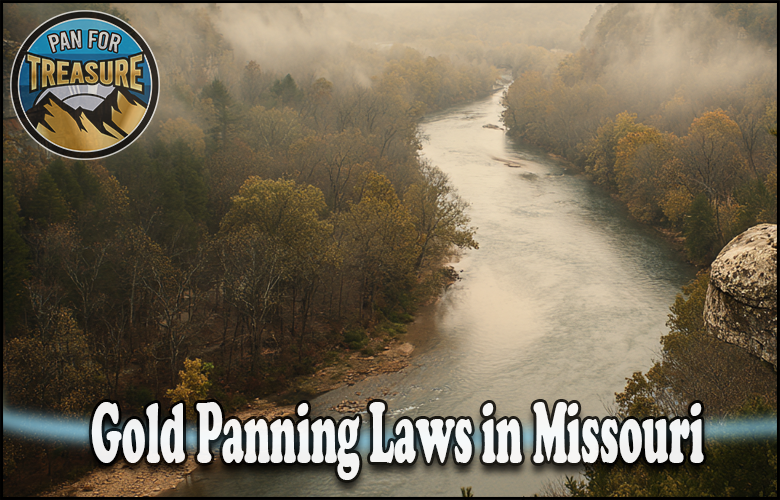
The gold panning laws in Missouri are not governed by a single state-level recreational prospecting statute. Missouri has no dedicated gold panning permit or program. The rules that apply depend entirely on where you pan: state parks prohibit all rock and mineral removal, Missouri Department of Conservation (MDC) areas prohibit prospecting and mining, Mark Twain National Forest allows hand panning with restrictions, and private land requires landowner permission.
Missouri’s regulatory framework for prospecting is a patchwork. The Missouri Department of Natural Resources (DNR) handles commercial mining permits under the Land Reclamation Act (Chapter 444, RSMo). The DNR also manages state parks, where collecting is prohibited. The MDC manages Conservation Areas with their own prohibition on mining and prospecting. The U.S. Forest Service manages Mark Twain National Forest, which is the most accessible public land for recreational hand panning in the state.
This guide breaks down the rules for each land type so you know what is allowed and where. If you are new to the hobby, start with our getting started with gold panning guide.
TL;DR
- No state panning permit: Missouri has no dedicated recreational gold panning statute or permit system.
- State parks: Removal of rocks, minerals, plants, animals, artifacts, or relics is prohibited without written permission from the state park director.
- MDC Conservation Areas: Prospecting, exploring, mining, or extracting minerals is prohibited except as specifically approved by the commission.
- Mark Twain National Forest: Gold panning is allowed in active streambeds and unvegetated gravel bars using only gold pans. Sluice boxes, motorized equipment, and digging in stream banks are not allowed.
- Private land: Requires landowner permission. Most land in Missouri is privately owned.
- Commercial mining: Regulated by the DNR Land Reclamation Program under Chapter 444, RSMo. Requires permits from the Missouri Mining Commission.
Glacial Placer (Northern 1/3 of State)
None (No Commercial Gold Mining)
Extra-fine Flour Gold
Northern MO Counties Near Missouri River
Mark Twain National Forest (Hand Pan Only)
Gold Pan Only, No Sluice or Motorized
Gold Panning Laws in Missouri
Missouri’s rules for gold panning are scattered across multiple agencies and land types. There is no single statute that says “recreational gold panning is allowed under these conditions.” Instead, you need to know which agency manages the land you are on and follow their specific rules. A Missouri attorney who specializes in stream law has noted that any mining requires a permit from DNR, any construction in a stream (including a sluice) could require U.S. Army Corps of Engineers approval, and a mineral lease from the riparian landowner may also be required. The practical result is that hand panning is the only method that avoids triggering multiple permit requirements.
Missouri State Parks – Prohibited
The Missouri State Parks system is managed by the DNR. State park rules are clear: removal of plants, animals, rocks, downed timber, artifacts, or relics is prohibited without written permission from the state park director. This prohibition covers gold panning. You cannot collect rocks, minerals, or any natural objects in Missouri state parks. This applies to all state parks and state historic sites, including popular destinations like Meramec State Park, Ha Ha Tonka State Park, and Table Rock Lake State Park.
MDC Conservation Areas – Prohibited
The Missouri Department of Conservation (MDC) manages over 1,000 Conservation Areas across the state. MDC regulations specifically prohibit prospecting, exploring, mining, or extracting minerals, metals, oil, natural gas, or other nonrenewable resources, except as specifically approved by the commission. This prohibition is explicit and covers gold panning. Do not pan for gold on MDC Conservation Areas.
Mark Twain National Forest – Allowed with Restrictions
The Mark Twain National Forest covers approximately 1.5 million acres across southern and central Missouri. This is the primary public land where recreational gold panning is allowed. The Forest Service permits gold panning under the following conditions:
- Gold panning is limited to active streambeds and unvegetated gravel bars.
- Only gold pans may be used. Sluice boxes are not allowed.
- Digging in stream banks is not allowed.
- Motorized equipment is not allowed.
- Collection must not cause undue or unnecessary degradation of the land.
- Rock and mineral collecting is restricted to small hand-size samples from the surface only.
- Tools are limited to rock hammers and garden trowels for general rock collecting.
- Collection in Wilderness Areas, caves, historical areas, and archaeological areas is prohibited.
- Collecting is for personal, non-commercial use only.
Mark Twain National Forest lands are not contiguous. They are scattered across many counties and intermixed with private land. It is easy to accidentally cross onto private property. Familiarize yourself with the Purple Paint Law (Missouri’s trespassing marker system) and contact the appropriate Mark Twain District Office when in doubt about land boundaries.
Private Land
Most land in Missouri is privately owned. Landowner permission is required before accessing or panning on private land. Missouri follows riparian rights law, meaning streambed ownership generally belongs to the adjacent landowner. The state does recognize public rights of access on navigable waterways for certain uses (fishing, boating), but whether gold panning qualifies as a protected public use on navigable waters is not clearly addressed in Missouri law.
Missouri’s Purple Paint Law (Section 569.145, RSMo) allows landowners to mark property boundaries with purple paint marks on trees or posts as a legal “no trespassing” notice. Learn to recognize these marks before heading out.
Public Stream Access Points
Missouri has numerous public stream access points maintained by MDC and the DNR for fishing and boating. Some prospectors use these access points to reach streams for panning. The legality of panning at these access points is a gray area. The access point itself is public property, but the streambed may be privately owned. When a conservation agent encountered a prospector at a public stream access in central Missouri, the agent reportedly had no specific rules to cite and simply asked if the person was finding anything. Experiences vary. If you use a public access point, stick to hand panning only, cause no disturbance, and be prepared to leave if asked.
Commercial Mining
The Missouri Land Reclamation Act (Chapter 444, RSMo) regulates industrial mineral mining, including sand and gravel operations. The DNR Land Reclamation Program administers permits through the Missouri Mining Commission. Any mechanized mining operation, including dredging or large-scale sluicing in waterways, would trigger these commercial permitting requirements plus potential Clean Water Act Section 404 permits from the Army Corps of Engineers.
Equipment Restrictions
| Equipment | State Parks / MDC Areas | Mark Twain National Forest | Private Land |
|---|---|---|---|
| Gold Pan | Prohibited | Allowed (streambeds/gravel bars only) | With landowner permission |
| Hand Shovel / Trowel | Prohibited | Trowel only, no bank digging | With landowner permission |
| Classifier / Screen | Prohibited | Gray area, check with District | With landowner permission |
| Sluice Box | Prohibited | Not allowed | May require DNR/Corps permits |
| Suction Dredge / Motorized | Prohibited | Not allowed | Requires DNR and Corps permits |
For gear recommendations, see our best tools for gold panning roundup.
Best Locations for Gold Panning in Missouri
Gold in Missouri is limited to glacial placer deposits in roughly the northern third of the state and scattered fine particles in major river systems. For more on where gold occurs, see our page on whether there’s gold in Missouri. These locations focus on where panning access exists, whether public or commonly reported by prospectors.
- Chariton River and Tributaries (Adair/Schuyler/Chariton Counties) – The most commonly cited gold panning river in Missouri. The Chariton River is a 218-mile tributary of the Missouri River. Placer gold has been reported along sandbars and gravel deposits. Mussel Fork Creek (Chariton County) is a known tributary with gold reports. Most access is on private land; get permission before panning.
- Missouri River Gravel Bars (Multiple Counties) – The Missouri River carries sediment from a massive drainage area. Exposed gravel bars at low water may contain fine flour gold. Public access exists at numerous river access points maintained by MDC and the Army Corps of Engineers. Stick to hand panning at public access points.
- Mark Twain National Forest Streams (Multiple Southern MO Counties) – The best option for legal public-land panning. Forest streams in the Ozarks region provide access without private land concerns. Gold potential is low in the Ozarks, but the legal access is clear. Contact the local Ranger District for stream recommendations.
- North Fabius River (Schuyler/Scotland/Knox/Clark/Lewis/Marion Counties) – Flows southeasterly through the glaciated northern part of the state. Fine placer deposits have been reported. The river crosses mostly private land; seek landowner permission.
- Grand River (Multiple Counties) – Feeds into the Missouri River near Brunswick in Chariton County. Reports of fine gold. Access at public bridge crossings and river access points.
- Thompson River (Northern MO) – Another northern Missouri river with fine gold reports. Flows through the glaciated region.
- Platte River (Northwestern MO) – Located in northwestern Missouri near Kansas City. Both the Platte and the Missouri River in this area have produced fine gold for patient prospectors.
- Sand Creek (Near South Gifford) – Gold has been found in glacial outwash zones near this creek. Small but documented gold occurrences. Private land access required.
- Big River (Eastern MO) – Stretches across several counties in the historic Lead Belt of eastern Missouri. Some prospectors have reported finding fine gold flakes. The area’s rich mineral history (lead, zinc, barite) makes the geology interesting for prospecting.
- Clear Creek (Near Piedmont, Wayne County) – Located in the Ozarks, Clear Creek is accessible near Mark Twain National Forest land. Some placer gold reports from this area.
Gold Prospecting History in Missouri
Missouri has no gold mining history in the traditional sense. No commercial gold mine has ever operated in the state, and no gold rush has occurred. The state’s mining legacy is built on lead (the Old Lead Belt and Viburnum Trend produced much of America’s lead for over a century), zinc, barite, iron, and coal. Missouri’s official state mineral is galena (lead ore), not anything related to gold.
Gold in Missouri was deposited by glaciers during the Pleistocene ice ages. Glaciers advancing south from Canada covered roughly the northern third of the state, bringing gold-bearing gravels from Canadian Shield source rocks. When the glaciers melted roughly 12,000 years ago, these deposits were left behind in terminal moraines and outwash plains. The gold is extremely fine flour, far too dispersed for commercial mining.
During the Great Depression of the 1930s, some Missouri families panned rivers like the Missouri and Chariton for supplemental income, consistent with Depression-era prospecting across the Midwest. In the late 20th and early 21st century, recreational gold panning grew as a hobby, with prospecting clubs forming around Kansas City and other areas. The Missouri chapter of the GPAA has organized outings to known gold-bearing streams.
Tips for Gold Panning in Missouri
- Mark Twain National Forest is your best public option. It is the only major public land in Missouri where hand panning is clearly allowed. Contact the local Ranger District before your trip to confirm current rules and get stream recommendations. Remember that Forest lands are not contiguous.
- Stay out of state parks and MDC Conservation Areas. Both explicitly prohibit mineral collecting and prospecting. Violations can result in removal from the area and fines. There is no ambiguity here.
- Learn Missouri’s Purple Paint Law. Landowners can mark boundaries with purple paint on trees or posts instead of posting “no trespassing” signs. A purple mark has the same legal force as a sign. If you see purple paint, you are at a property boundary and should not cross without permission.
- Get landowner permission for private streams. Most of Missouri is private land. The best gold-bearing streams (Chariton River, North Fabius, etc.) cross private property. A polite knock on the door goes a long way. Many rural Missouri landowners are receptive when approached respectfully.
- Stick to hand pans only on public land. Sluice boxes are not allowed on Mark Twain National Forest land. On any state waterway, a sluice could trigger DNR and Army Corps permitting requirements. A gold pan is the only equipment that avoids regulatory complications everywhere. See our panning techniques guide for fine gold methods.
- Focus on northern Missouri for gold. The glacial limit runs roughly along the Missouri River. Most gold reports come from counties north of that line: Adair, Schuyler, Chariton, Knox, Clark, and Lewis. Southern Missouri (the Ozarks) has interesting mineral deposits but very limited gold.
- Work gravel bars and sandbars at low water. After the spring flood season recedes, exposed gravel bars on the Missouri River and its tributaries offer the best panning material. Look for areas where the current slows, at inside bends, and downstream from tributary confluences.
- Pan extremely carefully. Missouri gold is flour-sized. Standard panning technique will lose most of it. Use slow, controlled movements. A spiral pan or a snuffer bottle is recommended for capturing particles you can barely see. For more on permits in other states, see our permit guide.
- Watch for other minerals. Missouri is rich in galena (lead), pyrite, chalcopyrite, and other minerals that can be confused with gold. Pyrite is brittle and lighter than gold. Galena is heavy and silver-gray. Real gold is soft, malleable, and stays bright yellow when flattened.
- Consider joining the Missouri GPAA chapter. Local prospecting clubs have knowledge of accessible streams, landowner relationships, and group outings that are hard to replicate on your own. The Kansas City area chapter has been active for years.
Resources for Missouri Prospectors
- Missouri State Parks – Laws and Regulations – Official rules for all Missouri state parks, including the prohibition on removing rocks, minerals, and natural objects.
- Missouri DNR – Industrial Mineral Permitting – Information on commercial mining permits, the Land Reclamation Act, and the Missouri Mining Commission.
- Mark Twain National Forest – USFS page for Missouri’s only National Forest, with contact information for District Ranger offices and recreation information.
- Gold Prospectors Association of America (GPAA) – National organization with a Missouri chapter. Resources, forums, and group outings.
- Gold Panning Permits Guide – Our breakdown of permit requirements across the country, useful for comparing Missouri’s patchwork system to states with formal prospecting programs.
Learn About Other States Gold Panning Laws
Planning a trip or curious about the rules elsewhere? Explore the laws for these popular gold panning states.
Conclusion
The gold panning laws in Missouri require knowing which agency manages the land you are standing on. State parks prohibit all rock and mineral removal. MDC Conservation Areas prohibit prospecting and mining. Mark Twain National Forest allows hand panning in active streambeds and unvegetated gravel bars with gold pans only (no sluices, no bank digging, no motorized equipment). Private land requires landowner permission, and most of Missouri is private.
Missouri has no dedicated recreational prospecting program and no state-level panning permit. The clearest legal path is hand panning on Mark Twain National Forest land or on private land with written permission. For more on the state’s gold potential, see our best places to pan for gold in America guide.
Check out the laws in Kansas, Illinois, Arkansas, Kentucky, and Iowa, or browse our full gold panning laws by state directory.
Frequently Asked Questions – MO Gold Panning Laws
Is gold panning legal in Missouri?
Yes, but it depends on where you pan. Hand panning is allowed on Mark Twain National Forest land in active streambeds and unvegetated gravel bars. State parks and MDC Conservation Areas prohibit mineral collecting and prospecting. Private land requires landowner permission. Missouri has no state-level recreational panning permit.
Do I need a permit to pan for gold in Missouri?
Not for hand panning on Mark Twain National Forest land or on private land with permission. Missouri has no dedicated gold panning permit. However, using mechanized equipment like dredges or sluice boxes in waterways could trigger commercial mining permits from the DNR and Army Corps of Engineers permits. Stick to a hand pan to avoid permitting complications.
Can I use a sluice box in Missouri?
Not on Mark Twain National Forest land, where sluice boxes are specifically not allowed. On private land with landowner permission, a sluice box might be used, but constructing anything in a stream could require Army Corps of Engineers approval, and any mining activity may trigger DNR permitting under the Land Reclamation Act. A hand pan is the only equipment that is clearly permitted for recreational prospecting.
Can I pan for gold in Missouri state parks?
No. Missouri state park rules prohibit removal of rocks, minerals, plants, animals, artifacts, or relics without written permission from the state park director. This includes gold panning. MDC Conservation Areas also prohibit prospecting and mining.
Where is the best place to pan for gold in Missouri?
For legal public access, Mark Twain National Forest streams in southern Missouri are the clearest option. For gold potential, the Chariton River and its tributaries in northern Missouri (Adair, Schuyler, Chariton counties) have the most gold reports, but these are mostly on private land. The Missouri River gravel bars at public access points are another option.
What kind of gold is found in Missouri?
Nearly all gold in Missouri is extremely fine flour gold deposited by glaciers during the ice ages. The glacial limit covers roughly the northern third of the state. No commercial gold mining has ever operated in Missouri. The gold is too fine and too dispersed for anything beyond recreational panning.

⛏ Recommended Gear ⛏


* As an Amazon Associate I earn from qualifying purchases at no extra cost to you.
Subscribe to Our Newsletter

Ryan Conlon is the founder of Pan for Treasure.
A lifelong gold panning enthusiast, he created this site to help beginners learn the ropes and share practical tips from his own time on the creek. [email protected]