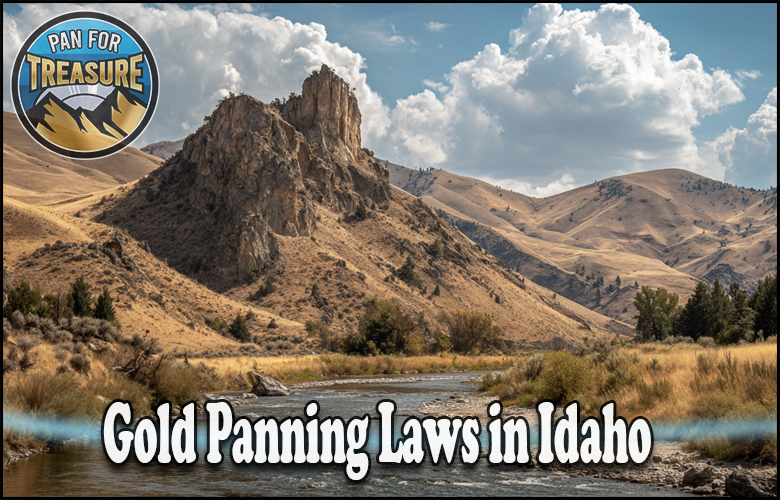
The gold panning laws in Idaho are well-defined and generally favorable for recreational prospectors. Hand panning does not require a permit in Idaho. If you want to use motorized equipment like a suction dredge, you’ll need an IDWR Small Scale Mining Authorization (Letter Permit), which costs $10 for residents and $30 for non-residents. Idaho also requires a separate DEQ permit for dredge operations.
Idaho earned its statehood because of gold. The territory was established in 1863 directly because of the massive gold strikes at Pierce, Florence, and the Boise Basin. Total production is estimated at nearly 10 million troy ounces. The Boise Basin alone produced over 2.8 million ounces. Vast stretches of BLM and National Forest land cover the state, and several rivers are specifically designated as open to recreational mining by the public.
This guide covers the permit structure, equipment rules, open and closed streams, and where you can legally prospect. If you’re new to the hobby, start with our getting started with gold panning guide.
TL;DR
- Hand panning requires no permit in Idaho. No mineral claim is needed to pan or participate in small-scale mining.
- Suction dredges and motorized equipment: Require an IDWR Small Scale Mining Authorization (Letter Permit) – $10 residents, $30 non-residents, valid Jan 1 to Dec 31.
- Dredge limits: 5-inch nozzle max, 15 HP max, 2 cubic yards/hour max. Anything larger requires a Joint Application for Stream Channel Alteration Permit.
- DEQ permit also required for suction dredging (IPDES suction dredge general permit).
- Open vs. closed streams: Not all Idaho streams are open to small-scale mining. IDWR publishes a list of open streams with specific season dates. Closed streams are off-limits.
- Check for existing claims: Idaho has over 40,000 mining claims. Check BLM’s LR2000 database before prospecting. Do not mine on someone else’s claim without permission.
- Designated recreational mining rivers: The South Fork Payette River, portions of the Middle Fork Clearwater, Lochsa River, and Priest River are designated open to the public with no claims accepted.
~10 Million Troy Ounces
1860s (Pierce, Boise Basin)
Boise Basin (2.8M+ oz)
40,000+
Not Required
$10 Resident / $30 Non-Resident
Featured
Gold Panning Laws in Idaho
Idaho’s regulatory structure involves multiple agencies, but the rules are clear. The key agencies are the Idaho Department of Water Resources (IDWR), Idaho Department of Lands (IDL), Idaho Department of Environmental Quality (DEQ), and the Bureau of Land Management (BLM).
Hand Panning – No Permit Required
Simple gold panning with a hand pan does not require any permit in Idaho. You do not need a mining claim to pan. You can pan on BLM land, National Forest land, and designated recreational mining rivers without any authorization, as long as you’re not on someone else’s active claim and you’re not using mechanized equipment.
IDWR Small Scale Mining Authorization (Letter Permit)
If you use any mechanized equipment below the ordinary high watermark of a stream, you need an IDWR Small Scale Mining Authorization. This includes suction dredges, powered sluice boxes, highbankers with powered pumps, or any equipment that digs, scrapes, dredges, or moves streambed material using power.
The permit details:
- Cost: $10 per person (Idaho residents), $30 per person (non-residents)
- Valid January 1 through December 31 (annual)
- Suction dredge nozzle diameter: 5 inches maximum
- Engine/motor: 15 horsepower maximum
- Processing capacity: 2 cubic yards per hour maximum
- Equipment exceeding these limits requires a Joint Application for Stream Channel Alteration Permit
DEQ IPDES Permit
In addition to the IDWR Letter Permit, anyone operating a suction dredge on any Idaho stream must obtain IPDES (Idaho Pollutant Discharge Elimination System) suction dredge general permit coverage from the Idaho Department of Environmental Quality. This is a water quality permit separate from the IDWR mining authorization.
Open vs. Closed Streams
This is one of the most important rules in Idaho. Not all streams are open to small-scale mining. IDWR publishes a list of streams that are open for recreational mining, along with the specific dates each stream is open. Many streams have seasonal windows, often summer months only. Some streams are closed year-round to protect fish habitat, particularly during spawning seasons.
Mining on a closed stream is a violation of Idaho’s Stream Channel Protection Act, which carries a minimum fine of $150 per day. Always check the IDWR Small Scale Mining Program Instructions for the current list of open and closed streams before you go.
Designated Recreational Mining Rivers
Idaho has designated certain river segments as open to the general public for recreational mining. No mining claims are accepted on these stretches. They include:
- South Fork Payette River: From the Sawtooth Wilderness boundary to Banks
- Main Payette River: From Banks to Black Canyon Dam
- Upper Priest River: From the Canadian border to Priest Lake
- Middle Fork Clearwater River: From Lowell to Kooskia
- Lochsa River: From Powell Ranger Station to Lowell
BLM and National Forest Land
Idaho has extensive BLM and National Forest land, much of it in gold-bearing regions. Hand panning on unclaimed BLM land is allowed as casual use under 43 CFR 3809. On National Forest land, hand panning and non-motorized prospecting with minimal disturbance generally do not require a Notice of Intent (NOI). Activities involving motorized equipment, sluicing, or dredging within stream channels require NOI submission to the Forest Service district ranger, plus IDWR and DEQ permits.
Idaho has over 40,000 active mining claims. Before prospecting anywhere, check the BLM’s LR2000 Mineral and Land Records System to confirm you are not on an existing claim. Prospecting on someone else’s claim without permission is not allowed.
State Endowment Land
Idaho endowment lands are managed by the Idaho Department of Lands for the benefit of public schools. These lands may require an exploration location or mineral lease from IDL. Contact IDL before prospecting on state endowment land.
Private Land
Written permission from the landowner is required before prospecting on private property. Idaho has significant private land holdings, including ranches and timber company land intermixed with public land. Verify land ownership before starting.
Equipment Restrictions
| Equipment | BLM Land (No Claim) | National Forest | Designated Rec. Rivers | Private Land |
|---|---|---|---|---|
| Gold Pan | Allowed (no permit) | Allowed (no permit) | Allowed (no permit) | With permission |
| Hand Shovel / Trowel | Allowed | Allowed | Allowed | With permission |
| Classifier / Screen | Allowed | Allowed | Allowed | With permission |
| Non-powered Sluice (small) | Allowed | NOI may be required | Allowed | With permission |
| Powered Sluice / Highbanker | IDWR + DEQ permits | IDWR + DEQ + NOI | IDWR + DEQ permits | With permission + permits |
| Suction Dredge (5″ max) | IDWR + DEQ permits | IDWR + DEQ + NOI | IDWR + DEQ permits | With permission + permits |
| Metal Detector | Allowed | Check with district | Allowed | With permission |
| Dredge Over 5″ Nozzle | Stream Channel Alteration Permit | Plan of Operations + permits | Not allowed | Multiple permits required |
For gear recommendations, see our best tools for gold panning roundup.
Our Favorite Posts
Best Gold Panning Locations in Idaho
Idaho is one of the richest gold states in the country. Nearly every creek and river in central Idaho has some gold. For more detail, see our page on whether there’s gold in Idaho.
- Boise Basin / Idaho City (Boise County) – The largest gold-producing district in Idaho with over 2.8 million ounces. Grimes Creek, Mores Creek, and dozens of tributaries all produce gold. Idaho City was once the largest city in the Pacific Northwest. The area is heavily claimed, so check BLM records. Joining a prospecting club is the best way to access productive ground here.
- South Fork Payette River (Boise County) – Designated recreational mining river open to the public with no claims. Runs from the Sawtooth Wilderness boundary to Banks. A great option for beginners because you don’t need to worry about claims.
- Salmon River (Lemhi/Idaho Counties) – One of the first places gold was found in Idaho (1860-1861). Known as the “River of No Return,” it runs 425 miles through central Idaho. Placer gold and occasional nuggets reported. Some stretches are remote and dangerous. Multiple access points, but check which sections are open for mining.
- South Fork Clearwater River / Elk City (Idaho County) – The Elk City district produced around 800,000 ounces. The South Fork Clearwater from Elk City downstream is one of the most active placer areas in the state. Good public access through National Forest land.
- Florence District / French Creek (Idaho County) – One of Idaho’s oldest and richest districts. Gold discovered in 1861. Production estimated at $15-30 million in 1860s dollars. The Florence district east of Riggins remains one of the most active placer areas in the state.
- Warren-Marshall District (Idaho County) – Central Idaho near the Salmon River. Significant gold production dating to the early days of Idaho’s gold rush. Remote but productive.
- Murray / Prichard Creek (Shoshone County) – Site of Idaho’s last major gold rush in the 1880s. Prichard Creek, Eagle Creek, Beaver Creek, and Trail Creek all produce placer gold. Located in the Coeur d’Alene Mining District, which is better known for silver but still has gold.
- Atlanta District (Elmore County) – At the southern edge of the Sawtooth Mountains. The Atlanta lode was discovered in 1864. The district produced over 441,000 ounces through 1959. Remote but still has active claims and productive ground.
- Middle Fork Clearwater / Lochsa River – Designated recreational mining rivers. The Middle Fork from Lowell to Kooskia and the Lochsa from Powell Ranger Station to Lowell are open to the public. No claims accepted on these stretches.
- Snake River – Fine gold can be found along parts of the Snake River, though dams have altered the river significantly. Not as productive as the mountain rivers but accessible.
For a broader look, see our list of the best places to pan for gold in America.
History of Gold in Idaho
Gold was first found in Idaho in 1852 along the Pend Oreille River, but the first significant discovery came in 1860 at Pierce City on the Clearwater River. This triggered a rush that brought thousands of miners from the California goldfields into what was then part of Washington Territory. In 1861, rich placer deposits were found at Elk City, Orofino, Florence, and along the Salmon River.
The Boise Basin strike of 1862 was the biggest of all. George Grimes and a group of prospectors from Walla Walla discovered placer gold 25 miles northeast of Boise. Within months, Idaho City grew to 6,000 residents and became the largest city in the Pacific Northwest, bigger than Portland. The Boise Basin rush was the largest in the country since the California Gold Rush of 1849 and was a direct cause of Idaho being organized as a separate territory in 1863.
In 1870, production peaked at over 400,000 ounces in a single year. After the richest placers were worked out, Chinese laborers reworked the tailings. Hydraulic mining and bucket-line dredging kept production going well into the 20th century. The Silver City district in Owyhee County produced over 1 million ounces of gold alongside its silver. Total Idaho gold production is estimated at 9.3 to 10 million troy ounces, making it one of the top gold-producing states in U.S. history.
Recommended Reading
Tips for Gold Panning in Idaho
- Check claims first. Idaho has 40,000+ active mining claims. Use the BLM LR2000 system or visit the county recorder’s office to verify the land you plan to prospect is unclaimed. Mining on someone else’s claim without permission is a violation.
- Start at designated recreational rivers. The South Fork Payette, Middle Fork Clearwater, and Lochsa River are open to the public with no claims. These are the best starting points for beginners.
- Check the IDWR open stream list. Not all streams are open, and open seasons vary by stream. A five-minute check of the IDWR website can save you a $150/day fine.
- Get both permits for dredging. You need the IDWR Letter Permit AND the DEQ IPDES permit before running a suction dredge. Having one without the other is not enough.
- Prepare for remote country. Many of Idaho’s best gold areas are in backcountry. Roads may be rough, cell service nonexistent, and distances between towns long. Bring spare tires, extra food and water, and a plan. See our panning techniques guide.
- Look for old workings. Tailing piles, hand-stacked rocks, and old mining debris mark where the old-timers found gold. These areas still produce.
- Join a prospecting club. The Boise Basin is heavily claimed. Clubs like the GPAA, Idaho Gold Prospectors Association, and local chapters provide access to claimed ground and local knowledge.
- Watch for seasonal closures. Many streams close during fish spawning seasons. Mountain weather can also make high-country streams inaccessible until mid-summer.
- Bring the right gear. Idaho gold ranges from fine flour to picker-size flakes to occasional nuggets. A pan, classifier, snuffer bottle, and a small non-powered sluice will cover most situations without triggering permit requirements.
Rules
- Gold Panning Laws in Delaware – What Prospectors Need to Know
- Gold Panning Laws in Arkansas – What Prospectors Need to Know
- Gold Panning Laws in New Jersey – What Prospectors Need to Know
- Gold Panning Laws in Michigan – What Prospectors Need to Know
- Gold Panning Laws in South Dakota – What Prospectors Need to Know
Resources for Idaho Prospectors
- IDWR Small Scale Mining Permits – Official page for the Letter Permit, open/closed stream lists, equipment limits, and program instructions.
- IDWR Small Scale Mining FAQs – Answers to common questions about permits, claims, equipment, and regulations.
- Idaho Department of Lands – Recreational Mining – Information on state land mining, claim verification, and dredge/placer mining regulations.
- BLM Mining Claims / LR2000 – Check for existing mining claims before prospecting. Contact BLM Idaho State Office at (208) 373-4000.
- Gold Prospectors Association of America (GPAA) – National organization with Idaho claims and chapters.
Conclusion
The gold panning laws in Idaho are clear and prospector-friendly. Hand panning requires no permit and no mining claim. Motorized equipment below the high watermark requires an affordable IDWR Letter Permit ($10/$30) and a DEQ IPDES permit. Designated recreational mining rivers like the South Fork Payette give beginners a place to prospect without worrying about claims.
Idaho is one of the top gold-producing states in American history, with nearly 10 million ounces of recorded production. The Boise Basin, Salmon River, Clearwater drainage, and dozens of other districts still produce gold for recreational panners today. The biggest challenges are checking for existing claims and preparing for the remote backcountry where much of the best gold lies.
Check out the laws in neighboring Montana, Oregon, Washington, Wyoming, Nevada, and Utah, or browse our full gold panning laws by state directory.
Frequently Asked Questions – ID Gold Panning Laws
Do you need a permit to pan for gold in Idaho?
No. Hand panning does not require a permit or mining claim in Idaho. If you use motorized equipment like a suction dredge, powered sluice, or highbanker below the ordinary high watermark, you need an IDWR Small Scale Mining Authorization ($10 residents, $30 non-residents) and a DEQ IPDES suction dredge permit.
Is suction dredging legal in Idaho?
Yes, on open streams with proper permits. You need both an IDWR Letter Permit and a DEQ IPDES permit. Dredges are limited to a 5-inch nozzle, 15 HP motor, and 2 cubic yards per hour. Not all streams are open – check the IDWR open stream list and season dates. Mining on a closed stream carries a $150/day minimum fine.
Where can you pan for gold for free in Idaho?
The South Fork Payette River (Sawtooth Wilderness boundary to Banks), Middle Fork Clearwater River (Lowell to Kooskia), and Lochsa River (Powell Ranger Station to Lowell) are designated recreational mining rivers open to the public with no mining claims accepted. Unclaimed BLM and National Forest land is also open to hand panning.
How do I check for mining claims in Idaho?
Use the BLM’s LR2000 Mineral and Land Records System online, or contact the BLM Boise office at (208) 373-4000. You can also visit the county recorder’s office for the county you plan to prospect in. Idaho has over 40,000 active claims, so always check before prospecting.
What is the best place to pan for gold in Idaho?
The Boise Basin near Idaho City is the richest gold district in the state with over 2.8 million ounces of historical production. However, it is heavily claimed. For unclaimed access, the South Fork Payette River and Clearwater drainage are the best starting points. The Salmon River, Elk City area, and Florence district are also highly productive.
Can you use a sluice box in Idaho without a permit?
A small non-powered sluice box that moves less than a quarter cubic yard per hour can be used without an IDWR Letter Permit on open streams. Non-powered sluice equipment moving more than a quarter cubic yard per hour is classified as small-scale mining and requires the Letter Permit. Any sluice powered by a pump requires the permit.
⛏ Recommended Gear ⛏


* As an Amazon Associate I earn from qualifying purchases at no extra cost to you.
Subscribe to Our Newsletter

Ryan Conlon is the founder of Pan for Treasure.
A lifelong gold panning enthusiast, he created this site to help beginners learn the ropes and share practical tips from his own time on the creek. [email protected]