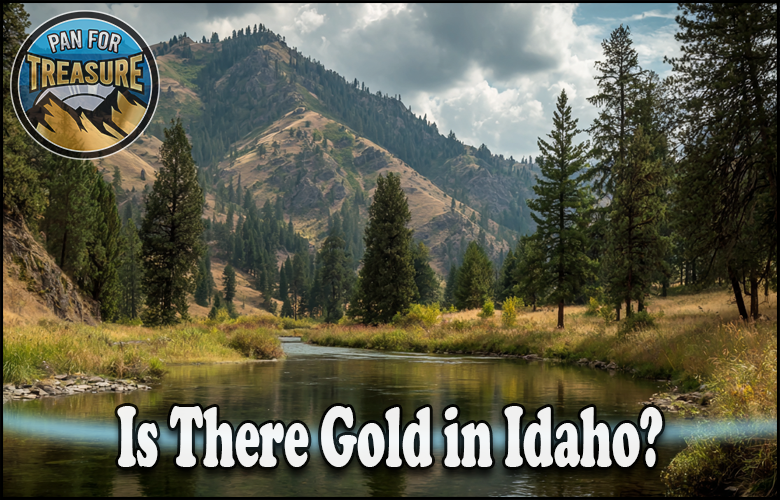
Is there gold in Idaho? Idaho is one of the premier gold states in the western United States. The state has produced nearly 10 million ounces of gold across 41 mining districts spanning 20 counties. The Boise Basin alone yielded over 2.8 million ounces, making it one of the richest gold strikes in American history. At its peak in 1870, Idaho produced more than 400,000 ounces of gold in a single year.
Gold was first discovered in Idaho in 1860 at Orofino Creek near present day Pierce, and within a few years the Boise Basin gold rush had turned Idaho City into the largest city in the Pacific Northwest. Today, recreational panning is allowed on most public land across central Idaho, and the Stibnite Gold Project (with proven reserves of 4.8 million ounces) was approved by the U.S. Forest Service in January 2025, positioning Idaho as a future major gold producer once again.
TL;DR
- Gold Present: Yes, massive deposits. Idaho produced nearly 10 million ounces of gold historically, ranking among the top gold states in the country.
- Best Region: Central Idaho, particularly the Boise Basin (Idaho City area), the South Fork Clearwater River corridor, and the Salmon River drainages.
- Gold Type: Both placer gold (fine to coarse, with occasional large specimens) and lode gold (quartz vein deposits in the Idaho Batholith and associated formations).
- Top Spot: The Boise Basin (Grimes Creek, Mores Creek, Elk Creek) near Idaho City, the richest single gold district in state history.
- Legal Note: Recreational panning with hand tools is generally allowed on unpatented public land in national forests. Many productive areas are heavily claimed, so verify claim status before working any area. Suction dredge regulations vary by waterway.
- Verdict: Idaho is a world class gold state with exceptional recreational prospecting opportunities across vast public lands in the central mountains.
Total Production
Nearly 10 million ounces historically. The top five producing districts were Boise Basin (~2.9M oz), French Creek/Florence (~1M oz), Silver City (~1M oz), Warren (~800K oz), and Elk City (~800K oz).
Peak Year
1870, when over 400,000 ounces were extracted, primarily from placer mines in the Boise Basin. Idaho was one of the top gold producing states in the nation during the 1860s and 1870s.
Mining Districts
41 districts spanning 20 counties have recorded gold occurrences. Hundreds of lode mines and thousands of placer deposits have been documented across central Idaho.
Active Mining
The Stibnite Gold Project (Perpetua Resources) was approved by the Forest Service in January 2025. It holds proven reserves of 4.8 million ounces and will be one of the largest gold mines in the U.S.
Idaho Batholith
The geological foundation of Idaho’s gold. This massive Cretaceous intrusion of quartz monzonite hosts the majority of the state’s gold deposits in associated quartz veins and placer gravels.
Public Land
Over 60% of Idaho is federally managed (national forests, BLM), providing extensive public land access for recreational prospecting. The Boise, Payette, Salmon, and Nez Perce national forests cover the gold belt.
Featured
Where Is There Gold in Idaho?
Idaho ranks #4 of 50 for gold potential.
Quick reference below – details on each location follow, or jump to the Idaho map.
| Location / Area | River / Creek | County | Gold Type | Land Access |
|---|---|---|---|---|
| Grimes Creek | Grimes Creek | Boise | Not listed | Check for claims |
| South Fork Clearwater River | South Fork Clearwater River | Idaho | Placer gold | Not listed |
| Elk Creek and Mores Creek | Elk Creek, Mores Creek | Boise | Fine gold | Not listed |
| Warren Creek | Warren Creek | Idaho | Not listed | Check for claims |
| Yankee Fork | Yankee Fork | Custer | Not listed | Not listed |
| South Fork Boise River | South Fork Boise River | Elmore | Not listed | Not listed |
| Orofino Creek | Orofino Creek | Clearwater | Not listed | Not listed |
| Snake River | Snake River | Not listed | Flour gold | Public land |
Is there gold in Idaho throughout the state, or is it concentrated in certain areas? Gold occurs primarily in central Idaho, in a broad swath of mountainous terrain underlain by the Idaho Batholith. The most productive areas extend from the Clearwater River drainages in the north through the Boise Basin, the Salmon River country, and the Sawtooth Mountains in the south.
The Boise Basin (Boise County)
The Boise Basin is Idaho’s richest gold region by a wide margin. Placer gold was discovered here in 1862 by George Grimes, and within months a massive gold rush had drawn thousands of miners. The basin produced over 2.8 million ounces of gold from 1863 through 1959, with 95% coming from placer deposits.
The major districts within the basin include Idaho City, Moore Creek, Centerville, Quartzburg, Pioneerville, and Grimes Pass. Idaho City briefly became the largest city in the Pacific Northwest. The gold occurs in gravels derived from the Idaho Batholith quartz monzonite, with the richest concentrations along Grimes Creek, Mores Creek, and Elk Creek. Dredge and hydraulic operations worked the basin for decades, and tailing piles are visible for miles along the creeks.
This area is heavily claimed today, making joining a prospecting club the best option for beginners. The Idaho Gold Prospectors Association provides member access to productive claims.
Clearwater River Country (Idaho County)
Idaho’s first gold discovery was at Orofino Creek near Pierce in 1860, by prospector Elias D. Pierce. The Pierce Mining District quickly developed and produced gold worth more than $5 million in its early years. Further south, the Elk City district produced approximately 800,000 ounces.
The South Fork of the Clearwater River from its headwaters downstream through the canyon west toward Grangeville is one of the state’s most productive placer gold corridors. Both American River and Red River, tributaries of the Clearwater, were mined extensively during the early gold rush. This area remains rich and quite remote.
Warren and the Salmon River (Idaho and Valley Counties)
Rich placers were discovered in Warren Meadows in 1862, shortly after the Boise Basin and Florence strikes. Before 1900, an estimated $15 million in gold was mined from the Warren district, mostly from placers. Lode deposits were found as early as 1866.
The Salmon River and its many tributaries (including the South Fork and Middle Fork) drain through gold bearing terrain for hundreds of miles. The Salmon River country is some of the most remote and wild gold prospecting territory in the lower 48 states, bordered by the Frank Church River of No Return Wilderness.
Atlanta and Featherville (Elmore County)
Shadowed by the Sawtooth Mountains, the Atlanta district produced significant gold from both placer and lode deposits. The Atlanta lode, 40 to 120 feet wide and traceable for about 2 miles, was one of the larger lode discoveries in the state. Elmore County’s total production from 1889 through 1959 exceeded 441,000 ounces.
The South Fork Boise River near Featherville and Pine also produced gold. A bucketline dredge operated on the Boise River near Featherville from 1922 to 1927. All waterways in this area are worth prospecting.
Yellow Pine and Stibnite (Valley County)
The Thunder Mountain Gold Rush of 1900 drew prospectors to this remote area. The Stibnite mining district, active from 1899 through the 1990s, produced both gold and strategic minerals (antimony, tungsten). Perpetua Resources (formerly Midas Gold) received Forest Service approval in January 2025 to resume mining at Stibnite. The project holds proven and probable reserves of 4.8 million ounces of gold, 1.2 million ounces of silver, and 148.6 million pounds of antimony, making it one of the most significant undeveloped gold deposits in the United States.
Silver City and Owyhee County
Silver City was primarily a silver mining district, but it produced over 1 million ounces of gold as well, mostly from hard rock deposits on War Eagle Mountain. The district was discovered in 1863. Jordan Creek and a few other seasonal streams in the area contain placer gold, often with a silvery appearance due to high silver alloy content.
Our Favorite Posts
Best Places to Look for Gold in Idaho
- Grimes Creek (Boise County): One of the most heavily mined creeks in the Boise Basin and still productive for recreational panners. Tailing piles line the creek for miles. The area is heavily claimed, so verify claim status or join a local prospecting club for access.
- South Fork Clearwater River (Idaho County): One of the richest placer gold corridors in the state. The stretch from the headwaters downstream through the canyon toward Grangeville has produced gold for over 160 years. Remote but very rewarding.
- Elk Creek and Mores Creek (Boise County): Both were major producers in the Boise Basin. Mores Creek was among the first waterways mined in the 1862 rush. The creeks still yield fine gold and small pickers for patient prospectors.
- Warren Creek (Idaho County): Extensively dredged during the historic era. The area around Warren still has active placer claims and produces gold. The town itself is a fascinating relic of Idaho’s mining past.
- Yankee Fork (Custer County): Gold was discovered here in 1870 and the towns of Bonanza and Custer were built for miners. The Yankee Fork Gold Dredge, a massive bucket line machine, churned up the valley in the mid 1900s and recovered millions in gold. The dredge itself is now a historic site you can visit.
- South Fork Boise River (Elmore County): The Atlanta and Featherville areas offer stretches of gold bearing river in beautiful mountain country. Access is remote but the scenery and prospecting potential are excellent.
- Orofino Creek (Clearwater County): Site of Idaho’s very first gold discovery in 1860. The mountains surrounding Orofino Creek still contain gold and many modern prospectors report success.
- Snake River: The Snake River contains extremely fine flour gold throughout much of its length in southern Idaho. The gold is nearly impossible to mine economically due to its fineness, but patient panners can recover gold dust. Several stretches are accessible on public land.
- Jordan Creek (Owyhee County): Below Silver City, Jordan Creek contains placer gold washed from the surrounding lode deposits. The gold often has a distinctive silvery appearance. This is high desert country, very different from the forested mountains of central Idaho.
- Salmon River (Lemhi County): The main stem and tributaries of the Salmon River flow through gold bearing terrain for hundreds of miles. Prospecting here often means accessing remote gravel bars in wilderness adjacent areas.
History of Gold in Idaho
Discovery and the First Rushes (1860 to 1862)
Idaho’s gold story began on August 12, 1860, when Elias D. Pierce discovered gold at Orofino Creek near present day Pierce. Pierce had been exploring the Nez Perce territory for months, following up on reports of gold in the region. His discovery triggered the first rush of miners into what would become Idaho Territory.
Within two years, additional strikes at Florence, Elk City, and other locations along the Clearwater drainage had drawn thousands more prospectors. But the biggest discovery was yet to come.
The Boise Basin Rush (1862 to 1870s)
On August 2, 1862, George Grimes and a group of prospectors from Walla Walla discovered placer gold 25 miles northeast of Boise. Grimes was killed shortly after the discovery (accounts vary on whether by fellow miners or by Native Americans), but the rush he started was unstoppable.
By December 1862, a major gold rush was underway. Idaho City was founded and within months had over 6,000 residents, making it the largest city in the Pacific Northwest, larger than Portland. At the peak, some accounts say 15,000 to 20,000 miners worked the Boise Basin. Mining was so intensive that houses in Idaho City collapsed because the ground beneath them was mined out.
The Boise Basin rush produced over 2.8 million documented ounces, and some estimates place total production (including undocumented early placer output) as high as 6 to 12 million ounces. This would make it one of the richest individual gold districts in American history.
Lode Mining and Expansion (1860s to 1900s)
As easily recovered placer gold diminished, miners turned to hard rock (lode) mining. Stamp mills appeared throughout the gold belt, crushing gold bearing quartz for processing. The Quartzburg district in the Boise Basin, the Atlanta lode in Elmore County, and Silver City in Owyhee County all became significant lode producers.
Chinese miners played a major role in Idaho’s gold history, reworking the placer deposits that white miners had abandoned. By 1870, the typical Boise Basin placer miner was described in contemporary accounts as Chinese.
Hydraulic mining and dredging operations extended the productive life of many placer districts well into the 20th century. Large scale dredges operated on the Boise River, Yankee Fork, Warren Creek, and other drainages.
Modern Era and the Stibnite Project
Gold mining in Idaho declined through the mid 20th century, though small scale operations continued in many districts. The Coeur d’Alene mining district in the Idaho Panhandle became famous for its silver and lead production (nearly 1 billion ounces of silver), with gold produced as a byproduct.
The most significant recent development is the Stibnite Gold Project. In January 2025, the U.S. Forest Service approved Perpetua Resources’ plan to resume mining at the historic Stibnite district near Yellow Pine. The project holds proven reserves of 4.8 million ounces of gold and will also produce antimony, a critical mineral. The project is expected to require $1.3 billion in initial investment and operate for approximately 15 years. It will be one of the largest gold mines in the United States when operational.
Recommended Reading
Geology of Gold in Idaho
Idaho’s gold deposits are intimately connected to the Idaho Batholith, one of the largest exposed granitic intrusions in North America. This massive body of quartz monzonite was emplaced during the Cretaceous period (roughly 70 to 100 million years ago) and underlies much of central Idaho.
Gold bearing quartz veins formed when hot, mineral rich fluids circulated through fractures and shear zones in and around the batholith as it cooled. Many of these veins were later intruded by Tertiary age porphyry dikes, which are closely associated with lode gold deposits throughout the Boise Basin and other districts.
The rich placer deposits that made Idaho famous were created by millions of years of erosion breaking down these lode deposits and concentrating gold in stream gravels. The deep alluvial fill in valleys like the Boise Basin trapped enormous quantities of placer gold. In some areas, both Pleistocene (older, elevated) and Recent (modern streambed) gravels contain gold.
At Stibnite, the mineralization occurs in structurally prepared zones with disseminated arsenical pyrite, with gold occurring in near solid solution. The antimony mineralization is associated with the mineral stibnite (antimony sulfide), while additional gold occurs in epithermal quartz adularia carbonate veins.
Best Locations
- Is There Gold in Rhode Island? Top Locations and if It’s Worth the Trip
- Best Places to Pan for Gold and Gemstones in America
- Is There Gold in Massachusetts? Top Locations and if It’s Worth the Trip
- Is There Gold in South Carolina? Top Locations and if It’s Worth the Trip
- Is There Gold in Oklahoma? Top Locations and if It’s Worth the Trip
What Type of Gold Can You Find in Idaho?
Idaho produces a full range of gold types. Fine placer gold (small flakes and dust) is the most common find for recreational panners, particularly in the Boise Basin, where fine gold dominated production. The Snake River is known for extremely fine flour gold that is difficult to recover without specialized equipment.
Small pickers and occasional nuggets are found in many of the state’s waterways, particularly in less worked tributaries and in the Clearwater and Salmon River drainages. While large nuggets are not common, specimens of gold in quartz weighing several pounds have been found in the Boise Basin.
Lode gold in quartz veins is visible at historic mine sites throughout central Idaho. The metal detecting potential near old mine dumps and tailings is significant, as early processing methods missed substantial gold.
Tips for Gold Prospecting in Idaho
- Start on public land. Over 60% of Idaho is federally managed. The Boise, Payette, Salmon Challis, and Nez Perce Clearwater National Forests all contain gold bearing ground. Recreational panning with hand tools is generally permitted on unclaimed public land.
- Check claim status. Many of Idaho’s most productive areas, especially in the Boise Basin, are heavily claimed. Use the BLM’s LR2000 database to verify that the ground you plan to work is not under active mining claims. Respecting claims is both legally required and important for maintaining positive relations in the prospecting community.
- Join a prospecting club. The Idaho Gold Prospectors Association and other local clubs maintain group claims on productive ground and offer organized outings. Club membership is often the best way for beginners to access proven gold areas, especially in the heavily claimed Boise Basin.
- Bring proper equipment. A gold pan, classifier, snuffer bottle, and crevicing tools are the basics. A small sluice box can dramatically increase the volume of material you process. Fine gold recovery is important in Idaho, as much of the placer gold is small.
- Prepare for remote country. Many of Idaho’s best prospecting areas are in very remote mountain terrain. The Salmon River country, Warren, and Atlanta areas require long drives on dirt roads and may have limited cell service. Carry supplies, notify someone of your plans, and be prepared for changing mountain weather.
- Respect suction dredge regulations. Idaho dredging regulations vary by waterway and change periodically. Some rivers have seasonal restrictions to protect spawning fish. Check current rules with the Idaho Department of Water Resources and the Army Corps of Engineers before dredging.
- Explore the less visited districts. While the Boise Basin gets the most attention, the state has 41 gold producing districts. Areas like the Salmon River tributaries, Lemhi County, and the Owyhee country see far fewer prospectors and may offer better opportunities for new discoveries.
Resources
- Western Mining History: Where to Find Gold in Idaho for detailed maps of gold bearing townships and historic production data.
- Gold Rush Nuggets: Gold in Idaho for an overview of top producing districts and prospecting tips.
- USGS: Historical Perspective of Mineral Production of Idaho for comprehensive district by district production records.
- Idaho Gold Mining: Boise Basin for detailed history of the state’s richest gold district.
- Perpetua Resources: Stibnite Gold Project for information on Idaho’s upcoming major gold mine and its 4.8 million ounce reserves.
Conclusion
Is there gold in Idaho? Idaho is one of the finest gold states in the western United States, with nearly 10 million ounces of historical production and 4.8 million ounces of proven reserves at the soon to be developed Stibnite Gold Project. The Boise Basin alone produced more gold than many entire states, and the 41 mining districts spanning central Idaho offer recreational prospectors an enormous range of terrain to explore.
What sets Idaho apart is the combination of rich gold deposits, vast public land, and truly remote wilderness country that has not been thoroughly prospected with modern methods. From the well known creeks of the Boise Basin to the wild canyons of the Salmon River, Idaho rewards prospectors who are willing to put in the effort to reach good ground.
Ready to explore more gold states? Check out our guides for nearby states: Is There Gold in Montana?, Is There Gold in Oregon?, Is There Gold in Washington?, and Is There Gold in Nevada?. Or browse the full state directory to find gold near you.
Frequently Asked Questions – Is There Gold in ID
How much gold has been found in Idaho?
Idaho has produced nearly 10 million ounces of gold historically. The Boise Basin alone produced over 2.8 million documented ounces (some estimates range as high as 12 million ounces including undocumented early production). Other major districts include Florence, Silver City, Warren, and Elk City, each producing roughly 800,000 to 1 million ounces.
Can you still find gold in Idaho today?
Yes. Recreational prospectors find gold regularly in central Idaho’s streams and rivers. The Boise Basin, Clearwater River system, Salmon River drainages, and many other areas all produce gold for patient panners. Additionally, the Stibnite Gold Project with 4.8 million ounces of reserves was approved for development in January 2025.
Do you need a permit to pan for gold in Idaho?
Recreational panning with hand tools is generally allowed on unclaimed public land in national forests without a specific permit. However, many productive areas are under active mining claims. Always check claim status through the BLM before working any area. Suction dredging requires permits and is regulated by waterway.
Where is the best place to find gold in Idaho?
The Boise Basin (Grimes Creek, Mores Creek, Elk Creek near Idaho City) is the most proven area. The South Fork Clearwater River, Warren, the Yankee Fork, and the Salmon River drainages are also excellent. Many of the best areas are remote and require backcountry access.
What was the Boise Basin gold rush?
The Boise Basin gold rush began in August 1862 when George Grimes discovered placer gold northeast of Boise. Within months, thousands of miners flooded the area, making Idaho City the largest city in the Pacific Northwest. The basin produced over 2.8 million ounces of gold and was one of the richest gold districts in American history.
What is the Stibnite Gold Project?
The Stibnite Gold Project, owned by Perpetua Resources, is a major gold mining development in Valley County near Yellow Pine. Approved by the Forest Service in January 2025, it holds proven reserves of 4.8 million ounces of gold and will also produce antimony, a critical mineral. The project is expected to invest $1.3 billion and operate for approximately 15 years.
⛏ Recommended Gear ⛏


* As an Amazon Associate I earn from qualifying purchases at no extra cost to you.
Subscribe to Our Newsletter

Ryan Conlon is the founder of Pan for Treasure.
A lifelong gold panning enthusiast, he created this site to help beginners learn the ropes and share practical tips from his own time on the creek. [email protected]