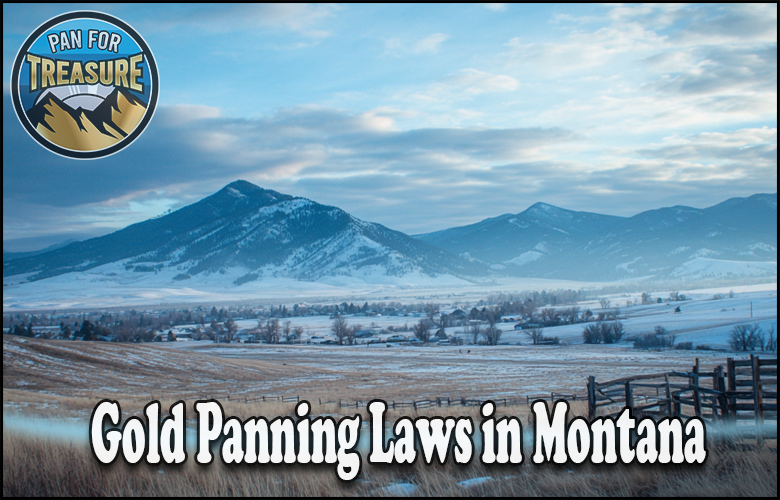
The gold panning laws in Montana are among the most prospector-friendly in the country, thanks to a unique combination of abundant public land, the Montana Stream Access Law, and a multi-agency permitting system that favors hand panning. Recreational gold panning with hand tools is allowed without a permit on most National Forest and BLM land that is open to mineral entry. Suction dredging requires permits from the Montana Department of Environmental Quality (DEQ) and the local Conservation District. National parks, wilderness areas, and active mining claims are off-limits.
Montana is the “Treasure State” for good reason. The USGS credits Montana with over 17.7 million troy ounces of gold produced from 1862 through 1965. The state has over 3,500 documented gold mines. The regulatory framework reflects this history: multiple agencies share oversight, including the DEQ, the Department of Natural Resources and Conservation (DNRC), Fish, Wildlife and Parks (FWP), the U.S. Forest Service, and the BLM.
This guide covers the specific rules for each land type and equipment category so you can prospect legally. If you are new to the hobby, start with our getting started with gold panning guide.
TL;DR
- Hand panning on public land: Allowed without a permit on most National Forest and BLM land open to mineral entry. This is classified as “casual use” under federal regulations (36 CFR 228 and 43 CFR 3809).
- Stream Access Law: Montana’s Stream Access Law allows the public to use any natural waterway capable of recreational use up to the ordinary high-water mark, regardless of who owns the streambed. You must access streams through legal entry points.
- Non-motorized sluice boxes: Generally allowed on National Forest and BLM land as casual use, provided they do not cause significant surface disturbance.
- Suction dredges: Require a DEQ General Permit (MPDES, intake 4 inches or less), a 310 Permit from the local Conservation District, and a Forest Service NOI if on National Forest land. Seasonal restrictions apply (typically July 1 to September 30).
- State Trust Lands: Require a Recreational Use License ($10 resident, $20 non-resident) from the DNRC. Hand panning only.
- Off-limits areas: National parks (Glacier, Yellowstone), designated wilderness areas, active mining claims, and lands withdrawn from mineral entry.
Lode and Placer (Western Montana)
17.7+ Million Troy Ounces (1862-1965)
Flour Gold to Nuggets
Western MT (Continental Divide)
Libby Creek (Kootenai NF)
7th Largest Gold-Producing State
Featured
Gold Panning Laws in Montana
Montana does not have a single state-level recreational gold panning statute. Instead, the rules come from a combination of federal land management regulations, state environmental permits, and the Montana Stream Access Law. The level of regulation depends on two factors: what land you are on, and what equipment you are using. Hand panning with a gold pan and basic hand tools triggers almost no permitting. Motorized equipment like suction dredges triggers a multi-agency permitting process.
Montana Stream Access Law
The Montana Stream Access Law is one of the most generous public access laws in the nation. Established in 1985 following the Montana Supreme Court’s ruling in Montana Coalition for Stream Access v. Curran (1984), the law allows the public to use any natural water body capable of recreational use up to the ordinary high-water mark, regardless of who owns the underlying land. This means you can legally pan for gold within the streambed of a river that flows through private property, as long as you access the stream through a legal entry point.
Legal entry points include public bridge right-of-ways, fishing access sites maintained by FWP, state or federal land boundaries, and private land with the owner’s permission. You cannot cross private land to reach a stream without permission. Montana uses orange paint marks on trees and posts as a legal “no trespassing” marker. If you see orange paint, you are at a private property boundary.
The Stream Access Law covers “water-related recreation” including fishing, floating, swimming, and boating. While gold panning is not specifically listed, it is a water-related activity that occurs within the streambed below the high-water mark. Prospectors in Montana commonly use this law to pan on streams that flow through private land by accessing through public entry points.
National Forest Land – Casual Use
Montana has 10 National Forests managed by the U.S. Forest Service Northern Region. Most National Forest land open to mineral entry allows “casual use” prospecting without a permit. Under Forest Service regulations (36 CFR 228), casual use includes gold panning, hand sample collection, metal detecting, and using non-motorized sluice boxes, as long as the activity does not cause “significant surface disturbance.” The Forest Service recommends filing a Notice of Intent (NOI) with the District Ranger even for casual use, so they can confirm the area is open to mineral entry and not already claimed.
Activities that go beyond casual use, such as using mechanized earth-moving equipment, require a Plan of Operations (POO) approved by the District Ranger. Suction dredging typically requires an NOI at minimum, and the Ranger will determine if a full POO is needed.
Areas excluded from prospecting on National Forest land include designated wilderness areas, caves, historical and archaeological sites, areas withdrawn from mineral entry, and active mining claims. Check with the local Ranger District before your trip.
BLM Land – Casual Use
The Bureau of Land Management manages millions of acres in Montana. Under BLM regulations (43 CFR 3809), casual use includes hand panning, non-motorized sluicing, metal detecting, and use of hand and battery-operated drywashers. No permit is required for casual use on BLM land open to mineral entry. The BLM advises that “a recreational miner with a pick, shovel or gold pan does not need a special permit on BLM land in Montana.”
For suction dredges with intake diameters of 4 inches or less, the BLM defers permitting to the Montana DEQ Water Protection Bureau. Larger dredges may require a BLM Plan of Operations in addition to DEQ permits.
State Trust Lands
Montana’s DNRC manages approximately 5.2 million acres of state trust lands. These lands are managed primarily to generate revenue for public schools, so recreational use is secondary. To pan for gold on state trust lands, you must purchase a Recreational Use License ($10 for residents, $20 for non-residents). The license is valid from March 1 through the end of February the following year. Only hand panning is allowed on state trust lands. If mineral rights are leased to a private entity, you also need the leaseholder’s consent.
State Parks and National Parks – Prohibited
Gold panning is prohibited in Glacier National Park, Yellowstone National Park, and all other NPS units in Montana. Montana state parks generally do not permit gold panning unless specifically designated for this activity. Bannack State Park, the site of Montana’s first major gold strike, allows limited demonstration panning along designated sections of Grasshopper Creek, but this is more of an educational experience than serious prospecting.
Suction Dredge Permits
Suction dredging in Montana requires multiple permits regardless of where you dredge. The Montana DEQ issues the MPDES General Permit for Portable Suction Dredging (MTG370000) for recreational dredges with intake diameters of 4 inches or less. Applicants must submit a Notice of Intent (NOI-37 form) through the DEQ’s FACTS online system. There is an application fee and an annual fee.
In addition to the DEQ permit, dredgers must obtain a 310 Permit from the local Conservation District under the Montana Natural Streambed and Land Preservation Act. The 310 Law requires review of any work within a perennial stream to prevent erosion, habitat destruction, or water quality degradation. The Conservation District board must review and approve the application, and a site inspection is often required. Expect a 30 to 60 day waiting period.
Montana Fish, Wildlife and Parks (FWP) enforces seasonal restrictions on dredging to protect fish spawning. The typical dredging season runs from July 1 through September 30, but some streams have shorter windows or are closed entirely, particularly those with bull trout or other sensitive species. New applicants must secure area seasonal stream restrictions from the FWP biologist before the DEQ will process their permit. Dredgers must maintain at least 500 feet of separation from other dredging operations.
On National Forest land, dredgers must also file a Notice of Intent with the District Ranger. On BLM land, the operator must contact BLM in advance to determine if notice or a plan is required.
Small Miner Exclusion Statement (SMES)
For operations that go beyond casual use but disturb less than 5 acres and remove less than 36,500 tons of material annually, Montana’s Metal Mine Reclamation Act requires a Small Miner Exclusion Statement (SMES). This is filed with the DEQ Hard Rock Mining Bureau and costs $50. Most recreational prospectors will never need an SMES, but it becomes relevant for small-scale mining operations using motorized equipment.
Mining Claims
Montana has thousands of active mining claims on public land. Panning on someone else’s active claim without permission is illegal mineral trespass. Before prospecting, check the BLM’s Mineral and Land Records System (MLRS) online, visit the county Clerk and Recorder’s office, or look for physical claim markers. You do not need to hold a mining claim to prospect on unclaimed public land.
Equipment Restrictions
| Equipment | National Forest / BLM (Casual Use) | State Trust Lands | Private Land |
|---|---|---|---|
| Gold Pan | Allowed, no permit | Allowed with Rec. Use License | With landowner permission |
| Hand Shovel / Pick / Trowel | Allowed, no bank digging | Hand tools only | With landowner permission |
| Classifier / Screen | Allowed, no permit | Allowed with Rec. Use License | With landowner permission |
| Non-motorized Sluice Box | Generally allowed as casual use | Not allowed | May require 310 Permit |
| Highbanker (uses water pump) | Requires permits (NOI/POO + 310) | Not allowed | Requires DEQ and 310 permits |
| Suction Dredge (4″ or less) | DEQ General Permit + 310 + NOI | Not allowed | DEQ General Permit + 310 |
For gear recommendations, see our best tools for gold panning roundup.
Our Favorite Posts
- Gold Panning Laws in Nevada – What Prospectors Need to Know
- Gold Panning Laws in Oregon – What Prospectors Need to Know
- Is it Legal to Pan for Gold in the United States?
- Gold Panning Laws in Washington – What Prospectors Need to Know
- Gold Panning Laws in North Carolina (NC) – What Prospectors Need to Know
Best Locations for Gold Panning in Montana
The vast majority of Montana’s gold districts are in the mountainous western third of the state, near the Idaho border and along the Continental Divide. The eastern two-thirds of “Big Sky Country” is mostly plains with very limited gold potential. For more on where gold occurs, see our page on whether there’s gold in Montana.
- Libby Creek Recreational Gold Panning Area (Lincoln County) – The only designated recreational gold panning area in Montana. Located 23 miles south of Libby in the Kootenai National Forest. Free, no permit required, and any gold you find is yours to keep. Rules: hand tools and pans only, no motorized or mechanized equipment, limit yourself to one or two 5-gallon buckets at a time, and all material must be processed within the panning area. Primitive camping available. Howard Lake Campground is one mile south.
- Alder Gulch / Virginia City Area (Madison County) – The most productive placer district in Montana history. Over 2.5 million troy ounces of gold were recovered from Alder Gulch between 1863 and 1889. Much of the gulch is now on private land or active claims. Check BLM records before panning. Some public access exists along the road between Virginia City and Alder.
- Confederate Gulch (Broadwater County) – Home to the legendary Montana Bar, where pans reportedly yielded over $1,000 in gold at a time when gold was worth less than $20 per ounce. Total district production exceeded 550,000 ounces. Located in the Helena National Forest. Some areas may require a free permit from the Ranger District. Active claims exist; verify before panning.
- Grasshopper Creek / Bannack (Beaverhead County) – Site of Montana’s first major gold rush in 1862. Bannack is now a state park; prospecting within the park is restricted to designated demonstration areas. Grasshopper Creek upstream and downstream of the park boundary may offer access on public land. Contact the Dillon Ranger District.
- Big Hole River and Tributaries (Beaverhead County) – An estimated $5 million in gold (19th-century values) was taken from the Big Hole drainage. Basin Creek, Fish Creek, Soap Gulch, and Moose Creek are all tributaries with historic placer production. National Forest access exists in the upper drainage.
- Blackfoot River / Lincoln Area (Powell/Lewis and Clark Counties) – Gold Canyon Creek, Beaver Creek, and Snowshoe Creek near Lincoln have all produced placer gold. The Blackfoot River itself carries fine placer gold. Public land access exists through Helena National Forest.
- Gold Creek (Powell County) – Site of Montana’s first documented gold find in 1852, a full decade before the Bannack rush. Located near Drummond. Historic placer production. Check for claims before panning.
- Missouri River near Helena (Lewis and Clark County) – The Missouri River between Helena and Great Falls carries placer gold from the Last Chance Gulch drainage and numerous tributary gulches. El Dorado Bar, Spokane Bar, and French Bar are historically productive gravel deposits. Public access at FWP fishing access sites.
- Garnet Range / Bear Creek (Granite County) – The Garnet ghost town area sits on BLM land. Bear Creek has been especially productive. Check with the BLM Missoula Field Office for current claim boundaries and access.
- Cooke City Area / Jardine Mining District (Park County) – Located north and northeast of Yellowstone National Park. Significant lode gold production and scattered placer deposits. Do not cross into Yellowstone boundaries. Gallatin National Forest land provides access.
- Cedar Creek Mining District / Bitterroot Mountains (Mineral/Sanders Counties) – Northwestern Montana near the Idaho border. Historic placer strikes including Cayuse Creek, where early prospectors reportedly found an ounce per pan. Remote access through Lolo National Forest.
- Highland District / Butte Area (Silver Bow County) – The Highland Centennial Nugget, weighing over 25 troy ounces, was found near Butte in the 1980s. Most Butte-area gold comes as a byproduct of massive copper mining, but surrounding creeks on public land can produce placer gold.
Gold Prospecting History in Montana
Montana’s gold mining history is among the richest of any state. The first documented gold find occurred in 1852 when prospectors found gold in gravels along Gold Creek in Powell County. The discovery was small, and a full decade passed before Montana’s first true gold rush began.
In 1862, John White discovered a major placer deposit on Grasshopper Creek in what is now Beaverhead County. The town of Bannack sprang up almost overnight, becoming the first territorial capital of Montana. Tens of thousands of miners poured into the territory.
In May 1863, William Fairweather and five companions found gold in Alder Gulch near present-day Virginia City. The Alder Gulch placers were extraordinarily rich. An estimated $30 million in gold (at less than $20 per ounce) was extracted in just the first three years. The population along the “Fourteen Mile City” running the length of the gulch swelled to over 10,000 in less than three months. Virginia City replaced Bannack as the territorial capital.
In 1864, four discouraged prospectors camped at the mouth of a gulch near present-day Helena. One decided to try one more pan, reportedly saying “here’s for the last chance.” Last Chance Gulch proved spectacularly rich, and Helena grew into a permanent city.
Also in 1864, former Confederate soldiers discovered gold in Confederate Gulch in the Big Belt Mountains. The Montana Bar in Confederate Gulch became one of the richest placer deposits ever found anywhere. Individual pans reportedly yielded over $1,000 in gold. One week’s sluice production on Montana Bar netted $115,000 at less than $20 per ounce. The town of Diamond City peaked at roughly 10,000 residents by 1868 and was mostly abandoned by 1880.
In total, the USGS credits Montana with lode and placer gold production of over 17.7 million troy ounces from 1862 through 1965. Four districts (Butte, Helena, Marysville, and Virginia City) each produced more than one million ounces. Twenty-seven additional districts produced between 100,000 and one million ounces each. Montana ranks as the seventh largest gold-producing state in U.S. history.
Recommended Reading
Tips for Gold Panning in Montana
- Check for active mining claims before you go. Montana has thousands of active claims on public land. Use the BLM’s Mineral and Land Records System (MLRS) online or visit the county Clerk and Recorder’s office. Panning on someone’s claim without permission is mineral trespass and is taken seriously in Montana. Look for physical claim markers as well.
- Use the Stream Access Law to your advantage. Montana’s law gives you the right to use waterways up to the ordinary high-water mark for recreation. Access streams at FWP fishing access sites, public bridge right-of-ways, or from public land. You cannot cross posted private land to reach a stream. See our panning techniques guide for help once you get streamside.
- Start at Libby Creek. If you are new to Montana prospecting, the Libby Creek Recreational Gold Panning Area in the Kootenai National Forest is the easiest legal option. No permit, no claims to worry about, no fees. Bring your own equipment. The area has a documented mining history dating to the 1860s and the stream does produce color.
- Focus on western Montana. Nearly all of Montana’s gold districts are west of the Continental Divide. The mountainous terrain from the Idaho border to Helena contains the vast majority of historic production. The eastern plains have extremely limited gold potential.
- File a Notice of Intent if you plan more than basic panning. Even though casual use on National Forest land does not strictly require a permit, the Forest Service recommends filing an NOI with the District Ranger. This confirms the area is open to mineral entry and protects you from accidentally working on claimed or withdrawn land.
- Plan way ahead for dredging. If you want to suction dredge in Montana, start the permitting process months in advance. You need a DEQ General Permit (NOI-37 form), a 310 Permit from the Conservation District (30 to 60 day review), FWP seasonal restriction clearance, and an NOI with the Forest Service or BLM. The typical dredging window is July 1 to September 30. Some streams are permanently closed to dredging.
- Watch for mercury in old placer areas. Historic mining operations used mercury (quicksilver) for gold recovery. You may encounter mercury beads in streams near old mining sites. Do not handle mercury with bare hands, do not dispose of it in waterways, and do not attempt to use it for gold recovery. Carry nitrile gloves and a sealed container.
- Respect the orange paint. In Montana, orange paint marks on trees and posts are a legal “no trespassing” marker. If you see orange paint, you are at a private property boundary. Do not cross without permission. For more on permits in other states, see our permit guide.
- Pan bedrock crevices and inside bends. Montana’s gold ranges from flour-sized particles to substantial nuggets. Work exposed bedrock crevices with a crevice tool, and focus on inside bends where the current slows. Gravel bars below tributary confluences are also productive. See our best tools for gold panning page for crevice tools and snuffer bottles.
- Join a local prospecting club. The GPAA has Montana claims available to members. Local clubs like the Northwest Montana Gold Prospectors, the Hellgate Mineral Society, and the Central Montana Prospectors Coalition organize outings and maintain landowner relationships that are hard to replicate on your own.
Rules
- Gold Panning Laws in Delaware – What Prospectors Need to Know
- Gold Panning Laws in Arkansas – What Prospectors Need to Know
- Gold Panning Laws in New Jersey – What Prospectors Need to Know
- Gold Panning Laws in Michigan – What Prospectors Need to Know
- Gold Panning Laws in South Dakota – What Prospectors Need to Know
Resources for Montana Prospectors
- USFS Northern Region – Recreational Prospecting in Montana – Official Forest Service page for Montana prospecting rules, permit requirements, and contact information for all 10 National Forests.
- Montana Fish, Wildlife and Parks – Stream Access – Official information on the Montana Stream Access Law, Class I and II waters, and rights and responsibilities of recreationists and landowners.
- Montana DEQ – Water Permitting and Operator Assistance – Suction dredge General Permit information, NOI-37 forms, and the FACTS online permitting system.
- BLM Montana/Dakotas – Mining and Minerals – BLM casual use guidelines, mining claim information, and links to the Mineral and Land Records System (MLRS).
- Kootenai National Forest – Libby Creek Recreational Gold Panning Area – Rules, directions, and geology information for Montana’s only designated recreational panning area.
Conclusion
The gold panning laws in Montana are built on a foundation of public access. The Montana Stream Access Law gives you the right to use waterways up to the high-water mark. National Forest and BLM land allow casual-use hand panning without permits on areas open to mineral entry. Non-motorized sluice boxes are generally allowed as casual use on federal land. Suction dredging requires DEQ, Conservation District, and Forest Service or BLM authorization, with seasonal restrictions protecting fish habitat.
Montana is a genuinely productive state for recreational gold panning. With over 17.7 million ounces of historic production and thousands of gold-bearing streams in the western mountains, the odds of finding color are far better here than in most states. The key is checking for active claims, accessing streams legally, and matching your equipment to the permit requirements. For more on the state’s gold-bearing areas, see our best places to pan for gold in America guide.
Check out the laws in Idaho, Colorado, California, Alaska, and Arizona, or browse our full gold panning laws by state directory.
Frequently Asked Questions – MT Gold Panning Laws
Is gold panning legal in Montana?
Yes. Recreational gold panning with hand tools is legal on most National Forest and BLM land open to mineral entry, and no permit is required. You can also pan within streams up to the ordinary high-water mark under Montana’s Stream Access Law, provided you access the stream through a legal entry point. National parks, wilderness areas, and active mining claims are off-limits.
Do I need a permit to pan for gold in Montana?
Not for hand panning with a gold pan and basic hand tools on National Forest or BLM land. Non-motorized sluice boxes are generally allowed as casual use. Suction dredges require a DEQ General Permit and a 310 Permit from the local Conservation District. State Trust Lands require a Recreational Use License ($10 resident, $20 non-resident).
Can I use a sluice box in Montana?
Non-motorized sluice boxes are generally allowed on National Forest and BLM land as part of casual use, provided they do not cause significant surface disturbance. On State Trust Lands, only hand panning is allowed. On private land, a sluice box in a perennial stream may trigger 310 Permit requirements under the Montana Natural Streambed and Land Preservation Act. Highbankers that use water pumps are considered motorized equipment and require additional permits.
Can I suction dredge in Montana?
Yes, with permits. Recreational suction dredges with intake diameters of 4 inches or less require a DEQ General Permit (MPDES), a 310 Permit from the Conservation District, and on National Forest land, an NOI with the District Ranger. Seasonal restrictions apply, typically limiting dredging to July 1 through September 30. Some streams are permanently closed to dredging to protect bull trout and other sensitive species.
Does Montana’s Stream Access Law apply to gold panning?
The Stream Access Law allows public use of any natural waterway capable of recreational use up to the ordinary high-water mark. While gold panning is not specifically listed among the defined recreational uses, it is a water-related activity that occurs within the streambed. Prospectors routinely use this law to access gold-bearing streams. You must enter from a legal access point and cannot cross posted private land without permission.
Where is the best place to pan for gold in Montana?
For easy legal access with no permits or claim concerns, the Libby Creek Recreational Gold Panning Area in the Kootenai National Forest is the best starting point. For the highest gold potential, the historic districts around Virginia City (Alder Gulch), Confederate Gulch, Helena (Last Chance Gulch), and the Big Hole drainage offer the most productive streams, but many areas are claimed. Check BLM records before panning anywhere in western Montana.
⛏ Recommended Gear ⛏


* As an Amazon Associate I earn from qualifying purchases at no extra cost to you.
Subscribe to Our Newsletter

Ryan Conlon is the founder of Pan for Treasure.
A lifelong gold panning enthusiast, he created this site to help beginners learn the ropes and share practical tips from his own time on the creek. [email protected]