First Posted October 27, 2025 | 🕒 Last Updated on June 27, 2026 by Ryan Conlon
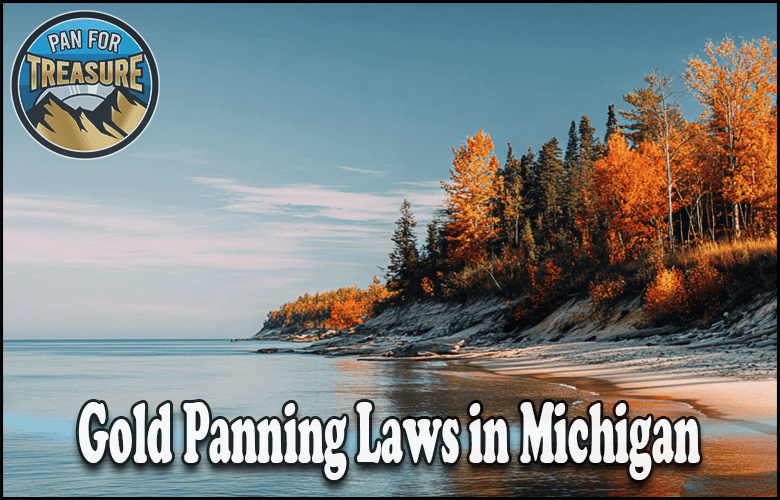
The gold panning laws in Michigan allow recreational hand panning on state-owned land where both surface and mineral rights belong to the state. No permit is needed for hand panning. Sluice boxes require a separate permit from the Department of Environment, Great Lakes, and Energy (EGLE), are limited to July and August, and must stay within size restrictions. Power sluicing and dredging are prohibited.
Michigan has real gold. The Ropes Gold Mine near Ishpeming in the Upper Peninsula operated on and off from 1883 to 1991 and produced over $700,000 worth of gold and silver (19th century values). More than 74 gold mines and prospects opened in the UP during the late 1800s. The Lower Peninsula holds glacial placer gold scattered across dozens of counties by Ice Age glaciers. Gold has been documented in at least 33 of Michigan’s 83 counties.
This guide covers the DNR land use rules, EGLE permit requirements, closed areas, and the best places to pan. If you are new to the hobby, start with our getting started with gold panning guide.
TL;DR
- Hand panning: Allowed on state land where the state owns both surface and mineral rights. No permit required. Can be done year-round.
- Sluice box: Requires an EGLE permit ($50 application fee). Limited to July 1 through August 31. Maximum sluice size: 52 inches long, 12 inches wide, 6.5 inches deep. Must identify a specific 300-square-foot area.
- Power sluicing and dredging: Prohibited on state land.
- Closed areas: Great Lakes shores and bottomlands, designated trout streams, natural rivers, natural areas, and mussel beds are all off-limits.
- Annual limit: No more than one-half troy ounce (15.55 grams) of gold per person per year from state-owned land.
- Bank disturbance: Excavating, digging, or disturbing the banks of any stream or river is prohibited.
- Private land: Requires written landowner permission. DNR land use rules do not apply to private property.
Lode (UP) + Glacial Placer (Statewide)
$700,000+ (Ropes Mine, 1883-1897)
Fine Placer, Flour Gold, Rare Lode
Marquette County (UP) + NW Lower Peninsula
Allowed, No Permit for Hand Panning
0.5 Troy Ounce Per Person
Gold Panning Laws and Regulations in Michigan
Michigan has one of the more clearly defined recreational prospecting frameworks in the eastern United States. Two agencies share oversight: the Department of Natural Resources (DNR), which manages state land access through a Land Use Order, and the Department of Environment, Great Lakes, and Energy (EGLE), which issues permits for sluice box use under Part 301 of the Natural Resources and Environmental Protection Act (NREPA, 1994 PA 451). The Michigan DNR recreational gold panning page is the best starting point for current rules.
Hand Panning on State Land – No Permit Required
The DNR Land Use Order allows recreational gold panning on state-owned land where both the surface and mineral rights are owned by the state. Hand panning by itself does not require a permit and can be done year-round. You must verify that the state owns both surface and mineral rights before panning. The state provides mineral rights ownership maps to help with this. Split-ownership parcels (where the state owns the surface but a private party owns the minerals, or vice versa) are off-limits.
Sluice Box Use – EGLE Permit Required
Using a sluice box on state-owned streams requires a permit from EGLE under Part 301 (Inland Lakes and Streams) of the NREPA. The permit application costs $50 and can be found at michigan.gov/jointpermit. Key sluice box restrictions include:
- Sluicing is allowed only from July 1 through August 31.
- Maximum sluice box dimensions: 52 inches long, 12 inches wide, 6.5 inches deep. Hand-operated only.
- Individual prospecting areas must be 300 square feet or less per location.
- The permit application must identify the specific area where the sluice box will be used.
- No processing or extractive chemicals may be used.
Prohibited Activities on State Land
The DNR Land Use Order specifically prohibits the following on state-owned land:
- Excavating, digging, or disturbing the banks of any stream or river.
- Gold panning or sluicing in designated trout streams.
- Gold panning or sluicing in natural rivers or natural areas.
- Gold panning or sluicing where stream mussel beds are known or encountered.
- Use of any power sluice box or dredge.
- Removing gold in excess of one-half troy ounce (15.55 grams) per year per person.
- Panning on Great Lakes shores and bottomlands.
The DNR provides maps showing closed areas, including designated trout streams, natural rivers, and natural areas. Check these maps before heading out.
Private Land
The DNR land use rules apply only to state-owned land. On private property, gold panning is between you and the landowner. Written permission is required. Many productive streams in both the UP and the Lower Peninsula cross private land. Riparian rights in Michigan follow the thread-of-the-stream doctrine, meaning streambed ownership is split between the owners of opposing banks.
Federal Land (National Forests)
Michigan contains parts of the Huron-Manistee National Forests in the Lower Peninsula and the Ottawa and Hiawatha National Forests in the UP. Recreational hand panning with non-motorized equipment is generally allowed on National Forest land under the General Mining Law of 1872. Check with the local Ranger District for any site-specific closures. Sluicing and motorized equipment on National Forest land may require additional authorization.
Rock and Mineral Collecting on State Land
Michigan allows individuals to collect up to 25 pounds per year of rock, mineral specimens (not including gold-bearing material), or invertebrate fossils from state-owned land for personal, non-commercial hobby use. Gold-bearing material is handled separately under the recreational panning Land Use Order and is limited to the one-half troy ounce annual cap.
Equipment Restrictions
| Equipment | State Land (Surface + Mineral Rights) | National Forest | Private Land |
|---|---|---|---|
| Gold Pan | Allowed, no permit, year-round | Allowed, no permit | With landowner permission |
| Hand Shovel / Trowel | Allowed in streambed, not banks | Allowed, minimal disturbance | With landowner permission |
| Classifier / Screen | Allowed, no permit | Allowed | With landowner permission |
| Hand Sluice Box (max 52x12x6.5″) | EGLE permit required, July-August only | Check with Ranger District | With landowner permission |
| Power Sluice / Highbanker / Dredge | Prohibited | Likely requires permit | May require EGLE permit |
For gear recommendations, see our best tools for gold panning roundup.
Best Locations for Gold Panning in Michigan
Michigan gold occurs in two distinct zones. The Upper Peninsula has genuine lode gold deposits in Precambrian greenstone belts, along with placer gold eroded from those deposits. The Lower Peninsula has glacial placer gold scattered south by Ice Age glaciers. Gold has been documented in at least 6 UP counties and 27 Lower Peninsula counties. For more detail, see our page on whether there’s gold in Michigan.
Upper Peninsula
- Marquette County (Ishpeming area) – Michigan’s most productive gold area. The Ropes Gold Mine, Michigan Gold Mine, Gold Lake Mine, and more than a dozen other operations worked gold-bearing quartz veins in the Ishpeming Greenstone Belt. Stream gravels and glacial moraine debris throughout the county contain placer gold. The Yellow Dog River, Dead River, and streams near the old mine sites are well-documented producers. This is the best county in the state for gold.
- Ontonagon County – The Flat River area and the Victoria Copper Mine district have produced gold as a byproduct of copper mining. Gold occurs in association with copper deposits in the Keweenaw volcanic rocks. Some placer gold in local streams.
- Gogebic County – The Eureka Mine area has documented gold occurrences. Located in the far western UP near the Wisconsin border. Limited access to some areas.
- Iron County – Placer gold has been reported in the Iron River area. The county’s metamorphic rocks share some characteristics with the Marquette greenstone belt.
Lower Peninsula
- Grand River (Multiple Counties) – Michigan’s longest river at 252 miles. Glacial gold has been reported throughout its length. Accessible from Jackson, Eaton Rapids, Grand Ledge, Ionia, and Grand Haven. A good starting point for beginners because of easy access from multiple cities.
- Flat River (Ionia/Montcalm Counties) – Placer gold documented since the early 1900s. The area around Greenville and downstream through Ionia County produces fine gold.
- Rogue River (Kent County) – Near Rockford. Prospectors have reported finding fine flour gold here. Accessible from the Grand Rapids area.
- Cedar River (Antrim County) – Gold discoveries reported since the 19th century. Most gold is placer. Located in northwestern Lower Michigan in an area with several productive streams.
- Manistee River and Little Sable River (Manistee County) – Both rivers produce placer gold. Many prospectors visit Manistee County for the chance to work two gold-bearing rivers in a single trip.
- Lake Leelanau (Leelanau County) – Gold deposits have been found along gravel bars and shores. Often overlooked by out-of-state prospectors but known to Michigan locals. Focus on the southern end for best results.
- Boyne River (Charlevoix County) – Low-water gravels along the Boyne River have produced placer gold. Northwestern Lower Michigan has consistent glacial gold reports.
- Stony Creek / Barkus Park Campground (Ionia County, near Lyons) – A privately owned pay-to-pan site where recreational prospectors pay a fee to pan Stony Creek. Fine flour gold has been found here. A good option for beginners who want a guaranteed legal panning location.
History of Gold Mining in Michigan
Gold was first noted in Michigan’s Upper Peninsula as early as 1845, when State Geologist Douglass Houghton documented traces of gold during his surveys of the region’s mineral deposits. But it took another 36 years before anyone did something about it.
In 1881, Julius Ropes, a chemist and former postmaster from Ishpeming, discovered a gold-bearing quartz vein in serpentine rocks north of town. He formed the Ropes Gold and Silver Company and began mining in 1883. The mine employed 35 men and used stamp mills to crush ore. In the first hundred tons, gold averaged $9 per ton. By January 1887, the mine had produced $67,338 in gold. The best months brought in $4,000 to $8,000. Total production during the initial 1883-1897 period reached $647,902 in gold and silver. Another $54,929 was recovered from tailings by the cyanide leaching process in 1900-1901, bringing the total to over $702,000 in period values.
The Ropes discovery triggered a minor gold rush in the Marquette area. More than 74 mines and prospects opened across the UP. The Michigan Gold Mine, four miles west of the Ropes, found the richest ore and largest nuggets in the state. Its first run averaged $293 per ton from 28 tons of ore. Gold Lake Mine, Superior Gold Mining Company, Peninsular Gold Mining Company, Grummett Mine, and Swains Mine all operated during this period. Most had limited production and short lives.
The Ropes Mine had a long second act. After decades of dormancy, the inflation of the 1970s pushed gold prices high enough to justify reopening. Callahan Mining Company purchased the property, sank a truck decline to 900 feet, and began mining again in 1983. A new shaft reached 1,548 feet depth. Operations continued until 1991, when expensive repairs and falling gold prices forced the final closure. The Ropes was the only profitable gold mine in Michigan’s history.
In the Lower Peninsula, gold has always been glacial. Ice Age glaciers scraped gold-bearing rock from Canada and scattered it across Michigan as they retreated. This gold is extremely fine (flour to small flake size) and too dispersed for commercial mining. But it exists across dozens of counties and keeps recreational prospectors busy. The Grand River, Flat River, Manistee River, and many other drainages produce small amounts of placer gold for patient panners.
Tips for Gold Panning in Michigan
- Verify land ownership before you pan. The DNR rules only apply to land where the state owns both surface and mineral rights. Split-ownership parcels are off-limits. Use the DNR website’s mineral rights maps to confirm ownership. This step is not optional.
- Check the closed-area maps. Designated trout streams, natural rivers, natural areas, mussel beds, and Great Lakes shores are all closed to prospecting. The DNR provides maps of these areas on their recreational gold panning page. Print or download them before your trip.
- Do not disturb the banks. The Land Use Order specifically prohibits excavating, digging, or disturbing stream banks. Work only in the streambed itself, below the ordinary high-water line. This is one of the most commonly cited rules and one of the easiest to break accidentally.
- Start with the Upper Peninsula. If you want the best chance of finding gold, head to Marquette County. Streams draining the Ishpeming Greenstone Belt, the Yellow Dog River, and the Dead River area have the strongest track record. The UP has lode-derived placer gold, which is generally coarser than glacial flour.
- Pan carefully for fine gold. Most Michigan gold is extremely fine. Use slow, controlled panning movements. A spiral pan, Gold Cube, or blue bowl can help retain flour gold that standard panning would lose. See our panning techniques guide for fine gold methods.
- Work inside bends and exposed bedrock. Gold settles where water slows. Inside bends, behind boulders, and in cracks in exposed bedrock are your best targets. Dig down to bedrock if it is within reach. In the Lower Peninsula, also check below dams, where gold concentrates behind the obstruction.
- If you want to sluice, plan ahead. The EGLE permit application process can take time. The permit limits sluicing to July and August and requires you to identify a specific 300-square-foot area. Apply well before your planned trip. For more on gold panning permits, see our permit guide.
- Consider pay-to-pan sites. Barkus Park Campground near Lyons (Ionia County) is a privately owned site that charges a small fee for panning access on Stony Creek. It is a low-pressure way to learn panning technique in a location where fine gold has been found.
- Watch for copper and pyrite. Michigan’s geology produces abundant copper (especially in the UP) and pyrite. Small pieces of native copper are common in UP stream gravels. Copper is reddish and easily identified. Pyrite is brittle and lighter than gold. Real gold is soft, heavy, and does not shatter when struck.
- Join the Michigan GPAA chapter. The Michigan chapter of the Gold Prospectors Association of America (GPAA) has local knowledge, group outings, and access arrangements that are hard to find on your own. Experienced members can point you to productive spots and help you avoid wasting time on barren ground.
Resources for Michigan Prospectors
- Michigan DNR – Recreational Gold Panning and Sluicing on State Land – The official DNR page with the Land Use Order, closed-area maps, mineral rights ownership maps, and contact information.
- EGLE General Permit Categories – The full list of general permit categories including Amateur Recreational Gold Prospecting (Category B). Details sluice box rules, seasonal restrictions, and area limits.
- Gold in Michigan (Open File Report) – State geological survey report covering gold occurrences by county, mine histories, geology, and references. The most detailed technical source on Michigan gold.
- Gold Prospectors Association of America (GPAA) – National organization with a Michigan chapter. Resources, forums, group outings, and equipment guidance for recreational prospectors.
- Gold Panning Permits Guide – Our breakdown of permit requirements across the country, including states with similar two-tier systems to Michigan.
Conclusion
The gold panning laws in Michigan are well-defined compared to many eastern states. Hand panning on state land where the state owns both surface and mineral rights requires no permit and is allowed year-round. Sluice boxes need an EGLE permit, cost $50, and are restricted to July and August. Power sluicing and dredging are prohibited. Designated trout streams, natural rivers, natural areas, mussel beds, and Great Lakes shores are all off-limits.
Michigan has real gold with real history. The Ropes Mine near Ishpeming produced over $700,000 in gold and silver across two operating periods, and more than 74 other prospects opened across the Upper Peninsula. The Lower Peninsula holds glacial placer gold in dozens of counties. With proper research into land ownership and closed areas, Michigan offers solid recreational panning opportunities for patient prospectors. For more on where gold exists in the state, see our best places to pan for gold in America guide.
Check out the laws in Ohio, Indiana, Wisconsin, Illinois, and Minnesota, or browse our full gold panning laws by state directory.
Frequently Asked Questions – Gold Panning in Michigan
Is gold panning legal in Michigan?
Yes. Recreational hand panning is allowed on state-owned land where both surface and mineral rights belong to the state. No permit is needed for hand panning. Sluice boxes require a separate EGLE permit. Panning on private land requires landowner permission. Several areas are closed to protect habitat, including designated trout streams, natural rivers, and mussel beds.
Do I need a permit to pan for gold in Michigan?
Not for hand panning on qualifying state land. A gold pan, hand shovel, and classifier can be used year-round without a permit. If you want to use a sluice box, you need an EGLE permit ($50 application), and sluicing is restricted to July and August. The sluice box cannot exceed 52 inches long, 12 inches wide, and 6.5 inches deep. Power sluicing and dredging are not allowed.
Where is the best place to find gold in Michigan?
Marquette County in the Upper Peninsula is the most productive gold area. Streams near the historic Ropes Mine, the Yellow Dog River, and the Dead River have the strongest track records. In the Lower Peninsula, the Grand River, Flat River, Rogue River, and streams in Manistee and Antrim counties produce glacial placer gold. The UP offers coarser gold; the Lower Peninsula yields mostly flour and fine flakes.
How much gold can I keep from state land?
The DNR Land Use Order limits recreational prospectors to one-half troy ounce (15.55 grams) of gold per person per year from state-owned mineral and surface lands. This limit applies to the combined total from all state land locations. There is no annual limit on private land (subject to landowner agreement).
Can I use a sluice box in Michigan?
Yes, but only with an EGLE permit. The permit costs $50 to apply for, limits sluicing to July 1 through August 31, and requires hand-operated sluice boxes no larger than 52 by 12 by 6.5 inches. You must identify a specific 300-square-foot area where the sluice will be used. No chemicals may be used. Power sluices, highbankers, and dredges are prohibited on state land.
What areas are closed to gold panning in Michigan?
Great Lakes shores and bottomlands, designated trout streams, natural rivers, natural areas, and any stream segments with known mussel beds are all closed to recreational gold panning and sluicing. The DNR provides maps of these closed areas on their website. Additionally, you cannot pan on state land where the state does not own both the surface and mineral rights.

⛏ Recommended Gear ⛏


* As an Amazon Associate I earn from qualifying purchases at no extra cost to you.
Subscribe to Our Newsletter

Ryan Conlon is the founder of Pan for Treasure.
A lifelong gold panning enthusiast, he created this site to help beginners learn the ropes and share practical tips from his own time on the creek. [email protected]