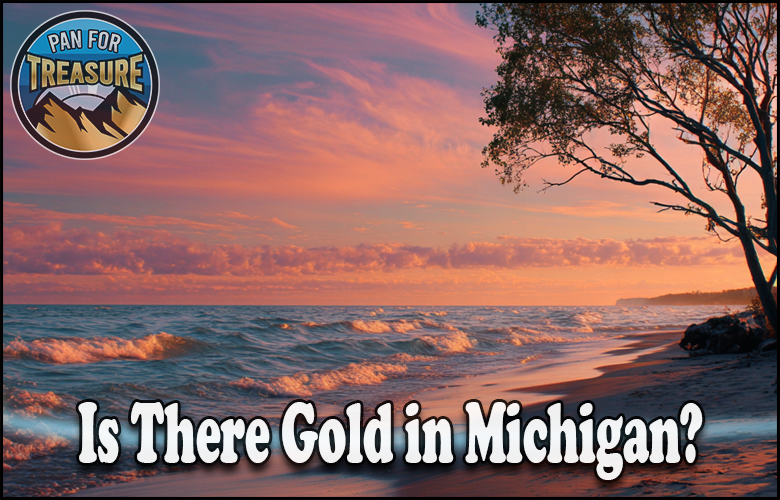
Is there gold in Michigan? Yes. Michigan has both lode gold in bedrock quartz veins and placer gold scattered across rivers and streams in both the Upper and Lower Peninsulas. The Ropes Gold Mine near Ishpeming in Marquette County was the state’s only major gold producer, operating off and on for over a century from 1881 until its closure in 1991. At least 13 gold mines operated in the Upper Peninsula during the late 1800s.
Gold was first noted in Michigan as early as 1845, and Dr. Douglass Houghton (the state’s first geologist) reported gold among the Upper Peninsula’s mineral riches in his landmark 1841 survey. Small amounts of gold can be found in most waterways across the state, deposited by glaciers that scraped across gold bearing Canadian bedrock during the last ice age. The Michigan Department of Natural Resources allows recreational gold panning on state owned land where the state holds both surface and mineral rights.
Michigan may be best known for its copper and iron mines, but gold is a real part of the state’s mineral heritage. The area north of Ishpeming and Negaunee, sometimes called the “gold area,” produced the richest finds, and streams throughout both peninsulas continue to yield fine gold for patient prospectors.
TL;DR
- Gold Present: Yes, in both lode (bedrock) and placer (stream/glacial) deposits. Gold has been found in 20+ counties across both peninsulas. At least 13 mines operated in the Upper Peninsula.
- Best Region: Marquette County in the Upper Peninsula, particularly the area north of Ishpeming and Negaunee (the “gold area”). The Ropes Gold Mine was the state’s major producer.
- Gold Type: Three modes: vein deposits in quartz (UP only), placer deposits in streams, and glacial deposits statewide. Most gold found today is very fine dust. Lode gold specimens in quartz have been found near Ishpeming.
- Top Spot: Streams near the Ropes Gold Mine area in Marquette County. In the Lower Peninsula, the Grand River (especially near Ionia) and the Flat River near Lowell are good starting points.
- Legal Note: Recreational gold panning is allowed on state land where the state owns both surface and mineral rights. Hand tools only on public land. National Forests in the UP offer additional access. Private land requires permission.
- Verdict: Michigan is the strongest gold state in the Great Lakes region. The UP has real lode gold history, and fine placer gold can be found in rivers statewide. Excellent public land access makes it very beginner friendly.
Major Mine
The Ropes Gold Mine near Ishpeming (Marquette County) operated from 1881 to 1991. It produced gold worth approximately $645,000 in 1880s dollars ($24+ million today). One report claims $650 million total in gold and silver over the mine’s full history. It was the only major gold producer in Michigan.
Number of Mines
At least 13 gold mines operated in the Upper Peninsula during the late 1800s and early 1900s, including the Ropes, Michigan, Gold Lake, Superior, Peninsular, Grummett, Swains, Mocklers, Grayling, Giant, Krieg, Coon, and Brown mines.
Discovery
Gold first noted in the UP in 1845. Dr. Douglass Houghton reported gold in his 1841 survey. In 1869, Waterman Palmer found gold bearing quartz near Cascade yielding up to $900/ton, but the vein was too small. Julius Ropes opened the first major mine in 1881.
Three Gold Types
Vein deposits: native gold in quartz veins in the UP’s Precambrian bedrock. Placer deposits: gold concentrated in stream gravels near lode sources. Glacial deposits: fine gold scattered across both peninsulas by ice sheets from Canada.
Statewide Gold
Gold has been found in 20+ counties across both peninsulas. Almost any waterway in Michigan has the potential to hold some gold. The Grand River (252 miles, the state’s longest) has glacial gold deposits reported throughout its course.
Legal Status
Recreational panning allowed on state land where the state owns surface and mineral rights. Hand tools only (panning by hand). National Forests in the UP offer excellent access. Private land requires landowner permission. Contact DNR to confirm specific locations.
Featured
Where Is There Gold in Michigan?
Michigan ranks #18 of 50 for gold potential.
Quick reference below – details on each location follow, or jump to the Michigan map.
| Location / Area | River / Creek | County | Gold Type | Land Access |
|---|---|---|---|---|
| Streams near the Ropes Gold Mine, Marquette County (UP) | Not listed | Marquette | Placer gold | Not listed |
| Yellow Dog River and Dead River, Marquette County (UP) | Yellow Dog River, Dead River | Marquette | Not listed | Not listed |
| Grand River near Ionia (Lower Peninsula) | Grand River | Not listed | Fine glacial gold | Public access |
| Flat River north of Lowell | Flat River | Kent | Not listed | Not listed |
| Muskegon River, Newaygo County | Muskegon River | Newaygo | Not listed | Not listed |
| Rapid River, Kalkaska County | Rapid River | Kalkaska | Not listed | State forest |
| Victoria Copper Mine area, Ontonagon County (UP) | Not listed | Ontonagon | Placer gold | Not listed |
| Barkus Campground, Pewamo | Stony Creek | Ionia | Not listed | Not listed |
Is there gold in Michigan worth pursuing? Absolutely. Michigan stands out as the strongest gold state in the Great Lakes region, with genuine lode gold history in the Upper Peninsula and glacial placer gold in rivers across the entire state. The gold divides neatly into two stories: the UP’s hard rock gold district and the statewide glacial deposits.
Marquette County (The Gold Area)
Marquette County in the Upper Peninsula is Michigan’s gold capital. The region north of Ishpeming and Negaunee, historically called the “gold area,” is where virtually all of Michigan’s commercial gold production occurred.
Julius Ropes, the former Ishpeming postmaster, druggist, and school board member, discovered gold in rock outcroppings about five miles northwest of town in 1880. He formed the Ropes Gold and Silver Company in August 1881 with partners Dr. Carpenter, S.S. Curry, and C.P. Cummings. The company had a capital stock of $1,000,000 with 400,000 shares.
The Ropes Mine sank two shafts and erected a stamp mill. The first hundred tons of ore averaged $9 per ton in gold. By January 1887, the mine had produced $67,338 in gold, with monthly production ranging from $400 to $8,000 in their best months. The gold occurred as native (free) gold in quartz veins within peridotite, part of the UP’s ancient Precambrian bedrock.
Two miles northeast of the Ropes Mine, the Michigan Gold Mine produced some of the finest museum quality native gold specimens from the area. The ore was so rich that workers were caught stealing it during peak production in 1890. The Gold Lake Mine, Superior Gold Mining Company, Peninsular Gold Mining Company, and at least eight other mines all operated in the vicinity during the 1890s. Specimens from these mines were displayed at the 1895 World’s Fair in Chicago.
All regional stream gravels and glacial moraine debris in Marquette County contain placer gold, making the entire county worthy of investigation. The Yellow Dog River and Dead River, which extends north to Lake Superior, flow through areas where many productive mines operated.
Other Upper Peninsula Counties
Beyond Marquette County, gold has been found in several UP counties. Ontonagon County, famous for its massive native copper deposits, also has placer gold at the Victoria Copper Mine and in the Flat River. Iron County’s Iron River has produced placer gold. The Blind Sucker River in Alger and Luce Counties contains fine gold particles, likely deposited by glacial activity.
The Huron Mountains northwest of Ishpeming have produced placer gold recovered from glacial drift. In 1932, the Michigan College of Mining Technology introduced a course in gold prospecting and sent students into the Hurons to prospect, though nothing commercially significant came from the venture.
Lower Peninsula
The Lower Peninsula has no lode gold deposits, but glacial placer gold exists across a wide swath of the state. A 1911 study by Allen documented placer gold in counties stretching from Allegan and Barry in the southwest to Kalkaska and Charlevoix in the north.
The Grand River, Michigan’s longest at 252 miles, has glacial gold deposits throughout its course. The areas near Ionia and the Portland State Game Area south of Portland have been particularly productive. Allen’s 1911 study recorded 4 to 30 colors per pan in the Grand River below Lyons, with some grains the size of mustard seeds.
The Flat River north of Lowell flows through an area with glacial moraines containing gold. The Muskegon River in Newaygo County is known for gold. The Rapid River in Kalkaska County has produced gold from its gravel bars. The Boyne River in Charlevoix County and the Cheboygan River have both yielded placer gold.
A Lower Peninsula folklore tells of a man in early 20th century Alcona County who kept hauling dirt from river banks back to his shack. He reportedly found enough gold to support himself for the rest of his life. Some believe the location was near the Black River in Haynes Township. Gold nuggets were found in 1912 on the Fleming farm, though the exact location has been debated ever since.
Our Favorite Posts
Best Places to Look for Gold in Michigan
- Streams near the Ropes Gold Mine, Marquette County (UP): The most productive gold area in the state. All regional streams and glacial moraine debris contain placer gold. The source is bedrock lode deposits, so gold particles near Ishpeming can be larger than typical glacial dust. Look for streams on state land near old mine sites.
- Yellow Dog River and Dead River, Marquette County (UP): Both rivers flow through areas with historic mine activity. The Dead River Valley extends north to Lake Superior. Gold values up to 0.6 oz per ton have been reported in some prospects.
- Grand River near Ionia (Lower Peninsula): Michigan’s longest river with documented glacial gold deposits. The Portland State Game Area south of Portland offers public access. Allen’s 1911 study confirmed 4 to 30 colors per pan. Good beginner spot due to easy access.
- Flat River north of Lowell (Kent County): Flows through an area with glacial moraines containing gold. A state game area provides river access and placer deposits.
- Muskegon River, Newaygo County: Known for a large amount of gold compared to other Lower Peninsula rivers.
- Rapid River, Kalkaska County: Runs through state forests in northern Michigan. Gravel bars in the river are the most likely places to find gold.
- Victoria Copper Mine area, Ontonagon County (UP): Placer gold found as a byproduct of the copper mining region.
- Barkus Campground, Pewamo (Ionia County): A privately owned pay per dig site ($10 per prospector) where campers pan for gold in Stony Creek. Good for beginners who want a guaranteed panning experience.
- Boyne River, Charlevoix County: Placer gold in low water gravels. A scenic northern Michigan prospecting option.
- Lake Superior beaches, Marquette County (UP): Fine gold can be found in black sand concentrates along Great Lakes beaches near areas with upstream gold sources.
History of Gold in Michigan
Michigan’s gold history begins with Dr. Douglass Houghton, the state’s first geologist, whose landmark 1841 report described rich mineral deposits in the Upper Peninsula including copper, iron, silver, and gold. Houghton’s report sparked a mining boom that predates the California gold rush by several years. On one of his early surveying trips, Houghton reportedly secured enough gold to fill an eagle’s quill from a small UP stream.
Houghton’s death in 1846, when his boat sank on Lake Superior, launched an enduring legend. Storytellers say that during his final trip, while camped somewhere near modern Negaunee, he found a large gold deposit but kept the location secret. When his ship sank, the location was lost forever. No evidence has surfaced to confirm the story.
Small amounts of gold were found as early as 1845 in the UP. In 1864, during a silver mining boom, economic quantities of gold were found in specimens from the Silver Lake district near Ishpeming. In 1869, Waterman Palmer disclosed a small vein of gold bearing quartz near Cascade that yielded up to $900 per ton, but the vein was too small for profitable mining.
The real gold rush began in 1881 with Julius Ropes. His mine’s early success attracted a wave of prospecting and mine development. By 1887, gold was discovered four miles west of the Ropes Mine on Cleveland Iron Company property, where the richest ore and largest nuggets were found (specimens were displayed at the 1895 World’s Fair in Chicago). At the peak, 13 mines operated in the Ishpeming area.
Most mines struggled financially. The Krieg Mine flooded below the 100 foot level. The Coon Mine had the same problem. The Ropes Mine itself changed hands multiple times, closing and reopening as gold prices and technology changed. Financial troubles forced Ropes himself to walk away. After the original $645,792 in production, Corrigan McKinney and Company bought the mine in 1900 and recovered $200,000 from the tailings alone.
By 1906, gold mining in Michigan had largely ceased. The Grummett Gold and Silver Mining Company attempted to renew explorations in Michigamme but found no buyers by 1913. The Ropes Mine was reopened in the 1930s and again in the 1970s before finally closing in 1991 after a hoist shaft collapsed. All shafts and declines have since been capped.
Recommended Reading
Geology of Gold in Michigan
Michigan’s gold geology splits between the ancient Precambrian bedrock of the Upper Peninsula and the glacial deposits that cover both peninsulas.
The Upper Peninsula contains some of the oldest rocks in North America, part of the Canadian Shield. The gold area north of Ishpeming features Precambrian peridotite and other igneous and metamorphic rocks that are billions of years old. Gold occurs as native (free) metal in quartz veins cutting through this ancient bedrock, a classic lode gold setting similar to deposits in the great gold fields of California and Colorado, though on a much smaller scale.
The Lower Peninsula, by contrast, has no exposed Precambrian bedrock. Sedimentary rocks (limestone, sandstone, shale) underlie the surface, covered by thick glacial deposits. Any gold in the Lower Peninsula was transported from Canada by Pleistocene ice sheets that scraped across gold bearing bedrock of the Canadian Shield and deposited the pulverized material in glacial till, outwash, and moraines as the ice retreated.
This glacial gold is extremely fine because it was ground to dust during transport. The glacial outwash belt running diagonally from the southwest to northeast of the Lower Peninsula, through Allegan, Barry, Ionia, Montcalm, and Newaygo Counties, is a particularly favorable zone.
Michigan’s position at the southern edge of the Canadian Shield gives it a geological advantage over states further south. The glaciers that shaped the Great Lakes carried gold bearing material directly from Canadian source rocks and deposited it relatively close to the source, meaning Michigan’s glacial gold is more widespread than in states like Illinois or Indiana where the glacial material traveled further and was more diluted.
Best Locations
- Is There Gold in Rhode Island? Top Locations and if It’s Worth the Trip
- Is There Gold in Washington? Top Locations and if It’s Worth the Trip
- Best Places to Pan for Gold and Gemstones in America
- Is There Gold in Massachusetts? Top Locations and if It’s Worth the Trip
- Is There Gold in South Carolina? Top Locations and if It’s Worth the Trip
Tips for Gold Prospecting in Michigan
- Start in the Upper Peninsula if possible. Marquette County streams near the historic gold area north of Ishpeming offer the best chance of finding gold in Michigan. The gold here comes from actual bedrock sources, so particles can be slightly larger than typical glacial dust.
- Use state land wisely. The Michigan DNR allows recreational gold panning on state land where the state owns both surface and mineral rights. Contact the DNR to confirm that your chosen location qualifies. National Forests in the UP provide additional excellent access.
- Master fine gold recovery. The vast majority of Michigan gold is extremely fine dust. Standard gold panning technique may lose the finest particles. Consider fine gold specific tools: a fine gold sluice box, spiral wheel, or Gold Cube will improve your recovery rate dramatically.
- Work gravel bars on inside bends. In both peninsulas, the best gold accumulates on gravel bars at the inside curves of rivers. Dig down to bedrock or the clay layer if it is not too deep. Behind large boulders on straight sections is another productive spot.
- Try the Grand River. For Lower Peninsula prospectors, the Grand River is the best starting point. It is 252 miles long, runs through multiple cities, and has documented gold deposits. The areas near Ionia and Portland offer the best reports.
- Explore gravel pits. Many Michigan prospectors believe gold can be found in just about any gravel pit in the state by dry panning. Glacial deposits that ended up in gravel pits carry the same gold that is in the rivers.
- Combine gold and copper hunting. The UP is world famous for native copper specimens. A trip to Marquette County for gold can easily include a visit to the Keweenaw Peninsula for copper. The mineral diversity of Michigan’s UP is exceptional.
- Check Great Lakes beaches. Fine gold in black sand concentrates can be found on Lake Superior beaches near areas with upstream gold sources. After storms, heavier minerals including gold concentrate in the wave washed sands.
Resources
- Gold Rush Nuggets: Where to Pan for Gold in Michigan for a comprehensive guide to prospecting locations and fine gold recovery tips.
- Michigan Tech A.E. Seaman Mineral Museum: Gold in Michigan (PDF) for the definitive county by county list of gold occurrences compiled from geological records.
- Rare Gold Nuggets: Gold Prospecting Locations in Michigan for detailed information on the Ropes Mine area and Lower Peninsula rivers.
- Gold Panning Laws in Michigan for current regulations on recreational prospecting on state and private land.
Conclusion
Is there gold in Michigan? Yes, and more than most people realize. The Upper Peninsula’s Ropes Gold Mine produced gold for over a century, at least 13 mines operated in the Ishpeming area during the 1890s gold rush, and fine placer gold exists in rivers across both peninsulas. Michigan is the strongest gold state in the Great Lakes region, with the unique combination of Precambrian lode gold in the UP and widespread glacial deposits statewide.
The gold is mostly fine, and no one is getting rich panning Michigan rivers. But the state’s excellent public land access (DNR allows recreational panning on state land), the historic gold area near Ishpeming, and the sheer number of gold bearing waterways make Michigan one of the best eastern states for recreational prospecting. The UP scenery and world class mineral collecting are bonuses that make any prospecting trip worthwhile.
Start with streams near Ishpeming if you can reach the UP, or the Grand River near Ionia for a Lower Peninsula adventure. For more gold prospecting destinations, check Is There Gold in Georgia?, Is There Gold in Colorado?, and Is There Gold in Maine?. Or browse the full state directory to find gold near you.
Frequently Asked Questions – Is There Gold in MI
Has gold been mined in Michigan?
Yes. The Ropes Gold Mine near Ishpeming in Marquette County was the state’s major producer, operating from 1881 to 1991. At least 13 gold mines operated in the Upper Peninsula during the late 1800s. The Ropes Mine produced gold worth approximately $645,000 in 1880s dollars. Corrigan McKinney recovered an additional $200,000 from the tailings alone.
Where is the best place to find gold in Michigan?
Streams near the historic gold area north of Ishpeming in Marquette County (Upper Peninsula) offer the best prospects. In the Lower Peninsula, the Grand River near Ionia, the Flat River near Lowell, and the Muskegon River in Newaygo County are the most documented gold bearing waterways.
Can you pan for gold in Michigan legally?
Yes. The Michigan Department of Natural Resources allows recreational gold panning on state owned land where the state holds both surface and mineral rights. Hand tools only on public land. National Forests in the UP offer additional access. Always contact the DNR to confirm that a specific location is open to prospecting.
Is Michigan gold from glaciers or bedrock?
Both. The Upper Peninsula has genuine lode gold in Precambrian bedrock quartz veins, particularly near Ishpeming. The rest of Michigan’s gold is glacial, transported from Canadian bedrock by Pleistocene ice sheets. The UP has both types, while the Lower Peninsula has glacial gold only.
Can you find gold nuggets in Michigan?
Gold nuggets are rare in Michigan. The Ropes Mine area near Ishpeming produced the largest nuggets and finest specimens, some of which were displayed at the 1895 World’s Fair. In streams, the gold is mostly fine dust. Near lode sources in the UP, slightly larger particles are possible, but expect mostly fine material.
What is the Ropes Gold Mine?
The Ropes Gold Mine, located about five miles northwest of Ishpeming in Marquette County, was Michigan’s only major gold producer. Founded by Julius Ropes in 1881, it operated intermittently until 1991. The mine produced gold from quartz veins in Precambrian peridotite and had a 10 stamp mill, ball mill, and jaw crushers. All shafts are now capped and closed.

⛏ Recommended Gear ⛏


* As an Amazon Associate I earn from qualifying purchases at no extra cost to you.
Subscribe to Our Newsletter

Ryan Conlon is the founder of Pan for Treasure.
A lifelong gold panning enthusiast, he created this site to help beginners learn the ropes and share practical tips from his own time on the creek. [email protected]