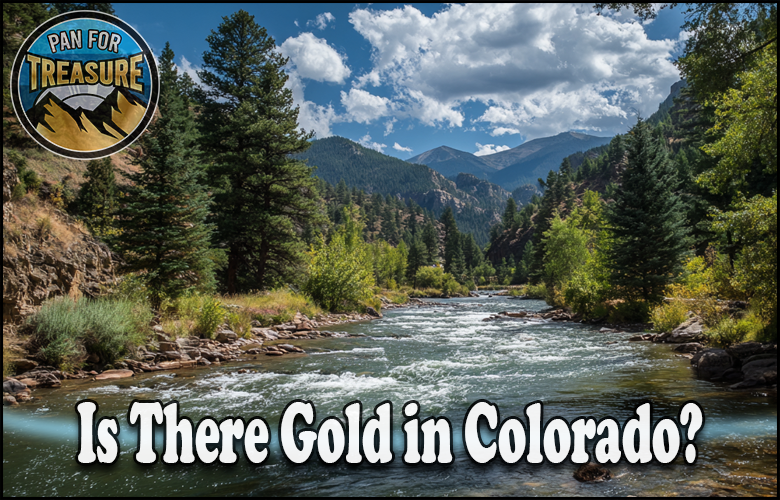
Is there gold in Colorado? Yes, and a lot of it. Colorado has produced an estimated 45 million ounces of gold, making it historically the second most productive gold state in the country behind California. The Pikes Peak Gold Rush of 1858 brought tens of thousands of prospectors to the territory, and gold mining has continued in Colorado ever since.
Gold deposits follow the Colorado Mineral Belt, a northeast-trending zone of mineralization that cuts diagonally across the Rocky Mountains from Boulder County to the San Juan Mountains. The Cripple Creek district alone has produced over 21 million ounces, and it remains an active mine today.
Recreational prospectors can still find gold in Colorado’s mountain streams and historic mining districts. From Clear Creek near Denver to the San Juan rivers near Silverton, the state offers hundreds of gold-bearing waterways on public land. For panning regulations, see our gold panning laws in Colorado guide.
TL;DR
- Gold Present: Yes, in very large quantities. Colorado has produced approximately 45 million ounces of gold, ranking second in U.S. history.
- Best Region: The Colorado Mineral Belt, stretching from Boulder County southwest through Central City, Idaho Springs, Breckenridge, Leadville, and into the San Juan Mountains. The Cripple Creek district lies southeast of the main belt.
- Gold Type: Both placer and lode gold in abundance. Placer nuggets and flakes in mountain streams, lode gold in quartz and sulfide veins, and byproduct gold from silver, lead, and zinc mines.
- Top Spot: Clear Creek near Idaho Springs and Golden provides the most accessible recreational panning near Denver. For experienced prospectors, the San Juan Mountains and the upper Arkansas River region offer excellent potential.
- Active Mines: The Cripple Creek and Victor Gold Mine (now owned by SSR Mining) is the only major active gold mine in the state, producing roughly 170,000 ounces per year.
- Legal Note: Recreational gold panning with hand tools is generally allowed on BLM and U.S. Forest Service lands without a permit. Always verify claim status before prospecting, and check for area-specific restrictions.
- Verdict: Colorado is one of the premier gold states in the country with proven deposits across its mountain regions. Recreational prospectors have excellent opportunities on public land throughout the western half of the state.
Geology
Gold deposits follow the Colorado Mineral Belt, a zone of Laramide-to-Tertiary igneous intrusions cutting across Precambrian metamorphic and igneous rocks of the Rocky Mountains.
Historical Production
Approximately 45 million ounces total. The Cripple Creek district alone has produced over 21 million ounces. Seven districts have each produced over 1 million ounces.
Best Area
The Cripple Creek district (Teller County) for lode gold. For placer prospecting: Clear Creek (Clear Creek County), the upper Arkansas River, and the San Juan Mountains.
Active Claims
Thousands of active mining claims across the state, concentrated in the mountain counties along the Colorado Mineral Belt. Always verify claim status before prospecting.
Primary Gold Type
Lode gold in sulfide veins and quartz veins. Placer gold (flakes, pickers, and occasional nuggets) in mountain streams draining mineralized areas.
Best Season
Late June through September, after snowmelt recedes and mountain streams become workable. Many high-elevation areas are inaccessible until early summer.
Featured
Where Is There Gold in Colorado?
Colorado ranks #6 of 50 for gold potential.
Quick reference below – details on each location follow, or jump to the Colorado map.
| Location / Area | River / Creek | County | Gold Type | Land Access |
|---|---|---|---|---|
| Clear Creek | Clear Creek | Not listed | Not listed | Not listed |
| Arapahoe Bar, Wheat Ridge | Clear Creek | Jefferson | Not listed | Free access |
| Upper Arkansas River and Point Barr | Upper Arkansas River, Arkansas River | Chaffee, Lake | Placer gold | BLM land |
| Upper Animas River near Silverton | Upper Animas River, Animas River | San Juan | Fine gold | National forest; Public access |
| Breckenridge Area | Blue River, Swan River, French Gulch | Summit | Placer gold | Public land; Check for claims |
| North Fork of the South Platte River | North Fork, South Platte River | Park | Not listed | National forest; Public access |
| Canyon Creek and Ouray Area | Canyon Creek, Uncompahgre River | Ouray | Placer gold | Public access; Check for claims |
| San Miguel River near Telluride | San Miguel River | San Miguel | Fine placer gold | Not listed |
Is there gold in Colorado throughout the state? Gold has been found in most of Colorado’s mountain counties, but production is heavily concentrated along the Colorado Mineral Belt. This northeast-trending zone of mineralization stretches from near Boulder on the northeast to the San Juan Mountains on the southwest, crossing the Sawatch, Mosquito, Gore-Tenmile, and Front Ranges along the way.
The Front Range (Clear Creek and Gilpin Counties)
The Front Range mining districts were the first major gold discoveries in Colorado. Prospectors traced placer gold up Clear Creek from Denver into the mountains, leading to the founding of Idaho Springs, Georgetown, and the twin cities of Central City and Black Hawk in 1859.
The Central City-Black Hawk district in Gilpin County and the Idaho Springs-Empire district in Clear Creek County together produced about 6.2 million ounces of gold. Gold occurs in sulfide veins found in Precambrian gneiss and granodiorite.
These districts are among the most accessible in the state, located just 30 to 45 miles west of Denver along Interstate 70.
Cripple Creek and Victor (Teller County)
The Cripple Creek district is the richest gold camp in Colorado history and one of the richest in the world. Gold was discovered here in 1891, relatively late in Colorado’s mining history, and the district quickly became the state’s dominant producer.
Over 21 million ounces of gold have been extracted from Cripple Creek, more than half of Colorado’s total output. The gold occurs in an unusual geological setting: altered and brecciated volcanic rocks of Oligocene age, not the typical quartz vein deposits found elsewhere in the state.
The Cripple Creek and Victor Gold Mine continues to operate as a large-scale open-pit heap leach operation. SSR Mining acquired the mine from Newmont in early 2025, and it remains the only major active gold mine in Colorado with a 12-year mine life plan.
Summit County (Breckenridge)
The Breckenridge mining district in Summit County produced approximately 1 million ounces of gold from both placer and lode deposits. Gold was first discovered here in the 1860s, and the district saw extensive hydraulic mining and later dredging operations along the Blue River and Swan River.
The biggest gold nugget ever found in Colorado was discovered near Breckenridge in 1887. The crystalline gold nugget weighed 13 pounds, 7 ounces before washing. Characteristic gravel ridges left by the old dredges can still be seen along the Blue River and Snake River today.
Leadville and Lake County
The Leadville district produced approximately 3.2 million ounces of gold, most of it as a byproduct of the area’s famous silver and lead mining. One of the richest placer gold discoveries in Colorado history occurred at California Gulch in 1860, the site of the original Oro City.
The placers were exhausted within four years, but lode gold was discovered in 1868. The subsequent silver discoveries in 1877 made Leadville one of the wealthiest cities in the West and boosted its population from 200 to over 15,000 in just two years.
The San Juan Mountains (San Juan, San Miguel, and Ouray Counties)
The San Juan Mountains in southwestern Colorado mark the terminus of the Colorado Mineral Belt and contain some of the state’s most spectacular mining districts. Gold here is associated with Tertiary volcanic calderas and occurs in intrusives, veins, and chimneys.
The Telluride district in San Miguel County produced approximately 3 million ounces of gold along with large quantities of silver, lead, and copper. The Silverton district in San Juan County and the Sneffels district in Ouray County each produced over 1 million ounces.
The San Juan mining towns of Silverton, Telluride, and Ouray are connected by the famous Million Dollar Highway and surrounded by dramatic alpine scenery, ghost towns, and hundreds of old mine workings.
Park County (Alma, Fairplay, and Tarryall)
Rich placer deposits were found on the west side of South Park in 1859. The Alma-Fairplay district produced about 1.55 million ounces of gold, more than two-thirds from lode deposits. The Tarryall district produced 67,000 ounces, almost entirely from placers.
Floating dredges worked the floor of South Park Valley east of Fairplay from 1941 to 1952, and the distinctive gravel ridges they left behind are still visible today.
Our Favorite Posts
- Best Places to Pan for Gold and Gemstones in America
- Is There Gold in California? Top Locations and if It’s Worth the Trip
- Is There Gold in Idaho? Top Locations and if It’s Worth the Trip
- Is There Gold in Alaska? Top Locations and if It’s Worth the Trip
- Is There Gold in North Carolina? Top Locations and if It’s Worth the Trip
Best Places to Find Gold in Colorado
Given that is there gold in Colorado is a resounding yes, here are the top locations for recreational prospectors, ranked by accessibility and gold potential.
- Clear Creek (Clear Creek County): The most accessible gold panning in Colorado and the closest quality prospecting to Denver. Clear Creek runs through Idaho Springs and Golden. Gold panning is allowed on Clear Creek County Open Space and U.S. Forest Service land with hand tools (no sluice boxes or dredges on county open space). The Argo Mine and Mill in Idaho Springs offers commercial panning experiences for beginners.
- Arapahoe Bar, Wheat Ridge (Jefferson County): A managed gold panning area just west of Denver on Clear Creek, operated by the Wheat Ridge Parks and Recreation Department. No entry or panning fees. Gas-powered equipment is prohibited. Sections of the creek run warm year-round due to Coors brewery cooling water, making this one of the few places in Colorado where you can pan in winter.
- Upper Arkansas River and Point Barr (Chaffee and Lake Counties): The Arkansas River drains the Leadville and Alma mining districts and carries placer gold. Point Barr is a 37-acre BLM public area where you can camp and pan. A 4WD vehicle with high clearance is recommended. Special rules may apply in some stretches of the Arkansas River area.
- Upper Animas River near Silverton (San Juan County): The Animas River drains the rich Silverton mining district. Public access is available along sections managed by the San Juan National Forest. Fine gold and occasional flakes can be found in the stream gravels. The scenery is spectacular, with 13,000-foot peaks on all sides.
- Breckenridge Area (Summit County): The Blue River, Swan River, and French Gulch all produced significant placer gold historically. Old dredge tailings remain visible throughout the area. Some sections are on public land, but many areas have active claims, so check status before prospecting.
- North Fork of the South Platte River (Park County): The Alma-Fairplay area in South Park was one of Colorado’s earliest and most productive placer districts. Streams draining the east side of the Mosquito Range carried gold into the valley floor. Some public access is available on national forest land.
- Canyon Creek and Ouray Area (Ouray County): Canyon Creek runs through a narrow gorge before meeting the Uncompahgre River near Ouray. Natural gold traps like boulders, gravel bars, and bedrock shelves concentrate placer gold. Public access is available on U.S. Forest Service land, but check for active claims.
- San Miguel River near Telluride (San Miguel County): The river drains one of Colorado’s richest gold districts. While large-scale mining is long gone, fine placer gold still washes into the creek gravels. The Telluride area offers a combination of historic mining interest and world-class mountain scenery.
- La Plata River (La Plata County): Southwest of Durango, the La Plata River drains a mineralized district with gold-bearing geology. Sections of the river on San Juan National Forest land are accessible for recreational panning with hand tools.
- Cache la Poudre River (Larimer County): Less well known than the major mountain districts, but placer gold has been found in several locations along the Poudre River near Fort Collins. Metal detecting near old mining areas may also produce results.
Colorado Gold Panning Map
Recommended Reading
History of Gold in Colorado
Colorado’s gold mining history rivals California’s in drama, innovation, and economic impact. The Pikes Peak Gold Rush transformed a remote frontier into one of the wealthiest territories in the nation and led directly to Colorado’s statehood.
The Pikes Peak Gold Rush (1858 to 1861)
The first documented gold discovery in Colorado was made by Lewis Ralston in 1850, when he panned about a quarter ounce from a stream near present-day Arvada. But it was not until 1858, when prospectors from Georgia found placer gold on the South Platte River near Denver, that the rush began.
The cry of “Pikes Peak or Bust!” drew an estimated 100,000 gold seekers west in 1859. Many turned back, and the early discoveries near Denver were modest. But in May 1859, John H. Gregory struck rich lode gold near present-day Central City, and George Jackson found significant placer gold at Idaho Springs. These discoveries proved Colorado’s gold potential was real.
The Mineral Belt Unfolds (1860s to 1870s)
Prospectors traced gold from the Front Range southwest across the mountains, following what would become known as the Colorado Mineral Belt. Rich placers were found in South Park (Fairplay and Alma) in 1859, at California Gulch (Leadville) in 1860, and in Summit County (Breckenridge) in the 1860s.
By the mid-1860s, placer deposits were declining and miners were struggling with sulfide ores that resisted the simple amalgamation techniques of the day. Colorado gold production dropped sharply. The introduction of improved smelting technology, including the construction of smelters in Denver and Black Hawk, revived the industry by the 1870s.
Silver and the San Juans (1870s to 1893)
The discovery of massive silver deposits at Leadville in 1877 shifted Colorado’s mining focus from gold to silver, earning the state the nickname “The Silver State.” The San Juan Mountains opened to mining in the 1870s, producing gold, silver, copper, and lead from districts around Silverton, Telluride, and Ouray.
The Silver Crash of 1893, when Congress repealed the Sherman Silver Purchase Act, devastated Colorado’s silver mining towns overnight. But the crash set the stage for the state’s greatest gold discovery.
Cripple Creek (1891 to Present)
Gold was discovered at Cripple Creek in 1891 by cowboy Bob Womack. The district quickly became the most productive gold camp in North America. By 1900, Colorado’s gold production peaked at nearly 1.4 million ounces, driven almost entirely by Cripple Creek.
The district produced legendary fortunes. Winfield Scott Stratton staked his Independence claim on July 4, 1891, and sold it in 1899 for $11 million. The Cresson Mine produced a single vug (underground cavity) measuring 14 feet wide, 23 feet long, and 36 feet high that yielded 60,000 ounces of gold.
Large-scale open-pit mining began in the 1990s, and the Cripple Creek and Victor Mine continues to operate today under SSR Mining, with a 12-year mine life plan and reserves of 2.8 million ounces.
Best Locations
- Is There Gold in Rhode Island? Top Locations and if It’s Worth the Trip
- Is There Gold in Washington? Top Locations and if It’s Worth the Trip
- Best Places to Pan for Gold and Gemstones in America
- Is There Gold in Massachusetts? Top Locations and if It’s Worth the Trip
- Is There Gold in South Carolina? Top Locations and if It’s Worth the Trip
What Type of Gold Can You Find in Colorado?
Colorado produces a wide variety of gold types, reflecting the diversity of its deposits.
Placer gold is found in streams throughout the mountain regions. Colorado placer gold ranges from fine flour gold to visible flakes and occasional small nuggets. The Breckenridge area was particularly noted for large placer specimens, including the state’s famous 13-pound crystalline nugget found in 1887.
Lode gold is the dominant type historically. Most of Colorado’s gold production came from sulfide veins containing gold associated with pyrite, chalcopyrite, and other sulfide minerals in Precambrian metamorphic and igneous host rocks. The Central City, Idaho Springs, and San Juan districts are prime examples.
Byproduct gold was recovered in large quantities from silver, lead, zinc, and copper mines throughout the state. The Leadville and Gilman districts produced hundreds of thousands of ounces of gold as a secondary product of base metal mining.
Epithermal gold at Cripple Creek occurs in a unique volcanic setting, disseminated through altered and brecciated volcanic rocks rather than in conventional quartz veins. This style of deposit is recovered by heap leaching rather than traditional underground mining.
Tips for Gold Prospecting in Colorado
- Start near Denver. Clear Creek from Idaho Springs to Golden is the most accessible gold prospecting area in the state. It is a great place for beginners to learn panning techniques before heading deeper into the mountains.
- Check for active claims. Colorado has thousands of active mining claims, and trespassing on a claim is illegal. Use the BLM LR2000 database or the BLM Colorado State Office to verify land status before you prospect.
- Be prepared for altitude. Many of Colorado’s best gold areas are at elevations above 9,000 feet. Altitude sickness, sudden weather changes, and cold water are real concerns. Acclimatize before doing strenuous work, carry warm layers, and be aware of afternoon thunderstorms in summer.
- Prospect after snowmelt. Spring runoff moves gold in Colorado’s streams every year. The best time to prospect is typically late June through September, after high water recedes but before snow returns. Fresh deposits are often exposed as water levels drop.
- Pan to bedrock in mountain streams. Colorado’s mountain creeks often have bedrock close to the surface. Work the cracks and crevices with a crevicing tool, and you will often find concentrated gold in places the old-timers could not reach with their equipment.
- Explore old dredge tailings. The gravel ridges left by historic bucket-line dredges along the Blue River, Swan River, South Platte, and Arkansas River still contain recoverable gold. These tailings are easy to access and can be productive with basic panning equipment.
- Join a local club. The Gold Prospectors of the Rockies and other Colorado clubs maintain claims and share knowledge about productive areas. Membership gives you access to claimed ground and experienced mentors.
- Know the motorized equipment rules. Recreational gold panning with hand tools is generally permitted on public lands. Suction dredges with nozzles over 4 inches require state authorization. Some areas, including portions of the Arkansas River, have special rules. Always check with the local BLM or Forest Service office before using anything beyond a pan.
- Look at old mine dumps. Colorado has thousands of abandoned mine sites. The waste rock piles around old lode mines sometimes contain gold that was uneconomical to process at the time. A metal detector can help locate gold-bearing quartz specimens in mine dumps.
- Respect wilderness areas. Designated Wilderness Areas in Colorado are closed to all mineral collection, including gold panning. Make sure you know the boundaries before you start prospecting.
Resources
- Colorado Geological Survey: Metals for geological information on gold districts and the Colorado Mineral Belt.
- BLM Colorado Mining Claim Packet for information on mining claims, prospecting regulations, and land status on federal lands.
- Colorado Geological Survey RS-28: Gold Occurrences of Colorado for a comprehensive database of gold locations and geological summaries.
- Colorado Division of Reclamation, Mining and Safety for state mining regulations, permitting, and compliance requirements.
- Western Mining History: Colorado Gold Production Summary for detailed historical production data by district and county.
Conclusion
Is there gold in Colorado? Without question. With approximately 45 million ounces produced since the Pikes Peak Gold Rush of 1858, Colorado ranks as one of the greatest gold states in American history. Seven individual mining districts have each produced over 1 million ounces, and the Cripple Creek and Victor Mine continues to operate today.
For recreational prospectors, Colorado offers outstanding opportunities. Clear Creek near Denver provides easy access for beginners, while the San Juan Mountains, the upper Arkansas River, and the Breckenridge area reward experienced prospectors with fine gold and spectacular mountain scenery.
The state’s high elevations and short prospecting season (late June through September for many areas) require preparation, and the thousands of active mining claims mean you must verify land status before setting up. But for those willing to do the homework, Colorado remains one of the best gold prospecting destinations in the country.
Ready to explore more gold states? Check out our guides for nearby states: Is There Gold in Wyoming?, Is There Gold in New Mexico?, Is There Gold in Utah?, Is There Gold in Arizona?, and Is There Gold in Nebraska?. Or browse the full state directory to find gold near you.
Frequently Asked Questions – Is There Gold in CO
How much gold has been found in Colorado?
Colorado has produced an estimated 45 million ounces of gold, making it historically the second most productive gold state in the United States behind California. The Cripple Creek district alone has produced over 21 million ounces, more than half of the state total.
Can you still find gold in Colorado?
Yes. Recreational prospectors find gold in Colorado’s mountain streams regularly. Clear Creek, the upper Arkansas River, the San Juan rivers, and streams near Breckenridge and Fairplay all continue to produce placer gold. The Cripple Creek and Victor Gold Mine also remains an active commercial operation.
Is it legal to pan for gold in Colorado?
Recreational gold panning with hand tools is generally allowed on public lands managed by the BLM and U.S. Forest Service without a permit. You must verify that the area is not under an active mining claim, and some areas have special restrictions. Motorized equipment like suction dredges may require state authorization. For details, see our gold panning laws in Colorado guide.
Where is the best place to pan for gold in Colorado?
Clear Creek near Idaho Springs and Golden is the most accessible and popular recreational panning location, especially for visitors from Denver. For more experienced prospectors, the upper Animas River near Silverton, the Arkansas River near Leadville, and streams in the Breckenridge area are excellent choices with proven gold production.
What is the Colorado Mineral Belt?
The Colorado Mineral Belt is a northeast-trending zone of mineral deposits that stretches from Boulder County on the northeast to the San Juan Mountains on the southwest. This belt coincides with a concentration of Laramide-to-Tertiary igneous intrusions and contains the majority of Colorado’s gold, silver, and base metal deposits, including the districts at Central City, Idaho Springs, Leadville, Breckenridge, and the San Juan Mountains.
Is there still an active gold mine in Colorado?
Yes. The Cripple Creek and Victor Gold Mine in Teller County is the only major active gold mine in Colorado. It is a large-scale open-pit heap leach operation now owned by SSR Mining, with a 12-year mine life plan and reserves of 2.8 million ounces. The mine produced approximately 170,000 ounces per year under Newmont and has produced over 85,000 ounces in the first seven months since SSR Mining’s acquisition in early 2025.

⛏ Recommended Gear ⛏


* As an Amazon Associate I earn from qualifying purchases at no extra cost to you.
Subscribe to Our Newsletter

Ryan Conlon is the founder of Pan for Treasure.
A lifelong gold panning enthusiast, he created this site to help beginners learn the ropes and share practical tips from his own time on the creek. [email protected]