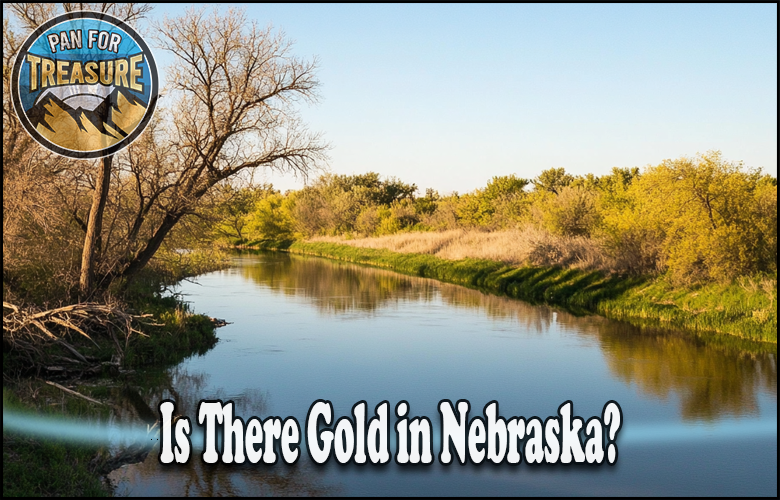
Is there gold in Nebraska? Yes, though in very small quantities. Nebraska has gold from two distinct sources. In the western part of the state, fine placer gold washes downstream through the North and South Platte Rivers from the rich gold districts of Colorado and Wyoming.
In the far eastern part of the state, glacial deposits from the Pleistocene ice ages contain fine gold transported from Canadian bedrock.
No commercial gold mining has ever operated in Nebraska. The gold found here is almost exclusively flour gold, tiny particles that have traveled vast distances from their original sources.
But prospectors have confirmed finding gold in both regions, and the state’s rivers and streams offer opportunities for recreational panners willing to work patiently with careful technique.
Nebraska has an unexpected connection to gold rush history. Before the creation of Colorado Territory in 1861, the Pike’s Peak gold rush of 1858 to 1860 technically took place in “western Kansas Territory and southwestern Nebraska Territory.”
An 1859 map in the Library of Congress is titled “Map of the Recently Discovered Gold Regions in Western Kansas and Nebraska.” The gold that sparked 100,000 prospectors to rush west is the same gold that eventually washes downstream into Nebraska’s Platte River system.
TL;DR
- Gold Present: Yes, in trace amounts from two sources. Fine placer gold in the North and South Platte Rivers (from Colorado/Wyoming gold districts) and glacial gold in eastern Nebraska streams (from Canadian bedrock).
- Best Region: Western Nebraska along the South Platte River, which drains some of Colorado’s richest mining regions. The closer to the Colorado/Wyoming borders, the better the odds. Eastern Nebraska rivers (Little Nemaha, Big Nemaha, Missouri) hold glacial gold.
- Gold Type: Almost exclusively flour gold, extremely fine particles. No nuggets expected. The great distance from source rocks means only the finest particles reach Nebraska. Clays act as false bedrock and can trap gold above the true bottom.
- Top Spot: The confluence of the North and South Platte Rivers near North Platte (Lincoln County) is the most frequently cited location. The South Platte generally has better gold concentrations because it drains Colorado’s gold country more directly.
- Legal Note: Most land is privately owned. Landowner permission is required for nearly all prospecting. Some BLM land exists in western Nebraska (primarily in the Pine Ridge area). The Nebraska National Forest has had mining claims but access is limited.
- Verdict: Nebraska is a weak gold state, but it is not barren. Patient prospectors with fine gold recovery skills can find color in the Platte River system and eastern glacial streams. For serious gold hunting, neighboring Colorado is a far better destination.
Commercial Production
Zero. No commercial gold mining has ever operated in Nebraska. Only 3 mines are listed in USGS records for the entire state, and those are for lead, antimony, and bismuth. The Diggings database records 788 mining claims (99.6% now closed), mostly for uranium exploration in Dawes County.
Western Gold (Platte Rivers)
Fine placer gold from the North and South Platte Rivers, carried downstream from Colorado’s Front Range and Wyoming gold districts. The South Platte drains some of Central Colorado’s richest mining regions. Gold has been reported throughout both rivers from the state line to at least Lincoln County.
Eastern Gold (Glacial Drift)
Pleistocene glaciers covered the far eastern portion of Nebraska, depositing till containing fine gold from Canadian source rocks. Gold reported in the Little and Big Nemaha Rivers (Lancaster and Richardson Counties), Muddy Creek near Stella, and the Missouri River along the eastern border.
Elk Creek Carbonatite
Southeastern Nebraska hosts the Elk Creek carbonatite, a 6 to 8 km diameter intrusive complex buried under 200 meters of sedimentary rock. It is the largest known niobium deposit in the United States. While not a gold deposit, it proves that deep igneous processes have affected Nebraska’s geology.
Pike’s Peak Connection
The 1858 Pike’s Peak gold rush technically occurred in western Kansas Territory and southwestern Nebraska Territory. An 1859 Library of Congress map shows “Recently Discovered Gold Regions in Western Kansas and Nebraska.” The same Colorado gold washes downstream into Nebraska’s Platte Rivers today.
Sand and Gravel Tips
Multiple prospectors have reported that sand and gravel operations in Nebraska process material that contains fine gold. These commercial operations concentrate heavy minerals as a byproduct. Befriending local gravel plant operators can provide access to pre concentrated gold bearing material.
Featured
Where Is There Gold in Nebraska?
Nebraska ranks #39 of 50 for gold potential.
Quick reference below – details on each location follow, or jump to the Nebraska map.
| Location / Area | River / Creek | County | Gold Type | Land Access |
|---|---|---|---|---|
| South Platte River (western Nebraska) | South Platte River | Not listed | Flour gold | Not listed |
| Confluence of North and South Platte Rivers | South Platte River | Lincoln | Not listed | Not listed |
| North Platte River (Scottsbluff to Oshkosh) | North Platte River | Not listed | Fine gold | Not listed |
| Little Nemaha and Big Nemaha Rivers | Little Nemaha River, Big Nemaha River | Lancaster, Richardson | Fine glacial gold | Not listed |
| Muddy Creek near Stella | Muddy Creek | Richardson | Nuggets | Not listed |
| Missouri River (eastern border) | Missouri River | Not listed | Fine gold | Not listed |
| Sand and gravel operations (statewide) | Not listed | Not listed | Fine gold | Permission required |
| Blue River (southeastern Nebraska) | Blue River | Not listed | Not listed | Not listed |
Is there gold in Nebraska that a recreational prospector can actually find? Yes. Multiple prospectors have confirmed finding gold in Nebraska, from flour gold in the South Platte to fine particles in eastern glacial streams. One TreasureNet forum member reported finding “flour to fine sand size” gold and confirmed the Platte River as the right area to look. Others have confirmed gold finds near Ogallala on the South Platte and in sand and gravel deposits across the state.
The gold in Nebraska comes from two fundamentally different geological sources, and understanding which one you are targeting will shape where and how you prospect.
Western Nebraska (North and South Platte Rivers)
The South Platte River is the more promising of the two for gold. It originates in the mountains of central Colorado near Fairplay and flows northeast through Denver and into Nebraska. Along its course through Colorado, it drains several historically productive gold mining regions. Fine gold particles that erode from these districts travel downstream and eventually reach Nebraska.
The North Platte River originates in northern Colorado and flows through Wyoming before entering western Nebraska. Wyoming has gold deposits in the Medicine Bow and Sierra Madre ranges, and fine gold from these sources enters the North Platte system. The areas around Scottsbluff, Bridgeport, and Oshkosh on the North Platte are worth investigating.
The confluence of the North and South Platte Rivers near the city of North Platte in Lincoln County is the most commonly cited gold location in Nebraska. This is where material from both river systems combines, and the change in water dynamics at the confluence creates natural gold traps in gravel bars and bends.
The key challenge is distance. Colorado’s gold districts are hundreds of miles upstream. Only the finest flour gold particles can travel this far. You should not expect to find anything larger than microscopic specks. The closer you prospect to the Colorado or Wyoming borders, the better your odds, simply because the gold has traveled a shorter distance and may retain slightly more size.
Eastern Nebraska (Glacial Deposits)
The far eastern edge of Nebraska was covered by Pleistocene glaciers that advanced from the north. These ice sheets scraped across gold bearing Canadian bedrock and deposited the material as glacial till, outwash, and moraines as the ice retreated. This is the same process that deposited glacial gold across Iowa, Missouri, Illinois, and other Midwestern states.
Gold has been reported in the Little and Big Nemaha Rivers in Lancaster County. Muddy Creek in southeastern Nebraska south of Stella in Richardson County has produced gold finds. The Blue River and Missouri River along the eastern border are also likely to contain trace glacial gold.
One prospector noted that nearly any creek in northeastern Nebraska is worth exploring for glacial gold, though concentrations are extremely low. The key is looking for streams that have reworked glacial deposits and concentrated heavy minerals in gravel bars, bends, and behind obstructions.
A useful tip from experienced Midwest prospectors: look for dense clay layers that act as false bedrock. Gold settles on top of these clay layers and cannot pass through. Pan the gravels immediately above the dense clay for the best concentrations. Also look for dark, iron stained soils, which indicate mineral concentration.
Central Nebraska (Loup River System)
The South Loup River in central Nebraska flows through ancient glacial deposits and has carved natural sluices through gravel bars. The river’s meandering creates gold trapping conditions where fine particles may settle during low water. This area has been less explored than the Platte system, and any gold present would be extremely fine.
Our Favorite Posts
Best Places to Look for Gold in Nebraska
- South Platte River (western Nebraska): The best overall gold potential in the state. Drains Colorado’s gold country. Focus on gravel bars and bends, especially closer to the Colorado border. Fine flour gold throughout the river.
- Confluence of North and South Platte Rivers (Lincoln County): Near the city of North Platte. The merging of two river systems creates natural gold trapping conditions. Gravel bars at the confluence are the primary target.
- North Platte River (Scottsbluff to Oshkosh): Carries fine gold from Wyoming sources. Gravel bars and exposed bedrock areas during low water offer the best prospects.
- Little Nemaha and Big Nemaha Rivers (Lancaster/Richardson Counties): Documented glacial gold finds. Eastern Nebraska streams that have reworked glacial till deposits.
- Muddy Creek near Stella (Richardson County): Specifically cited by prospectors as producing gold in southeastern Nebraska. A reader tip documented by Rare Gold Nuggets.
- Missouri River (eastern border): The Missouri carries material from a massive upstream watershed including Montana, the Dakotas, and glaciated regions. Exposed gravel bars during low water may contain fine gold.
- Sand and gravel operations (statewide): Commercial gravel operations process vast quantities of material and naturally concentrate heavy minerals. With permission, tailings or reject piles from these operations can be a productive source of fine gold.
- Blue River (southeastern Nebraska): Flows through the glaciated region and likely contains trace gold from glacial deposits.
Geology of Gold in Nebraska
Nebraska’s geology explains both why gold exists here and why it is so limited. The state sits on the Great Plains, covered by thick sedimentary deposits including Cretaceous marine shales, Tertiary river and wind deposited sands (including the vast Ogallala Formation), and Quaternary loess and glacial deposits. No gold forming igneous or metamorphic bedrock is exposed anywhere at the surface.
However, Nebraska is not geologically simple beneath the surface. The Elk Creek carbonatite in southeastern Nebraska (Johnson County) is a remarkable 6 to 8 kilometer diameter intrusive complex buried under about 200 meters of sedimentary rock. Discovered in 1971 through magnetic and gravity surveys, it is the largest known niobium deposit in the United States and also hosts significant rare earth element mineralization. The carbonatite is Early Cambrian in age (about 544 million years old) and intruded Precambrian basement rocks.
While the Elk Creek carbonatite does not contain gold in commercial quantities, its existence proves that igneous processes have affected Nebraska’s deep geology. NioCorp Developments has been advancing the Elk Creek Critical Minerals Project with proven reserves of 36.3 million tonnes of niobium bearing ore. This is a reminder that Nebraska’s flat surface hides complex geology underneath.
The gold that reaches Nebraska comes from two external sources. From the west, the Platte River system carries fine gold eroded from the gold bearing quartz veins and placer deposits of Colorado’s Front Range and Wyoming’s mountain ranges. The South Platte in particular drains the Fairplay, Breckenridge, and Central City mining districts. Gold particles are progressively ground finer as they travel downstream, so by the time they reach Nebraska, only flour sized specks remain.
From the north and northeast, Pleistocene glaciers deposited material from the Canadian Shield, which contains ancient gold bearing greenstone belts. The glacial limit in Nebraska roughly follows the eastern edge of the state. Streams that have reworked these glacial deposits may concentrate the tiny gold particles in gravel bars.
Recommended Reading
Tips for Gold Prospecting in Nebraska
- Get landowner permission. Nearly all land in Nebraska is privately owned. The state has very limited public land for prospecting. Some BLM land exists in the Pine Ridge area of northwestern Nebraska, but this is not a documented gold region. Always ask permission before accessing streams on private property.
- Master fine gold recovery. All Nebraska gold is flour gold, the smallest size category. A standard gold pan can lose these tiny particles. Consider using a fine gold sluice box, blue bowl, or spiral wheel for better recovery. Pan extremely slowly and carefully.
- Prospect at low water. The Platte River system is wide and shallow. During low water periods (late summer and fall), gravel bars are exposed that are normally submerged. These exposed bars provide the best access to gold bearing gravels.
- Focus on the South Platte. Between the North and South Platte, the South Platte drains richer gold country in Colorado and is more likely to contain recoverable gold. Start near the Colorado border and work downstream.
- Check sand and gravel operations. Multiple prospectors report that sand and gravel plants in Nebraska inadvertently concentrate fine gold during processing. With permission, sampling tailings from these operations can shortcut the search for productive areas.
- Pan above clay layers. In eastern Nebraska’s glacial streams, dense clay layers act as false bedrock, trapping gold above them. Dig through the gravel to the clay layer and concentrate your panning on the material just above the clay.
- Consider a trip to Colorado. If you are serious about gold, the Colorado gold districts that feed Nebraska’s Platte Rivers are only a few hours west. Colorado offers vastly better gold concentrations, public land access, and recreational panning opportunities at places like Clear Creek near Idaho Springs.
- Enjoy the full experience. Nebraska offers excellent agate hunting (Blue Agate is the state gemstone), fossil collecting (particularly in western Nebraska’s Badlands formations), and beautiful scenery along the Platte River. Combine gold panning with rockhounding for a more rewarding trip.
Best Locations
- Is There Gold in Rhode Island? Top Locations and if It’s Worth the Trip
- Is There Gold in Washington? Top Locations and if It’s Worth the Trip
- Best Places to Pan for Gold and Gemstones in America
- Is There Gold in Massachusetts? Top Locations and if It’s Worth the Trip
- Is There Gold in South Carolina? Top Locations and if It’s Worth the Trip
Resources
- Gold Rush Nuggets: Gold Panning and Prospecting in Nebraska for an overview of both western Platte River gold and eastern glacial deposits.
- Rare Gold Nuggets: Prospecting Placer Gold Deposits in Nebraska for specific location tips including the Stella/Muddy Creek report.
- Library of Congress: Map of Recently Discovered Gold Regions in Western Kansas and Nebraska (1859) for the historical gold rush map connecting Nebraska Territory to the Pike’s Peak rush.
Conclusion
Is there gold in Nebraska? Yes, in limited but confirmed quantities. Fine placer gold from Colorado and Wyoming’s gold districts washes downstream through the North and South Platte Rivers, and glacial deposits in eastern Nebraska contain trace gold from Canadian source rocks. Multiple prospectors have documented finding gold in both regions.
Nebraska will never be a gold prospecting destination. The concentrations are extremely low, the gold is all flour sized, and most land is privately owned. But the Platte River connection to Colorado’s rich gold country means that real gold does flow through the state, and patient prospectors with the right skills and equipment can find it.
The 1859 Library of Congress map titled “Recently Discovered Gold Regions in Western Kansas and Nebraska” is a reminder that gold has been part of Nebraska’s story since before the state existed. The gold that sparked the Pike’s Peak rush still washes downstream today, one microscopic particle at a time. For better gold prospecting nearby, head to Colorado, Montana, or the Great Lakes states. Or browse the full state directory to find gold near you.
Frequently Asked Questions – Is There Gold in NE
Has gold ever been mined commercially in Nebraska?
No. There has never been a commercial gold mining operation in Nebraska. The state’s gold concentrations are far too low for commercial extraction. Only 3 mines are listed in USGS records for Nebraska, and they produced lead, antimony, and bismuth, not gold.
Where is the best place to find gold in Nebraska?
The South Platte River in western Nebraska has the best gold potential, as it drains Colorado’s gold country. The closer to the Colorado border, the better. The confluence of the North and South Platte Rivers near North Platte (Lincoln County) is the most cited location. In eastern Nebraska, the Little and Big Nemaha Rivers have reported glacial gold.
What kind of gold can you find in Nebraska?
Only flour gold, extremely fine particles that are nearly invisible. The gold has traveled hundreds of miles from source rocks in Colorado, Wyoming, or Canada, and has been ground to the smallest possible size. No nuggets, flakes, or pickers have been documented in Nebraska.
Is the Elk Creek deposit a gold mine?
No. The Elk Creek carbonatite in southeastern Nebraska is the largest known niobium deposit in the United States, with significant rare earth elements. It does not contain commercial gold. It is buried 200 meters underground and is being developed by NioCorp Developments for niobium, scandium, and titanium production.
Can I pan for gold on public land in Nebraska?
Nebraska has very limited public land. Some BLM land exists in the Pine Ridge area of northwestern Nebraska, and the Nebraska National Forest has had mining claims. However, most streams and rivers cross private property. Always get landowner permission before prospecting on private land.
Should I go to Colorado instead?
If your goal is finding gold, yes. Colorado’s Front Range gold districts (Clear Creek, South Platte headwaters, Breckenridge area) offer vastly better gold concentrations and are only a few hours from western Nebraska. The same gold that trickles into Nebraska is far more concentrated at its Colorado sources.
⛏ Recommended Gear ⛏


* As an Amazon Associate I earn from qualifying purchases at no extra cost to you.
Subscribe to Our Newsletter

Ryan Conlon is the founder of Pan for Treasure.
A lifelong gold panning enthusiast, he created this site to help beginners learn the ropes and share practical tips from his own time on the creek. [email protected]