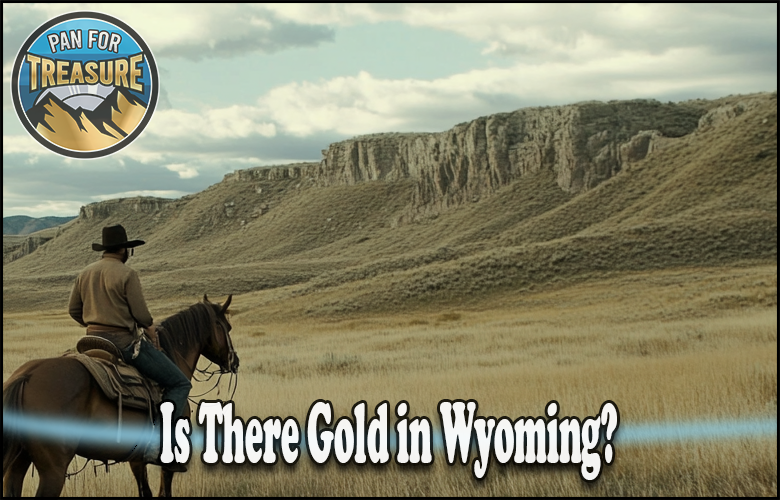
Is there gold in Wyoming? Yes, and the state’s gold story centers on one of the great western mining districts. The South Pass, Atlantic City, and Miners Delight area in Fremont County was Wyoming’s principal gold producer, and estimates of its total output range from 70,000 to 334,000 ounces. The Carissa Mine, discovered in 1867, was the largest and most productive gold mine in the Sweetwater Mining District and is now preserved as a State Historic Site.
Gold was first reportedly found near South Pass in 1842 by a Georgian working for the American Fur Company, though Indians killed him before he could profit. The real rush began in June 1867, when mountain man Lewis Robison carried 40 ounces of gold dust into Salt Lake City, crushed from quartz rock in just two days. The Carissa lode assayed at an excellent $75.24 per ton in gold. Within months, South Pass City grew from nothing to a settlement with fifty houses and several stamp mills.
The South Pass greenstone belt continues to produce gold today. Two prospectors working Smith Gulch in recent decades recovered about 20 ounces of gold per week from an area that many assumed was mined out. A boulder found in 1905 near Rock Creek contained an estimated 630 ounces of gold. The Wyoming State Geological Survey continues to identify significant gold anomalies throughout the district.
TL;DR
- Gold Present: Yes. The South Pass district is estimated at 70,000 to 334,000 ounces total. Official records: ~82,000 oz through 1959 (records incomplete). The Carissa Mine alone: 50,000 to 180,000 oz before 1911. Rock Creek dredging: 11,000 to 30,000 oz (1933 to 1941). A 630 oz gold boulder found in 1905.
- Best Region: South Pass, Atlantic City, Miners Delight (Fremont County) in the southern Wind River Range. The Douglas Creek district (Albany County). Bear Lodge Mountains (Crook County). Medicine Bow Mountains. Absaroka Range (Kirwin).
- Gold Type: Both lode gold in greenstone belt shear zones and placer gold in creeks. Coarse gold: nuggets of 0.07 to 34+ oz reported. Rock Creek averages 75% of gold within 3 feet of bedrock. Wire gold and massive nuggets in specific areas.
- Top Spot: Rock Creek near Atlantic City. Willow Creek near South Pass City. Spring Gulch. Big Atlantic Gulch. The South Pass greenstone belt is actively prospected with modern equipment.
- Legal Note: South Pass City State Historic Site is preserved (no mining). BLM manages surrounding federal lands. Active mining claims exist throughout the district. The Shoshone and Arapaho reservation restricts access in some areas. Check BLM claim records.
- Verdict: Wyoming is a genuine gold state with an exciting history and ongoing potential. The South Pass greenstone belt contains gold at depth and continues to feed placer deposits. Modern prospectors are finding gold in areas previously thought mined out. South Pass City State Historic Site is a must visit for gold history enthusiasts.
Production
Official: ~82,000 oz through 1959 (records incomplete). Estimates range to 334,000 oz (Hausel, 1989). The Carissa Mine: 50,000 to 180,000 oz before 1911. Rock Creek dredging by E.T. Fisher Company: 11,000 to 30,000 oz (1933 to 1941). Douglas Creek district: ~10,000 to 11,000 oz.
Carissa Mine
Discovered June 1867 by Lewis Robison. Assayed at $75.24/ton in gold. In winter 1867, 400+ oz recovered with hand tools. Four tons of ore yielded 1,400 oz shipped to Utah. Three shafts: 90 to 450 feet deep. Averaged 0.32 oz/ton (range: trace to 2.64 oz/ton). Now a State Historic Site with working mill demonstrations.
South Pass City
Built in 1867 below the Carissa Mine. By November had 50 houses and several stamp mills. At its peak, 12 stamp mills operated in the greenstone belt. Soldiers at nearby Camp Stambaugh deserted to search for gold. Now a State Historic Site with 70+ preserved structures. Women’s suffrage connection: Esther Hobart Morris.
Spectacular Finds
A boulder found near Rock Creek in 1905 contained an estimated 630 ounces of gold. A fist sized piece weighed 34 ounces. The Bullion Mine yielded about 21,000 oz during its heyday. In 1891, hydraulic operations on Rock Creek recovered 6,720 oz in one season. Two modern prospectors recovered 20 oz/week from Smith Gulch.
Greenstone Belt
The South Pass greenstone belt contains Precambrian metamorphic rocks with gold in shear zones. Evidence at the Carissa Mine shows shears continue to great depth, providing a continuous source of gold for placer deposits. Several shear zones trend from South Pass City to Atlantic City to Miners Delight with many more likely buried.
Modern Potential
1980s exploration companies found evidence of large disseminated low grade gold deposits possibly exceeding 1 million ounces. In 2006, Fremont Gold won approval for 200 test pits at Dickie Springs (giant paleoplacer deposit). Wyoming State Geological Survey continues identifying gold anomalies. Gold remains in the ground.
Featured
Where Is There Gold in Wyoming?
Wyoming ranks #13 of 50 for gold potential.
Quick reference below – details on each location follow, or jump to the Wyoming map.
| Location / Area | River / Creek | County | Gold Type | Land Access |
|---|---|---|---|---|
| Rock Creek near Atlantic City | Rock Creek | Fremont | Not listed | Not listed |
| Willow Creek near South Pass City | Willow Creek | Fremont | Not listed | Not listed |
| Spring Gulch | Spring Gulch | Fremont | Nuggets | Not listed |
| Big Atlantic Gulch | Big Atlantic Gulch | Fremont | Nuggets | Not listed |
| Sweetwater River placers | Sweetwater River | Not listed | Not listed | Not listed |
| Meadow Gulch | Meadow Gulch | Fremont | Not listed | Not listed |
| Moore's Gulch, Douglas Creek district | Moore's Gulch, Douglas Creek | Albany | Lode/quartz-vein gold | Not listed |
Is there gold in Wyoming that prospectors can find today? Yes. The South Pass greenstone belt continues to feed gold into drainages, and modern prospectors with equipment ranging from gold pans to backhoes are finding gold in areas previously considered mined out.
South Pass / Atlantic City / Miners Delight (Fremont County)
This is Wyoming’s premier gold district. Rock Creek, Willow Creek, Spring Gulch, Big Atlantic Gulch, and Meadow Gulch all produce placer gold. The greenstone belt foliation creates natural riffles at bedrock that trap gold. Any drainage cutting across foliation will sample gold bearing structures. Coarse gold and nuggets from 0.07 to over 1 ounce are found.
Douglas Creek District (Albany County)
The only other district exceeding 10,000 ounces. Placers found in Moore’s Gulch in 1868. Gold in quartz veins in Precambrian schist. The Keystone mine produced most lode gold. Active during the 1860s to 1890s, with a revival in 1934 to 1940.
Other Districts
The Bear Lodge Mountains (Crook County) were prospected in 1875. Medicine Bow Mountains and Sierra Madre have the Centennial Ridge, Douglas Creek, Gold Hill, and New Rambler districts. The Absaroka Mountains saw prospecting at Kirwin. The Rattlesnake Hills area has ongoing exploration for large disseminated gold deposits.
Our Favorite Posts
- Best Places to Pan for Gold and Gemstones in America
- Is There Gold in Georgia? Top Locations and if It’s Worth the Trip
- Is There Gold in California? Top Locations and if It’s Worth the Trip
- Is There Gold in Arizona? Top Locations and if It’s Worth the Trip
- Is There Gold in Alaska? Top Locations and if It’s Worth the Trip
Best Places to Look for Gold in Wyoming
- Rock Creek near Atlantic City (Fremont County): The E.T. Fisher Company dredged 11,000 to 30,000 oz here (1933 to 1941). 75% of gold within 3 feet of bedrock. Channel is 100 to 250 feet wide. The 630 oz boulder was found nearby. Much gold remains.
- Willow Creek near South Pass City (Fremont County): Site of the original Carissa Mine discovery. Most of the creek is unprospected and has limited dredge tailings. Some areas restricted due to reported mercury contamination from historic mining.
- Spring Gulch (Fremont County): Continues to yield nuggets. Accessible from the South Pass area. GPS: approximately 42 degrees 31’59″N, 108 degrees 40’43″W.
- Big Atlantic Gulch (Fremont County): XL Dredging operated here around 1910 and recovered nuggets weighing 0.07 to 1 ounce. Gold on and near bedrock.
- Sweetwater River placers: Gold in gravels along the Sweetwater River near South Pass. The Granier ditch (1884) brought water from Christina Lake for hydraulic mining. In 1891, 6,720 ounces were recovered.
- Meadow Gulch (Fremont County): A known gold producing drainage in the greenstone belt.
- Moore’s Gulch, Douglas Creek district (Albany County): Placers found 1868. Gold in quartz veins in Precambrian schist. Second most productive district in Wyoming.
History and Geology of Gold in Wyoming
The South Pass area has a storied history intertwined with the westward migration. Thousands of emigrants passed through South Pass on the Oregon Trail, most hurrying west to California’s gold and never realizing they were walking over significant deposits. The first reported discovery was in 1842, but Indian hostilities prevented development.
The real rush came in June 1867, when Lewis Robison carried gold to Salt Lake City and the Carissa lode was discovered. The rush was on. By late July, several prospects looked excellent, and South Pass City grew rapidly. Within years, the boom towns of South Pass City, Atlantic City, and Miners Delight appeared along the greenstone belt. Camp Stambaugh was established to protect miners from Indian attacks, but the Army had difficulty keeping soldiers, as many deserted to search for gold.
By 1872, twelve stamp mills operated in the district. The Bullion Mine reportedly yielded 21,000 ounces. But as surface ores were exhausted and deeper mining proved difficult, the boom waned. Hydraulic mining revived the district in 1890 to 1891, with 6,720 ounces recovered in one season. The E.T. Fisher Company dredged Rock Creek profitably from 1933 to 1941.
Geologically, the South Pass greenstone belt contains Precambrian metamorphic rocks with gold concentrated in shear zones parallel to foliation. The Carissa lode is one such shear zone, recognized by intensely folded and faulted structures with brecciated rock, mylonite, and quartz fillings. These shear zones continue to great depth, providing a continuous source of gold for placer deposits. Any drainage that cuts across foliation acts as a natural gold trap.
Recommended Reading
Tips for Gold Prospecting in Wyoming
- Visit South Pass City State Historic Site. Tour the restored Carissa Mine with working mill demonstrations. Walk through 70+ preserved structures. This is essential context for prospecting in the area.
- Focus on Rock Creek. This is the most productive and best documented placer in Wyoming. Look for narrows where water velocity decreases, stream meanders, and fault zone intersections. 75% of gold is within 3 feet of bedrock.
- Bring a metal detector. South Pass produces coarse gold and nuggets. The 2013 Liberty (WA) finds demonstrate what modern detectors can do in old districts. Wyoming’s dry gulches and benches are ideal detector territory.
- Sample drainages cutting foliation. The greenstone belt’s foliation creates natural riffles on bedrock. Any creek cutting across the grain of the rock will concentrate gold. Look for the transition from smooth bedrock to rough, foliated surfaces.
- Check BLM claim status. Active mining claims exist throughout the South Pass area. BLM maintains records. Some areas near the State Historic Site are restricted. Verify before prospecting.
- Plan for remote conditions. South Pass is at about 7,500 feet elevation in central Wyoming. Weather can be severe. Bring adequate supplies, water, and emergency gear. Cell service is limited. Ferry County (WA) is rated the coldest county in that state; South Pass can be similarly harsh. A gold pan and sluice box are your basic tools.
Best Locations
- Is There Gold in Rhode Island? Top Locations and if It’s Worth the Trip
- Is There Gold in Washington? Top Locations and if It’s Worth the Trip
- Best Places to Pan for Gold and Gemstones in America
- Is There Gold in Massachusetts? Top Locations and if It’s Worth the Trip
- Is There Gold in South Carolina? Top Locations and if It’s Worth the Trip
Resources
- Wyoming State Geological Survey: Gold for official information on gold districts, publications, and the Carissa Mine’s production history.
- WyoHistory: South Pass Gold Rush for the authoritative history of the 1867 gold rush including the Carissa discovery and boom town development.
- South Pass Greenstone: Gold Deposits at South Pass by geologist Dan Hausel for detailed prospecting guides with GPS coordinates, geological analysis, and assessment of remaining placer gold.
Conclusion
Is there gold in Wyoming? Yes, and the South Pass greenstone belt remains one of the most interesting gold districts in the Rocky Mountain West. With estimated production of 70,000 to 334,000 ounces, ongoing modern discoveries, and geological evidence of gold continuing to great depth, the district has significant remaining potential. The Carissa Mine’s restoration as a State Historic Site makes it a must visit for gold history enthusiasts.
For more Rocky Mountain gold, see Is There Gold in Colorado?, Is There Gold in Montana?, Is There Gold in South Dakota?, and Is There Gold in Idaho?. Browse the full state directory to find gold near you.
Frequently Asked Questions – Is There Gold in WY
Where is the best place to find gold in Wyoming?
Rock Creek near Atlantic City in the South Pass greenstone belt. Also Willow Creek near South Pass City, Spring Gulch, and Big Atlantic Gulch. The Douglas Creek district in Albany County is a secondary target.
How much gold has Wyoming produced?
Official records show ~82,000 ounces through 1959, but records are incomplete. Estimates by geologist Dan Hausel suggest up to 334,000 ounces from the South Pass district alone. The Carissa Mine produced 50,000 to 180,000 ounces before 1911.
Can you visit the Carissa Mine?
Yes. The Carissa Mine is part of South Pass City State Historic Site in Fremont County. Tours include demonstrations of the working mid 20th century mill equipment. The site has 70+ preserved structures from the 1867 boom town.
Is there still gold at South Pass?
Yes. Geologist Dan Hausel documented shear zones continuing to great depth, providing continuous gold for placer deposits. Two modern prospectors recovered 20 oz/week from Smith Gulch. The greenstone belt remains a significant gold source.
⛏ Recommended Gear ⛏


* As an Amazon Associate I earn from qualifying purchases at no extra cost to you.
Subscribe to Our Newsletter

Ryan Conlon is the founder of Pan for Treasure.
A lifelong gold panning enthusiast, he created this site to help beginners learn the ropes and share practical tips from his own time on the creek. [email protected]