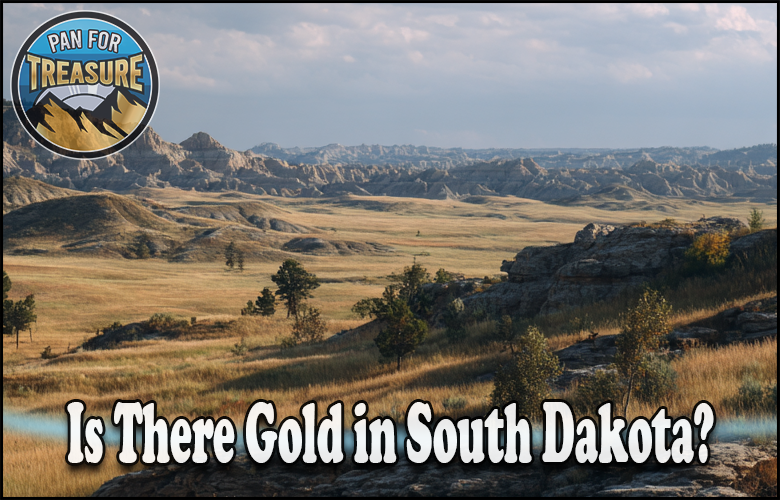
Is there gold in South Dakota? Yes, and South Dakota is one of the most important gold producing states in American history. The Homestake Mine in Lead produced over 40 million troy ounces of gold during its 125 year lifetime, making it the second largest gold producer in United States history (behind only Nevada’s Carlin district). At its peak, the Homestake Mine produced approximately 10 percent of the world’s gold supply. Total recorded production through 1965 was 31,207,892 ounces, and the mine continued producing until 2001, reaching over 39.8 million ounces.
The Black Hills Gold Rush began in 1874 when General George Armstrong Custer’s expedition discovered gold near present day Custer, South Dakota. The large placer deposits of Deadwood Gulch were found in 1875, and by 1876 thousands of gold seekers had flooded into the region. By 1880, between $6 and $8 million in placer gold had been mined, about half from Deadwood Gulch alone.
South Dakota ranks third among the states in total gold production. About 99 percent of the state’s gold came from within a 5 mile radius of Lead in the northern Black Hills. The Homestake Mine was the longest continuously operating mine in United States history and the largest and deepest gold mine in the Western Hemisphere, reaching 8,000 feet underground.
TL;DR
- Gold Present: Yes, massive. Over 40 million ounces total from the Homestake Mine alone. South Dakota ranks 3rd nationally. 99% of production came from within 5 miles of Lead. The state was the leading gold producer in the U.S. in recent decades before closure.
- Best Region: The Black Hills, specifically the northern Black Hills around Lead and Deadwood (Lawrence County). Secondary areas: Keystone, Hill City, and Custer (Pennington County). The Precambrian core of the Black Hills hosts all gold deposits.
- Gold Type: Both lode and placer. The Homestake ore body is in cummingtonite schist (Precambrian iron formation). Placer gold in Deadwood and Whitewood Creeks, French Creek. Low grade lode gold (less than 1 oz/ton) in massive ore bodies. Some refractory gold requiring chemical processing.
- Top Spot: Deadwood and Whitewood Creeks for recreational placer prospecting. French Creek near Custer for historic placer gold. The northern Black Hills creeks and gulches draining the Lead/Deadwood area are richest.
- Legal Note: Much of the Black Hills is National Forest (Black Hills National Forest), where recreational prospecting may be permitted with restrictions. Active mining claims exist throughout. Check BLM and Forest Service regulations before prospecting.
- Verdict: South Dakota is a world class gold state. The Homestake Mine’s 40+ million ounces ranks it among the greatest gold mines ever operated anywhere. The Black Hills offer recreational prospecting in creeks and gulches where the 1876 gold rush began. The Black Hills Mining Museum in Lead provides excellent education.
Total Production
Over 40 million troy ounces of gold from the Homestake Mine alone (1878 to 2001). Also produced 9 million ounces of silver. South Dakota ranks 3rd nationally in total gold production. The Lead Mining District was the 2nd largest gold producer in U.S. history.
Homestake Mine
Discovered April 9, 1876 by Fred and Moses Manuel, Alex Engh, and Hank Harney. Purchased by George Hearst, Lloyd Tevis, and James Haggin for $70,000 in 1877. Deepest mine in the Western Hemisphere at 8,000 feet. Longest continuously operating mine in U.S. history. Produced 10% of world gold supply for 125 years.
Black Hills Gold Rush
Began 1874 with Custer’s expedition finding gold on French Creek. Rich placer deposits found at Deadwood and Whitewood Creeks in 1875. By 1876, thousands flooded in despite Sioux treaty claims. By 1880, $6 to $8 million in placer gold had been mined. Deadwood became the legendary Wild West town.
Hearst Fortune
George Hearst bought the Homestake for $70,000 in 1877, consolidating claims by fair and foul means. The mine generated the Hearst family fortune. After George’s death, his wife Phoebe Hearst managed the mine for 28 years. Their son William Randolph Hearst built his media empire from Homestake wealth.
Geology
Gold deposits lie in Precambrian metamorphic rocks forming the Black Hills dome (60 miles long, 25 miles wide). The Homestake ore occurs in the Homestake Formation, a cummingtonite schist unit 200 to 300 feet thick. Ore concentrated in cross fold zones near the garnet isograd. Low grade (under 1 oz/ton) but massive ore body.
After the Mine
The Homestake Mine closed in 2001 due to low gold prices and high costs. In 2006 it was donated to South Dakota and became the Sanford Underground Research Facility (SURF). Scientists study neutrinos and dark matter at depths where solar particle interference is minimal. Dakota Gold Corp acquired mining rights in 2022.
Featured
Where Is There Gold in South Dakota?
South Dakota ranks #11 of 50 for gold potential.
Quick reference below – details on each location follow, or jump to the South Dakota map.
| Location / Area | River / Creek | County | Gold Type | Land Access |
|---|---|---|---|---|
| Deadwood and Whitewood Creeks | Whitewood Creek, Deadwood Gulch | Lawrence | Placer gold | National forest |
| French Creek near Custer | French Creek | Custer | Not listed | Not listed |
| Rockerville | Not listed | Pennington | Placer gold | Not listed |
| Hill City area | Not listed | Pennington | Placer gold | Not listed |
| Keystone area | Not listed | Pennington | Lode gold | Not listed |
| Bald Mountain district | Not listed | Lawrence | Lode gold | Not listed |
| Garden district | Not listed | Lawrence | Not listed | Not listed |
Is there gold in South Dakota that recreational prospectors can find today? Yes. While the Homestake Mine dominated production, placer gold exists throughout the Black Hills in creeks and gulches. Small scale miners still work the surrounding mountains, and recreational prospectors can find gold in many waterways. About 99 percent of South Dakota’s gold came from within a 5 mile radius of Lead, but gold exists elsewhere in the Precambrian core of the Black Hills.
Northern Black Hills (Lawrence County)
The northern Black Hills around Lead and Deadwood are the epicenter of South Dakota gold. Deadwood Gulch was the site of the richest placer deposits, yielding about half the $6 to $8 million in placer gold mined by 1880. Whitewood Creek and its tributaries also produced substantial placer gold. Today, creeks and gulches draining the Lead and Deadwood area still contain gold for patient prospectors. The surrounding area has numerous historic mining districts.
Southern Black Hills (Pennington and Custer Counties)
French Creek near Custer was the site of the original 1874 discovery by the Custer expedition. While the deposits proved small, gold exists in the stream. The Keystone, Hill City, and Rockerville areas all have gold districts. Pennington County hosted several gold mines, though on a much smaller scale than Lawrence County. Seven districts in the Black Hills produced more than 10,000 ounces each.
Southeastern Utah (Glen Canyon/San Juan)
Though the Black Hills dominate, there were also gold rushes in southeastern South Dakota’s portion of the Missouri River drainage. However, these produced very little gold compared to the Black Hills.
Our Favorite Posts
Best Places to Look for Gold in South Dakota
- Deadwood and Whitewood Creeks (Lawrence County): Site of the original 1876 placer discoveries that sparked the Black Hills Gold Rush. Half of all Black Hills placer gold came from Deadwood Gulch. Recreational prospecting possible in surrounding National Forest areas.
- French Creek near Custer (Custer County): Site of the first gold discovery (1874) by miners Ross and McKay during the Custer expedition. Historic placer deposits. The town of Custer offers tourist gold panning experiences.
- Rockerville (Pennington County): A significant placer district near Keystone. Gold discovered in the 1876 rush. The district produced substantial placer gold in its early years.
- Hill City area (Pennington County): One of the towns established during the northern push of the gold rush. Surrounding creeks contain placer gold.
- Keystone area (Pennington County): Near Mount Rushmore. Historic gold mining district with both lode and placer deposits. The Holy Terror Mine was one of the more productive lode mines outside Lead.
- Bald Mountain district (Lawrence County): Produced significant gold from lode mines. Located in the northern Black Hills near the Homestake Mining District.
- Garden district (Lawrence County): Another northern Black Hills gold producing district with documented production exceeding 10,000 ounces.
History and Geology of Gold in South Dakota
Rumors of gold in the Black Hills predated the gold rush by decades. In the 1860s, Father De Smet, a Catholic missionary, reportedly saw Sioux Indians carrying gold they said came from the Black Hills. The famous Thoen Stone, discovered in 1887 on Lookout Mountain, tells of Ezra Kind and six companions who entered the Black Hills in 1833, “got all the gold we could carry” in 1834, and were subsequently killed by Indians.
The official story begins in 1874 when General George Armstrong Custer led an expedition of 1,000 men into the Black Hills to investigate gold reports, despite the land being Sioux territory under the Fort Laramie Treaty of 1868. Miners Ross and McKay, attached to the expedition, found gold in French Creek near present day Custer. Although the deposits were small, news spread rapidly.
By late 1875, miners had pushed north to Deadwood and Whitewood Creeks, where they found the gravels rich with placer gold. The ensuing stampede created the legendary town of Deadwood, one of the wildest places in the American West. In 1876, the Black Hills were ceded to the United States.
On April 9, 1876, Fred and Moses Manuel, Hank Harney, and Alex Engh discovered the lode source of the placer gold. They named their claim the Homestake. George Hearst purchased it for $70,000 in 1877 and began developing what would become one of the greatest mines in world history. An 80 stamp mill began crushing ore by July 1878. By 1879, shares were listed on the New York Stock Exchange, making it the first publicly traded mining stock.
The Homestake ore was low grade (less than 1 ounce per ton on average, with a lifetime average of 0.3 ounces per ton), but the ore body was enormous. The mine reached 8,000 feet underground and produced over 40 million ounces of gold and 9 million ounces of silver. At its peak, nearly 1,000 stamps pounded ore and over 2,000 men were employed.
Geologically, the Black Hills are a dome of Precambrian metamorphic rocks surrounded by concentric bands of Paleozoic and Mesozoic sedimentary rocks. The Precambrian core, exposed over an area 60 miles long and 25 miles wide, consists of intensely folded metasedimentary rocks (schist, slate, quartzite), amphibolites, and intrusive granite. The Homestake ore occurs within the Homestake Formation, a cummingtonite schist unit 200 to 300 feet thick, where gold was concentrated in cross fold zones near the garnet isograd metamorphic boundary.
Recommended Reading
Tips for Gold Prospecting in South Dakota
- Visit the Black Hills Mining Museum. Located in Lead, this museum provides excellent education on the Homestake Mine and Black Hills mining history. Walking through the exhibits gives context for prospecting in the area.
- Try tourist panning first. Several operations near Deadwood and Keystone offer tourist gold panning experiences with guaranteed gold. These are great for beginners and families before venturing into the creeks on your own.
- Focus on northern Black Hills creeks. The richest placer deposits are in gulches and creeks draining the Lead/Deadwood area. Whitewood Creek, Deadwood Gulch tributaries, and surrounding waterways are your best targets for recreational gold panning.
- Check regulations carefully. The Black Hills National Forest has specific rules for recreational prospecting. Active mining claims exist throughout the area. The BLM maintains claim records. Some areas near the Homestake Mine may have environmental restrictions (the mine is a Superfund site).
- Bring a sluice box. Much Black Hills placer gold is fine. A sluice box processes more material and captures fine gold better than panning alone. A metal detector may also be effective in dry gulches and bench areas.
- Explore beyond Lead/Deadwood. While the northern Black Hills are richest, the Keystone, Hill City, and Custer areas also have gold. These are less prospected and may offer finds to those willing to explore.
Best Locations
- Is There Gold in Rhode Island? Top Locations and if It’s Worth the Trip
- Is There Gold in Washington? Top Locations and if It’s Worth the Trip
- Best Places to Pan for Gold and Gemstones in America
- Is There Gold in Massachusetts? Top Locations and if It’s Worth the Trip
- Is There Gold in South Carolina? Top Locations and if It’s Worth the Trip
Resources
- USGS: Gold in the Black Hills and How New Deposits Might Be Found for the scientific analysis of Black Hills gold geology, including the Homestake Formation and exploration strategies.
- Western Mining History: South Dakota Gold Production for district by district production data and geological descriptions of the Black Hills gold deposits.
- Black Hills Mining Museum: History for the complete story of the Black Hills Gold Rush and Homestake Mine development.
Conclusion
Is there gold in South Dakota? Emphatically yes. The Homestake Mine’s 40+ million ounces makes it one of the greatest gold mines ever operated anywhere in the world. South Dakota ranks third nationally in total gold production, and the Black Hills Gold Rush of 1876 created the legendary town of Deadwood. The Precambrian core of the Black Hills still contains gold in its creeks and gulches, and recreational prospecting continues to this day.
For beginners, tourist panning operations near Deadwood and Keystone provide accessible introductions. For experienced prospectors, the northern Black Hills creeks offer genuine placer gold. For other major western gold states, see Is There Gold in Colorado?, Is There Gold in Montana?, Is There Gold in Wyoming?, and Is There Gold in Nevada?. Browse the full state directory to find gold near you.
Frequently Asked Questions – Is There Gold in SD
Where is the best place to find gold in South Dakota?
The northern Black Hills around Lead and Deadwood. Deadwood Gulch and Whitewood Creek produced half of all Black Hills placer gold. French Creek near Custer was the original 1874 discovery site. Rockerville and Keystone are secondary targets.
How much gold has South Dakota produced?
Over 40 million troy ounces, primarily from the Homestake Mine (1878 to 2001). This makes South Dakota the 3rd ranked gold producing state and the Homestake the 2nd largest producing gold mine in U.S. history.
Can you still find gold in the Black Hills?
Yes. Small scale mining continues and recreational prospectors find placer gold in creeks and gulches. The northern Black Hills draining the Lead/Deadwood area are richest. Tourist panning operations provide guaranteed finds for beginners.
What happened to the Homestake Mine?
It closed in 2001 due to low gold prices and high costs. In 2006 it became the Sanford Underground Research Facility (SURF), where scientists study neutrinos and dark matter at depths up to 8,000 feet. Dakota Gold Corp acquired mining rights in 2022.

⛏ Recommended Gear ⛏


* As an Amazon Associate I earn from qualifying purchases at no extra cost to you.
Subscribe to Our Newsletter

Ryan Conlon is the founder of Pan for Treasure.
A lifelong gold panning enthusiast, he created this site to help beginners learn the ropes and share practical tips from his own time on the creek. [email protected]