
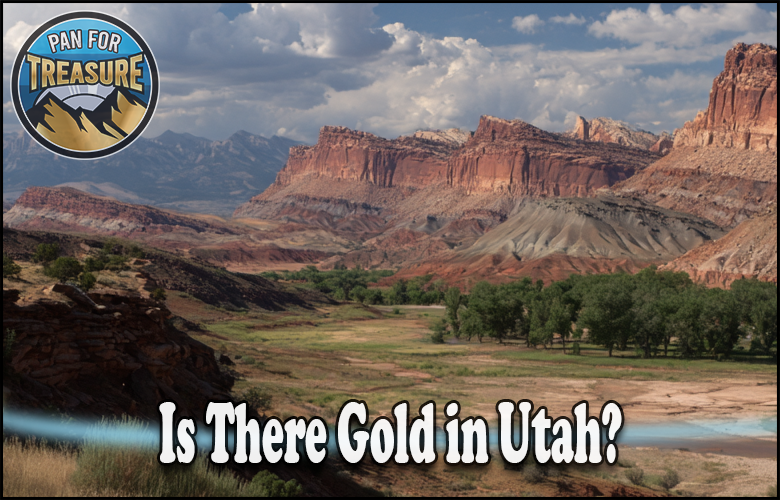
Is there gold in Utah? Yes, and Utah is one of the most significant gold producing states in the country. Through 1960, Utah produced approximately 17,765,000 ounces and ranked sixth nationally. The Bingham Canyon mine (now operated by Rio Tinto Kennecott) has produced over 30 million ounces of gold as a byproduct of copper mining, making it likely the second largest gold producing mine in U.S. history. The mine continues to produce approximately 500,000 ounces of gold annually.
Utah’s gold story is dominated by three great districts. Bingham Canyon in Salt Lake County is the world’s largest open pit mine and the nation’s largest producer of byproduct gold. The Mercur district in Tooele County produced about 2.5 million ounces as a primary gold camp. The Tintic district in Juab County yielded approximately 2,648,000 ounces alongside massive silver, lead, copper, and zinc production.
Gold was first important in Utah in the late 1890s, and the state became a leader in gold extraction technology. Daniel C. Jackling, who developed the open pit copper mining method at Bingham, and George H. Dern, who managed Mercur’s gold operations before becoming Utah’s governor, were both transformative figures in American mining.
TL;DR
- Gold Present: Yes, major. ~17.8 million ounces through 1960. Bingham Canyon: 30+ million ounces (ongoing, ~500,000 oz/year). Mercur: ~2.5 million ounces. Tintic: ~2.6 million ounces. Utah ranks 6th nationally in total gold production.
- Best Region: Bingham Canyon (Salt Lake County) for production. Mercur (Tooele County) was the largest primary gold district. Tintic (Juab County) produced gold with base metals. Additional districts: Park City, Gold Hill, Goldstrike.
- Gold Type: Primarily byproduct gold from copper porphyry deposits (Bingham). Carlin type sediment hosted gold (Mercur). Replacement deposits in Paleozoic limestones (Tintic). Some placer gold (Bingham Canyon placers, Glen Canyon/San Juan River).
- Top Spot: For recreational prospecting, Bingham Canyon placers (historic, mostly depleted), creeks in the Oquirrh and East Tintic Mountains, and southeastern Utah’s San Juan River area. Public land access is limited near active mines.
- Legal Note: Much of Utah’s gold bearing land is under active commercial mining claims or private ownership. BLM and National Forest lands may allow recreational prospecting. Check regulations. Active mines (Bingham, Goldstrike) are not accessible.
- Verdict: Utah is a gold powerhouse in terms of production but has limited recreational prospecting opportunities compared to its neighbors. The Bingham Canyon mine alone produces more gold annually than most states have produced in their entire history. For recreational prospecting, Colorado, Nevada, and Idaho offer better access.
Total Production
~17.8 million ounces through 1960 (6th nationally). Bingham Canyon alone has produced 30+ million ounces and continues at ~500,000 oz/year. In 1984, Utah produced 238,459 ounces worth $101 million, amounting to 12.2% of total U.S. production that year.
Bingham Canyon
The world’s largest open pit mine and deepest. Produced 30+ million ounces of gold (as byproduct of copper). First claimed 1863. Placers discovered 1864, producing ~$1.5 million by 1900. Daniel C. Jackling pioneered open pit methods here in 1906, revolutionizing world mining. Over $174 billion total production value.
Mercur District
Utah’s largest primary gold mining district: ~2.5 million ounces. No gold was ever visible in hand specimen (Carlin type deposit). The cyanide leaching process was first successfully used here in the 1890s. George H. Dern managed operations before becoming Utah governor. Barrick produced 100,000+ oz/year (1985 to 1995).
Tintic District
~2,648,000 ounces of gold alongside $400+ million in silver, lead, gold, copper, and zinc. One of Utah’s top three mining districts. Peak gold year: 1907 (113,000 ounces). Active from 1869 to 1957. The town of Eureka was the primary settlement.
Glen Canyon Placer Rush
In the 1880s to 1911, prospectors found placer gold in southeastern Utah’s slickrock country. The Hoskaninni Company built a huge gold dredge in Glen Canyon. The Zahn Mining Company ran the largest operation on the San Juan River. All produced very little gold due to lack of water and fine particle size.
Geology
Utah’s gold deposits are closely related to Tertiary age igneous intrusions. The Bingham porphyry copper deposit is the largest byproduct gold producer in the U.S. Mercur is a Carlin type (sediment hosted) deposit, recognized as similar to Nevada’s famous Carlin mine in 1968. Small amounts of gold occur in virtually all mineral deposits in the state.
Where Is There Gold in Utah?
Is there gold in Utah that recreational prospectors can access? Yes, though access is more limited than in neighboring states. Most of Utah’s major gold production came from large commercial operations. However, placer gold exists in some streams, and historical mining areas offer prospecting opportunities on public land.
Oquirrh Mountains (Salt Lake/Tooele Counties)
The Oquirrh Mountains host both Bingham Canyon and the Mercur district. Bingham Canyon placers were discovered in 1864 and produced approximately $1.5 million before depletion by 1900. The Mercur district is largely reclaimed. Creeks draining the mountains may contain gold, though much of the area is under active mining claims or environmental remediation.
East Tintic Mountains (Juab County)
The Tintic and East Tintic districts around Eureka produced millions of ounces. Historic mining areas may offer limited prospecting on public land. The Bureau of Land Management manages some areas.
Southeastern Utah (Grand/San Juan Counties)
Glen Canyon and the San Juan River saw placer gold rushes in the 1880s to 1911. The gold was extremely fine and difficult to recover, but it exists in river gravels. The creation of Lake Powell submerged Glen Canyon deposits, but the San Juan River area may still offer some access.
Other Districts
Park City (Summit/Wasatch Counties), Gold Hill (Tooele County), Goldstrike (Washington County), and the La Sal Mountain placers all produced gold. Some of these areas have public land access.
Best Places to Look for Gold in Utah
- San Juan River area (San Juan County): Historic placer gold district. Accessible in southeastern Utah. Fine gold in river gravels. The largest placer operations were here in the early 1900s.
- Gold Hill area (Tooele County): The Clifton Mining District, organized 1889. Gold, arsenic, and tungsten were mined. Remote western Utah near the Nevada border. Some public land access.
- Creeks in the East Tintic Mountains (Juab County): Near Eureka. Historic mining district with documented gold production. Check for active claims before prospecting.
- Cottonwood districts (Salt Lake County): Big and Little Cottonwood canyons at Alta. Produced about 30,000 ounces of gold alongside silver. Popular recreation area with possible stream prospecting.
- American Fork district (Utah County): Historic gold and silver mining area in the Wasatch Mountains. Some National Forest access.
- La Sal Mountain placers (Grand/San Juan Counties): Placer deposits in southeastern Utah mountains. Remote but potentially accessible.
History and Geology of Gold in Utah
Utah’s mining development was unusual because Brigham Young initially discouraged Mormon participation in mining, fearing they would abandon farming. The California Volunteers stationed at Fort Douglas, many of whom were prospectors, made the first discoveries. The first claim was staked in Bingham Canyon in September 1863, and gold placers were found there in 1864.
The placers at Bingham Canyon were the largest and most productive ever found in Utah, yielding about $1.5 million. But the real wealth lay in the massive porphyry copper deposit beneath. In 1906, Daniel C. Jackling made the revolutionary decision to mine Bingham Canyon using open pit methods with steam shovels and railroad. This marked a departure from traditional mining focused on small, high grade deposits and transformed world copper mining. By 1912, Bingham Canyon was the largest industrial mining complex in the world.
The Mercur district has a remarkable story. Gold bearing ores were found around 1883, but miners could not separate the gold from the rock. The gold was so finely disseminated that no free gold was ever visible. Disappointed prospectors left. Then in 1889, the ores were rediscovered and gold successfully recovered using the newly developed cyanide leaching process. From 1890 to 1900, almost 2 million tons of ore produced over 380,000 ounces. In 1968, Newmont Mining recognized Mercur as a Carlin type deposit, similar to their Carlin mine in Nevada, which led to modern redevelopment.
Geologically, Utah’s gold deposits are related to Tertiary igneous intrusions. Bingham is a classic porphyry copper gold deposit. Mercur is a sediment hosted (Carlin type) deposit in Paleozoic limestones. Tintic has replacement deposits in carbonate rocks. The state has 13 districts in 9 counties that produced more than 10,000 ounces each.
Tips for Gold Prospecting in Utah
- Focus on historic placer areas. Bingham Canyon placers are depleted, but other areas (San Juan River, La Sal Mountains) may still hold gold. Research historic production to identify targets.
- Check active claims. Utah has extensive mining claims. The BLM maintains claim records. Many areas near major mines are under active claims or environmental remediation. Verify before prospecting.
- Visit the Utah Geological Survey website. UGS provides excellent information on gold districts, including their “Utah Gold” page with publications and maps for prospectors.
- Consider southeastern Utah. The San Juan River and La Sal Mountain placer areas are more remote but may offer better recreational access than the heavily claimed Wasatch Front districts.
- Bring fine gold recovery equipment. Much Utah placer gold is very fine, especially in the Glen Canyon and San Juan River areas. A gold pan and sluice box with fine matting are essential.
- Explore neighboring states for better access. Colorado, Idaho, and Nevada have more accessible recreational prospecting. Utah’s gold wealth is concentrated in large commercial operations with limited public access.
Resources
- Utah Geological Survey: Utah Gold for the official guide to Utah’s gold districts, history, and publications.
- Western Mining History: Principal Gold Districts of Utah for district by district production data and geological descriptions.
- Utah Geological Survey: The Mercur District for the history of Utah’s largest primary gold camp, including the Jackling and Dern connections.
Conclusion
Is there gold in Utah? Emphatically yes. Utah ranks sixth nationally in total gold production, and the Bingham Canyon mine continues to produce approximately 500,000 ounces annually. The Mercur district’s 2.5 million ounces and Tintic’s 2.6 million ounces represent major primary gold production. However, recreational prospecting access is more limited than in neighboring states because most gold comes from large commercial operations.
For recreational prospectors, the San Juan River area in southeastern Utah and some historic districts offer opportunities. For better public land access, neighboring Colorado, Idaho, and Nevada are excellent choices. Browse the full state directory to find gold near you.
FAQ
Where is the best place to find gold in Utah?
For recreational prospecting, the San Juan River area in southeastern Utah and Gold Hill in western Tooele County. Most major production areas (Bingham, Mercur, Tintic) are under active mining or reclamation.
How much gold has Utah produced?
~17.8 million ounces through 1960. Bingham Canyon alone has produced 30+ million ounces total and continues at ~500,000 oz/year. Utah ranks 6th nationally.
Is the Bingham Canyon mine still producing gold?
Yes. Operated by Rio Tinto Kennecott, Bingham Canyon produces approximately 500,000 ounces of gold annually as a byproduct of copper mining. It is the largest byproduct gold producer in the United States.
What was special about the Mercur district?
No free gold was ever visible in hand specimen. It was one of the first mines to successfully use the cyanide leaching process (1889). It was later recognized as a Carlin type deposit, similar to Nevada’s famous Carlin mine. It produced about 2.5 million ounces total.

⛏ Recommended Gear ⛏


* As an Amazon Associate I earn from qualifying purchases at no extra cost to you.
Subscribe to Our Newsletter

Ryan Conlon is the founder of Pan for Treasure.
A lifelong gold panning enthusiast, he created this site to help beginners learn the ropes and share practical tips from his own time on the creek. [email protected]