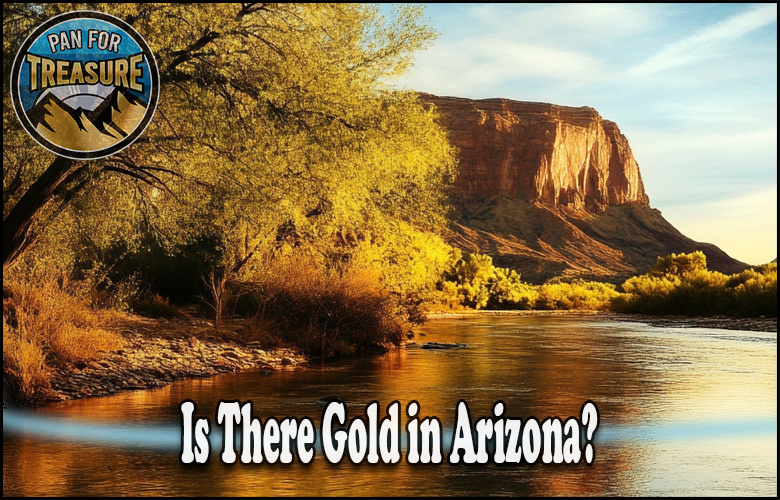
Is there gold in Arizona? Absolutely. Arizona is one of the top gold-producing states in American history, with over 16 million ounces pulled from its mountains, deserts, and riverbeds since the late 1700s. Gold can be found across the state, from the Bradshaw Mountains of central Arizona to the desert washes of Yuma County, and prospectors still find gold here regularly.
Arizona ranks among the best places to pan for gold in America, and its gold-bearing regions stretch across a northeast-to-southwest belt roughly 65 miles wide. Yavapai County alone has produced millions of ounces. While large-scale commercial gold mining has mostly ended in the state, recreational prospecting remains popular year-round, with winter months drawing snowbird prospectors from across the country.
Whether you are a beginner looking for your first flake or an experienced prospector chasing nuggets with a metal detector, Arizona has something to offer. Before you head out, make sure you understand the gold panning laws in Arizona and check out our getting started guide if you are new to the hobby.
TL;DR
- Gold Present: Yes, abundant. Arizona is a top-ten gold producing state historically.
- Best Region: Yavapai County and the Bradshaw Mountains in central Arizona.
- Gold Type: Placer gold (flakes, flour, and nuggets) plus lode deposits. Nuggets are common in several districts.
- Top Spot: Lynx Creek in the Prescott National Forest, with a dedicated recreational gold panning area.
- Legal Note: Gold panning is allowed on BLM land and national forests without a permit for casual, non-motorized prospecting. State Trust Land is closed to prospecting.
- Best Season: October through April. Summer temperatures in the desert can exceed 110°F.
- Verdict: Arizona is an outstanding gold state with easy access to public land, a long mining history, and gold still being found today.
Geology
Precambrian schists and granites host gold-bearing quartz veins. Tertiary volcanic activity created additional deposits.
Historical Production
Over 16 million ounces of gold since the late 1700s, ranking Arizona among the top gold states.
Best Area
Yavapai County, especially the Bradshaw Mountains, Lynx Creek, and the Rich Hill/Weaver district.
Active Claims
Over 55,000 mining claims recorded on Arizona public lands, with heavy claim density in gold country.
Primary Gold Type
Placer gold (flakes, fine gold, and nuggets) in dry washes and creeks. Lode gold in quartz veins.
Best Season
October through April for desert areas. Higher elevations near Prescott are comfortable May through October.
Featured
Where Is There Gold in Arizona?
Arizona ranks #5 of 50 for gold potential.
Quick reference below – details on each location follow, or jump to the Arizona map.
| Location / Area | River / Creek | County | Gold Type | Land Access |
|---|---|---|---|---|
| Lynx Creek | Lynx Creek | Yavapai | Placer gold | National forest; Check for claims |
| Rich Hill / Weaver District | Not listed | Yavapai | Nuggets | Check for claims |
| Bradshaw Mountains | Not listed | Yavapai | Lode gold | National forest; BLM land |
| Hassayampa River | Hassayampa River | Yavapai | Placer gold | Public access |
| Oatman / San Francisco District | Silver Creek | Mohave | Placer gold | Not listed |
| Gold Basin District | Colorado River | Mohave | Lode gold | BLM land |
| Little San Domingo Placers | Not listed | Maricopa | Nuggets | Check for claims |
| Greaterville Placers | Not listed | Pima | Not listed | BLM land |
Is there gold in Arizona spread across a wide area? Yes. Gold-bearing deposits trend from the northwest to the southeast across the state, concentrated in a belt about 65 miles wide that borders the southwest margin of the Colorado Plateau. Within this belt, deformed Precambrian rocks have been tilted, faulted, and intruded by igneous rocks that carried gold into the surrounding formations.
Central Arizona (Yavapai County)
Yavapai County is the heart of Arizona gold country. The Bradshaw Mountains, Lynx Creek drainage, Rich Hill, Big Bug district, and the Hassayampa River area have collectively produced millions of ounces. The geology here is dominated by Precambrian Yavapai Series schists intruded by the Bradshaw Granite. Gold occurs in quartz veins, fissure veins in the schist, and as placer deposits eroded from these sources into creeks and dry washes.
The Prescott National Forest offers large tracts of public land open to recreational prospecting. This is where most beginners should start.
Western Arizona (Mohave and La Paz Counties)
Mohave County is the second richest gold-producing area in the state. The San Francisco district near Oatman produced over 2 million ounces, mostly from lode deposits in the Black Mountains. The Gold Basin district north of Kingman is popular with metal detectorists. La Paz County holds the Plomosa, La Paz, and Dome districts along the Colorado River. These desert placers were some of the first gold discoveries in Arizona, dating to the 1860s.
Southern Arizona (Cochise, Pima, and Santa Cruz Counties)
The Dos Cabezas district in Cochise County has produced notable placer gold, including multi-ounce nuggets from the Teviston placers. The Huachuca Mountains are popular with prospectors and local clubs. In Pima County, the Greaterville placers near the Santa Rita Mountains were first discovered in 1874 and produced about $15,000 in gold per year during their peak. Santa Cruz County holds the Patagonia Mountains, where gold can be found in drainages on the mountain flanks.
Southwest Arizona (Maricopa and Yuma Counties)
Maricopa County is the fifth largest gold producer in Arizona. The Vulture Mine near Wickenburg was the most productive gold mine in state history between 1863 and 1942, producing approximately 366,000 ounces of gold. The Little San Domingo placers south of Wickenburg are popular with metal detectorists and are known for producing nuggets. Yuma County holds several historic placer districts along the Colorado River, including the Dome and Castle Dome districts.
Eastern Arizona (Greenlee and Gila Counties)
Most gold from eastern Arizona has come as a byproduct of copper mining, particularly from the Clifton-Morenci district in Greenlee County (about 228,000 ounces through 1959). Gila County has produced approximately 240,500 ounces. The San Francisco River in Greenlee County offers some placer prospecting opportunities.
Our Favorite Posts
- Is There Gold in Georgia? Top Locations and if It’s Worth the Trip
- Is There Gold in Idaho? Top Locations and if It’s Worth the Trip
- Is There Gold in Alaska? Top Locations and if It’s Worth the Trip
- Is There Gold in North Carolina? Top Locations and if It’s Worth the Trip
- Is There Gold in Montana? Top Locations and if It’s Worth the Trip
Best Places to Find Gold in Arizona
Here are the top locations where is there gold in Arizona gets answered with real results, ranked by gold potential and accessibility.
- Lynx Creek (Yavapai County): The most popular recreational gold panning spot in Arizona. Located in the Prescott National Forest, several miles of the creek are withdrawn from mineral entry, meaning no private claims. Over 100,000 ounces of placer gold have been recovered from this drainage since 1863. Gold ranges from fine flakes to multi-ounce nuggets. The Lynx Creek Gold Pan Day Use Area is managed by the U.S. Forest Service. Panning, metal detecting, and hand tools are allowed. Motorized equipment is not. Access is easy via Walker Road off Highway 69 near Prescott.
- Rich Hill / Weaver District (Yavapai County): One of the most famous gold locations in Arizona. Located near Congress, about 50 miles south of Prescott. Known for producing large nuggets, including legendary early finds of 200 ounces by the Weaver party in the 1860s. By 1883, about a million dollars in gold had been produced. Much of the area is under active claims, but joining a local prospecting club (like GPAA or the Arizona Association of Gold Prospectors) can give you access. Metal detecting is the preferred method here.
- Bradshaw Mountains (Yavapai County): A large gold-producing region with multiple districts including Big Bug, Tiger, and Crown King. Both lode and placer deposits. Total production from the Big Bug district alone was about 627,000 ounces through 1959. Access varies by area, with a mix of BLM land, national forest, and private claims.
- Hassayampa River (Yavapai County): The Hassayampa and its tributaries near Prescott were some of the few areas in Arizona where hydraulic mining and even dredging were attempted historically. Placer gold production from these drainages is estimated in the millions of dollars. Some public access remains, though many areas are claimed.
- Oatman / San Francisco District (Mohave County): The richest gold district in Mohave County, with over 2 million ounces of gold produced. Most came from lode mining, but placer gold has been found in Silver Creek and nearby washes. The old mining town of Oatman is now a tourist destination. Some surrounding desert areas are open for detecting.
- Gold Basin District (Mohave County): Located about 50 miles north of Kingman, near the Colorado River. Both lode and placer deposits. This area is popular with metal detectorists. Mining started in the early 1870s. Access is mostly via BLM land.
- Little San Domingo Placers (Maricopa County): Located about an hour from Phoenix. The gold is spread over a large area of dry washes. Historically, nice nuggets have been recovered here. Some areas remain open, though many claims are active. A sensitive metal detector is recommended.
- Greaterville Placers (Pima County): First discovered in 1874, the placers here are found in creeks and gulches draining the Santa Rita Mountains. Gold is mostly fine but consistent. Located in southern Arizona, making this a good winter prospecting destination. Some BLM and Forest Service land is accessible.
- Dos Cabezas / Teviston Placers (Cochise County): Significant placer gold deposits with coarse gold and multi-ounce nuggets reported. A dry land dredge operated here from 1937 to 1940. Access can be tricky, so verify land status before prospecting.
- Vulture Mine Area (Maricopa County): The old Vulture Mine near Wickenburg was Arizona’s most productive gold mine. The mine and town are privately owned, but prospectors have found gold nuggets in the surrounding desert using metal detectors.
For legal details on where and how you can prospect in each of these areas, read our full gold panning laws in Arizona guide.
Arizona Gold Panning Map
Recommended Reading
Gold Mining History in Arizona
Gold was first discovered in Arizona by Spanish explorers and missionaries. Padre Lopez reportedly worked the Quijotoa placers as early as 1774, making Arizona one of the earliest gold-producing regions in what would become the United States. For nearly a century, small-scale Spanish and Mexican prospectors worked scattered placer deposits along the Colorado River and in the southern deserts.
The first major gold rush came in 1862, when rich placer deposits were found at La Paz in western Yuma County. This discovery set off a wave of prospecting that quickly spread to the Bradshaw Mountains. By 1863, gold lodes and placers were being worked at Lynx Creek, Rich Hill, Hassayampa Creek, and Big Bug. The Vulture Mine near Wickenburg, discovered in 1863, became the state’s most productive gold operation and ran intermittently until 1942.
The Civil War and conflict with the Apache limited mining activity for years. After a truce in 1872, prospectors spread across the territory. Silver and copper eventually overshadowed gold as commodity prices shifted, but gold mining revived during economic downturns when gold prices rose. The Oatman district in the Black Mountains saw one of Arizona’s last gold rushes when rich ore was discovered in 1915, leading to a boom that built the town almost overnight.
When Arizona became the 48th state in 1912, President Taft signed the statehood proclamation with a golden pen made from locally mined gold. From the early 1900s onward, most of Arizona’s gold was recovered as a byproduct of copper mining. The last major gold mine, the Gold Road at Oatman, shut down in 1998. The Copperstone mine in La Paz County also produced over 500,000 ounces before closing that same year. By 2006, all of Arizona’s gold production came as a byproduct of copper operations.
Best Locations
- Is There Gold in Rhode Island? Top Locations and if It’s Worth the Trip
- Is There Gold in Washington? Top Locations and if It’s Worth the Trip
- Is There Gold in Massachusetts? Top Locations and if It’s Worth the Trip
- Is There Gold in South Carolina? Top Locations and if It’s Worth the Trip
- Is There Gold in Oklahoma? Top Locations and if It’s Worth the Trip
What Type of Gold Can You Find in Arizona?
Arizona produces several types of gold. Placer gold in the form of flakes, fine flour gold, and nuggets is found in creeks, rivers, and dry desert washes across the state. The arid climate means that much of Arizona’s gold is found in dry placers, where wind and ancient floodwaters deposited gold particles in washes, gulches, and alluvial fans.
Nuggets are a real possibility in Arizona, particularly in the Rich Hill, Weaver, Little San Domingo, Dos Cabezas, and Huachuca districts. Multi-ounce nuggets have been documented in all of these areas. Metal detecting is one of the most productive methods for finding Arizona gold because of the dry conditions and the coarse nature of the gold in many districts.
Fine gold and flour gold are more common in the creek drainages near the Bradshaw Mountains, Greaterville, and along the Colorado River tributaries. In some parts of Arizona, placer gold gets trapped in caliche, a cement-like calcium carbonate soil layer, which makes it very difficult to recover without breaking the material apart. This is something to watch for, especially in desert areas.
Tips for Finding Gold in Arizona
- Prospect in the cooler months. Desert temperatures exceed 110°F in summer. The best time for low-elevation prospecting is October through April. Higher elevation areas like Prescott are comfortable from spring through fall.
- Bring plenty of water. Many Arizona prospecting areas have no water sources. Carry at least one gallon per person per day, and more if you plan to pan (you will need water for that too).
- Use a metal detector. Because so much of Arizona’s gold is found in dry washes and desert terrain, a quality gold-specific metal detector (like a pulse induction model) is often more productive than traditional panning. Learn more in our best tools guide.
- Learn to dry wash. Dry washing is the primary recovery method in Arizona’s waterless desert areas. A hand-cranked or battery-powered drywasher separates gold from dry gravel using air instead of water.
- Check for claims before you dig. Arizona has heavy claim activity, especially around known gold areas. Use the BLM’s LR2000 or MLRS online system to check claim status. Also look for posted claim markers and boundary signs on the ground.
- Focus on inside bends of washes. During flash floods, heavy gold settles on the inside bends of desert washes, behind large boulders, and in bedrock cracks. These are the first places to check.
- Watch for black sand. Concentrations of black sand (magnetite and hematite) in your pan or drywasher are a good indicator that gold may be present. The heavy minerals settle together. Learn more in our what does gold look like in a pan guide.
- Study the geology. Arizona gold is closely associated with Precambrian schist, granite, and quartz veins. Look for areas where these rock types are exposed and eroding. Read more about reading terrain in our gold panning techniques guide.
- Join a local club. The Arizona Association of Gold Prospectors and local GPAA chapters provide access to private claims, group digs, and mentoring from experienced prospectors. This is one of the best ways to find productive ground in a heavily claimed state.
- Watch out for caliche. In desert areas, gold can become trapped in hard calcium carbonate layers called caliche. This material must be broken up to release the gold, similar to crushing hard rock.
Resources
- Arizona Geological Survey (AZGS): The AZGS Document Repository hosts thousands of documents on mineral resources, mining districts, and geologic maps. Their Mining Data website contains over 20,000 mine files. Visit the AZGS Gold Prospecting page.
- Bureau of Land Management (BLM) Arizona State Office: Manages over 55,000 mining claims on Arizona public land. Use their MLRS system to check claim status before prospecting. Contact: 602-417-9528. Visit BLM Arizona.
- Prescott National Forest: Manages the Lynx Creek Gold Pan Day Use Area and provides information on rockhounding and prospecting regulations on forest land. Visit Prescott NF Rocks & Minerals.
- Gold Prospectors Association of America (GPAA): Holds numerous claims throughout Arizona, especially in the Wickenburg and Bradshaw Mountains area. Membership provides access to these claims. Visit GPAA.
- Arizona Association of Gold Prospectors: A local prospecting club based near Wickenburg that provides access to claims, equipment, and group outings. Membership starts around $200. Visit AAGP.
Conclusion
Is there gold in Arizona? Without question. Arizona is one of the best states in the country for gold prospecting, with over 16 million ounces of historical production, gold-bearing geology stretching across the state, and millions of acres of public land open to recreational prospecting. From the legendary Lynx Creek and Rich Hill to the desert washes of La Paz and Yuma counties, gold is still being found by hobbyists and serious prospectors alike.
The biggest challenge in Arizona is not finding gold-bearing ground, but dealing with the heat and the lack of water. Plan your trips for the cooler months, carry plenty of water, and consider investing in a metal detector or drywasher to make the most of the state’s dry placer deposits. If you are new to prospecting, Lynx Creek is the perfect starting point with easy access, no claim worries, and a long track record of producing gold. Check out our beginner’s guide to gold panning before your first trip.
Ready to explore more states? Check out our guides for neighboring states: Is There Gold in California?, Is There Gold in Nevada?, Is There Gold in New Mexico?, Is There Gold in Colorado?, and Is There Gold in Utah?. Or browse the full state directory to find gold near you.
Frequently Asked Questions – Is There Gold in AZ
Has gold ever been found in Arizona?
Yes. Arizona has produced over 16 million ounces of gold since the late 1700s. Gold was first worked by Spanish missionaries in the Quijotoa district as early as 1774. Major placer and lode deposits were discovered across the state beginning in the 1860s, and gold is still found by recreational prospectors today.
Can you pan for gold in Arizona?
Yes. Recreational gold panning is legal on BLM land and in national forests throughout Arizona. The Lynx Creek Gold Pan Day Use Area in the Prescott National Forest is specifically set aside for recreational panning. No permit is needed for casual, non-motorized hand panning on federal public land. State Trust Land, however, is closed to prospecting.
Where is the most gold in Arizona?
Yavapai County in central Arizona has produced more gold than any other county in the state. The Bradshaw Mountains, Lynx Creek, Rich Hill, and Hassayampa River area are the most productive placer regions. Mohave County ranks second, led by the San Francisco district near Oatman, which has produced over 2 million ounces.
What kind of gold is found in Arizona?
Arizona has both placer and lode gold. Placer gold ranges from fine flour gold to coarse flakes and nuggets. Several districts (Rich Hill, Dos Cabezas, Huachuca, Little San Domingo) are known for producing multi-ounce nuggets. Much of the placer gold is found in dry washes and desert terrain, making metal detecting and dry washing the most common recovery methods.
Do you need a permit to prospect for gold in Arizona?
For casual recreational panning using hand tools on BLM land or national forest land, no permit is required. If you plan to use motorized equipment, suction dredges, highbankers, or drywashers, you may need to file a Notice of Intent (NOI) or a Plan of Operations with the managing agency. Mining on State Trust Land requires a lease from the Arizona State Land Department. Always check current regulations with the local BLM or Forest Service office before heading out.
Is Arizona good for gold prospecting?
Arizona is one of the best states in the country for gold prospecting. It has rich gold deposits across multiple counties, large areas of BLM and national forest land open to prospecting, a mild winter climate that allows year-round activity, and a long history of producing both fine gold and sizable nuggets. The main challenges are summer heat in the desert and the lack of water for traditional panning in many areas.
⛏ Recommended Gear ⛏


* As an Amazon Associate I earn from qualifying purchases at no extra cost to you.
Subscribe to Our Newsletter

Ryan Conlon is the founder of Pan for Treasure.
A lifelong gold panning enthusiast, he created this site to help beginners learn the ropes and share practical tips from his own time on the creek. [email protected]