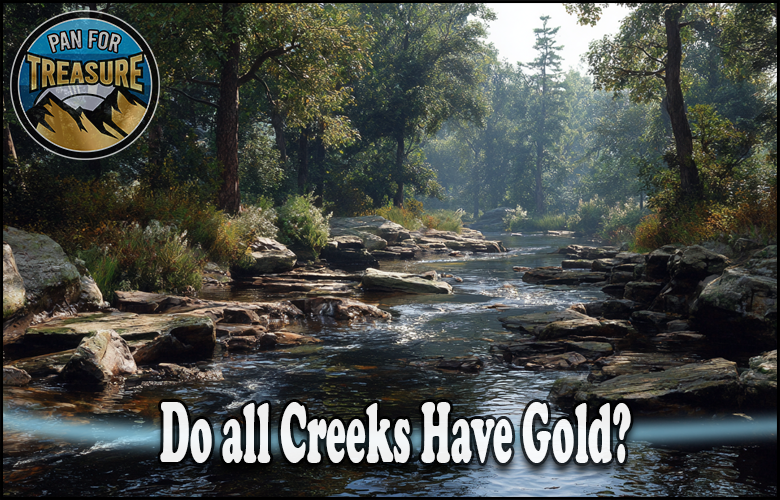
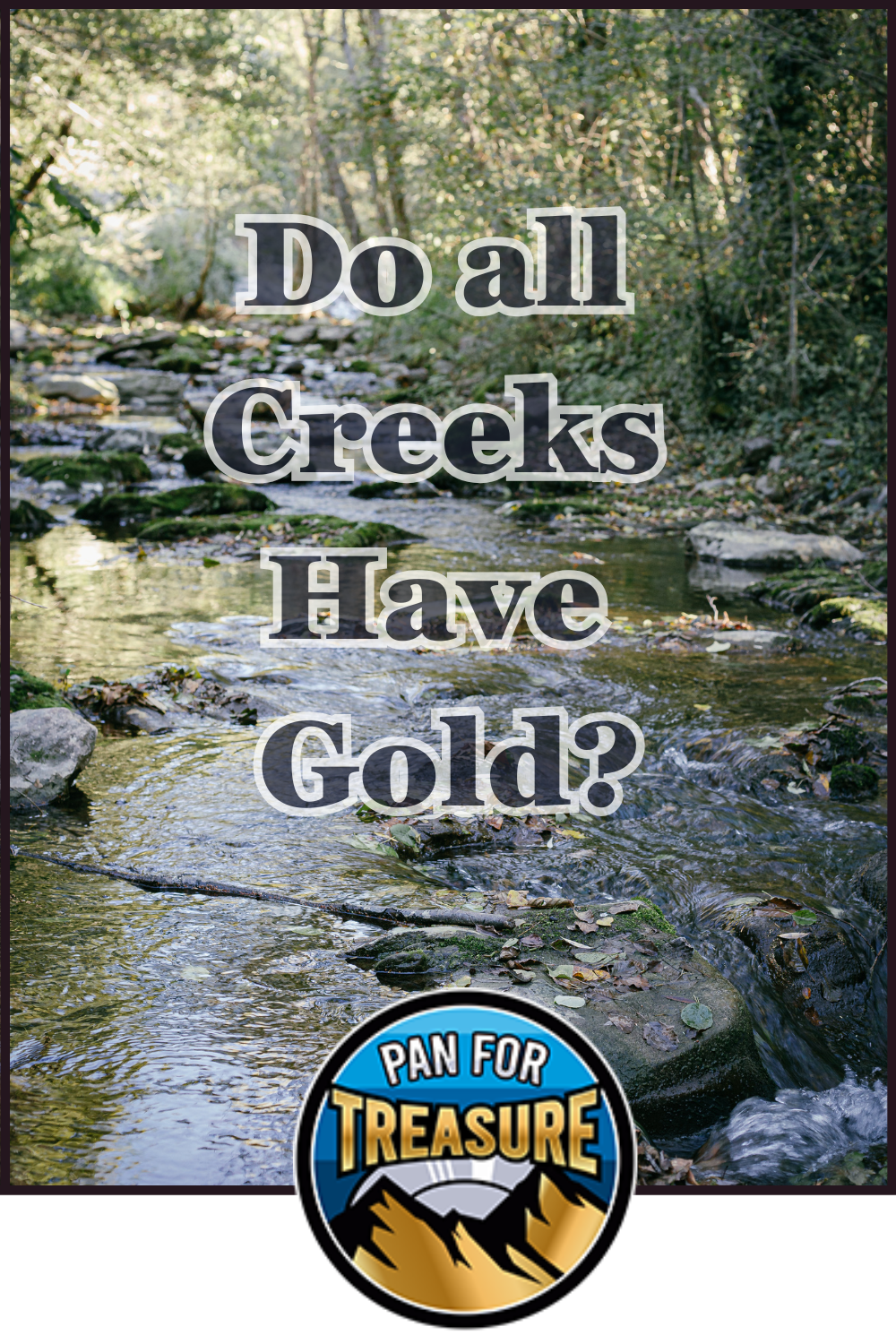
Do all creeks have gold? No. Gold is far too rare and too unevenly distributed for every waterway to carry it, and most creeks in the United States contain no recoverable gold at all.
Gold ends up in a creek only when that creek drains a region where gold exists in the surrounding rock. Water then erodes those deposits and carries the heavy metal downstream, where it settles in predictable traps.
If the geology upstream never contained gold, no amount of panning will produce color. That single fact explains why two creeks a few miles apart can be worlds apart in their prospects.
The good news is that you do not need to guess. Historical mining records, state geological surveys, and a little fieldcraft will tell you whether a given creek is worth your time long before you get your feet wet.
TL;DR
- Not all creeks: Most creeks carry no recoverable gold. A creek only holds gold if its watershed drains gold-bearing rock.
- Source matters most: Gold in a stream is eroded from lode deposits or older placers upstream. No source, no gold.
- Follow the history: The single best predictor is documented past production. If an area was mined, its creeks are worth checking.
- Gold is a trap-seeker: Because gold is dense, it drops out of moving water first and collects in bedrock cracks, inside bends, and behind boulders.
- Small vs. large: Small creeks concentrate gold in tight, easy-to-read spots. Large rivers hold more total gold but spread it across a wider, harder-to-work channel.
- Verify before you dig: USGS data and state survey records reveal gold districts. Check the law for the specific creek before prospecting.
Do all creeks have gold in equal measure, or is it concentrated in a few lucky drainages? The answer is firmly the latter, and understanding why comes down to how gold gets into moving water in the first place.
Featured
Gold in Rivers and Creeks: How Erosion and Accumulation Work
Gold does not form in a creek. It forms deep underground in lode deposits, where mineral-rich fluids deposit gold in quartz veins and host rock over millions of years.
When those deposits are pushed toward the surface and exposed, weathering and erosion break the rock apart. Rain and running water then pick up the freed gold particles and move them downhill.
Because gold is extremely dense, roughly nineteen times heavier than water, it behaves very differently from sand and gravel once it enters a stream. The lighter material stays suspended and washes far downstream, while gold sinks quickly and lodges in the first place the current slows down.
This is the heart of placer geology. Over centuries, this sorting process concentrates gold into specific traps rather than spreading it evenly along the streambed.
Where the Gold Settles
The most productive traps share one feature: they are places where water loses energy. When the current slows, it can no longer carry heavy gold, so the metal drops out.
Common gold traps include the following, listed roughly from most to least reliable:
- Bedrock crevices: Cracks and depressions in exposed bedrock act like natural sluice riffles, catching gold and holding it for years.
- Inside bends: On the inner curve of a bend, water moves slowest, allowing gold to accumulate.
- Behind large boulders: The calm pocket directly downstream of a big rock is a classic trap.
- Gravel bars: The upstream head of a gravel bar often holds gold that dropped as the current widened and slowed.
- Root wads and obstructions: Anything that breaks the flow can create a low-energy pocket where gold settles.
Reading these features is a skill in itself. If you are new to it, our guide to gold panning tips and tricks walks through how to identify likely deposits in the field.
Our Favorite Posts
Mining Areas vs. Non-Mining Areas
The most reliable shortcut in all of prospecting is this: gold is found where gold has already been found. Creeks that drain historic mining districts are dramatically more likely to produce than creeks in regions with no mining past.
This is not superstition. It reflects the underlying geology. A region that produced gold a century ago still contains gold-bearing rock today, and that rock continues to shed metal into local waterways.
By contrast, a creek in a region with no gold in its bedrock will never produce, no matter how promising the water looks. A beautiful, boulder-strewn mountain stream in the wrong geology is still barren.
States such as California, Alaska, Georgia, Idaho, and Oregon contain vast, well-documented gold belts. Reviewing where gold occurs in these states is a smart first step; for example, our overviews of whether there is gold in California, Idaho, and Oregon map out the productive districts in each.
How to Tell if a Region Has Gold
Before you ever fill a pan, you can research whether a creek’s watershed is likely to hold gold. Useful sources include:
- State geological surveys: Nearly every state survey publishes maps of known mineral and gold occurrences.
- Historic mining records: Old mine locations, ghost towns, and claim records point directly at gold-bearing ground.
- USGS data: Federal databases catalog mineral resources and past production across the country.
- Local prospecting clubs: Members often know which nearby creeks produce and which do not.
Barren Creeks: Why Some Waterways Hold No Gold
It is worth stating plainly, because it saves enormous frustration: many creeks contain no gold whatsoever. These are barren waterways, and they are the norm rather than the exception.
A creek is barren when its entire watershed drains rock that never contained gold. Sedimentary lowlands, many coastal plains, and large swaths of the central United States simply lack the geology that produces placer gold.
No prospecting technique can extract gold that was never there. A barren creek will not become productive with a finer pan, a better sluice, or more patience.
This is precisely why upfront research matters more than fieldwork. An hour spent with a geological survey map can spare you weeks of fruitless panning in the wrong drainage.
Recommended Reading
Where to Find Gold in Creeks: Tips and Techniques
Once you have confirmed that a creek drains gold-bearing ground, the next task is finding the specific spots where gold has concentrated. Working the whole creek is inefficient; working the traps is not.
Start by looking for exposed bedrock, since crevices in bedrock are the single richest trap type. Then work the inside of bends, the pockets behind boulders, and the heads of gravel bars.
Sampling is your friend. Take a few pans from several likely spots before committing to one location, and let the results guide where you dig in earnest.
A Simple Field Method
A practical approach for a new creek looks like this:
- Confirm the geology and legality of the creek before arriving.
- Walk the stretch and note bedrock outcrops, bends, and boulders.
- Take test pans from three or four different traps.
- Compare results and focus your effort where you see the most color.
- Work down to and along the bedrock, where the heaviest gold hides.
Recovering the tiny flakes that most creeks yield takes good technique. Our guide to mastering fine gold recovery covers how to keep fine gold from escaping the pan.
Articles
Smaller Creeks vs. Major Rivers: Pros and Cons
Size changes the game. Small creeks and large rivers both hold gold in the right geology, but they reward different approaches.
Small creeks concentrate gold into a narrow, shallow channel, which makes traps easy to read and reach. The total amount of gold is usually modest, but access and simplicity are on your side.
Large rivers carry far more total gold, but they spread it across a wide, deep, powerful channel that is harder and sometimes more dangerous to work. Reaching productive bedrock can require more equipment and effort.
| Factor | Small Creeks | Major Rivers |
|---|---|---|
| Total gold present | Usually lower | Usually higher |
| Ease of reading traps | Easier, channel is narrow | Harder, channel is wide |
| Access to bedrock | Often shallow and reachable | Often deep and difficult |
| Equipment needed | Pan and hand tools | May need sluice or more gear |
| Safety | Generally lower risk | Strong current, higher risk |
| Best for | Beginners, quick sampling | Higher-volume, experienced work |
Best Locations for Finding Gold in Creeks and Rivers
The best creeks are the ones flowing out of documented gold country. Rather than chase rumors, start where records and geology agree that gold exists.
The classic gold-producing regions remain the safest bets. The Sierra Nevada in California, the interior of Alaska, the mountains of Idaho and Oregon, and the historic districts of the Southern Appalachians all feed productive creeks.
For a broader tour of where to begin, our roundup of the top states to pan for gold ranks the most productive regions, and the best locations to find gold hub gathers state-by-state hotspots in one place.
Prospecting near old workings can be especially productive. Our overview of gold mining at historical sites explains how to research and safely explore ground that has produced before.
Factors Affecting Gold Accumulation in Creeks and Rivers
Even within a gold-bearing creek, some stretches are rich and others are nearly empty. Several factors determine where the metal piles up.
Water velocity is the master variable. Fast water carries gold past; slow water drops it. Every good trap is fundamentally a place where the current eases.
Gradient and channel shape control velocity. Steep, straight reaches move gold through, while flatter reaches, bends, and obstructions cause it to settle.
Flood history matters too. Major floods rework a streambed and can expose or bury gold, which is why fresh deposits often appear after high water recedes. Bedrock depth is the final factor, since the richest gold usually rests directly on or in the bedrock beneath the gravel.
If you want to speak the language of these features fluently, our gold mining terms glossary defines the key concepts prospectors use to describe them.
Resources for Researching Gold-Bearing Creeks
Before you head out, these official sources will help you confirm whether a creek is worth prospecting and whether it is legal to do so:
- U.S. Geological Survey (USGS) — National mineral resource data, topographic maps, and past-production records for locating gold districts.
- National Park Service: Placer Mining History — A clear federal explanation of how placer gold forms and moves in waterways.
- Bureau of Land Management: Mining and Minerals — Rules and information on prospecting and claims on federal public land.
- Gold Prospectors Association of America (GPAA) — Club claims, local chapters, and members who know which regional creeks produce.
Conclusion
So, do all creeks carry the same promise? Not remotely. Gold is concentrated in a small fraction of waterways, and the deciding factor is always the geology upstream.
The prospectors who consistently find color are the ones who research before they dig. They start in documented gold country, read the traps where slow water drops heavy metal, and confirm the law for each spot.
Do that, and panning becomes a matter of skill rather than luck. Skip it, and even flawless technique will come up empty in the wrong drainage.
Before choosing a creek, check the panning rules for your area through our state gold panning laws guides, and remember the core lesson: not all creeks have gold, but the right ones, backed by the right research, absolutely do.
Frequently Asked Questions – Do All Creeks Have Gold
Do all creeks have gold in them?
No. Most creeks contain no recoverable gold. A creek holds gold only if its watershed drains rock that contains gold, which then erodes and washes into the stream. In regions with no gold-bearing geology, the creeks are barren.
How can I tell if a creek has gold before I start panning?
Research the geology first. Check your state geological survey, USGS mineral data, and historic mining records to see whether the area has produced gold. Creeks that drain known mining districts are the most likely to hold gold.
Why does gold collect in certain spots and not others?
Gold is very dense, so it drops out of moving water wherever the current slows. It concentrates in bedrock crevices, on the inside of bends, behind boulders, and at the heads of gravel bars. These low-energy pockets act as natural traps.
Are small creeks or large rivers better for finding gold?
It depends on your goals. Small creeks concentrate gold into narrow, easy-to-read channels and are ideal for beginners. Large rivers hold more total gold but spread it across a wide, deep, sometimes dangerous channel that takes more effort and equipment to work.
Can a creek that has no gold ever become productive?
No. If the surrounding geology contains no gold, no technique will produce color. Better equipment and more patience cannot extract gold that was never deposited there in the first place.
Does gold in a creek ever run out?
A well-known spot can be worked down, but many creeks are replenished. Floods and high water rework the streambed and can carry fresh gold down from upstream deposits, which is why productive spots often refresh after major storms.
Is it legal to pan any creek that has gold?
Not automatically. Access and permitted methods depend on land ownership and state and federal rules. Always confirm the regulations for a specific creek, including any claims on the ground, before prospecting.
⛏ Recommended Gear ⛏


* As an Amazon Associate I earn from qualifying purchases at no extra cost to you.
Subscribe to Our Newsletter

Ryan Conlon is the founder of Pan for Treasure.
A lifelong gold panning enthusiast, he created this site to help beginners learn the ropes and share practical tips from his own time on the creek. [email protected]