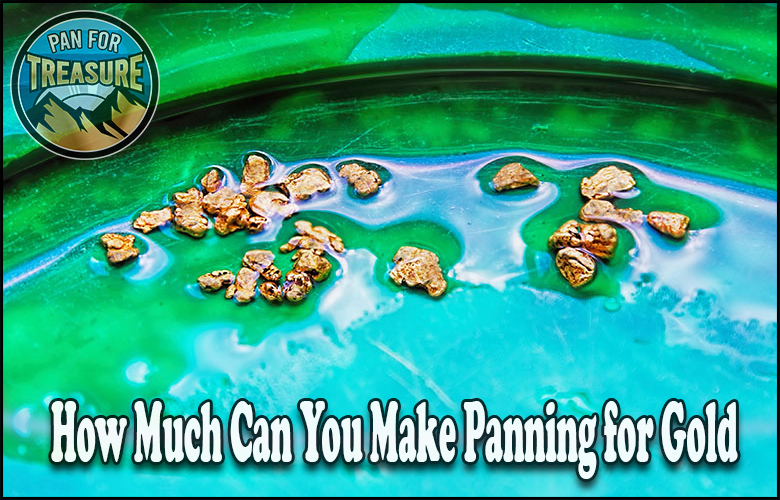
How much can you make panning for gold realistically? For most recreational panners, the honest answer is a few dollars to a few tens of dollars in gold on a good day, with the real payoff being the experience rather than the income.
Gold panning is one of the oldest and simplest ways to recover gold, but it is also one of the slowest. A skilled panner processes only a small volume of material by hand, so the amount of gold recovered is modest even in rich ground.
That said, “how much” depends heavily on where you pan, how good your ground is, and what you count as earnings. With today’s gold price hovering around $4,000 per troy ounce, even small amounts of recovered gold are worth more than they were a few years ago.
This guide sets realistic expectations, then shows how serious hobbyists stretch their returns, and where pay-to-pan sites fit in for those who want a more guaranteed experience.
TL;DR
- Typical hobby returns: Most recreational panners recover a few dollars to a few tens of dollars of gold on a productive day, not a paycheck.
- Location is everything: Earnings depend almost entirely on the richness of the ground you work. Documented gold country beats random creeks by a wide margin.
- Gold price helps: With gold around $4,000 per troy ounce, small recoveries are worth more than in the past, though volume stays the limiting factor.
- Scale up carefully: Better sites, sluices, and skill increase returns, but panning alone rarely rivals an hourly wage.
- Pay-to-pan sites: Salted tourist attractions guarantee finds and a fun experience, but they are entertainment, not income.
- Value beyond gold: For nearly everyone, the reward is the hobby itself, with any gold recovered as a bonus.
How much can you make panning for gold if you treat it seriously rather than casually? More than a dabbler, but the ceiling for a hand pan alone stays low. Understanding why starts with setting realistic expectations.
Setting Realistic Expectations for How Much You Can Make Panning for Gold
The first thing to understand is that a gold pan is a sampling and finishing tool, not a production machine. It is superb at testing ground and recovering fine gold, but it processes only a tiny volume of gravel per hour.
A typical recreational session might yield a small vial of fine flakes, often called “flour gold,” weighing a fraction of a gram. Even at strong gold prices, that translates to modest dollar figures.
To put numbers on it, consider that a troy ounce is a bit over 31 grams. If a good day yields a tenth of a gram of gold, that is roughly a three-hundredth of an ounce, which at around $4,000 per ounce works out to a value in the low teens of dollars.
The people who consistently do better are not luckier; they are working richer ground with better technique. Where you pan matters far more than how many hours you put in.
What Drives Your Returns
Several factors separate a productive day from an empty one:
- Ground richness: The gold content of the gravel you work is the single biggest factor by far.
- Location research: Panning in documented gold districts dramatically raises your odds.
- Technique: Good panning recovers the fine gold that beginners wash away.
- Time and volume: More material processed means more chances, but a pan caps how much you can handle.
- Gold price: A higher spot price raises the dollar value of whatever you recover.
If you are just starting out, our getting started with gold panning guide covers the fundamentals that make the difference between finding color and finding nothing.
You Can Still Make Money Gold Panning
None of this means gold panning is worthless. It means the income is modest and the value is broader than the gold alone. Plenty of hobbyists cover their costs and occasionally do better.
In genuinely rich ground, a determined panner can recover meaningfully more, and lucky finds of a small nugget or a rich pocket do happen. Those moments are rare, but they are real, and they are part of the appeal.
There is also a compounding effect over time. As your skill grows and you learn to read a stream, your average returns rise. A first-year panner and a ten-year veteran working the same creek will not come home with the same vial.
Finally, the gold you keep holds its value. Unlike most hobbies, panning produces a tangible asset, and at today’s prices even small accumulations add up over many outings.
How to Make More Money Gold Panning
If your goal is to maximize what you recover, the path is not to pan harder but to pan smarter and, eventually, to process more material. Here is how experienced hobbyists increase their returns.
- Choose richer ground: Research historic districts and let past production guide you. Our roundup of the top states to pan for gold is a good starting point.
- Improve your technique: Learn to recover fine gold instead of washing it out. Small refinements add up over a day.
- Add a sluice: A sluice box processes far more gravel than a pan, using the pan only to finish concentrates.
- Work the right spots: Concentrate on natural gold traps like bedrock crevices and inside bends rather than random gravel.
- Go where records point: States like California, Georgia, and North Carolina have well-documented gold, as our overviews of gold in California, Georgia, and North Carolina detail.
Refining your methods pays off directly. Our gold panning tips and tricks guide covers the techniques that separate consistent producers from frustrated beginners.
| Approach | Material Processed | Relative Return |
|---|---|---|
| Pan only, random ground | Very low | Minimal |
| Pan only, researched ground | Low | Modest |
| Pan plus sluice, researched ground | Moderate | Noticeably higher |
| Skilled work in rich district | Moderate to high | Best realistic returns |
Pay-to-Pan Sites: A Guaranteed Experience
If you want a reliable dose of gold-panning fun without the uncertainty of a wild creek, pay-to-pan attractions are a popular option. These sites sell buckets of gold-bearing “paydirt,” often salted with gold or gemstones, so you are guaranteed to find something.
They are best understood as entertainment and education rather than income. You typically pay more for the bucket than the gold inside is worth, but you get a guaranteed find, instruction, and a memorable outing.
Several long-running attractions across the country make this easy for families and newcomers.
Reed Gold Mine, Midland, North Carolina
Reed Gold Mine is the site of the first documented gold discovery in the United States. It operates as a state historic site where visitors can pan for gold and tour the historic workings, making it as much a history lesson as a panning trip. You can read more about the state’s gold in our is there gold in North Carolina overview.
Big Thunder Gold Mine, Keystone, South Dakota
Located in the Black Hills near Mount Rushmore, Big Thunder Gold Mine offers guided mine tours and gold panning. It is a convenient stop for travelers exploring South Dakota, a state with a genuine gold-mining heritage, as covered in our is there gold in South Dakota guide.
Gold Panning in Jamestown, California
In the heart of California’s Mother Lode, the Jamestown area offers pay-to-pan experiences steeped in Gold Rush history. It is a fitting place to try panning given the region’s legendary output, detailed in our is there gold in California overview.
Consolidated Gold Mine, Dahlonega, Georgia
Dahlonega was the center of the Georgia gold rush, and Consolidated Gold Mine offers underground tours and gold panning. Georgia’s gold history runs deep, as our is there gold in Georgia guide explains.
Resources for Estimating Gold Panning Returns
These official and authoritative sources help you research ground, understand gold value, and set realistic expectations:
- U.S. Geological Survey (USGS) — Mineral resource data and historic production records for identifying productive districts.
- United States Mint — Official information on gold coinage and the metal’s monetary role.
- Gold Prospectors Association of America (GPAA) — Club claims, local chapters, and community knowledge on productive ground.
- Reed Gold Mine State Historic Site — Official information on the first U.S. gold discovery and visitor panning.
Conclusion
Weighing it all up, gold panning is a rewarding hobby with modest financial returns. For most people, a good day means a few dollars of gold, some fresh air, and the thrill of finding color in the pan.
You can absolutely improve your take by working richer ground, sharpening your technique, and adding a sluice to process more material. But treating a hand pan as a path to real income sets you up for disappointment.
The smarter frame is to enjoy the process, keep the gold you find as a small and appreciating bonus, and measure success by the experience rather than the paycheck.
So, how much can you make panning for gold? Enough to make it fun and occasionally surprising, rarely enough to quit your day job, and always enough to bring you back to the water again.
Frequently Asked Questions – How Much Can You Make Panning for Gold
How much money can you realistically make panning for gold?
For most recreational panners, a productive day yields a few dollars to a few tens of dollars of gold. Returns depend heavily on the richness of the ground, your technique, and the current gold price. Panning is best viewed as a hobby with a modest bonus rather than a source of income.
Can you make a full-time living just panning for gold?
Almost never with a hand pan alone. The volume of material you can process by hand is too low to generate a reliable income. Those who earn meaningful money from prospecting typically use larger equipment, work exceptional ground, or combine prospecting with related businesses.
How does the gold price affect what you earn?
A higher spot price directly increases the dollar value of whatever gold you recover. With gold around $4,000 per troy ounce, small recoveries are worth more than they were in past years, though the amount of gold you can physically pan still limits your total.
What is the best way to increase my gold panning returns?
Work richer, well-documented ground, improve your technique so you keep the fine gold, and add a sluice box to process more gravel than a pan can handle. Choosing the right location matters more than simply spending more hours panning.
Are pay-to-pan sites worth it?
They are worth it for a guaranteed, fun, and educational experience, especially for families and beginners. They are not a way to make money, since you generally pay more for the paydirt than the gold inside is worth. Think of them as entertainment rather than income.
How much gold does a typical pan of gravel contain?
In most ground, very little, often just a few tiny flakes or none at all. Even in productive districts, gold is concentrated in specific traps rather than spread evenly, which is why sampling and reading the stream are so important.
Is gold panning still profitable at all?
It can cover its costs and occasionally do better in rich ground, and the gold you keep holds its value. But for the vast majority of people, the value lies in the hobby, the outdoors, and the occasional exciting find rather than in profit.
⛏ Recommended Gear ⛏


* As an Amazon Associate I earn from qualifying purchases at no extra cost to you.
Subscribe to Our Newsletter

Ryan Conlon is the founder of Pan for Treasure.
A lifelong gold panning enthusiast, he created this site to help beginners learn the ropes and share practical tips from his own time on the creek. [email protected]