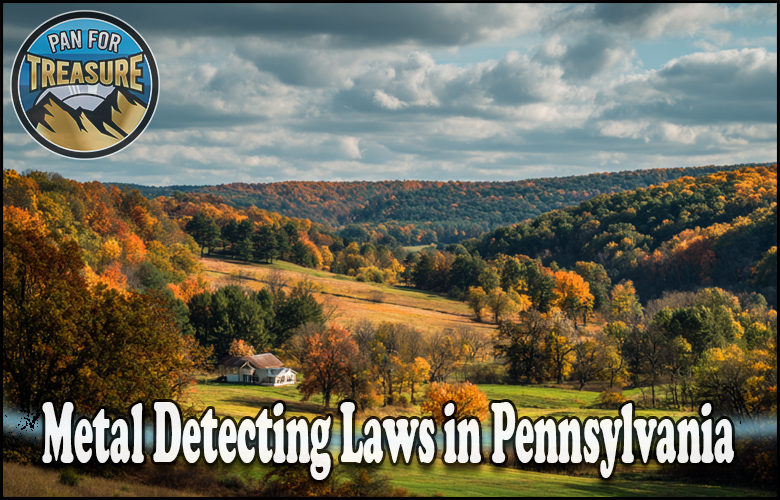
Metal detecting laws in Pennsylvania are among the best in the country for state park access.
The DCNR (Department of Conservation and Natural Resources) permits reasonable use of metal detectors in many state parks with no fee charged.
The rules are clearly published: sunrise to sunset only, screwdrivers and ice picks for digging tools (no shovels), and beaches/swimming areas available off-season (Tuesday after Labor Day through Saturday before Memorial Day).
Pennsylvania’s extraordinary history from William Penn’s 1682 founding through the Revolutionary War and Civil War makes the state one of the most historically productive for detecting.
The critical restriction is that Gettysburg National Military Park and Valley Forge National Historical Park are NPS sites and completely off-limits. Private land surrounding these battlefields is where the best relic finds come from.
New to the hobby? Start with our beginner’s guide to gold panning and prospecting.
TL;DR
- State Parks: Permitted in many state parks; NO FEE; sunrise to sunset; clear DCNR published rules
- Digging Tools: Screwdrivers, ice picks, and similar narrow-pronged devices ONLY; no shovels, spades, or garden trowels
- Beaches: Off-season detecting (Tues after Labor Day through Sat before Memorial Day); summer at park manager discretion
- Historical Objects: Report findings to park manager; consult PA Historical and Museum Commission for artifacts
- Gettysburg / Valley Forge: NPS sites; completely off-limits; private land surrounding battlefields is where finds come from
- Private Land: Excellent; William Penn era (1682), Revolutionary War, Civil War; written permission required
Permitted in many parks; NO FEE; published DCNR rules
Screwdrivers and ice picks ONLY; no shovels
Off-season: Tues after Labor Day to Sat before Memorial Day
William Penn (1682), Revolutionary War, Civil War (Gettysburg)
Gettysburg, Valley Forge, Independence Hall all off-limits
Historical objects reported to park manager
Metal Detecting Laws in Pennsylvania
Metal detecting laws in Pennsylvania are defined by a clear DCNR policy that is among the most detailed and accessible in the country. Here is the breakdown.
State Parks (DCNR Policy)
The DCNR states that reasonable use of metal detectors is permitted in many state parks. Key rules include:
No fee is charged. Metal detecting is permitted only from sunrise to sunset. Shovels, spades, garden trowels, and other similar tools may not be used to dig into or turn over ground areas covered by turf, vegetation, shrubs, or trees. The only permissible digging tools are screwdrivers, ice picks, and other similar narrow-pronged devices.
Metal detecting on beaches and in lake swimming areas is permitted within a reasonable distance of shore from the Tuesday after Labor Day until the Saturday prior to Memorial Day, unless posted otherwise. During summer, beach detecting is at the park manager’s discretion based on facility use. Metal detecting in other underwater areas is permitted within a reasonable distance of shore if it does not conflict with other activities.
Metal detecting is not permitted where it would conflict with a facility in use or within fenced areas of swimming pool complexes. Historical objects should be reported to the park manager. People who find historical artifacts should consult the Pennsylvania Historical and Museum Commission. Items found and removed from the park must be reported.
NPS Sites (Prohibited)
Pennsylvania’s NPS sites are critically important and completely off-limits: Gettysburg National Military Park, Valley Forge National Historical Park, Independence National Historical Park (Philadelphia), Fort Necessity National Battlefield, Johnstown Flood National Memorial, Steamtown National Historic Site, Delaware Water Gap National Recreation Area, and others.
Gettysburg is the most significant Civil War battlefield in the country. Do not detect on any NPS property. The private land surrounding Gettysburg is where Civil War relic finds come from.
State Forests
Pennsylvania has over 2 million acres of state forest. DCNR manages these separately from state parks. Check with the specific state forest district for metal detecting policies. Rules may differ from state parks.
City and County Parks
Municipal park rules vary across Pennsylvania. Philadelphia, Pittsburgh, and other major cities have their own parks departments. Many cities allow detecting without specific regulations. Check with each municipality.
Private Land
Private land with written landowner permission is the best option for relic hunting. ARPA does not apply. Pennsylvania’s deep colonial and military history makes private land detecting among the most productive in the country, particularly near Revolutionary War and Civil War sites.
Rules Summary
| Land Type | Detecting Allowed? | Tools | Found Items |
|---|---|---|---|
| State Parks (many) | Yes; no fee | Screwdrivers/ice picks only | Report historical objects; report removed items |
| State Park Beaches | Off-season; summer at manager discretion | Same tool limits | Same reporting |
| NPS Sites | No | N/A (prohibited) | N/A |
| State Forests | Check with district | Varies | Varies |
| City/County Parks | Varies | Check locally | Varies |
| Private Land | Yes | Any tools with permission | Finder keeps (per agreement) |
For the official DCNR policy, visit PA DCNR Metal Detecting page. For historical artifacts, contact the PA Historical and Museum Commission.
Our Favorite Posts
Best Metal Detecting Locations in Pennsylvania
- Gettysburg area private land (Adams County) – The NPS battlefield is off-limits, but private farmland surrounding the 1863 battlefield produces extraordinary Civil War relics. Camp sites, march routes, and supply lines extend well beyond the park boundaries.
- Valley Forge area private land (Chester, Montgomery Counties) – The NPS park is off-limits. Private land near the 1777-1778 winter encampment area produces Revolutionary War artifacts.
- Presque Isle State Park (Erie County) – Lake Erie beach detecting with the DCNR off-season rule. Heavy summer tourism produces modern finds available after Labor Day.
- Brandywine Battlefield area (Chester County) – The September 1777 battle was the largest of the Revolutionary War. Private land near the battlefield produces Revolutionary War items.
- Delaware River towns (Bucks, Northampton Counties) – Washington’s Crossing, Easton, Bristol, and other Delaware River communities have deep colonial and Revolutionary War history. Private land near old settlements is productive.
- State parks with beach access (various counties) – Multiple state parks with lake and river swimming areas allow off-season detecting. Codorus, Nockamixon, Promised Land, and others offer legal park detecting.
- Pittsburgh area (Allegheny County) – Fort Pitt (1758) and early frontier history. The oldest parts of the city have French and Indian War through early American history. Private land and city parks (check local rules).
- Lancaster County farmland (Lancaster County) – One of the oldest settled areas in Pennsylvania. Amish and Mennonite communities date to the 1700s. Private farmland with permission produces colonial-era items.
See our best locations to find gold guide and state-by-state directory.
Pennsylvania’s History and What You Might Find
Pennsylvania was founded by William Penn in 1682 as a Quaker colony. Philadelphia served as the nation’s capital during much of the Revolutionary War and early republic. The state saw critical Revolutionary War battles (Brandywine, Germantown, Valley Forge winter encampment) and the most famous Civil War battle at Gettysburg (July 1863).
Pennsylvania’s industrial heritage includes anthracite coal mining, steel production (Pittsburgh), and railroad history. The state’s dense population history from the 1680s onward means artifacts are found across every county.
Common finds include colonial-era coins (King George coppers, early American coins), Revolutionary War buttons, buckles, and musket balls, Civil War relics (particularly near Gettysburg), industrial-era artifacts, and coins spanning every era of American history. Pennsylvania’s detecting depth is matched by few other states.
Recommended Reading
Tips for Metal Detecting in Pennsylvania
- Use only screwdrivers and ice picks in state parks. The DCNR rule is specific: no shovels, spades, or trowels on turf or vegetated areas. Compliance protects the program for all detectorists.
- Detect state park beaches in the off-season. The window from Tuesday after Labor Day through Saturday before Memorial Day provides legal beach access at many state parks.
- Stay completely off Gettysburg NPS property. The battlefield is the most famous NPS site in the country. Enforcement is active. Private farmland surrounding the park is where Civil War finds come from.
- Report historical objects to the park manager. The DCNR rule requires reporting historical items and consulting the PA Historical and Museum Commission for artifacts. Report all items removed from a park.
- Build landowner relationships near battlefields. Private land near Gettysburg, Brandywine, Valley Forge surrounds, and other battle areas produces the best relic finds in the state.
- Research colonial-era sites. Pennsylvania’s Quaker, German, and Scots-Irish settlement history dates to the 1680s. Old county records and plat maps identify early homesteads and gathering places.
- Check state forest policies separately. State forests have different management than state parks. Contact the specific state forest district for detecting rules.
- Join a PA detecting club. Pennsylvania has one of the most active detecting communities in the country, particularly around Gettysburg and the Philadelphia area. Club members share productive locations and landowner contacts.
For technique help, see our techniques guide and tools and equipment guide.
Resources
- PA DCNR Metal Detecting Policy – The official, detailed DCNR metal detecting rules for state parks.
- PA Historical and Museum Commission – Archaeological resources, artifact reporting, and historical site information.
- National Park Service – Pennsylvania – NPS sites (Gettysburg, Valley Forge, etc.) where detecting is prohibited.
- PA State Parks Directory – Individual park information and contacts.
Conclusion
Metal detecting laws in Pennsylvania provide one of the best state park detecting frameworks in the country. Free access, published rules, and numerous participating parks make Pennsylvania accessible. Combined with the state’s extraordinary Colonial, Revolutionary War, and Civil War history, Pennsylvania is one of the top detecting states in America.
Follow the DCNR tool rules, detect beaches in the off-season, and build private landowner relationships near the historic battlefields. Pennsylvania rewards every level of detectorist.
Explore nearby state guides: metal detecting laws in New York, metal detecting laws in New Jersey, metal detecting laws in Ohio, metal detecting laws in Maryland, metal detecting laws in Delaware, and metal detecting laws in West Virginia. See the full state-by-state metal detecting laws directory.
Frequently Asked Questions – PA Metal Detecting Laws
Can I metal detect in Pennsylvania state parks?
Yes. Many state parks allow metal detecting with no fee. DCNR rules require sunrise-to-sunset hours, screwdriver/ice pick digging tools only (no shovels), and reporting of historical objects. Beaches are available off-season.
Is there a fee for metal detecting in PA state parks?
No. There is no fee charged for metal detecting in Pennsylvania state parks.
Can I detect at Gettysburg?
Gettysburg National Military Park (NPS) is completely off-limits. Private farmland surrounding the park produces extraordinary Civil War relics with landowner permission. This is where serious Gettysburg-area detecting happens.
What tools can I use in PA state parks?
Screwdrivers, ice picks, and similar narrow-pronged devices only. Shovels, spades, and garden trowels are prohibited on turf, vegetated, or wooded areas.
When can I detect at state park beaches?
Off-season: Tuesday after Labor Day through Saturday before Memorial Day. During summer, beach detecting is at the park manager’s discretion based on facility use.
How does Pennsylvania compare to neighboring states?
Pennsylvania has one of the best state park policies in the country. New York has a more complex regional permit system. Ohio requires local authority permits. New Jersey requires superintendent permits. Pennsylvania’s free, no-permit-needed approach with clear published rules is among the most accessible.
⛏ Recommended Gear ⛏


* As an Amazon Associate I earn from qualifying purchases at no extra cost to you.
Subscribe to Our Newsletter

Ryan Conlon is the founder of Pan for Treasure.
A lifelong gold panning enthusiast, he created this site to help beginners learn the ropes and share practical tips from his own time on the creek. [email protected]