Metal detecting laws in New Jersey require permits from the park superintendent for state park detecting. The permit may limit location, hours, and days of use.
Permits will not be issued for areas of significant historical or other value, or where detecting would be incompatible with resource protection or interfere with public use.
Historical sites like Monmouth Battlefield and Washington Crossing state parks are completely off-limits.
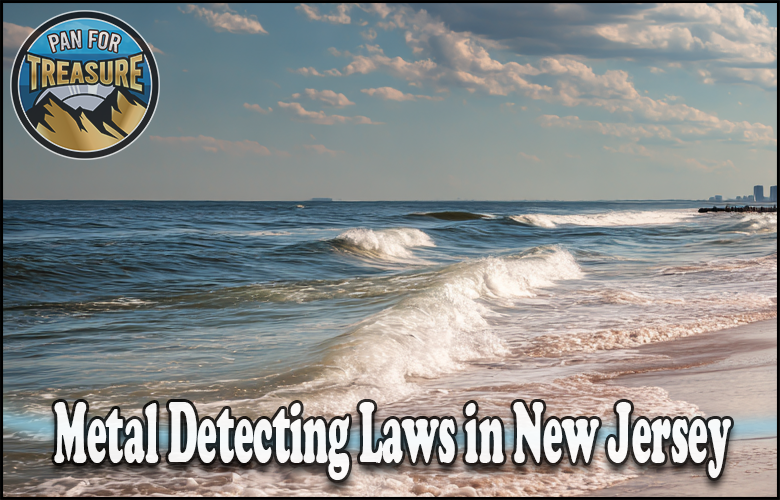
New Jersey’s 130-mile Atlantic coastline is the state’s biggest detecting asset. Beach detecting is popular, particularly during the off-season (generally October through April, outside bathing hours).
The state’s Revolutionary War history, colonial heritage, and dense population history make private land and municipal park detecting productive.
Wildlife Management Areas (WMA) allow detecting with a $50 permit from the Division of Fish and Wildlife.
New to the hobby? Start with our beginner’s guide to gold panning and prospecting.
TL;DR
- State Parks: Permits required from the park superintendent; may limit location, hours, and days; historical sites excluded
- Beaches: Most ocean beaches allow detecting outside bathing season hours (off-season: October-April is most accessible); some beach towns have local rules
- Historical Sites: Monmouth Battlefield, Washington Crossing, Fort Mercer, and other historic state parks are completely off-limits
- WMA Land: Wildlife Management Areas allow detecting with a $50 permit from Division of Fish and Wildlife
- Municipal Parks: Many municipalities have no specific regulation; some may require permits; ask at town hall
- Private Land: Excellent option; Revolutionary War, colonial, and industrial history; written landowner permission required
Superintendent permit required; historic sites excluded
130 miles of Atlantic coast; Jersey Shore beaches
$50 permit from Division of Fish and Wildlife
Colonial (1660s), Revolutionary War battles, industrial era
Off-season (Oct-Apr) most accessible; bathing hours restricted in summer
Monmouth Battlefield, Washington Crossing, Sandy Hook off-limits
Featured
Metal Detecting Laws in New Jersey
Metal detecting laws in New Jersey are governed by state park permit rules, shore community ordinances, and federal regulations. Here is the breakdown.
State Parks
New Jersey State Park Service requires permits from the park superintendent for metal detecting. The policy states that a permit may limit the location, hours, and days of use. A permit will not be issued for use in areas of significant historical or other value, or where such use would be incompatible with protection of the resource and/or interfere with public use.
This means each state park superintendent has discretion over whether to issue permits and what restrictions to impose. Non-historical state parks generally issue permits more readily than those with historical components.
State parks with significant historical resources are completely off-limits: Monmouth Battlefield State Park (Revolutionary War), Washington Crossing State Park, and other historically designated properties. Sandy Hook (NPS, part of Gateway National Recreation Area) is also off-limits due to both NPS rules and the presence of unexploded ordnance.
Island Beach State Park has its own specific rules and is reportedly more accommodating for beach detecting with proper permits.
Beaches
New Jersey’s 130-mile Atlantic coastline is the state’s primary detecting resource. Most beach communities allow metal detecting outside of bathing season hours. During summer (typically Memorial Day through Labor Day), detecting is restricted during lifeguard hours (generally 9-10 AM to 5-6 PM). After bathing season, you can detect at any time on most beaches.
Individual shore communities (municipalities) may have their own specific rules. Some may require beach badges or have additional restrictions. Check with the specific municipality before detecting. Most shore communities do not have specific anti-detecting ordinances.
State property extends from the high tide mark to 3 miles offshore. Below the high tide mark on state park beaches, the state park permit rules apply.
Wildlife Management Areas (WMA)
New Jersey Division of Fish and Wildlife allows metal detecting on WMA lands with a $50 permit. This provides access to public land beyond the state park system. Contact the Division of Fish and Wildlife for permit information and WMA-specific rules.
NPS Sites (Prohibited)
All NPS sites are off-limits: Sandy Hook (Gateway National Recreation Area), Morristown National Historical Park, Thomas Edison National Historical Park, Delaware Water Gap National Recreation Area, and others. Sandy Hook has the additional hazard of unexploded ordnance from its military history.
Municipal Parks
Many New Jersey municipalities have no specific regulation prohibiting metal detecting in town parks. The general advice from experienced detectorists: ask at the municipal building whether there are any regulations on using metal detectors in town parks. If there are no regulations, there is nothing to violate. Some county parks may require permits from the county park superintendent.
Pine Barrens
State-owned sections of the Pine Barrens (Pinelands) are off-limits for detecting. The area is patrolled by Park Rangers who are fully sworn police officers. The Pine Barrens have historical ruins and sites that are protected. Enforcement is active.
Private Land
Private land with written landowner permission is excellent in New Jersey. The state’s colonial history (1660s Dutch and English), Revolutionary War battles, and industrial heritage make private land detecting highly productive. ARPA does not apply to private property.
Rules Summary
| Land Type | Detecting Allowed? | Permit/Permission | Restrictions |
|---|---|---|---|
| State Parks (non-historical) | With superintendent permit | Permit from park superintendent | May limit location, hours, days |
| Historical State Parks | No | N/A (no permits issued) | Monmouth, Washington Crossing, etc. |
| Ocean Beaches | Generally yes (off-season best) | Check municipal rules | Restricted during bathing hours in summer |
| WMA Land | Yes | $50 permit from Fish & Wildlife | Follow WMA rules |
| NPS Sites | No | N/A (prohibited) | Sandy Hook, Morristown, etc. |
| Pine Barrens (state) | No | N/A (prohibited) | Active ranger enforcement |
| Municipal Parks | Varies | Check each municipality | Many have no specific prohibition |
| Private Land | Yes | Written landowner permission | Finder keeps (per agreement) |
For state park permits, contact the specific park superintendent through NJ Division of Parks and Forestry. For WMA permits, see NJ Division of Fish and Wildlife.
Our Favorite Posts
- Metal Detecting Laws in Kentucky – Public Land, Parks, and Beach Rules
- Metal Detecting Laws and Regulations
- Metal Detecting Laws in Georgia – Public Land, Parks, and Beach Rules
- Metal Detecting Laws in Wyoming – Public Land, Parks, and Beach Rules
- Metal Detecting Laws in Tennessee – Public Land, Parks, and Beach Rules
Best Metal Detecting Locations in New Jersey
New Jersey’s shore and Revolutionary War history create strong detecting opportunities.
- Jersey Shore beaches (various Ocean, Monmouth, Atlantic, Cape May Counties) – 130 miles of Atlantic beach with heavy summer tourism. Off-season (October through April) provides the most accessible detecting. Popular resort towns (Wildwood, Atlantic City, Long Beach Island, Point Pleasant) produce excellent jewelry and coin finds from millions of annual visitors.
- Island Beach State Park (Ocean County) – A 10-mile barrier island state park with specific metal detecting rules. Contact the park superintendent for the current permit and restrictions. The undeveloped beach is less crowded than resort beaches.
- Monmouth County private land (Monmouth County) – The Battle of Monmouth (June 1778) was one of the largest Revolutionary War battles. The NPS-affiliated battlefield is off-limits, but private farmland surrounding the battle area produces Revolutionary War artifacts. Freehold and surrounding communities have deep colonial history.
- Morristown area private land (Morris County) – Washington’s winter headquarters (1779-1780). Morristown NHP is off-limits (NPS), but private land in the surrounding area has Revolutionary War camp site and supply route history.
- Delaware River towns (various counties) – Trenton, Burlington, Bordentown, and other Delaware River communities have colonial and Revolutionary War history dating to the 1670s. Private land near old settlements is productive.
- WMA lands (various counties) – With a $50 permit, WMA lands across the state provide public land detecting access. These areas have varied history depending on location. Some WMA lands are former farmsteads with 18th and 19th-century artifacts.
- Cape May area (Cape May County) – One of America’s oldest seaside resorts (1760s). Cape May’s beaches and private properties have centuries of vacation and maritime history. Beach detecting on public beaches is productive.
- North Jersey old communities (Bergen, Essex, Passaic Counties) – Dutch colonial settlements from the 1660s. Some of the oldest European settlements in the Mid-Atlantic. Private land near old Dutch and English communities produces colonial-era items.
See our best locations to find gold guide and state-by-state directory.
New Jersey’s History and What You Might Find
New Jersey’s European history begins with Dutch settlements in the 1660s along the Hudson River and at Bergen (now Jersey City). English control followed, and New Jersey became one of the original 13 colonies. The state saw more Revolutionary War action per square mile than any other colony: the battles of Trenton (1776), Princeton (1777), Monmouth (1778), and Springfield (1780), plus Washington’s winter encampments at Morristown.
The state industrialized rapidly in the 1800s, with Paterson becoming a major manufacturing center (Alexander Hamilton’s vision for American industry). The shore communities developed as vacation destinations from the 1700s onward.
Common finds include colonial-era coins (King George coppers, Dutch tokens), Revolutionary War buttons and buckles, musket balls, Continental Army items, early American coins, maritime items along the coast, industrial-era artifacts near factory towns, and massive quantities of modern jewelry and coins on the shore beaches. New Jersey’s dense population history means almost any old property has detecting potential.
New Jersey has no significant gold deposits.
Recommended Reading
Tips for Metal Detecting in New Jersey
- Detect shore beaches in the off-season. October through April provides the most accessible beach detecting. After summer crowds, the accumulated losses from millions of beachgoers are in the sand waiting. Early morning or evening during the season avoids bathing hours.
- Get state park permits from the superintendent. Each park superintendent issues permits individually. Non-historical parks are more likely to grant permits. Contact the specific park, not the state office, for the best results.
- Get the WMA $50 permit. Wildlife Management Areas provide public land access across the state. The $50 permit is a good investment for access to areas not covered by state park rules.
- Stay off all NPS sites. Sandy Hook (also has unexploded ordnance hazards), Morristown, and other NPS sites are strictly enforced. Know the boundaries.
- Avoid state Pine Barrens land. Park Rangers patrol actively and enforce the prohibition. The Pine Barrens have historical sites that are protected. Stick to private land in the area with landowner permission.
- Research Revolutionary War sites on private land. New Jersey’s Revolutionary War history is dense. Battle maps, encampment locations, and supply route records help identify productive private land near the major battlefields. Local historical societies are excellent resources.
- Check each shore town individually. Beach rules vary by municipality. Some towns require beach badges, others have specific detecting rules. A phone call to the beach patrol or municipal clerk confirms the rules for each town.
- Target Dutch colonial sites. North Jersey’s Dutch colonial heritage (1660s) predates most English colonial settlements. Private land near old Bergen County and Hudson County Dutch communities produces some of the oldest European artifacts in the Mid-Atlantic.
For technique help, see our techniques guide and tips and tricks.
Metal Detecting Laws
- Metal Detecting Laws in Wyoming – Public Land, Parks, and Beach Rules
- Metal Detecting Laws in Wisconsin – Public Land, Parks, and Beach Rules
- Metal Detecting Laws in West Virginia – Public Land, Parks, and Beach Rules
- Metal Detecting Laws in Washington – Public Land, Parks, and Beach Rules
- Metal Detecting Laws in Virginia – Public Land, Parks, and Beach Rules
Resources
- NJ Division of Parks and Forestry – State park information, superintendent contacts, and permit procedures.
- NJ Division of Fish and Wildlife – WMA permit information ($50) and Wildlife Management Area locations.
- NJ Historic Preservation Office – Historic site designations, archaeological protections, and cultural resource information.
- National Park Service – New Jersey – NPS sites in New Jersey (Morristown, Sandy Hook, etc.) where detecting is prohibited.
Conclusion
Metal detecting laws in New Jersey require more navigation than many states due to the layered permit system between state parks, WMA land, shore municipalities, and NPS sites. But New Jersey’s 130-mile Atlantic coastline, Revolutionary War battlefields, and Dutch colonial heritage make the Garden State one of the most historically productive detecting destinations on the East Coast.
Focus on off-season shore beach detecting, get your state park permits and WMA permit, and build private landowner relationships near Revolutionary War sites. New Jersey packs more history per square mile than almost any state, and the detecting reflects it.
Explore nearby state guides: metal detecting laws in New York, metal detecting laws in Pennsylvania, metal detecting laws in Delaware, metal detecting laws in Connecticut, and metal detecting laws in Maryland. See the full state-by-state metal detecting laws directory.
Frequently Asked Questions – NJ Metal Detecting Laws
Can I metal detect in New Jersey state parks?
Yes, with a permit from the park superintendent. The permit may limit location, hours, and days. Permits are not issued for historical state parks (Monmouth Battlefield, Washington Crossing) or where detecting would harm resources. Contact the specific park superintendent directly.
Can I detect on New Jersey beaches?
Yes. Most ocean beaches allow detecting outside bathing season hours. During summer, detecting is restricted during lifeguard hours. Off-season (October through April) is the most accessible time. Check with each shore municipality for specific local rules.
What is the WMA permit?
The New Jersey Division of Fish and Wildlife offers a $50 permit allowing metal detecting on Wildlife Management Areas across the state. This provides public land access beyond the state park system. Contact the Division for permit details and WMA-specific rules.
Can I detect at Sandy Hook?
No. Sandy Hook is part of Gateway National Recreation Area (NPS) and is completely off-limits. Additionally, the area has unexploded military ordnance buried from its history as a military installation, making detecting dangerous as well as illegal.
What can I find metal detecting in New Jersey?
Revolutionary War artifacts (buttons, buckles, musket balls) on private land near battlefields. Colonial-era coins including Dutch tokens in North Jersey. Maritime items along the coast. Modern jewelry and coins on shore beaches (one of the best beach detecting coastlines in the country). Industrial-era items near factory towns.
How does New Jersey compare to nearby states?
New York has a more complex permit system especially for NYC parks. Pennsylvania has its own park-by-park approach. Delaware allows beach detecting east of the dune line. Maryland allows swimming beach detecting with park manager permission. New Jersey’s $50 WMA permit is unique and provides valuable public land access not available in neighboring states.
⛏ Recommended Gear ⛏


* As an Amazon Associate I earn from qualifying purchases at no extra cost to you.
Subscribe to Our Newsletter

Ryan Conlon is the founder of Pan for Treasure.
A lifelong gold panning enthusiast, he created this site to help beginners learn the ropes and share practical tips from his own time on the creek. [email protected]