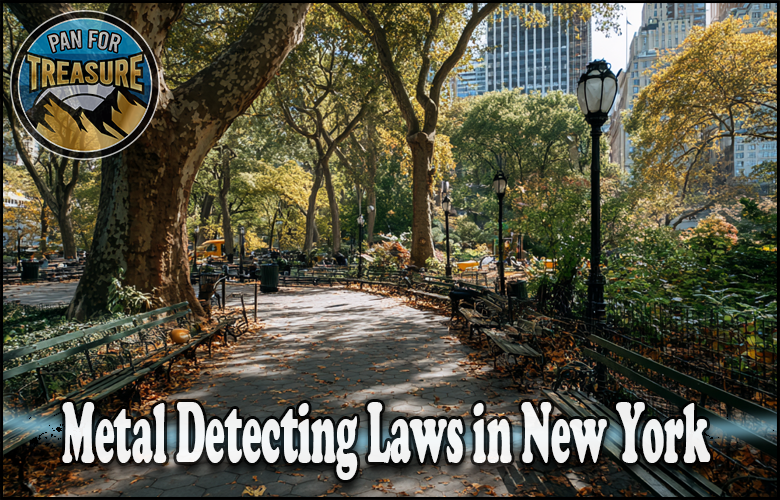
Metal detecting laws in New York are among the most complex in the country due to the layered regulatory system between state parks, New York City parks, and local municipalities.
New York State Parks, Recreation and Historic Preservation issues regional metal detecting permits that authorize use on sandy beach areas only during specified date ranges (typically January 1 through May 15 in many regions).
NYC Parks has its own separate permit system with specific rules. Central Park explicitly prohibits metal detecting.
Despite the complexity, New York offers outstanding detecting potential. The state’s Dutch colonial heritage (1620s), Revolutionary War battlefields, Erie Canal history, and dense population history make both beach and private land detecting productive.
The state has extensive coastline (Long Island, Hudson River, Lake Erie, Lake Ontario) and deep inland history.
New to the hobby? Start with our beginner’s guide to gold panning and prospecting.
TL;DR
- State Parks: Regional permits required; limited to sandy beach areas only; specific date ranges (often Jan 1-May 15); report all findings daily; coins kept, other items turned in
- NYC Parks: Separate NYC Parks permit required; significant objects reported within 48 hours; ball fields, woodlands, and native vegetation areas off-limits
- Central Park: Explicitly prohibited; no exceptions
- Wading: Permitted to 3 feet in bathing areas only at some parks; not permitted at all parks
- Adirondack Park: Permit required (~$10); 6 million acres; gold has been found in the Adirondacks
- Private Land: Excellent option; Dutch colonial, Revolutionary War, and Erie Canal history; written permission required
Regional permits; sandy beach areas only; seasonal dates
Separate NYC permit required; Central Park off-limits
Daily to park manager; coins kept; other items turned in
Dutch colonial (1620s), Revolutionary War, Erie Canal, industrial
6 million acres; permit ~$10; gold found historically
Long Island beaches, Hudson River, Lake Erie, Lake Ontario
Featured
Metal Detecting Laws in New York
Metal detecting laws in New York involve a multi-layered permit system. Here is the breakdown.
New York State Parks
The NYS Office of Parks, Recreation and Historic Preservation issues metal detecting permits by region. The permit system has specific rules: permits authorize use on sandy beach areas only at designated parks within the region. The permit period is typically January 1 through May 15 (off-season), though this varies by region. Wading is permitted to a depth of 3 feet in bathing areas only at some parks, and the permittee must be accompanied by another person while wading. Wading is not permitted at all parks.
Key permit conditions include: report to the park manager daily before using the detector; report all findings daily to the park manager or staff; coins may be kept; other items found must be turned in to the park; items found that are more than 100 years old are state property.
State historic sites are completely off-limits. The permit does not cover any historically designated property.
NYC Parks
New York City Parks has its own separate metal detecting permit system. A valid permit from NYC Parks is required for any detecting on Parks property. The permit defines specific conditions: ball fields, woodlands, and native vegetation areas are off-limits. All recovered significant objects must be reported to the Urban Park Service at (212) 360-2778 within 48 hours of finding. Applicants must submit a photo of significant objects upon request.
Central Park explicitly prohibits metal detecting. No permit will be issued for Central Park.
The five boroughs each have parks with varying characteristics. Some sandy beaches in Brooklyn and Staten Island may be more accessible for permits. Contact NYC Parks directly for current permit availability and restrictions.
Adirondack Park
Adirondack Park is the largest park in the continental United States at approximately 6 million acres. Metal detecting requires a permit (approximately $10). The park has diverse terrain including beaches, campgrounds, and forest areas. Gold has historically been found in the Adirondack Mountains. Contact the park for current permit details and designated detecting areas.
NPS Sites (Prohibited)
All NPS sites are off-limits: Statue of Liberty and Ellis Island, Saratoga National Historical Park, Fort Stanwix National Monument, Women’s Rights National Historical Park, Theodore Roosevelt Birthplace, and all others.
City and Town Parks (Outside NYC)
Municipal park rules vary across New York State. Many towns and cities have no specific metal detecting regulation. Some may require permits. Buffalo, Syracuse, Albany, Rochester, and other upstate cities should be checked individually. Long Island towns have their own beach rules.
Private Land
Private land with written landowner permission is excellent in New York. The state’s Dutch colonial history (1620s), English colonial period, Revolutionary War, and Erie Canal era make private land detecting diverse and productive. ARPA does not apply to private property. Items found on private land belong to the finder per agreement with the landowner, with no 100-year-old restriction.
Rules Summary
| Land Type | Detecting Allowed? | Permit/Permission | Found Items |
|---|---|---|---|
| State Parks (regional) | Sandy beaches only; seasonal | Regional permit required | Daily report; coins kept; other items turned in |
| NYC Parks | With NYC permit; restricted areas | NYC Parks permit required | Significant objects reported within 48 hrs |
| Central Park | No | N/A (prohibited) | N/A |
| Adirondack Park | With permit (~$10) | Permit required | Follow permit conditions |
| NPS Sites | No | N/A (prohibited) | N/A |
| Private Land | Yes | Written landowner permission | Finder keeps (per agreement) |
For state park permits, visit New York State Parks. For NYC permits, see NYC Parks Metal Detector Permits.
Our Favorite Posts
- Metal Detecting Laws in Kentucky – Public Land, Parks, and Beach Rules
- Metal Detecting Laws and Regulations
- Metal Detecting Laws in Georgia – Public Land, Parks, and Beach Rules
- Metal Detecting Laws in Wyoming – Public Land, Parks, and Beach Rules
- Metal Detecting Laws in Tennessee – Public Land, Parks, and Beach Rules
Best Metal Detecting Locations in New York
New York’s coastline, deep history, and diverse terrain offer excellent options.
- Long Island beaches (Nassau, Suffolk Counties) – Jones Beach, Robert Moses, and other state park beaches with regional permits during the off-season. Heavy summer tourism produces massive quantities of lost jewelry and coins. Long Island’s colonial history (1640s) adds depth.
- Adirondack Park (various northern counties) – 6 million acres with permit access. Old mining sites, logging camps, and resort-era locations. Gold has been found in Adirondack streams. See our gold panning laws in New York page.
- Hudson Valley private land (Westchester, Dutchess, Orange, Ulster Counties) – Dutch colonial settlements from the 1620s-1660s. Revolutionary War battlefields (West Point area, Saratoga surrounds). Private farmland near old estates and colonial settlements produces items spanning 400 years.
- Saratoga area private land (Saratoga County) – The Battle of Saratoga (1777) was the turning point of the Revolution. The NPS battlefield is off-limits, but private land surrounding the battle area produces Revolutionary War artifacts.
- Erie Canal corridor (various central counties) – The canal (1825) transformed New York and the nation. Private land along the old canal route, at lock sites, and near canal-era towns produces early 19th-century items.
- Lake Erie and Lake Ontario beaches (Erie, Niagara, Monroe, Oswego Counties) – Great Lakes beaches with state park permits during off-season. Tourist traffic and maritime history. Shipwreck items occasionally wash ashore.
- Staten Island and Brooklyn beaches (NYC boroughs) – With NYC Parks permits, some sandy beach areas may be accessible. Revolutionary War and colonial history in both boroughs.
- Finger Lakes area (various central counties) – Sullivan Campaign (1779) military route crossed this region. Private land along the documented route produces Revolutionary War artifacts. Iroquois cultural sites are strictly off-limits.
See our best locations to find gold guide and state-by-state directory.
New York’s History and What You Might Find
New York’s European history begins with Henry Hudson’s 1609 exploration and Dutch settlement of New Amsterdam (Manhattan) in 1626. The Dutch colonial period left artifacts across the Hudson Valley and New York City. English takeover in 1664 transformed New Amsterdam into New York.
The Revolutionary War saw major action across the state: the battles of Saratoga (1777), Long Island (1776), Oriskany (1777), and the Sullivan Campaign (1779). New York City was occupied by the British throughout most of the war.
The Erie Canal (completed 1825) connected the Great Lakes to the Atlantic and made New York the commercial center of America. The industrial revolution, immigration waves, and urban expansion continued through the 1800s and 1900s.
Common finds include Dutch colonial items (coins, trade goods, clay pipes) in the Hudson Valley and NYC area, Revolutionary War buttons and buckles, musket balls, early American coins, Erie Canal-era artifacts, maritime items along the coast, and massive quantities of modern jewelry and coins at beaches. New York’s dense population history means finds span from the 1620s to the present.
New York has minor gold occurrences in the Adirondacks but is not a significant gold prospecting state.
Recommended Reading
Tips for Metal Detecting in New York
- Understand the regional permit system. State park permits are issued by region with specific date ranges and park lists. Apply for the correct regional permit and check which parks are covered. The off-season (January-May in many regions) is the primary detecting window.
- Get the NYC Parks permit separately. NYC’s system is independent of state parks. Apply through nycgovparks.org. Avoid ball fields, woodlands, and native vegetation. Report significant objects within 48 hours.
- Do not detect in Central Park. The prohibition is explicit and enforced. Focus on other NYC Parks properties with permit access.
- Report all daily finds at state parks. The permit requires daily reporting to park staff. Coins can be kept. Other items must be turned in. Compliance protects your permit and the program.
- Focus on private land for Revolutionary War relics. Saratoga, Hudson Valley, and Long Island all have extensive Revolutionary War private land detecting. County historical societies and battle maps help identify camp sites and supply routes.
- Research Dutch colonial sites. The Hudson Valley’s Dutch heritage (1620s-1660s) predates most English colonial settlements. Private land near old Dutch patroon estates, trade posts, and settlements produces some of the oldest European artifacts in the Northeast.
- Detect Long Island beaches in the off-season. Summer accumulation of lost items makes fall and winter detecting at permitted state park beaches extremely productive. Apply for the Long Island regional permit early.
- Explore the Adirondacks for gold. The Adirondack Mountains have documented gold occurrences. A park permit and a gold-specific detector provide access to one of the Northeast’s few gold prospecting areas.
For technique help, see our techniques guide and tips and tricks.
Metal Detecting Laws
- Metal Detecting Laws in Wyoming – Public Land, Parks, and Beach Rules
- Metal Detecting Laws in Wisconsin – Public Land, Parks, and Beach Rules
- Metal Detecting Laws in West Virginia – Public Land, Parks, and Beach Rules
- Metal Detecting Laws in Washington – Public Land, Parks, and Beach Rules
- Metal Detecting Laws in Virginia – Public Land, Parks, and Beach Rules
Resources
- New York State Parks, Recreation and Historic Preservation – Regional permit information, designated parks, and permit applications.
- NYC Parks Metal Detector Permits – NYC-specific permit applications, rules, and restricted area information.
- NY State Historic Preservation Office – Historic site designations, archaeological protections, and cultural resource information.
- NY Department of Environmental Conservation – State forest and public land information for areas outside the state park system.
Conclusion
Metal detecting laws in New York are complex but navigable. The state park regional permit system, NYC’s separate permit program, and local municipal rules create multiple layers to manage. But New York’s Dutch colonial heritage, Revolutionary War battlefields, Erie Canal history, and extensive coastline make the effort worthwhile.
Apply for the right permits, focus on off-season beach detecting, and build private landowner relationships in the Hudson Valley and battlefield areas. New York packs extraordinary history into every region, and the detecting reflects it.
Explore nearby state guides: metal detecting laws in New Jersey, metal detecting laws in Connecticut, metal detecting laws in Pennsylvania, metal detecting laws in Massachusetts, and metal detecting laws in Vermont. See the full state-by-state metal detecting laws directory.
Frequently Asked Questions – NY Metal Detecting Laws
Can I metal detect in New York state parks?
Yes, with a regional permit limited to sandy beach areas during specified date ranges (often January 1 through May 15). Report all findings daily to park staff. Coins may be kept; other items must be turned in. State historic sites are excluded.
Can I metal detect in New York City parks?
Yes, with a separate NYC Parks permit. Ball fields, woodlands, and native vegetation areas are off-limits. Central Park is explicitly prohibited. Significant objects must be reported to the Urban Park Service within 48 hours.
Can I detect at Revolutionary War sites?
NPS sites (Saratoga, Fort Stanwix) are off-limits. State historic sites are also excluded from permits. Private land surrounding battlefield areas can be detected with landowner permission and is where the best Revolutionary War finds come from.
Is there gold in New York?
Minor gold occurrences exist in the Adirondack Mountains. Adirondack Park permits (~$10) provide access. Gold detecting in the Adirondacks is possible but not highly productive compared to western gold states.
What can I find metal detecting in New York?
Dutch colonial coins and trade goods (1620s+), Revolutionary War buttons, buckles, and musket balls, Erie Canal-era artifacts, maritime items along the coast, and enormous quantities of modern jewelry and coins at beaches. New York’s dense population history produces finds spanning 400 years.
How does New York compare to neighboring states?
New Jersey has a simpler state park permit system and $50 WMA permits. Connecticut allows DEEP land without permits. Pennsylvania has its own park-by-park approach. New York’s complexity is offset by the state’s extraordinary depth of history and extensive coastline.
⛏ Recommended Gear ⛏


* As an Amazon Associate I earn from qualifying purchases at no extra cost to you.
Subscribe to Our Newsletter

Ryan Conlon is the founder of Pan for Treasure.
A lifelong gold panning enthusiast, he created this site to help beginners learn the ropes and share practical tips from his own time on the creek. [email protected]