
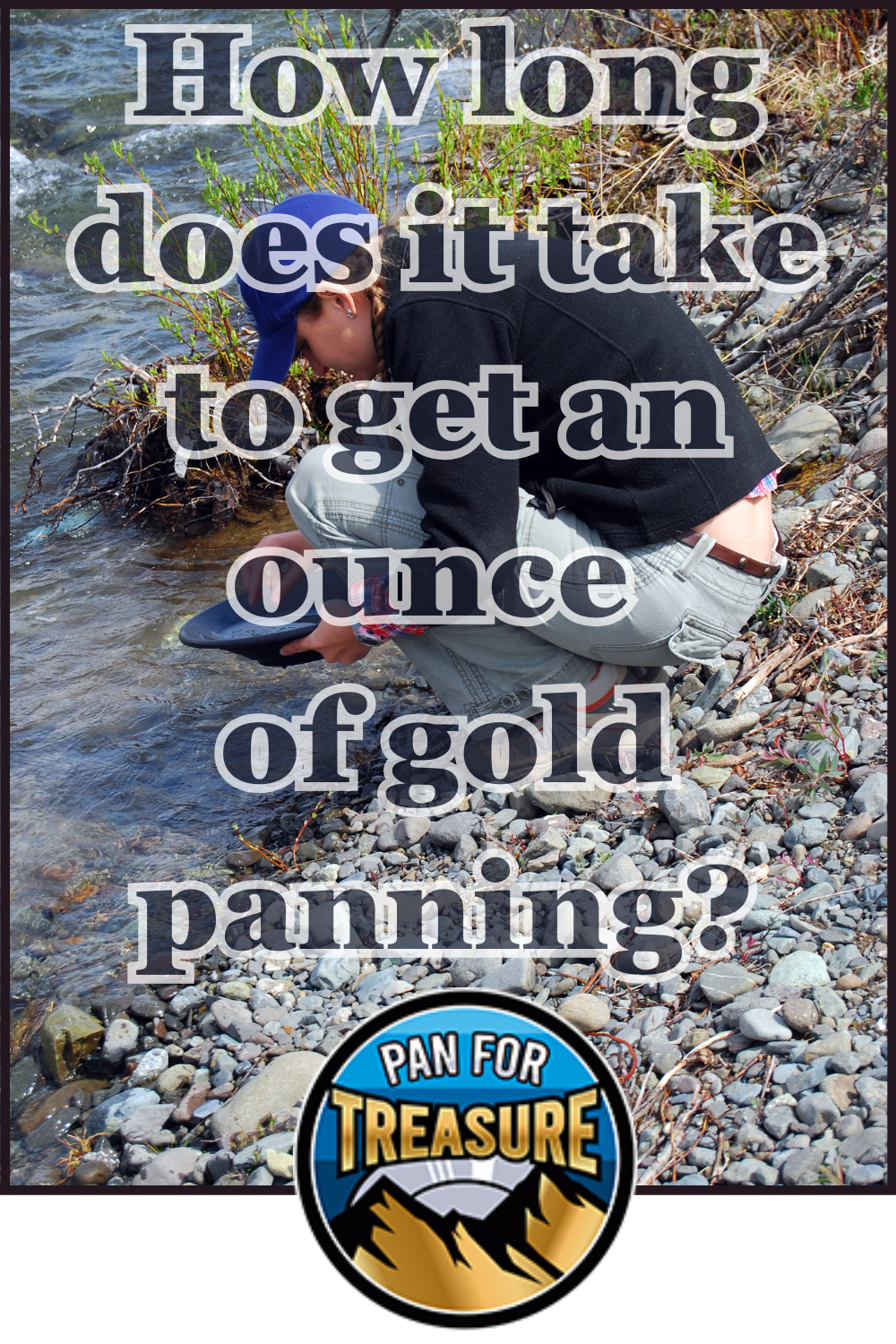
How long does it take to get an ounce of gold panning? For a typical recreational panner, somewhere between 30 and 300 full days of panning, which for a weekend hobbyist means one to several years. Most casual panners never accumulate a full troy ounce with a pan alone, and the ones who do treat it as a long-term milestone, not a season goal.
That answer surprises people, because an ounce doesn’t sound like much. But a troy ounce is 31.1 grams, and hand panning recovers gold a few flakes at a time.
The good news is that the math is knowable: how much material you can process, how rich the ground is, and how efficiently you pan all have realistic numbers attached. Once you see them, you can set honest expectations and, more importantly, see exactly which levers speed things up.
This guide breaks down the real math, the factors that matter most, and what that hard-won ounce is actually worth once you have it. If you haven’t panned before, start with our getting started with gold panning guide.
TL;DR
- A troy ounce = 31.1 grams. That’s roughly 300+ days of panning at a typical hobby recovery rate of about 0.1 gram per day.
- On good ground, it’s faster: Skilled panners on proven, unworked gravel can average 0.5 to 1 gram per day. That still means 30 to 60 full days of panning for one ounce.
- A pan processes very little material: 10 to 15 pans per hour is a solid pace, roughly a quarter to half a cubic yard of classified gravel in a full day.
- Location matters more than anything: The same effort on barren ground yields nothing. Rich, undisturbed pay streaks are what make fast ounces, and they’re rare.
- Equipment collapses the timeline: A sluice box processes 5 to 10 times more material than a pan. Highbankers and dredges (where legal) multiply it again.
- The payoff is real: With gold around $4,000 per troy ounce, that slow ounce is worth serious money, raw placer gold typically sells for 70 to 95% of spot depending on purity and form.
How Long Does It Take to Get an Ounce of Gold Panning? The Real Math
Three numbers control the answer: pans per day, gold per pan, and days in the field. Let’s build it from the bottom.
How much material can you actually pan?
An experienced panner works through 10 to 15 pans per hour of classified material. Over a solid 6-hour day at the water, that’s 60 to 90 pans, which works out to roughly a quarter to half a cubic yard of gravel.
A beginner moves at half that pace. That tiny throughput is the fundamental bottleneck of panning: the pan is a sampling and finishing tool, not a production tool.
How much gold is in each pan?
This is entirely a function of your ground:
- Average public panning areas (worked and reworked for generations): most pans are empty; a decent day yields a few small flakes, often 0.05 to 0.1 gram total.
- Good ground (proven creek, less-worked gravel, sampling on or near bedrock): 0.25 to 0.5 gram per day is a strong result.
- Genuinely rich, undisturbed pay streaks (rare, usually on claims): 1+ gram per day panning is possible, and this is where the stories of fast ounces come from.
Putting it together
| Scenario | Daily Recovery | Full Days to 1 Troy Ounce (31.1 g) | Weekends-Only Timeline |
|---|---|---|---|
| Beginner, average public ground | ~0.05 g/day | ~620 days | 6+ years |
| Typical hobby panner, decent ground | ~0.1 g/day | ~311 days | 3 years |
| Skilled panner, good ground | ~0.5 g/day | ~62 days | 7-8 months of weekends |
| Skilled panner, rich unworked ground | ~1 g/day | ~31 days | 3-4 months of weekends |
| Panner running a sluice box on good ground | 2-5 g/day | 6-16 days | A few weekends to a season |
So when someone asks how long it takes to pan an ounce, the honest range runs from “one great month on exceptional ground” to “several years of ordinary weekends”, and the difference is almost entirely the ground, not the panner.
The Factors That Decide Your Timeline
- Location richness. Nothing else comes close. A day on a rich pay streak beats a year on barren gravel. Research historic production, sample widely before settling in, and use our best locations to find gold directory and gold rush hotspots guide to start on proven ground.
- Reading the stream. Gold concentrates in predictable places: inside bends, behind boulders, in bedrock cracks, and on top of clay layers. Panners who dig in the right spots recover several times more than panners who dig randomly in the same creek. Our guide to selecting the ideal panning location covers how to read water.
- Getting to bedrock. Gold sinks over time. The richest material almost always sits in the last few inches above bedrock or false bedrock (packed clay). Surface gravel is usually the poorest.
- Panning skill and fine gold recovery. Beginners routinely wash fine gold out of the pan. Careful technique, classifying material first, and working concentrates slowly can double what ends up in your vial. See our guide to mastering fine gold recovery.
- Hours in the field. The math above assumes full days. Two or three hours after the drive, setup, and lunch is what most hobby trips really deliver, so a “day” of recovery often takes two or three calendar trips.
- Legal access. The richest ground is usually claimed. Club memberships (GPAA and local clubs) open productive claims legally, and rules on equipment vary by state, so check our gold panning laws by state directory before you upgrade gear.
Equipment That Shortens the Timeline
The pan’s limit is throughput, so every serious step up is about processing more gravel per hour while still catching the gold:
- Classifier (screen): The cheapest upgrade there is. Screening out rocks before panning means every pan is full of the material that actually carries gold, and it can nearly double your effective pace.
- Sluice box: The classic multiplier. A hand-fed stream sluice processes 5 to 10 times more material than panning alone, turning that 0.1 g day into a potential half-gram day on the same ground. Check legality first: some states restrict or permit sluices even for recreational use.
- Highbanker: A sluice with a pump that lets you work gravel away from the waterline. More throughput again, but permit requirements are common.
- Suction dredge: The fastest recreational tool on the water, and the most heavily regulated. Banned entirely in California and restricted in many other states.
- Gold-specific metal detector: A different game: it doesn’t process gravel at all, but in nugget country it can find in one signal what a pan takes a month to accumulate. See our best metal detectors for gold guide.
For a full rundown of gear worth owning, see our gold prospecting tools and equipment guide.
What Is That Ounce Worth When You Finally Get It?
With spot gold trading around $4,000 per troy ounce, a full ounce of recovered placer gold is a genuinely valuable milestone. Two things determine what you’d actually pocket:
- Purity. Natural placer gold isn’t pure. It runs roughly 70 to 95% gold (the rest is mostly silver and copper), varying by district. Buyers pay on assayed or estimated fine-gold content.
- Form. Fine dust and small flakes sell at a discount to melt value. Attractive nuggets and specimen pieces often sell at a premium above their gold content to collectors, sometimes a large one.
Realistically, an ounce of mixed placer gold sells for roughly 70 to 95% of spot: call it $2,800 to $3,800 at today’s prices, more if nuggets are involved. Divide that by the 30 to 300 days it took to recover, and you’ll see why panning is a hobby with a payout rather than a wage.
We run those numbers honestly in how much can you make panning for gold and can you make a living as a full-time gold prospector. And remember: gold you sell is taxable, our guide to taxes on found gold covers the rules.
Tips to Reach Your First Ounce Faster
- Spend your first hour sampling, not producing. Pan test holes across the bar, find the pay streak, then commit your digging to the best spot.
- Dig where gold stops, not where digging is easy. Inside bends, downstream of boulders, bedrock cracks, and moss on bedrock (“nature’s carpet”) out-produce loose surface gravel every time.
- Classify everything. A half-inch screen over a bucket costs almost nothing and doubles your effective throughput.
- Take concentrates home. Don’t burn creek time trying to pan out every speck. Pan down to concentrates, bag them, and finish carefully at home where you’ll lose less fine gold.
- Track your grams. Weigh and log every trip’s recovery. You’ll quickly learn which spots, depths, and techniques actually move your average, and watching the vial fill is half the fun.
- Join a club for access to better ground. The single biggest recovery jump most hobby panners ever experience is their first day on a good club claim instead of a hammered public site.
Resources for Panning Yield and Gold Value
- USGS – Prospecting for Gold in the United States – The classic USGS publication on where and how recreational prospectors find gold, and why most placer ground yields small amounts.
- USGS – Gold (General Interest Publication) – Official overview of gold’s properties, deposit types, and how placer deposits form and concentrate.
- BLM – Mining and Minerals Program – Rules for casual-use prospecting on the public lands where most American panning happens.
- Gold Prospectors Association of America (GPAA) – National club with member claims, outings, and yield expectations from real prospectors.
Conclusion
Set the fantasy aside and the numbers are refreshingly clear: a pan moves a quarter to half a cubic yard of gravel a day, typical ground gives up a tenth of a gram for that work, and a troy ounce is 31.1 grams. That’s the whole equation.
Better ground, better spots within that ground, a classifier, and eventually a sluice box are the levers that compress years into months.
Chase the process rather than the ounce and you’ll enjoy every trip while the vial slowly fills; chase the ounce and you’ll learn exactly why the old-timers moved so much dirt. Either way, now you know the honest answer to how long it takes to get an ounce of gold panning: anywhere from one extraordinary month to several ordinary years, and the ground you stand on decides which.
Frequently Asked Questions – Panning an Ounce of Gold
How long does it take to get an ounce of gold panning?
For most recreational panners, 30 to 300 full days of panning, which means one to several years of weekend trips. On rich, unworked ground a skilled panner averaging a gram a day could do it in about a month, but that ground is rare.
Equipment like a sluice box shortens the timeline dramatically.
How much gold can you pan in a day?
On typical public panning areas, a few small flakes, often 0.05 to 0.1 gram. On good, less-worked ground, 0.25 to 0.5 gram is a strong day.
Recoveries of a gram or more per day with a pan alone generally require rich, undisturbed pay streaks, usually on claims.
How many pans can you do in an hour?
An experienced panner works through 10 to 15 pans of classified material per hour. Beginners typically manage 5 to 8.
Over a six-hour day, that’s roughly a quarter to half a cubic yard of gravel processed.
How much is an ounce of panned gold worth?
With spot gold around $4,000 per troy ounce, raw placer gold typically sells for 70 to 95% of spot depending on purity, roughly $2,800 to $3,800 per ounce. Attractive nuggets can sell above melt value to collectors.
What’s the fastest way to speed up gold recovery?
In order of impact: move to richer ground (club claims are the usual route), dig on bedrock and in pay streaks instead of surface gravel, classify your material, then step up to a sluice box where legal. A sluice processes 5 to 10 times more gravel than a pan.
Is panning an ounce of gold worth the time financially?
As a wage, no: hundreds of hours for a few thousand dollars. As a hobby with a payout, absolutely.
The realistic financial wins in prospecting come from finding rich ground or nuggets, not from hourly pan production.
How much material do you have to move to find an ounce of gold?
On ground carrying a modest 0.2 gram per cubic yard, an ounce requires processing roughly 150 cubic yards, about 15 dump trucks of gravel. That’s why hand panners measure progress in flakes and why old mining operations moved entire hillsides.
⛏ Recommended Gear ⛏


* As an Amazon Associate I earn from qualifying purchases at no extra cost to you.
Subscribe to Our Newsletter

Ryan Conlon is the founder of Pan for Treasure.
A lifelong gold panning enthusiast, he created this site to help beginners learn the ropes and share practical tips from his own time on the creek. [email protected]