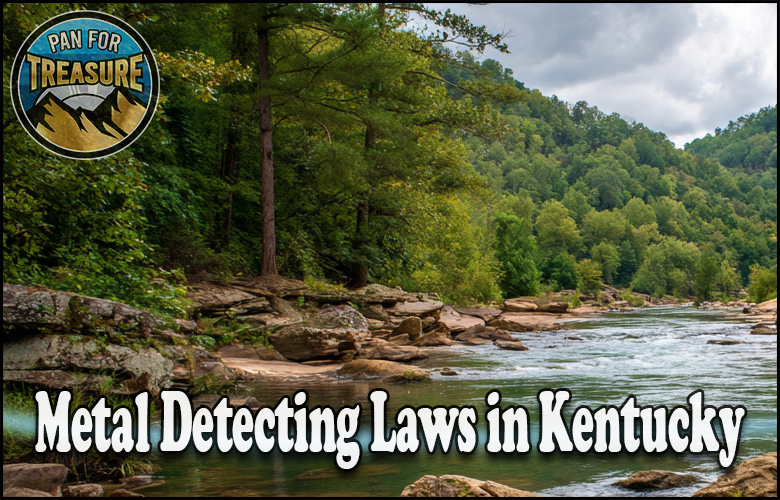
Metal detecting laws in Kentucky are among the most restrictive in the country for public land. Kentucky Administrative Regulation 304 KAR 1:050 prohibits the use of metal detectors in all Kentucky state parks.
The regulation is explicit, applying to all park grounds without exceptions for beaches or specific areas. Louisville Metro Parks (122 parks) also bans detecting under interpretation of the Kentucky Antiquities Act.
Private land is the primary legal option for Kentucky detectorists. The state’s rich history, from Daniel Boone’s frontier settlements through the Civil War (Kentucky was a border state with divided loyalties), makes private land detecting extremely productive.
Like Georgia and Indiana, Kentucky pushes the hobby almost entirely onto private property.
New to the hobby? Check out our beginner’s guide to gold panning and prospecting for the basics.
TL;DR
- State Parks: Metal detecting is strictly prohibited in all Kentucky state parks under 304 KAR 1:050; no exceptions
- Louisville Metro Parks: Metal detecting prohibited in all 122 city and county parks; fines up to $300
- Some City Parks Allow It: Bowling Green allows detecting with restrictions (daylight hours, small tools only); Richmond allows detecting outside ball fields
- Permits: Kentucky’s Department of Environmental Analysis handles detecting permits for state land, but permits are rarely issued to hobbyists
- Private Land: Best and primary option; written landowner permission required; no ARPA restrictions on private property
- Daniel Boone National Forest: Recreational detecting in developed areas may be allowed; check with Forest Supervisor; ARPA artifact restrictions apply
Prohibited in ALL state parks (304 KAR 1:050)
Prohibited in all 122 Metro Parks; $300 fines
Private land with written permission
Frontier (1770s), Civil War border state, bourbon era
Daniel Boone National Forest (708,000 acres)
Vary widely; Bowling Green allows with rules; Lexington no digging
Featured
Metal Detecting Laws in Kentucky
Metal detecting laws in Kentucky are restrictive on public land but straightforward. Here is the breakdown by land type.
State Parks (Prohibited)
Kentucky Administrative Regulation 304 KAR 1:050 prohibits the use of metal detectors in all Kentucky state parks. This prohibition is stated directly on the Kentucky State Parks website FAQ. The regulation applies to all park grounds, including beaches, campgrounds, picnic areas, and trails.
Unauthorized metal detecting in a state park, even to recover a lost personal item, can lead to citations, fines, and possible confiscation of equipment. If you have lost a personal item in a state park, you may visit the Park Ranger station and request limited permission to search, but this requires explicit documented authorization before you begin.
There are no exceptions, seasonal allowances, or permit programs for hobbyist metal detecting in Kentucky state parks.
Louisville Metro Parks (Prohibited)
Louisville Parks and Recreation prohibits metal detecting in all 122 city and county parks managed by the system. This ban is enforced under interpretation of the Kentucky Antiquities Act, which classifies metal detecting as an archaeological activity requiring a permit. Violations can result in fines up to $300. The Parklands of Floyds Fork also explicitly prohibits metal detecting.
City Parks (Varies Widely)
Outside Louisville, city park regulations vary significantly across Kentucky. There is no statewide rule governing municipal parks beyond the state park ban.
Bowling Green allows metal detecting in some city parks with restrictions: daylight hours only, small tools only (screwdrivers, small knives, ice picks), and prohibited areas include athletic fields, golf courses, and the aquatics center. Bowling Green has published a formal list of metal detecting rules.
Richmond Parks and Recreation allows metal detecting in city parks but not on ball fields. They request that holes be kept to minimum depth and that leave-no-trace practices be followed.
Lexington does not allow digging or disturbing the ground in parks. Metal detecting is limited to searching for recently lost surface items.
Florence allows metal detector use but prohibits any digging or ground disturbance. Authorities reportedly monitor for compliance.
Many smaller Kentucky cities have no specific rules but may have general ordinances against disturbing park grounds. Contact local officials directly and get permission (preferably in writing) before detecting in any municipal park.
Daniel Boone National Forest
The Daniel Boone National Forest covers over 708,000 acres in eastern Kentucky. General Forest Service policy allows recreational metal detecting in developed campgrounds and recreation sites unless heritage resources are present. ARPA artifact restrictions apply.
However, much of the Daniel Boone National Forest is surrounded by or adjacent to historically significant areas (frontier settlement sites, Civil War locations, Native American habitation areas). Contact the Forest Supervisor’s office for current policy on recreational detecting in specific areas.
Army Corps of Engineers and BLM Land
Kentucky has numerous Army Corps of Engineers reservoirs and managed areas. There are limited BLM properties managed by the Corps. Detecting policies vary by project. Contact the specific Corps office for rules.
Kentucky’s Department of Environmental Analysis handles detecting permits for state-managed land. Unless you are a professional archaeologist, it is unlikely you will be issued a permit for hobbyist detecting on state land.
Private Land
Private land with written landowner permission is the best and primary option for Kentucky detectorists. ARPA does not apply to private property. Kentucky has extensive private farmland, and the state’s frontier, Civil War, and bourbon industry history makes private land detecting extremely productive.
Kentucky detectorists often emphasize the importance of building relationships with landowners. Approaching farmers and landowners respectfully, explaining the hobby, and offering to share finds or show what you discover goes a long way in a state where public land options are so limited.
Rules Summary
| Land Type | Detecting Allowed? | Digging Allowed? | Permit/Permission | Artifacts |
|---|---|---|---|---|
| State Parks | No (304 KAR 1:050) | No | N/A (prohibited) | N/A |
| Louisville Metro Parks | No | No | N/A (prohibited); $300 fines | N/A |
| Some City Parks | Varies | Some allow small tools | Check each city individually | Report significant finds |
| Daniel Boone National Forest | Developed areas possibly | Casual hand tools | Check with Forest Supervisor | ARPA (100+ year rule) |
| NPS Sites | No | No | N/A (prohibited) | N/A |
| Private Land | Yes | Yes | Written landowner permission | Finder keeps (per agreement) |
For state park rules, see the Kentucky State Parks website. For archaeology regulations, contact the Kentucky Heritage Council / State Archaeology.
Our Favorite Posts
- Metal Detecting Laws and Regulations
- Metal Detecting Laws in Colorado – Public Land, Parks, and Beach Rules
- Metal Detecting Laws in Connecticut – Public Land, Parks, and Beach Rules
- Metal Detecting Laws in Wyoming – Public Land, Parks, and Beach Rules
- Metal Detecting Laws in Montana – Public Land, Parks, and Beach Rules
Best Metal Detecting Locations in Kentucky
With state parks off-limits, Kentucky detecting centers on private land and select city parks.
- Central Kentucky farmland (Bluegrass Region) (Fayette, Woodford, Bourbon, Scott Counties) – Kentucky’s oldest settled region, with communities dating to the 1770s and 1780s. Private farmland near old settlements, stage stops, and early road corridors produces frontier-era coins, buttons, and personal items. This is Daniel Boone country.
- Bowling Green area (Warren County) – One of the few Kentucky cities with clearly defined metal detecting rules allowing the hobby. City parks produce modern coins and jewelry. Private land in the surrounding area has Civil War history (Confederate capital of Kentucky was briefly in Bowling Green).
- Perryville Battlefield area (Boyle County) – The Perryville Battlefield State Historic Site itself is off-limits, but private land surrounding the battlefield area can produce Civil War artifacts. The October 1862 battle was the largest fought in Kentucky. Landowner permission required.
- Richmond area (Madison County) – City parks allow detecting outside ball fields. The Battle of Richmond (August 1862) was a significant Confederate victory. Private land near the battle area can produce Civil War relics. Eastern Kentucky University campus area has long history.
- Western Kentucky farmland (Calloway, Marshall, Graves Counties) – Fort Donelson and the Tennessee River corridor saw significant Civil War activity. Private land in the area produces both frontier-era and Civil War artifacts.
- Harrodsburg / Danville area (Mercer, Boyle Counties) – Harrodsburg (1774) was the first permanent English settlement west of the Appalachians. Private land near the old settlement area produces some of the earliest frontier artifacts in Kentucky.
- Daniel Boone National Forest developed areas (various eastern Kentucky counties) – With Forest Supervisor approval, developed recreation areas may allow detecting. The 708,000-acre forest has deep frontier and Cherokee/Shawnee history.
- Northern Kentucky / Covington area (Kenton, Campbell Counties) – The Cincinnati metro area extends into Kentucky. Older communities along the Ohio River date to the late 1700s. City parks and private land near historic river towns produce coins and artifacts.
See our best locations to find gold guide and our state-by-state metal detecting laws directory.
Kentucky’s History and What You Might Find
Kentucky was among the earliest areas settled west of the Appalachian Mountains. Daniel Boone blazed the Wilderness Road through the Cumberland Gap in 1775, and Harrodsburg (1774) and Boonesborough (1775) became the first permanent English settlements in Kentucky. The state achieved statehood in 1792 as the 15th state.
During the Civil War, Kentucky was a critically important border state that officially declared neutrality. Both Union and Confederate forces operated in the state, and major battles occurred at Perryville (October 1862), Richmond (August 1862), and Mill Springs (January 1862). Kentucky sent soldiers to both armies.
The bourbon whiskey industry has deep roots in Kentucky, dating to the late 1700s. Old distillery sites on private land can produce bottles, tools, and other industry artifacts.
Common detecting finds on Kentucky private land include Large Cents, Indian Head and Wheat pennies, silver coins from the 1800s, military buttons and buckles from both Union and Confederate forces, Minie balls, horseshoes, buckles, and personal items from frontier homesteads. Very early frontier-era items (1770s-1790s) are possible in the Bluegrass Region. Bourbon industry artifacts are specific to distillery areas.
Kentucky has minor gold occurrences in the eastern mountains but is not a practical gold prospecting state.
Recommended Reading
Tips for Metal Detecting in Kentucky
- Do not detect in state parks. The 304 KAR 1:050 prohibition is enforced and applies to all state park grounds. Equipment confiscation and citations are real consequences. Focus your efforts on private land and permissive city parks.
- Check each city individually. Kentucky city park rules vary enormously. Bowling Green allows detecting; Louisville bans it. Lexington allows detecting but not digging. Get the rules in writing from each city’s parks department before visiting.
- Build landowner relationships. With public land options so limited, private land access is essential. Approach landowners respectfully, explain the hobby, offer to show or share finds, and follow through on your commitments. Kentucky’s rural communities respond well to genuine, courteous requests.
- Research Civil War sites. Kentucky’s border state status means Civil War activity occurred across the state. County historical societies, Civil War round tables, and published battle maps help identify camp locations, supply routes, and skirmish sites on private land.
- Target the oldest settlements. Central Kentucky’s Bluegrass Region was settled in the 1770s, making it one of the earliest frontiers west of the Appalachians. Finds from this era are rare and valuable. Old plat maps and land grant records help identify the earliest homestead sites.
- Use small digging tools in city parks. Cities like Bowling Green that allow detecting specify small tools (screwdrivers, ice picks, small knives). Follow these rules carefully. Cities can and do revoke detecting privileges when people abuse the rules.
- Detect old road corridors. The Wilderness Road, Maysville Road, and other early Kentucky thoroughfares saw heavy traffic from the 1770s through the 1800s. Private land along these corridors, especially at old river crossings and stage stops, produces frontier-era items.
- Join a local club. Kentucky has active detecting communities, particularly around Bowling Green, Lexington, and the northern Kentucky area. Club members share productive locations, landowner contacts, and knowledge of local regulations that may not be published online.
For technique help, see our techniques guide and tools and equipment guide.
Metal Detecting Laws
- Metal Detecting Laws in Wyoming – Public Land, Parks, and Beach Rules
- Metal Detecting Laws in Wisconsin – Public Land, Parks, and Beach Rules
- Metal Detecting Laws in Washington – Public Land, Parks, and Beach Rules
- Metal Detecting Laws in Vermont – Public Land, Parks, and Beach Rules
- Metal Detecting Laws in Utah – Public Land, Parks, and Beach Rules
Resources
- Kentucky State Parks – Official state parks website with FAQ confirming the metal detecting prohibition and contact information.
- Kentucky Heritage Council / State Archaeology – Archaeological site protections, antiquities act information, and cultural resource preservation guidelines.
- Daniel Boone National Forest – Forest map, recreation areas, and supervisor’s office contact information for metal detecting inquiries.
- Kentucky Historical Society – Historical resources, research tools, and information on Kentucky’s frontier and Civil War heritage useful for research-based detecting.
Conclusion
Metal detecting laws in Kentucky are blunt about public land: state parks are off-limits, and many major cities follow suit. But Kentucky’s deep frontier history, Civil War battlefields, and bourbon heritage make private land detecting some of the best in the country. Detectorists who invest time in building landowner relationships and researching Civil War-era sites find Kentucky extremely rewarding.
The key to Kentucky detecting is private land access. Build those relationships, do your historical research, and focus on the Bluegrass Region’s frontier settlements and the Civil War corridors across the state.
Explore nearby state guides: metal detecting laws in Indiana, metal detecting laws in Ohio, metal detecting laws in Tennessee, metal detecting laws in Virginia, metal detecting laws in West Virginia, and metal detecting laws in Illinois. See the full state-by-state metal detecting laws directory.
Frequently Asked Questions – KY Metal Detecting Laws
Can I metal detect in Kentucky state parks?
No. Kentucky Administrative Regulation 304 KAR 1:050 prohibits the use of metal detectors in all Kentucky state parks. There are no exceptions for beaches, campgrounds, or specific areas. Unauthorized detecting can result in citations, fines, and equipment confiscation.
Can I metal detect in Louisville parks?
No. Louisville Parks and Recreation prohibits metal detecting in all 122 city and county parks. The ban is enforced under interpretation of the Kentucky Antiquities Act with fines up to $300. The Parklands of Floyds Fork also explicitly prohibits detecting.
Where can I legally metal detect in Kentucky?
Private land with written landowner permission is the primary legal option. Some cities like Bowling Green and Richmond allow detecting in city parks with restrictions. The Daniel Boone National Forest may allow detecting in developed recreation areas with Forest Supervisor approval. Focus on building private landowner relationships for the best access.
What are the best finds in Kentucky?
Kentucky’s frontier history (1770s onward) and Civil War border state status produce outstanding finds on private land. Large Cents, early silver coins, military buttons and insignia from both Union and Confederate forces, Minie balls, frontier-era buckles, and personal items from early homesteads are all found regularly by detectorists with good private land access.
Can I detect at Civil War battlefields in Kentucky?
Not at designated battlefield state historic sites, which are state property and off-limits. However, private land surrounding or adjacent to battlefield areas can be detected with landowner permission. Many of the best Civil War relic finds in Kentucky come from camp sites, supply routes, and skirmish locations on private land near the major battlefields.
Does Kentucky have gold for prospecting?
Kentucky has minor gold occurrences in the eastern mountains, but it is not a practical gold prospecting state. Metal detecting in Kentucky focuses on coins, relics, jewelry, and historical artifacts from the state’s frontier and Civil War heritage.
⛏ Recommended Gear ⛏


* As an Amazon Associate I earn from qualifying purchases at no extra cost to you.
Subscribe to Our Newsletter

Ryan Conlon is the founder of Pan for Treasure.
A lifelong gold panning enthusiast, he created this site to help beginners learn the ropes and share practical tips from his own time on the creek. [email protected]