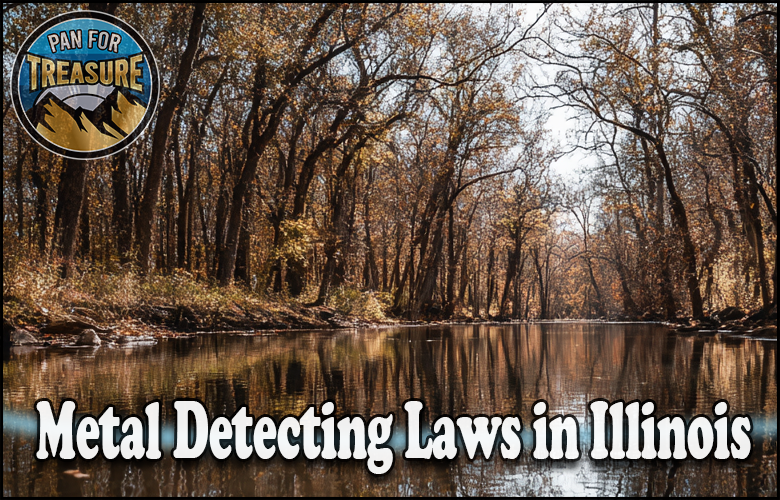
Metal detecting laws in Illinois center on a state park permit system managed by the Illinois Department of Natural Resources (IDNR). Not all state parks allow detecting. Those that do require a free permit from the park office, and the rules can vary from park to park.
Some parks that appear on the IDNR approved list may still refuse detectorists due to specific archaeological or cultural resource concerns at that location.
Illinois is a strong state for the hobby despite the permit requirements. The Land of Lincoln has layer upon layer of history: Native American settlements dating back thousands of years, French and British colonial forts, Civil War camps and supply routes, and 19th-century farming communities.
Private land detecting with landowner permission is the most productive and least restricted option, and Illinois has no shortage of old farmsteads, ghost towns, and historic communities to explore.
New to the hobby? Check out our beginner’s guide to gold panning and prospecting for the basics.
TL;DR
- State Parks: Not all state parks allow detecting; those that do require a free permit from the park office; each park evaluates requests individually
- IDNR Rules: Section 110.70 prohibits artifact collection except by permit under 17 Ill. Adm. Code 370; items of antiquity with park relevance must be turned in
- Digging Tools: Limited to small handheld tools (knives, ice picks); holes must be restored to original condition
- City Parks: Rules vary widely; Rockford requires a permit; Lake Zurich prohibits detecting; many cities have no specific regulation
- Shawnee National Forest: Recreational detecting generally allowed in developed areas; ARPA artifact restrictions apply; archaeological sites off-limits
- Private Land: Best option in Illinois; no ARPA restrictions; written landowner permission required
Permit required; not all parks allow detecting
Free (obtained at park office)
17 Ill. Adm. Code 370; Section 110.70 (artifact collection)
Native American (10,000+ years), French colonial, Civil War, frontier
Shawnee National Forest (southern Illinois)
Private land with permission; permitted state parks; city parks
Metal Detecting Laws in Illinois
Metal detecting laws in Illinois are governed by IDNR administrative rules for state land, federal regulations for national forest and NPS land, and a patchwork of city and county ordinances for local parks. Here is the breakdown by land type.
State Parks (IDNR)
The Illinois Department of Natural Resources manages the state park system. IDNR’s official position, stated in their FAQ, is clear: not all sites allow metal detecting, in order to protect significant cultural or natural resources. Those that do require permits that can be obtained at the park office. IDNR advises calling the specific park first to confirm detecting is allowed before visiting.
Section 110.70 of the IDNR administrative code makes it unlawful for any person to collect or take artifacts and/or mutilate, destroy, deface or excavate any archaeological site except as provided by permit according to 17 Ill. Adm. Code 370. The metal detecting permit form (modeled after the Giant City State Park permit) includes these key rules: items of antiquity with relevance to the park must be turned in to the park office, digging tools are limited to small handheld implements, all holes must be filled, and the permit must be carried while detecting.
State parks known to allow detecting with a permit include Giant City State Park, Starved Rock State Park, Mississippi Palisades State Park, Illini State Park, Cave-in-Rock State Park, Chain O’Lakes State Park, and North Point Marina. However, individual park managers have discretion to deny permits, and some areas within approved parks (especially near documented archaeological sites) may be off-limits.
Fort Massac State Park (Massac County) is entirely off-limits due to its significant historical and archaeological resources.
City and County Parks
City and county park regulations vary widely across Illinois. There is no statewide rule governing metal detecting in municipal parks. Some examples of the variation:
Rockford Park District requires a metal detecting permit from their Customer Service Office. Mason City (Iowa border area) and many other cities require permits. Lake Zurich and Lake Forest prohibit metal detecting in their parks. Many Illinois cities have no specific regulation, meaning detecting is technically allowed unless posted otherwise.
Always check with the specific park district or municipality before detecting in any city or county park. A quick phone call can save a citation.
Shawnee National Forest
The Shawnee National Forest in southern Illinois is the state’s only national forest. General Forest Service policy allows recreational metal detecting in developed campgrounds, swimming beaches, and other developed recreation sites unless heritage resources are present, in which case the Forest Supervisor may close those areas.
However, the Forest Service also requires that using a metal detector to locate mineral deposits (gold, silver) is considered prospecting and requires permits in Illinois. Archaeological site detecting requires a special-use permit available only for legitimate research. ARPA restrictions on artifacts over 100 years old apply fully.
Contact the Shawnee National Forest supervisor’s office for current policy on recreational detecting in specific areas.
National Parks and Monuments
All NPS sites in Illinois are off-limits. This includes the Lincoln Home National Historic Site (Springfield), Pullman National Historical Park (Chicago), and all other NPS-managed properties.
Army Corps of Engineers Land
Illinois has numerous Army Corps of Engineers reservoirs and managed waterways. Title 36, Section 327.14 governs these areas. Destruction, injury, defacement, removal or alteration of public property is prohibited. Metal detecting policies vary by project; contact the specific Corps office managing the land.
Private Land
Private land with written landowner permission is the best and least restricted option in Illinois. ARPA does not apply to private property. Illinois has extensive private agricultural land, and old farmsteads, ghost town sites, and historic communities on private property produce the best finds. Always get written permission and agree on terms regarding finds before detecting.
Rules Summary
| Land Type | Metal Detector Allowed? | Digging Allowed? | Permit/Permission | Artifacts (100+ Years) |
|---|---|---|---|---|
| State Parks (IDNR) | Some parks only (with permit) | Small handheld tools; fill all holes | Free permit from park office | Items of antiquity turned in to park |
| City/County Parks | Varies by city | Varies | Some require permits; some prohibit | Varies by ordinance |
| Shawnee National Forest | Developed areas generally yes | Casual hand tools; fill holes | Check with Forest Supervisor | Removal prohibited under ARPA |
| National Parks / NPS | No | No | N/A (prohibited) | N/A |
| Army Corps Land | Varies by project | Varies | Contact specific Corps office | Removal prohibited |
| Private Land | Yes | Yes | Written landowner permission | Finder keeps (per agreement) |
For IDNR park permits, contact the specific park office or visit the IDNR Parks Activities page. For archaeological regulations, see Illinois State Archaeological Survey.
Our Favorite Posts
Best Metal Detecting Locations in Illinois
Illinois offers diverse detecting opportunities from urban parks to rural farmland.
- Starved Rock State Park (LaSalle County) – One of the most popular state parks for detecting. The area was home to the Kaskaskia and other tribes for centuries, and 17th-century European contact left additional artifacts. Permit required from park office. Designated areas only.
- Giant City State Park (Williamson and Union Counties) – Another IDNR park that issues metal detecting permits. Southern Illinois location with deep history including pre-contact Native American use and Civil War-era activity.
- Mississippi Palisades State Park (Carroll County) – Bluffs overlooking the Mississippi River with long human habitation history. Detecting permitted with IDNR permit. Stay away from cliff edges and documented archaeological areas.
- Cave-in-Rock State Park (Hardin County) – Along the Ohio River in deep southern Illinois. The cave was used by river pirates in the late 1700s and early 1800s. Detecting with permit in designated areas.
- Chicago area parks (Cook County) – Some suburban park districts allow detecting with permits. Check each municipality individually. Older neighborhoods established in the mid-1800s produce old coins and relics. Lake Michigan beaches near Chicago can produce modern jewelry and coins.
- Galena area (Jo Daviess County) – Lead mining boomtown of the 1820s-1850s. Ulysses S. Grant’s pre-war home. Private land near old mining sites and the historic town can be extremely productive with landowner permission.
- Cahokia area (St. Clair County) – The region surrounding the Cahokia Mounds (a UNESCO World Heritage Site, strictly off-limits) has deep Native American and French colonial history. Private farmland in the area can produce pre-contact and colonial-era items. Do not approach the mounds or any protected archaeological site.
- Ghost towns (various counties) – Illinois has dozens of abandoned towns, especially in the southern and central parts of the state. Coal mining ghost towns, railroad-era settlements, and abandoned farming communities on private land produce 19th and early 20th-century artifacts. Verify land ownership and get permission.
- Old Route 66 corridor (various counties) – The historic Route 66 passes through Illinois from Chicago to East St. Louis. Roadside attractions, gas stations, and diners once lined the route. Private land along the old highway can produce mid-20th-century Americana.
See our full state-by-state metal detecting laws directory and our best locations to find gold guide for more.
Illinois History and What You Might Find
Illinois has been continuously inhabited for at least 10,000 years. The Cahokia civilization, centered near present-day Collinsville, was the largest pre-Columbian settlement north of Mexico, with an estimated 20,000 residents at its peak around 1100 AD. French explorers Marquette and Jolliet arrived in 1673, and French settlements at Kaskaskia and Cahokia (the colonial village, not the mounds) followed.
The state saw significant action during the Civil War era, not as a battlefield state but as a major staging, supply, and training ground. Camp Douglas in Chicago housed Confederate prisoners. Cairo, at the state’s southern tip, was a key Union supply base. Artifacts from military camps and supply routes are found on private land across the state.
Common metal detecting finds in Illinois include Indian Head and Wheat pennies, Barber and Mercury dimes, silver quarters, brass buttons (both military and civilian), lead Minie balls and cartridge casings near Civil War-era sites, horseshoes, harness hardware, and personal items from 19th-century farmsteads. Pre-contact Native American copper items and trade goods are occasionally found but are rare and should be reported if found on public land.
Illinois is not a gold state. There are no significant gold deposits, and gold prospecting is not a practical activity here. The focus for Illinois detectorists is coins, relics, and jewelry.
Recommended Reading
Tips for Metal Detecting in Illinois
- Call the park office first. Even if a state park is on the IDNR approved list, the park manager has discretion to deny permits. A quick phone call before driving to the park saves time and frustration.
- Get your city park rules in writing. Illinois city and county park regulations vary enormously. Some require permits, some prohibit detecting, and many have no specific rule. Check the municipal code or call the parks department before detecting.
- Focus on private land. Private property with landowner permission offers the least restricted and often most productive detecting in Illinois. Old farmsteads, ghost town sites, and historic properties are the best targets. Build relationships with landowners over time.
- Research old maps. Illinois has excellent historical map resources through the state archives and county historical societies. Plat maps from the 1800s show old homesteads, schools, churches, and gathering places that no longer exist but can still produce finds.
- Use small digging tools. IDNR rules limit digging to small handheld tools. Even on private land, using a small digging tool and cutting clean plugs is good practice. Fill every hole and replace turf neatly.
- Turn in items of antiquity at state parks. The IDNR permit requires turning in items of antiquity with relevance to the park. This includes anything that appears historically significant. Modern coins and jewelry are generally yours to keep.
- Detect after events. Public parks and fairgrounds (with permission) after festivals, county fairs, and community events produce fresh drops of coins and jewelry. Illinois hosts hundreds of community events each summer.
- Join a local club. Illinois has active metal detecting clubs, especially in the Chicago, Rockford, Springfield, and southern Illinois areas. Club members share knowledge about permitted locations, local regulations, and productive sites.
For technique help, see our techniques guide and tools and equipment guide.
Resources
- Illinois Department of Natural Resources – Parks Activities – State park activity listings, contact information for individual parks, and permit details.
- Illinois State Archaeological Survey – Information on archaeological site protections, reporting requirements, and state archaeology regulations (17 Ill. Adm. Code 370).
- Shawnee National Forest – Forest map, recreation information, and contact details for the supervisor’s office regarding metal detecting policies.
- Illinois State Archives – Historical maps, plat records, and county histories useful for research-based detecting.
Conclusion
Metal detecting laws in Illinois require more advance planning than some neighboring states due to the park-by-park permit system and varying city regulations. But the effort pays off. Illinois has deep, layered history from pre-contact civilizations through the Civil War and into the industrial age, and detectorists who do their homework find everything from Colonial-era trade goods to 19th-century silver coins.
Private land with landowner permission is the most productive strategy in Illinois. State parks with IDNR permits are a good supplement, especially in the scenic southern Illinois parks near the Ohio and Mississippi rivers. Do your research, get your permits, and respect the land.
Explore nearby state guides: metal detecting laws in Indiana, metal detecting laws in Iowa, metal detecting laws in Missouri, metal detecting laws in Wisconsin, and metal detecting laws in Kentucky. See the full state-by-state metal detecting laws directory.
Frequently Asked Questions – IL Metal Detecting Laws
Can I metal detect in Illinois state parks?
Some Illinois state parks allow metal detecting with a free permit from the park office, but not all parks participate. The IDNR advises calling the specific park first before visiting. Each permit request is individually evaluated, and the park manager has discretion to approve or deny. Fort Massac State Park and sites with significant archaeological resources are entirely off-limits.
Do I need a permit to metal detect in Illinois?
For state parks, yes. A free permit is required and must be obtained from the park office. For city and county parks, it depends on the municipality. Rockford requires a permit, while many cities have no specific regulation. For private land, no government permit is needed, just written landowner permission. For Shawnee National Forest, check with the Forest Supervisor’s office.
What happens if I find an artifact in an Illinois state park?
Items of antiquity with relevance to the park must be turned in to the park office per the IDNR metal detecting permit. On all public land, ARPA prohibits removal of man-made objects over 100 years old. Modern coins and jewelry found in state parks are generally yours to keep. If you find something that appears historically significant, report it to the park office.
Can I metal detect on private land in Illinois?
Yes. Private land with written landowner permission is the best option for metal detecting in Illinois. ARPA does not apply to private property. You can keep what you find per your agreement with the landowner. Old farmsteads, ghost town sites, and historic properties are the most productive private land locations.
Is there gold in Illinois?
Illinois is not a gold state. There are no significant gold deposits, and gold prospecting is not practical here. Metal detecting in Illinois focuses on coins, relics, jewelry, and historical artifacts from the state’s deep settlement history rather than on precious metals.
What are the best places to metal detect in Illinois?
The best state parks include Starved Rock, Giant City, Mississippi Palisades, and Cave-in-Rock (all with IDNR permits). Private land near the Galena lead mining district, along the old Route 66 corridor, and at ghost town sites across southern and central Illinois produces the best variety of finds. City parks in older communities with permits can be productive for coins and jewelry.

⛏ Recommended Gear ⛏


* As an Amazon Associate I earn from qualifying purchases at no extra cost to you.
Subscribe to Our Newsletter

Ryan Conlon is the founder of Pan for Treasure.
A lifelong gold panning enthusiast, he created this site to help beginners learn the ropes and share practical tips from his own time on the creek. [email protected]