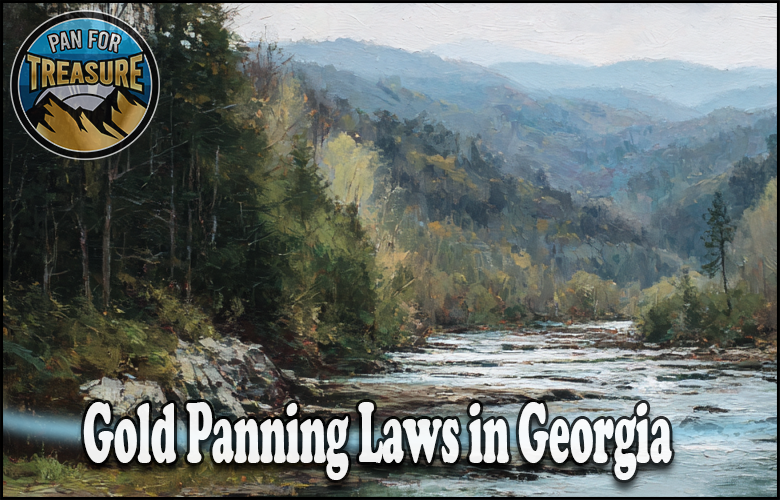
A prospector panning for gold in a Georgia stream where recreational gold panning is allowed under state regulations.
The gold panning laws in Georgia are straightforward: recreational hand panning is legal and does not require a surface mining permit. Georgia’s Environmental Protection Division (EPD) explicitly exempts hobbyists who pan for rocks and minerals as a recreational activity. But there are real limits on where you can go, what equipment you can use, and when certain streams are off-limits.
Georgia has legitimate gold. The state produced an estimated 870,000 troy ounces between 1828 and the mid-20th century, hosted America’s first major gold rush, and had its own U.S. Mint at Dahlonega. The Georgia Gold Belt stretches from Carroll County to Rabun County across the north Georgia mountains, and recreational prospectors still find gold in these streams today.
This guide covers the regulations you need to follow, where you can legally pan, and what restrictions apply. If you’re new to the hobby, start with our getting started with gold panning guide.
TL;DR
- No permit needed for recreational gold panning. The Georgia Surface Mining Act exempts hobbyists from surface mining permits.
- Chattahoochee-Oconee National Forest: Hand panning with a pan and small hand shovel/trowel is allowed. No sluice boxes, suction dredges, or motorized equipment. Stay in the streambed. No digging into banks.
- State parks: Gold panning and rock collecting are not permitted in Georgia state parks.
- Lake Allatoona (Corps of Engineers): Recreational panning allowed in tributary creeks. Gold pans only. No sluice boxes, rockers, dredges, or metal detectors.
- Suction dredging: Not allowed in national forests. Not recommended on private streams.
- Trout streams: Some primary trout streams close temporarily during spawning season. Contact GA DNR Wildlife Resources Division (770-535-5498) to check stream status.
- Private land: Get written permission from the property owner. Most gold-bearing streams in Georgia run through private land.
~870,000 Troy Ounces
1828-1849 (First Major US Rush)
Carroll to Rabun County
Near 24 Karat
North Georgia Mountains
Not Required
Featured
Gold Panning Laws in Georgia
Georgia’s regulatory framework for recreational gold panning is clearer than most eastern states. The Georgia Surface Mining Act of 1968 (as amended) defines mining as activity “for sale or for processing or for consumption in the regular operation of a business.” The Georgia EPD explicitly states that a surface mining permit is not required for hobbyists panning for rocks and minerals as a recreational activity.
That exemption applies statewide, but where you can actually pan depends on the land type.
Chattahoochee-Oconee National Forest
The Chattahoochee National Forest covers a large portion of north Georgia and overlaps significantly with the Georgia Gold Belt. This is the most accessible public land for gold panning in the state. The rules are clear:
- Hand panning with a gold pan and small hand shovel or trowel is allowed
- No special permission, permits, or fees are required
- Panning must stay within the streambed – do not dig into stream banks
- No significant stream disturbance
- No in-stream sluice boxes
- No suction dredges
- No motorized equipment
Some areas within the national forest may be closed or have additional restrictions. Always check with the local Ranger District office for the most current rules before heading out.
State Parks – Not Allowed
Gold panning, prospecting, and rock collecting are not permitted in Georgia state parks. This includes the Dahlonega Gold Museum State Historic Site, which is a museum only – not a panning location. Do not attempt to pan in any state park.
Lake Allatoona – Corps of Engineers Land
Lake Allatoona in Cherokee County sits within the historic Georgia Gold Belt, and some tributary creeks on U.S. Army Corps of Engineers land are open to recreational gold panning. The rules are strict:
- Gold pans only
- Digging must stay within creek beds – no bank digging
- No sluice boxes, rockers, dredges, or metal detectors
- Stay out of prohibited areas and organizational lease areas
Lake Allatoona is popular because it’s close to the Atlanta metro area and has eight campgrounds, making it a good base for a weekend prospecting trip.
Suction Dredging
Suction dredging is not allowed in national forests in Georgia. The Georgia EPD also says dredging is “not recommended” in privately owned streams. If you want to suction dredge on private land, you would need written landowner permission and should contact both the EPD and the GA DNR Wildlife Resources Division to understand applicable rules.
Trout Stream Restrictions
Georgia’s north mountain streams are home to trout, and some primary trout streams close temporarily to protect trout during spawning season. Before panning in any north Georgia stream, contact the GA DNR Wildlife Resources Division at 770-535-5498 to check whether the stream is open. Violating trout stream closures can result in penalties.
Private Land
Most gold-bearing streams in Georgia run through private property. Written permission from the property owner is required before any prospecting. The EPD strongly recommends getting permission in writing. If you find a willing landowner, respect their property, fill any holes, and keep the landowner informed of what you’re doing.
Equipment Restrictions by Land Type
| Equipment | National Forest | Lake Allatoona (Corps) | State Parks | Private Land |
|---|---|---|---|---|
| Gold Pan | Allowed | Allowed | Not allowed | With permission |
| Hand Shovel / Trowel | Allowed (in stream only) | In creek bed only | Not allowed | With permission |
| Classifier / Screen | Allowed | Check locally | Not allowed | With permission |
| Sluice Box | Not allowed | Not allowed | Not allowed | With permission |
| Metal Detector | Check with Ranger District | Not allowed | Some parks allow in designated areas | With permission |
| Suction Dredge | Not allowed | Not allowed | Not allowed | Not recommended (check EPD) |
| Motorized Equipment | Not allowed | Not allowed | Not allowed | May require permits |
For gear recommendations, see our best tools for gold panning roundup.
Our Favorite Posts
- Gold Panning Laws in California Permits, Rules and Best Spots
- Gold Panning Laws in Colorado – What Prospectors Need to Know
- Gold Panning Laws in Arizona – What Prospectors Need to Know
- Gold Panning Laws in Alaska – What Prospectors Need to Know
- Gold Panning Laws in Nevada – What Prospectors Need to Know
Best Gold Panning Locations in Georgia
Georgia’s gold is concentrated in the Georgia Gold Belt, a band of metamorphic rock stretching across the north Georgia mountains from Carroll County in the west to Rabun County in the northeast. Gold here is found in both placer deposits (stream gravels) and lode deposits (quartz veins in rock). The gold is exceptionally pure, often above 23 karats. For more detail, see our page on whether there’s gold in Georgia.
- Dahlonega Area / Yahoola Creek (Lumpkin County) – The heart of the Georgia Gold Rush. An estimated 400,000 to 500,000 ounces were extracted from the Dahlonega mining district alone. Yahoola Creek, Cane Creek, and numerous small tributaries all produced gold. Much of the land is private, but the Chattahoochee National Forest borders the area. The Dahlonega Gold Museum is worth a visit for history but does not allow panning.
- Chestatee River (Lumpkin/White Counties) – A major tributary of the Chattahoochee River with documented placer deposits. Multiple historic mines operated along its banks. The Tesnatee Creek tributary is also productive. Parts flow through national forest land where hand panning is allowed.
- Etowah River (Lumpkin/Dawson Counties) – Runs through the gold belt with known placer gold. Smaller creeks and tributaries draining into the Etowah are also worth sampling. The Little River, a tributary, has gold-bearing banks.
- Dukes Creek (White County) – Historic reports of large nuggets. Several mines operated here before the Civil War. The area near Helen, GA has both national forest access and commercial panning operations (Duke’s Creek Gold & Ruby Mines).
- Lake Allatoona Tributary Creeks (Cherokee County) – Corps of Engineers land with free public access for gold panning. Close to Atlanta, making it the most convenient option for day trips. Gold pans only, no other equipment.
- Chattahoochee River (White County) – A 430-mile river that starts in the north Georgia mountains. The upper stretches in White County, near where Nacoochee Creek joins, were the site of Georgia’s first documented gold discovery. National forest access in some sections.
- Auraria Area (Lumpkin County) – Just south of Dahlonega. Auraria was a boomtown of 10,000 people in the 1830s. The Calhoun Mine was the biggest operation. The town is mostly gone now, but the creeks still hold gold. Mostly private land.
- Nacoochee Valley (White County) – The confluence of the Nacoochee and Chattahoochee Rivers is often cited as the location of Georgia’s very first gold discovery. Rich placer deposits were found here. Mostly private land but worth investigating for access.
- Sixes Mine / Cherokee County Creeks – Cherokee County had several productive lode mines including the Cherokee Mine and Sixes Mine. Creeks in this area still produce gold for recreational panners.
For a broader look, see our list of the best places to pan for gold in America.
Commercial Gold Panning Sites
Georgia has several pay-to-pan operations where you can try gold panning with guaranteed results. These are great for beginners and families:
- Crisson Gold Mine (Dahlonega) – Operating open-pit gold mine established in 1847. The only operational stamp mill in Georgia. Gold panning, gem grubbing, and mine tours. You’re panning actual mine material, not salted dirt.
- Consolidated Gold Mine (Dahlonega) – Underground mine tours and gold panning. Good for learning the history and trying your hand at panning.
- Gold ‘n Gem Grubbin’ (Cleveland) – Located at the old Loud Mine site, 90 miles northeast of Atlanta. Gold panning and gemstone collecting.
- Outpost Gold & Gem (Helen) – Near Helen, GA. Family-friendly panning and gem mining.
These commercial sites charge admission but provide all equipment and instruction. They’re a good way to learn panning technique before heading to public land on your own.
Recommended Reading
History of Gold in Georgia
Georgia hosted the first major gold rush in the United States. Gold was discovered in what is now Lumpkin County in 1828, and by the summer of 1829, as many as 3,000 miners were working the streams and rivers of the north Georgia mountains. By 1830, the town of Dahlonega supported an estimated 15,000 miners, and the Philadelphia Mint was receiving over $212,000 in gold from Georgia that year alone.
So much gold was coming out of the mountains that in 1838 Congress established a U.S. Branch Mint at Dahlonega. Over its 23-year existence (it closed in 1861 at the start of the Civil War), the mint produced over $6 million in gold coins. Those coins are now extremely valuable to collectors due to their low mintage.
The gold rush had devastating consequences for the Cherokee people. Most of the gold was found on Cherokee land, and the rush was a direct factor in the forced removal of the Cherokee Nation on the Trail of Tears. The taking of Cherokee lands opened even more territory for mining.
When gold was discovered in California in 1848, many Georgia miners headed west. The Dahlonega Mint assayer M.F. Stephenson tried to stop them, declaring from the courthouse steps: “There’s gold in them thar hills!” The phrase became part of American culture. He was right – mining continued for decades, and the state produced an estimated 870,000 troy ounces total. The gold belt saw 500+ mines across 37 counties, with hydraulic mining and deep shaft operations continuing into the 20th century.
Rules
- Gold Panning Laws in Delaware – What Prospectors Need to Know
- Gold Panning Laws in Arkansas – What Prospectors Need to Know
- Gold Panning Laws in New Jersey – What Prospectors Need to Know
- Gold Panning Laws in Michigan – What Prospectors Need to Know
- Gold Panning Laws in South Dakota – What Prospectors Need to Know
Tips for Gold Panning in Georgia
- Start at a commercial operation. If you’re new to panning, spend a day at Crisson Gold Mine or Consolidated Gold Mine in Dahlonega. You’ll learn technique on guaranteed pay dirt before trying your luck on public land.
- Focus on the Chattahoochee National Forest. This is the largest block of public land in the gold belt where hand panning is allowed without permits or fees. The Dahlonega, Chestatee, and Etowah drainages are your best targets.
- Look for signs of old mining. Tailing piles, hand-stacked rocks, and old mining debris mark spots where the old-timers found gold. These areas still produce today. See our panning techniques guide.
- Pan the contact zones. Georgia gold often occurs where different rock types meet – mica schist and granite, or mica schist and hornblende schist. These contact zones are where gold veins formed.
- Call DNR before panning in trout streams. Some primary trout streams close seasonally. A quick call to 770-535-5498 can save you from a citation.
- Stay in the streambed. This is the single most common rule across all public land in Georgia. No bank digging, no disturbing vegetation on stream banks. Work material from the creek bottom only.
- Join a prospecting club. The Weekend Gold Miners, Southern Gold Miners Association, and GPAA all have chapters in Georgia. Club members share access to private properties and local knowledge that is hard to find any other way.
- Bring the right gear for fine gold. Georgia gold ranges from fine flakes to small nuggets. A black pan, snuffer bottle, and classifier will help you recover the finer material. Georgia gold is remarkably pure (near 24 karat), so even tiny flakes have good value.
- Get landowner permission in writing. The EPD specifically recommends this. Most productive streams in Georgia run through private land, and a written agreement protects both you and the landowner.
Resources for Georgia Prospectors
- Georgia EPD – Recreational Mining Exemption – Official state policy confirming that hobbyist gold panning does not require a surface mining permit. Lists dredging restrictions and trout stream contact info.
- Chattahoochee-Oconee National Forest – U.S. Forest Service information on recreation, access, and regulations for the national forest that covers much of the gold belt.
- Dahlonega Gold Museum State Historic Site – Museum housed in the 1836 Lumpkin County Courthouse. Exhibits on gold rush history, rare Dahlonega Mint coins, and mining equipment.
- Gold Prospectors Association of America (GPAA) – National organization with Georgia chapters and resources for recreational prospectors.
- Navigating the Gold Panning Permit Process – Our guide to understanding permit requirements for recreational prospecting across all states.
Conclusion
The gold panning laws in Georgia are clear and favorable for recreational prospectors. No surface mining permit is required for hobby panning. The Chattahoochee National Forest offers free public access for hand panning, and Lake Allatoona provides a convenient option near Atlanta. The main restrictions are no sluice boxes or dredges on public land, no bank digging, no panning in state parks, and seasonal trout stream closures.
Georgia’s gold belt is one of the most productive in the eastern United States, with real gold still in the streams. It’s a far better prospecting destination than most states east of the Mississippi.
Check out the laws in neighboring North Carolina, South Carolina, Alabama, Tennessee, and Florida, or browse our full gold panning laws by state directory.
Frequently Asked Questions – GA Gold Panning Laws
Is gold panning legal in Georgia?
Yes. Recreational gold panning is legal in Georgia and does not require a surface mining permit. The Georgia Surface Mining Act exempts hobbyists who pan for rocks and minerals as a recreational activity. You can pan on Chattahoochee National Forest land, Corps of Engineers land at Lake Allatoona, and private land with written owner permission. State parks do not allow panning.
Do you need a permit to pan for gold in Georgia?
No. A surface mining permit is not required for recreational hand panning. No permits or fees are needed to pan in the Chattahoochee National Forest as long as you use only a pan and small hand shovel and do not disturb the stream. Commercial mining operations require permits under the Georgia Surface Mining Act.
Can you use a sluice box in Georgia?
Not on public land. Sluice boxes, rockers, and suction dredges are not allowed in national forests or on Corps of Engineers land at Lake Allatoona. On private land with written landowner permission, a sluice box may be used, but suction dredging is not recommended by the Georgia EPD. Contact the EPD for guidance on equipment beyond a gold pan.
Where can you pan for gold for free in Georgia?
The Chattahoochee National Forest in north Georgia allows free hand panning with no permits or fees. Lake Allatoona tributary creeks on Corps of Engineers land are also free. Both require only a gold pan and hand shovel. Commercial operations in Dahlonega and Cleveland charge admission fees but provide equipment and instruction.
Can you pan for gold in Georgia state parks?
No. Gold panning, prospecting, and rock collecting are not permitted in Georgia state parks. This includes the Dahlonega Gold Museum State Historic Site, which is a museum only. State forests and national forests are better options for prospecting.
What is the best place to pan for gold in Georgia?
The Dahlonega area in Lumpkin County is the most productive gold region in the state, with an estimated 400,000 to 500,000 ounces extracted historically. Streams within the Chattahoochee National Forest near Dahlonega, the Chestatee River, Etowah River, and Dukes Creek are all proven gold-bearing waterways. Lake Allatoona is the best option close to Atlanta.

⛏ Recommended Gear ⛏


* As an Amazon Associate I earn from qualifying purchases at no extra cost to you.
Subscribe to Our Newsletter

Ryan Conlon is the founder of Pan for Treasure.
A lifelong gold panning enthusiast, he created this site to help beginners learn the ropes and share practical tips from his own time on the creek. [email protected]