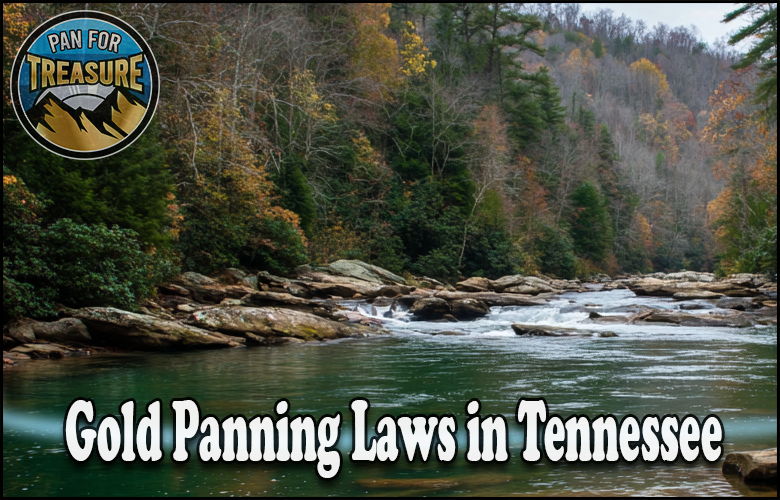
A Tennessee creek with shallow gravel bars where recreational gold panning sometimes takes place.
The gold panning laws in Tennessee allow recreational hand panning on public land and private land with the landowner’s permission.
Tennessee does not require a state permit for recreational gold panning with hand tools.
The Cherokee National Forest in southeastern Tennessee provides public access to gold-bearing streams, and the Coker Creek area in Monroe County is one of the best-known gold panning destinations in the southeastern United States.
Tennessee sits at the northern end of the Appalachian gold belt, the same geological formation that produced gold rushes in Georgia, the Carolinas, and Virginia. Gold was first mined in Monroe County in the 1820s, and the Coker Creek Mining District produced significant placer gold through the 1800s.
Today, recreational prospecting is popular in southeastern Tennessee, and several private gold panning operations offer public access for a fee.
This guide covers the current regulations, the best locations, and Tennessee’s gold mining history. If you are new to panning, start with our getting started with gold panning guide.
TL;DR
- Hand panning: No state permit required for recreational hand panning. Tennessee has no state-specific recreational mining statute.
- Cherokee National Forest: Recreational hand panning allowed as casual use. Contact the local Ranger District for rules on sluice boxes and larger equipment.
- Private land: Landowner permission required. Most productive gold-bearing land is privately owned. Several pay-to-pan operations exist near Coker Creek.
- Motorized equipment: Suction dredges and motorized equipment in waterways require permits from TDEC and potentially the US Army Corps of Engineers.
- Best area: Monroe County (Coker Creek, Tellico River tributaries) in the southeastern corner of the state is the primary gold-bearing region.
- Gold type: Fine to coarse placer gold. Coker Creek has produced nuggets up to several ounces. Flour gold common in most streams.
Coker Creek Mining District (Monroe County)
Modest (Exact Figures Not Recorded)
1820s, Monroe County (Coker Creek Area)
Monroe County (Southeastern Tennessee)
No (Recreational Hand Panning)
Cherokee National Forest (640,000+ Acres)
Featured
Gold Panning Laws in Tennessee
The recreational gold panning laws in Tennessee draw one clear line: hand tools are treated as recreation, and anything mechanized moves you toward regulated activity.
If you’re panning with a pan, hand shovel, and classifier, no state permit is required, and casual use rules apply in the Cherokee National Forest. That covers the vast majority of prospectors visiting Coker Creek and the surrounding streams.
The rules tighten as equipment scales up. Sluice boxes and any motorized equipment fall under TDEC’s waterway regulations, and suction dredging is restricted to a small number of waters even with proper authorization.
Streams holding threatened or endangered aquatic species can be closed to prospecting entirely, which is why some Coker Creek tributaries and Tellico River sections carry extra restrictions. Commercial-scale extraction is a different legal category altogether and requires state licensing.
The practical takeaway for recreational panners: hand pan freely on open Forest Service land, get written permission on private land, and check TDEC’s current rules before putting anything bigger than a pan in the water.
If you want guaranteed legal access with zero paperwork, the private pay-to-pan operations near Coker Creek remain the simplest option in the state.
Cherokee National Forest
The Cherokee National Forest covers over 640,000 acres in eastern Tennessee and is the primary public land with gold potential. Recreational hand panning with hand tools (pans, hand shovels, classifiers) is allowed as casual use on NF land. Non-motorized sluice boxes may be used in some areas, but check with the local Ranger District (Tellico or Ocoee/Hiwassee) for current rules. Motorized equipment is not allowed as casual use and requires Forest Service authorization.
State Parks and Wildlife Management Areas
Tennessee state parks generally do not allow mineral collection or gold panning without specific permission. Some wildlife management areas (WMAs) managed by the Tennessee Wildlife Resources Agency (TWRA) may allow panning, but rules vary. Contact the specific park or WMA before attempting to prospect.
Private Land
Most of the productive gold-bearing land in Tennessee is privately owned. Written landowner permission is required for any prospecting on private property. Several commercial pay-to-pan operations near Coker Creek charge a daily fee and provide guaranteed creek access with equipment. These are a good option for prospectors who want to avoid land access issues.
Waterway Regulations
The Tennessee Department of Environment and Conservation (TDEC) regulates activities in state waterways. Tennessee’s Aquatic Resource Alteration Permit (ARAP) applies to activities that alter the flow, course, or condition of any stream, river, or waterway. Recreational hand panning with minimal disturbance typically does not trigger ARAP requirements, but suction dredging or significant streambed disturbance likely requires an ARAP. Contact TDEC’s Division of Water Resources for guidance on specific equipment.
Motorized Equipment
Suction dredges, highbankers, and other motorized equipment used in or near waterways require TDEC permits and potentially a Section 404 permit from the US Army Corps of Engineers. The Forest Service does not allow motorized mining equipment as casual use on NF land. Get all necessary permits before using motorized equipment anywhere in Tennessee.
Equipment Restrictions
| Equipment | Cherokee National Forest | State Parks / WMAs | Private Land (With Permission) |
|---|---|---|---|
| Gold Pan | Allowed (casual use) | Check individual rules | With landowner permission |
| Shovel/Hand Tools | Allowed (casual use) | Check individual rules | With permission |
| Classifier/Screen | Allowed | Check individual rules | With permission |
| Non-motorized Sluice | Check with Ranger District | Not typically allowed | With permission |
| Suction Dredge | Requires USFS + TDEC permits | Not allowed | Requires TDEC permit |
| Highbanker/Motorized | Requires USFS + TDEC permits | Not allowed | Requires TDEC permit |
Our Favorite Posts
- Gold Panning Laws in California Permits, Rules and Best Spots
- Gold Panning Laws in Colorado – What Prospectors Need to Know
- Gold Panning Laws in Arizona – What Prospectors Need to Know
- Gold Panning Laws in Alaska – What Prospectors Need to Know
- Gold Panning Laws in Nevada – What Prospectors Need to Know
Best Gold Prospecting Locations in Tennessee
Tennessee’s gold is concentrated in the southeastern corner of the state, primarily in Monroe County and adjacent areas within the Appalachian gold belt. The geology consists of Precambrian metamorphic rocks (primarily the Great Smoky Group and Ocoee Supergroup) with gold-bearing quartz veins. For more details on where gold exists in the state, see our is there gold in Tennessee page.
- Coker Creek (Monroe County) – The most famous gold panning destination in Tennessee. Coker Creek drains the Unicoi Mountains in the southeastern corner of the state. Gold was first mined here in the 1820s, and the creek has produced nuggets up to several ounces. Mix of Cherokee NF and private land. Several pay-to-pan operations offer access. Fine to coarse placer gold.
- Tellico River and Tributaries (Monroe County) – The Tellico River drains a large area of the Cherokee NF in Monroe County. Tributaries including Bald River, North River, and Sycamore Creek carry placer gold from the Precambrian metamorphic rocks. NF land provides public access at multiple points. Fine gold in most areas.
- Citico Creek (Monroe County) – A major tributary of the Little Tennessee River in the Cherokee NF. The Citico Creek Wilderness Area restricts some activities, but hand panning outside the wilderness boundary is possible on NF land. Fine placer gold. Remote and less pressured than Coker Creek.
- Hiwassee River and Tributaries (Polk, Monroe Counties) – The Hiwassee River drains the southern end of Tennessee’s gold-bearing region. Tributaries like Gee Creek and Starr Mountain drainages carry placer gold. Mix of NF, state, and private land. The Hiwassee Scenic River section has access restrictions; check current rules.
- Ocoee River Area (Polk County) – The Ocoee River area in Polk County has metamorphic geology consistent with gold occurrences. The Copper Basin near Ducktown had extensive copper and sulfide mining that produced byproduct gold. Tributaries near the Ocoee District may carry trace gold. Cherokee NF provides some access.
- Sweetwater Creek / McMinn County – Sweetwater Creek in McMinn County has reported gold occurrences. The area is outside the primary gold belt but shares some geological characteristics. Mostly private land. Quantities are limited compared to Monroe County.
- Cane Creek (Monroe County) – Near Coker Creek in the Unicoi Mountains. Similar geology and gold potential. Mix of NF and private land. Less visited than Coker Creek itself. Good for prospectors seeking less crowded waters.
- Bald River (Monroe County) – Tributary of the Tellico River flowing through the Bald River Gorge Wilderness. Hand panning outside the wilderness boundary on NF land is allowed. Fine placer gold. Scenic and remote location in the Cherokee NF.
- North River (Monroe County) – Another Tellico River tributary in the Cherokee NF. Gold in gravels from Precambrian metamorphic bedrock. NF access at several points. Fine placer gold. Less documented than Coker Creek but geologically similar.
- Conasauga Creek (Polk County) – Drains the southern Cherokee NF near the Georgia border. The geology connects to the Dahlonega gold belt of Georgia. Fine placer gold in some sections. Mix of NF and private land.
- Brush Creek / Southeastern Monroe County – Near the Coker Creek area with similar Precambrian metamorphic geology. Small drainages in this area have produced placer gold. Mix of private and NF land. Worth sampling if you are already in the Coker Creek area.
- Unicoi Mountains Drainages (Monroe County) – Small unnamed creeks and branches draining the Unicoi Mountains between Coker Creek and the North Carolina border. Cherokee NF provides access to some of these drainages. Fine gold in gravels from quartz veins in metamorphic rock. Remote and requiring some hiking to reach.
History of Gold Mining in Tennessee
Gold was first discovered in the Coker Creek area of Monroe County in the early 1820s, making Tennessee one of the earliest gold-producing states east of the Mississippi. The discovery was part of the broader southeastern gold rush that swept through Georgia, the Carolinas, and Virginia between 1799 and the 1840s. Cherokee people living in the region were aware of gold before European settlement, and some accounts suggest they mined it in small quantities.
The Coker Creek Mining District became the center of Tennessee’s gold production. Placer mining dominated the early years, with miners working the creek gravels using pans, rockers, and sluice boxes. The creek produced nuggets of considerable size, and at least one documented nugget weighed over 2 ounces. By the 1830s, small lode mines were operating in Monroe County, targeting quartz veins in the Precambrian metamorphic rocks of the Unicoi Mountains.
The California Gold Rush of 1849 drew most miners westward, and Tennessee gold production declined sharply. Some mining continued through the Civil War era and into the late 1800s, but production was sporadic and never matched the 1830s peak. The Coker Creek area saw renewed interest during the Great Depression of the 1930s when unemployed workers returned to the creeks for subsistence panning.
The Copper Basin near Ducktown in Polk County produced copper, iron, and sulfide ores from the 1840s through the 20th century. Gold was a byproduct of copper smelting in some operations. The environmental damage from open copper smelting (which destroyed all vegetation in the basin) is one of the most well-documented examples of industrial environmental damage in American history. The area has since been partially reclaimed.
Modern recreational prospecting in Tennessee centers on the Coker Creek area, where several commercial panning operations offer public access. The GPAA and local prospecting clubs maintain interest in the region. The Cherokee National Forest provides the primary public land access for gold prospecting in southeastern Tennessee.
Recommended Reading
Tips for Gold Panning in Tennessee
- Start at Coker Creek. Coker Creek in Monroe County is Tennessee’s premier gold panning destination. The creek has produced gold for nearly 200 years, and several pay-to-pan operations provide guaranteed access and equipment. It is the best starting point for any Tennessee prospecting trip.
- Use Cherokee National Forest for public access. The Cherokee NF provides the best free public access to gold-bearing streams in Tennessee. The Tellico and Ocoee/Hiwassee Ranger Districts cover the gold-bearing region. Contact the Ranger District for current rules before panning.
- Get landowner permission on private land. Most productive gold-bearing land in Monroe and Polk Counties is privately owned. Never trespass. Pay-to-pan operations are a legitimate alternative that supports local landowners.
- Look for quartz veins. Tennessee gold is associated with quartz veins in Precambrian metamorphic rock. White quartz float and outcrops in or near stream gravels indicate gold-bearing geology. Sample gravels downstream of quartz exposures. See our techniques for beginners guide for panning tips.
- Pan on bedrock. The best gold concentrations in Coker Creek and other southeastern Tennessee streams are found in gravels sitting directly on bedrock. Dig down to bedrock in crevices and along the downstream edges of large rocks. Use a crevicing tool to clean out cracks where gold gets trapped.
- Bring fine gold recovery gear. While Coker Creek can produce coarser pieces, most Tennessee placer gold is fine. A snuffer bottle, spiral pan, and magnifying glass will help recover and identify fine gold.
- Pan after heavy rains. Southeastern Tennessee receives abundant rainfall. Panning after storms exposes fresh gravels and washes gold down from higher ground. Wait until water levels drop to safe wading conditions before entering any creek. Check our best gold panning kits for gear recommendations.
- Respect wilderness area boundaries. The Citico Creek Wilderness and Bald River Gorge Wilderness are within the Cherokee NF. Hand panning outside these boundaries is allowed on NF land, but check the specific wilderness restrictions before entering.
- Visit the Coker Creek area for history. The Coker Creek Village area in Monroe County has a long gold mining history. The village hosts an annual Coker Creek Gold Festival. Local shops and operations provide equipment and knowledge about the area’s gold history.
- Consider a trip to North Georgia. The Dahlonega gold belt in Georgia, just south of the Tennessee border, has richer deposits and more public panning opportunities. If you are in the Coker Creek area, a day trip to Georgia’s gold country is worthwhile.
Rules
- Gold Panning Laws in Delaware – What Prospectors Need to Know
- Gold Panning Laws in Arkansas – What Prospectors Need to Know
- Gold Panning Laws in New Jersey – What Prospectors Need to Know
- Gold Panning Laws in Michigan – What Prospectors Need to Know
- Gold Panning Laws in South Dakota – What Prospectors Need to Know
Resources for Tennessee Prospectors
- USDA Forest Service – Cherokee National Forest – Regulations, maps, and contact information for the Tellico and Ocoee/Hiwassee Ranger Districts.
- Tennessee Department of Environment and Conservation (TDEC) – Waterway permits, ARAP information, and environmental regulations.
- Tennessee Wildlife Resources Agency (TWRA) – Wildlife management area rules and access information.
- Gold Prospectors Association of America (GPAA) – Membership, claims, and educational resources for southeastern prospecting.
- Gold Panning Laws by State – Complete directory of gold panning regulations across all 50 states.
Conclusion
The gold panning laws in Tennessee allow recreational hand panning without a state permit, and the Cherokee National Forest provides over 640,000 acres of public land with gold-bearing streams in the southeastern corner of the state. Monroe County’s Coker Creek Mining District is the primary destination, with nearly 200 years of documented gold production. Private pay-to-pan operations near Coker Creek offer guaranteed access for prospectors who prefer to avoid land access complications.
Tennessee sits at the northern end of the Appalachian gold belt, and while its production never matched Georgia or the Carolinas, the state’s gold-bearing streams still produce fine to coarse placer gold for recreational panners. Check out the laws in North Carolina and Georgia, browse our gold panning near me page, our best places to pan guide, or see the full gold panning laws by state directory.
Frequently Asked Questions – TN Gold Panning Laws
Do I need a permit to pan for gold in Tennessee?
No state permit is required for recreational hand panning. The Cherokee National Forest allows casual use panning with hand tools. Motorized equipment in waterways requires permits from TDEC and potentially the US Army Corps of Engineers. Contact the local Ranger District for rules on non-motorized sluice boxes.
Where is the best place to pan for gold in Tennessee?
Coker Creek in Monroe County is Tennessee’s most famous and productive gold panning destination. The creek has produced gold since the 1820s, including nuggets up to several ounces. The Tellico River and its tributaries in the Cherokee National Forest also carry placer gold. Several pay-to-pan operations near Coker Creek offer guaranteed access.
Is there gold in other parts of Tennessee besides Monroe County?
Gold is primarily found in the southeastern corner of the state, concentrated in Monroe and Polk Counties within the Appalachian gold belt. McMinn County has some reported occurrences. The rest of Tennessee has no significant documented gold deposits, though glacial action did not reach the state to transport gold from other sources.
Can I use a sluice box in Tennessee?
Non-motorized sluice boxes may be allowed on Cherokee National Forest land, but check with the local Ranger District (Tellico or Ocoee/Hiwassee) for current rules. On private land with permission, sluice boxes are generally allowed. Motorized sluice boxes and highbankers require TDEC permits.
What kind of gold is found in Tennessee?
Tennessee placer gold ranges from fine flour gold to coarse flakes and occasional small nuggets. Coker Creek has produced the largest documented pieces, including nuggets of several ounces. The gold comes from quartz veins in Precambrian metamorphic rock of the Unicoi Mountains and surrounding formations.
Are there pay-to-pan operations in Tennessee?
Yes. Several commercial gold panning operations near Coker Creek in Monroe County charge a daily fee and provide creek access, equipment, and sometimes instruction. These are a good option for beginners, families, and prospectors who want guaranteed access to gold-bearing streams on private land.

⛏ Recommended Gear ⛏


* As an Amazon Associate I earn from qualifying purchases at no extra cost to you.
Subscribe to Our Newsletter

Ryan Conlon is the founder of Pan for Treasure.
A lifelong gold panning enthusiast, he created this site to help beginners learn the ropes and share practical tips from his own time on the creek. [email protected]