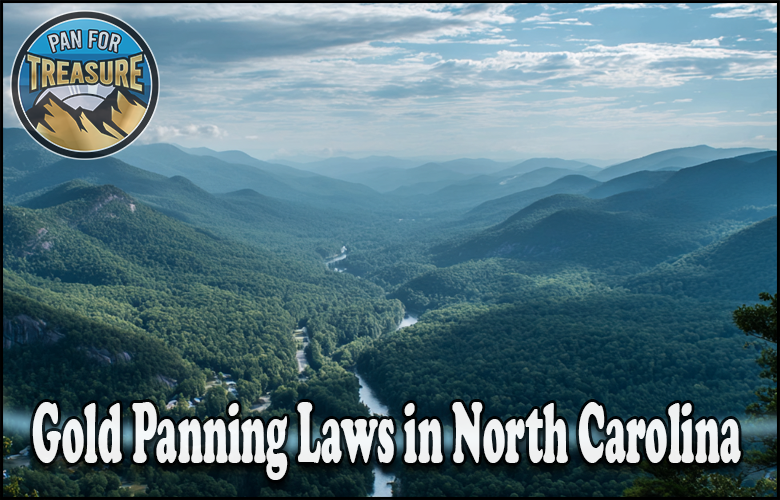
A North Carolina creek with gravel beds where recreational gold panning is popular in areas where it is permitted.
The gold panning laws in North Carolina allow recreational hand panning in national forests without a permit, as long as only hand tools are used and no significant stream disturbance results.
State parks and state forests prohibit the removal of rocks and minerals. Private land requires landowner permission.
North Carolina has no BLM land, so the primary public option for recreational prospecting is the state’s four national forests: Uwharrie, Pisgah, Nantahala, and Croatan.
North Carolina holds an extraordinary place in American gold history. The first documented gold discovery in the United States occurred here in 1799, when 12-year-old Conrad Reed found a 17-pound gold nugget in Little Meadow Creek in Cabarrus County.
For the next 50 years, North Carolina led the nation in gold production, and the U.S. government built a branch mint in Charlotte in 1837 to process the region’s output.
Total gold production from the state is estimated at approximately 1.1 million ounces, most of it from the Carolina Slate Belt across the central Piedmont.
This guide covers the regulations, best locations, and tips for panning in the Old North State. If you are new to gold prospecting, start with our getting started with gold panning guide.
TL;DR
- National forests: Recreational gold panning with hand tools is allowed without a permit on national forest land not under private mineral rights, wilderness designation, or other restrictions.
- State parks and forests: You cannot carry off rocks or minerals from state parks or recreation areas in North Carolina.
- Private land: Most land in NC is privately owned. Landowner permission is required, and private property may extend into rivers and streams.
- Equipment: Hand panning and hand tools (shovel, pan) are allowed in national forests. Mechanized equipment (dredges, highbankers, drywashers) requires Forest Service authorization.
- Gold type: Both placer (stream) and lode (quartz vein) gold from the Carolina Slate Belt. Fine to coarse gold, occasional nuggets.
- History: First documented US gold discovery (1799). Led the nation in production until 1848. Charlotte Mint operated 1838-1861. Approximately 1.1 million ounces total production.
Lode (Carolina Slate Belt Quartz Veins) and Placer
~1.1 Million Troy Ounces
1799, Reed Gold Mine, Cabarrus County
1803-1848 (Until California Gold Rush)
Allowed in National Forests (Hand Tools Only)
Carolina Slate Belt (Central Piedmont)
Featured
Gold Panning Laws in North Carolina
North Carolina’s gold panning regulations involve a patchwork of federal, state, and private land rules. The state has no dedicated recreational prospecting statute, so the applicable rules depend entirely on who owns and manages the land you are standing on.
National Forests
The National Forests in North Carolina (Uwharrie, Pisgah, Nantahala, and Croatan) allow recreational gold panning and hobby mineral collecting without a permit under these conditions: you are collecting for personal, noncommercial use; you are using hand tools only (no mechanized equipment); and no significant disturbance results. Activities involving digging with mechanized earth-moving equipment, suction dredges, highbankers, or drywashing equipment require Forest Service authorization. Contact the District Ranger for permits and regulations.
National forests do not allow gold panning in congressionally designated wilderness areas, corridors of designated wild and scenic rivers, or forest areas where mineral rights are owned by or under lease to a private party. Private land holdings are common within national forest boundaries. The boundary between private and public land is normally marked with tree blazes: one red blaze indicates private land, two red blazes indicate national forest land.
State Parks and State Forests
According to the NC Department of Environmental Quality (DEQ), you are not allowed to carry off any rocks or minerals from state parks or recreation areas in North Carolina. Prospecting is not allowed in state-owned parks or forests. This is straightforward and consistently enforced.
Private Land
Most property in North Carolina is privately owned. The NC Geological Survey notes that individuals interested in noncommercial prospecting should obtain permission from the landowner before entering private property. Most landowners are cooperative but do not tolerate trespassers. Private property may extend into rivers, streams, lakes, and other bodies of water, so do not assume that being in a creek means you are on public land.
For serious mining, a lease agreement or purchase of mineral rights can be negotiated with the landowner. Unless bought separately, mineral rights are normally retained by the landowner. Property deeds are recorded at courthouses in the county seat.
National Park Service Land
Collecting, rockhounding, and gold panning of rocks, minerals, and paleontological specimens are generally prohibited in all units of the National Park System (36 CFR 7.91). This includes the Blue Ridge Parkway and Great Smoky Mountains National Park.
NC Mining Act
The North Carolina Mining Act primarily addresses commercial mining operations and requires permits for mines. Recreational gold panning and small-scale prospecting are subject to less stringent regulations but must still comply with state and federal laws regarding water quality and environmental protection.
Equipment Restrictions
| Equipment | National Forest (Open Areas) | State Parks / State Forests | Private Land (With Permission) |
|---|---|---|---|
| Gold Pan | Allowed, no permit | Not allowed | With landowner permission |
| Shovel / Hand Tools | Allowed (no significant disturbance) | Not allowed | With permission |
| Classifier / Screen | Allowed (hand use) | Not allowed | With permission |
| Sluice Box | Gray area (contact Ranger District) | Not allowed | With permission |
| Suction Dredge / Highbanker | Requires Forest Service authorization | Not allowed | May require state permits |
| Metal Detector | Allowed for prospecting (not in wilderness) | Check individual park rules | With permission |
For gear recommendations, see our best tools for gold panning roundup.
Our Favorite Posts
- Gold Panning Laws in California Permits, Rules and Best Spots
- Gold Panning Laws in Colorado – What Prospectors Need to Know
- Gold Panning Laws in Arizona – What Prospectors Need to Know
- Gold Panning Laws in Alaska – What Prospectors Need to Know
- Gold Panning Laws in Nevada – What Prospectors Need to Know
Best Locations for Gold Panning in North Carolina
North Carolina’s gold deposits are concentrated in the Carolina Slate Belt, a band of volcanic and sedimentary rocks 25 to 70 miles wide running from the Virginia border through the central Piedmont into South Carolina. Gold also occurs in the Blue Ridge Mountains in the western part of the state. Streams flowing through former gold-producing districts offer the best opportunities. For more on the state’s gold, visit our page on whether there’s gold in North Carolina. Always confirm land ownership before prospecting.
- Uwharrie National Forest (Montgomery, Randolph, and Davidson Counties) – The top destination for recreational gold panning in North Carolina. Numerous creeks and streams flow through the Carolina Slate Belt. Recreational panning is allowed on most of the forest with shovel and pan techniques. No fee or permit required. The Uwharrie River and its tributaries are the primary targets.
- Reed Gold Mine State Historic Site (Cabarrus County) – Site of the first documented gold discovery in the United States (1799). Now a state historic site with a visitor center, underground mine tours, and a public panning area where visitors can pan for gold for a small fee. A 28-pound nugget and a 23-pound nugget were found here in the 1800s.
- Little River (Montgomery County) – Known for fine placer gold. Flows through the heart of the gold belt. Some sections within or adjacent to Uwharrie National Forest. Check land ownership at specific access points.
- Gold Hill Area (Rowan County) – One of North Carolina’s most productive historic gold districts. The Gold Hill mine complex was among the largest in the state during the 1840s. Now a small historic park with trails. Limited public panning opportunities; most land is private.
- Montgomery County Streams (Montgomery County) – Montgomery County had 13 major gold deposits and was the hub of North Carolina’s gold mining. Streams near Eldorado, Troy, and the Uwharrie Mountains contain placer gold. Mix of national forest and private land.
- Pisgah National Forest Streams (Burke, McDowell, and Transylvania Counties) – Gold deposits occur in the Blue Ridge area of these counties. Pisgah National Forest allows recreational panning with hand tools. Contact the District Ranger for specific stream recommendations and restrictions.
- Nantahala National Forest (Western NC, Multiple Counties) – Some gold occurrences in the western mountains. Recreational panning allowed with hand tools on open areas. Less documented than the Piedmont gold belt, but worth sampling.
- Vein Mountain Recreational Park (McDowell County) – A private facility that allows visitors to dig into old mine tailings and pan for gold. Equipment and guidance provided. Good for beginners and families.
- Cotton Patch Gold Mine (Stanly County) – Near New London, this facility is open to the public for gold panning from mine sediments. Controlled environment with a higher chance of finding gold. Good for a first-time experience.
- Mecklenburg County Streams (Mecklenburg County) – Charlotte and surrounding Mecklenburg County were gold mining hotspots. The Rudisil, St. Catherine, and Capps mines were major operations. Traces of gold were found during construction excavations in downtown Charlotte as recently as 1992. Almost entirely private land today; permission required.
- Granville, Person, and Caswell County Streams (Granville, Person, and Caswell Counties) – Numerous placer streams in these northeastern Piedmont counties. Less pressured than the more famous gold belt counties farther south. Mostly private land.
- Cabarrus and Union County Streams (Cabarrus and Union Counties) – The county where it all started. Streams draining the Reed Gold Mine area and surrounding districts still carry placer gold. Mostly private, but some public access points exist along waterways.
Gold Prospecting History in North Carolina
North Carolina’s gold history is the oldest and most significant of any state east of the Mississippi. The discovery at Reed’s farm launched America’s first gold rush and shaped the early economic development of the southeastern United States.
In 1799, 12-year-old Conrad Reed found a 17-pound gold nugget while fishing in Little Meadow Creek on his family’s farm in Cabarrus County. His father, John Reed, a Hessian immigrant farmer, did not recognize the rock as gold and used it as a doorstop for three years. In 1802, a jeweler in Fayetteville identified it and purchased it from Reed for $3.50, a fraction of its true value. Reed eventually learned the real worth and began mining his property. In 1803, his partners found a 28-pound nugget in the same creek.
News spread quickly, and landowners across the Piedmont began searching their streams. By 1825, Matthias Barringer discovered gold embedded in a quartz vein in Montgomery County, marking the start of lode mining in North Carolina. From 1804 to 1828, all domestic gold coined by the United States came from North Carolina. The state led the nation in gold production from 1803 until the California Gold Rush of 1848.
The Charlotte Mint opened in 1837 (first coin struck in March 1838) to process the region’s gold into $1, $2.50, and $5 coins. The mint produced over $5 million worth of gold coins before closing at the start of the Civil War. Christopher Bechtler, a German immigrant jeweler, had already established a private mint in Rutherfordton in 1831, the first to produce gold coins in the United States.
The Carolina Slate Belt, a geological zone of volcanic and sedimentary rocks running from Virginia through the Carolinas, contained the majority of the state’s gold deposits. During peak years in the 1830s and 1840s, annual production reached an estimated 35,000 to 50,000 troy ounces, and gold mining was second only to farming in the number of North Carolinians it employed. Skilled Cornish miners from England brought deep-mining expertise that later spread to the California gold fields.
Total gold production from North Carolina is estimated at approximately 1.1 million ounces. Production declined sharply after the California Gold Rush drew miners west, and annual output dropped from a peak of roughly 140,000 fine ounces in 1839 to just 5,645 ounces by 1860. Mining continued intermittently through the early 1900s, and exploration companies investigated old mines in the 1980s and 1990s, though none have returned to production.
Recommended Reading
Tips for Gold Panning in North Carolina
- Start at Uwharrie National Forest. This is the most accessible public land for gold panning in North Carolina. No permit required, hand tools allowed, and the forest sits directly on the Carolina Slate Belt. The Uwharrie River and its tributaries are proven gold-bearing streams. See our techniques for beginners guide before you go.
- Visit Reed Gold Mine for context. The Reed Gold Mine State Historic Site offers underground mine tours, exhibits, and a public panning area. Panning there for a small fee gives you a sense of what North Carolina gold looks like and teaches proper technique before you head to wild streams.
- Get landowner permission for private land. Most of North Carolina is privately owned, and private property extends into waterways. Do not assume that wading in a creek gives you the right to pan. Ask first, and get written permission when possible. The NC Geological Survey notes that most landowners are cooperative when asked politely.
- Know the forest boundary markers. In national forests, private land and public land are intermixed. Look for tree blazes: one red blaze marks private land, two red blazes mark national forest land. Panning on the wrong side of a boundary could mean trespassing.
- Pan where streams slow down. The NC Geological Survey recommends panning where streams begin to widen or change velocity, such as along the insides of bends or in slow-water areas below rapids. Fine gold and eroded material from old quartz veins settle in these areas as water loses energy.
- Look for quartz veins. Much of North Carolina’s gold occurs in quartz veins associated with Carolina Slate Belt volcanics. If you spot white quartz outcrops or quartz float (loose pieces) in a stream, sample the gravels downstream. Gold released from weathered quartz veins concentrates in nearby placer deposits.
- Focus on the Carolina Slate Belt counties. The most productive gold territory runs through Mecklenburg, Cabarrus, Rowan, Davidson, Guilford, Stanly, Montgomery, Randolph, Moore, and Union Counties. Streams in these counties have the best documented gold occurrences. For more on the state’s gold, see our best places guide.
- Try metal detecting on national forest land. Metal detecting for gold nuggets is allowed on national forest land (except in wilderness areas and other restricted zones). North Carolina has produced notable nuggets historically, and detecting old mine tailings or creek drainages near historic sites can be productive.
- Check for private mineral rights within national forests. Some parcels within national forest boundaries have privately held mineral rights. The Forest Service or BLM can help you verify whether mineral rights are held publicly or privately at a specific location.
- Join a prospecting club. The GPAA has claims and regional groups in the Southeast. Local clubs provide access to private claims, organize group outings, and share knowledge about productive locations. The right gold panning kit and local guidance make a significant difference.
Rules
- Gold Panning Laws in Delaware – What Prospectors Need to Know
- Gold Panning Laws in Arkansas – What Prospectors Need to Know
- Gold Panning Laws in New Jersey – What Prospectors Need to Know
- Gold Panning Laws in Michigan – What Prospectors Need to Know
- Gold Panning Laws in South Dakota – What Prospectors Need to Know
Resources for North Carolina Prospectors
- NC DEQ – Gold of North Carolina – State geological survey page on gold occurrences, regulations, and prospecting guidance.
- National Forests in North Carolina – Forest Products and Permits – Official USFS page with rules for hobby mining, gold panning, and mineral collecting in NC national forests.
- Reed Gold Mine State Historic Site – America’s first gold mine, with tours, exhibits, and a public panning area.
- NC DEQ – Gems/Gold Panning – State guidance on gold panning regulations, state park rules, and private land requirements.
- Gold Prospectors Association of America (GPAA) – National organization with southeastern claims and regional chapter information.
Conclusion
The gold panning laws in North Carolina allow recreational hand panning in national forests without a permit, making the Uwharrie, Pisgah, and Nantahala National Forests the primary public destinations. State parks and state forests prohibit removing rocks and minerals. Private land, which covers most of the state, requires landowner permission. The Forest Service is the key contact for current rules and restricted areas within the national forests.
North Carolina has the richest gold history of any state east of the Mississippi. The 1799 discovery at Reed’s farm launched America’s first gold rush, and for 50 years the state produced the majority of domestic gold for the nation. The Carolina Slate Belt still holds gold in its streams and quartz veins. Streams that flow through former gold-producing districts have been reworked by natural erosion, meaning fine gold is still available to patient panners. For neighboring state options, check our guides for Georgia, Virginia, and South Carolina, browse our gold panning near me page, or browse our gold panning near me page, our permits guide, and the full gold panning laws by state directory.
Frequently Asked Questions – NC Gold Panning Laws
Is gold panning legal in North Carolina?
Yes. Recreational gold panning with hand tools is legal in national forests on land open to mineral entry. State parks and state forests prohibit removing rocks and minerals. Private land requires landowner permission. No state permit is needed for recreational hand panning.
Do I need a permit to pan for gold in North Carolina?
Not for recreational hand panning in national forests. You may use a gold pan, shovel, and hand tools without a permit as long as no significant disturbance results and you are collecting for personal, noncommercial use. Mechanized equipment (suction dredges, highbankers) requires Forest Service authorization. Contact the District Ranger for details.
Can I pan for gold in North Carolina state parks?
No. The NC DEQ states that you are not allowed to carry off any rocks or minerals from state parks or recreation areas. The Reed Gold Mine State Historic Site is an exception; it offers a public panning area for a small fee as part of its educational programs.
Where is the best place to pan for gold in North Carolina?
The Uwharrie National Forest in Montgomery, Randolph, and Davidson Counties is the top public destination. It sits on the Carolina Slate Belt and allows recreational panning without a permit. The Uwharrie River and its tributaries are proven gold-bearing streams. For a historical experience, visit the Reed Gold Mine in Cabarrus County.
What kind of gold is found in North Carolina?
North Carolina produces both placer gold (from stream gravels) and lode gold (from quartz veins in the Carolina Slate Belt). Placer gold ranges from fine flour to coarse flakes, with occasional nuggets. The state has produced some remarkable nuggets historically, including specimens weighing 17 and 28 pounds from the Reed Gold Mine.
Was North Carolina really the first state where gold was found?
Yes. The first documented gold discovery in the United States was in 1799 at John Reed’s farm in Cabarrus County. Conrad Reed, age 12, found a 17-pound nugget in Little Meadow Creek. From 1804 to 1828, all domestic gold coined by the United States came from North Carolina, and the state led the nation in gold production until the California Gold Rush of 1848.
⛏ Recommended Gear ⛏


* As an Amazon Associate I earn from qualifying purchases at no extra cost to you.
Subscribe to Our Newsletter

Ryan Conlon is the founder of Pan for Treasure.
A lifelong gold panning enthusiast, he created this site to help beginners learn the ropes and share practical tips from his own time on the creek. [email protected]