
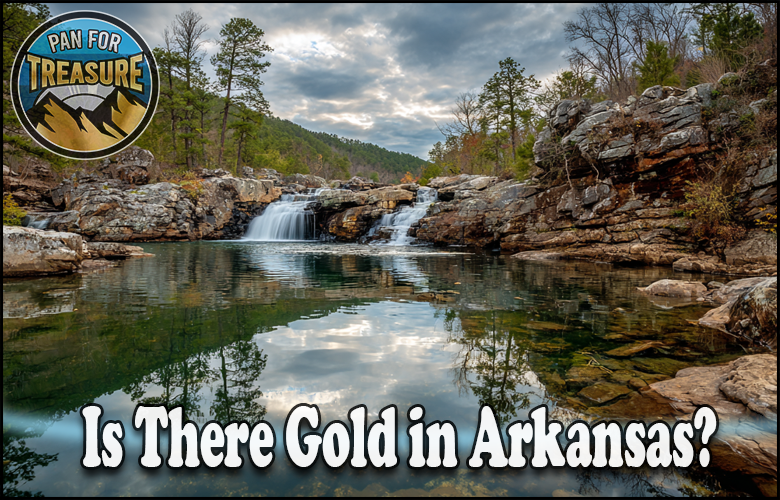
Is there gold in Arkansas? Barely. Arkansas has very limited gold deposits, and no payable quantities of gold have ever been confirmed by the state’s geological survey.
The Arkansas Geological Survey investigated gold rumors in the 1880s and again in the 1920s. Both times they concluded that no workable gold deposits exist in the state. Small traces of gold and silver have been found in vein material associated with igneous dikes near Hot Springs, but nothing of commercial or even significant recreational value.
That said, Arkansas is not completely devoid of gold. Spanish explorers reportedly found gold in the Ouachita Mountains as early as the 1540s, and scattered reports of very fine flour gold in area streams have persisted for centuries.
A handful of USGS-recorded gold locations exist in the state, and a few recreational prospectors have reported finding micro-flakes in streams draining the Ouachitas. But by any honest measure, Arkansas is one of the poorest states in the country for gold prospecting.
If you are set on prospecting in Arkansas, keep your expectations very low and consider focusing on the state’s real mineral strengths: world-class quartz crystals in the Ouachita Mountains and diamonds at Crater of Diamonds State Park. For gold panning regulations, see our gold panning laws in Arkansas guide.
TL;DR
- Gold Present: Trace amounts only. No confirmed payable deposits.
- Best Region: The Ouachita Mountains in western Arkansas, particularly streams draining Polk, Garland, and Saline counties.
- Gold Type: Extremely fine flour gold (micro-flakes) if anything is found at all.
- Top Spot: Streams in the Ouachita National Forest, though results are not guaranteed and most prospectors report little to no gold.
- Legal Note: Recreational panning is generally allowed in the Ouachita National Forest with hand tools and minimum-impact methods. State parks mostly prohibit mineral collection (except Crater of Diamonds for diamonds).
- Verdict: Arkansas is one of the weakest gold states in the country. Prospectors visiting the state should focus on quartz crystals and diamonds instead.
Geology
Ouachita Mountains with folded Paleozoic shales and sandstones. Minor igneous dikes near Hot Springs carry sparse gold and silver traces.
Historical Production
No recorded commercial gold production. Only trace amounts reported from a few scattered locations.
Best Area
The Ouachita Mountains, particularly the Bear City district and streams near Hot Springs and Polk County.
Active Claims
Virtually none for gold. Arkansas has very little BLM land, and gold claims are extremely rare.
Primary Gold Type
Extremely fine flour gold (micro-flakes) in creek sediments, if found at all.
Best Season
Spring and fall for comfortable weather. After heavy rains can help expose material in creek beds.
Where Is There Gold in Arkansas?
Is there gold in Arkansas in any meaningful quantity? The honest answer is not really. The Arkansas Geological Survey has stated clearly that no payable quantities of gold have been discovered in the state. However, trace amounts have been documented in a few specific areas, all concentrated in or near the Ouachita Mountains in the western part of the state.
The Ouachita Mountains
The Ouachita Mountains are the only region of Arkansas with any documented gold occurrences. These mountains are composed primarily of folded Paleozoic sedimentary rocks, including shales, sandstones, and novaculite.
In 1923, USGS geologists found sparse amounts of gold and silver in vein material associated with igneous dikes near Hot Springs in Garland County. The Bear City district west of Hot Springs was an area of past silver mining that also produced traces of gold associated with the local shales.
The geology of the Ouachitas is not favorable for significant gold deposits. The silica-rich quartz that Arkansas is famous for (the state produces some of the finest quartz crystals on the planet) is the same type of geological fluid that carries gold in other regions, but in Arkansas, conditions apparently never concentrated gold into workable deposits.
Polk County (Southwest Arkansas)
Polk County, in the southwestern part of the state near Mena, has scattered reports of gold in igneous rocks and quartz veins associated with manganese deposits. The Old Silver World Mine east of Mena historically produced silver and gold.
The Helen Gould Mine near Egger in Cherry Hill also has a history of gold mining, though production was minimal. Little Brushy Creek in this area was mined for gold and silver, with sodium cyanide leaching used to extract metals from low-grade ores.
Recorded USGS Gold Locations
The only officially recorded gold locations in Arkansas according to the USGS Mineral Resources Data System (MRDS) are the Julius Hess and Kellogg Mine sites in Pulaski County, the Old Spanish Diggings in Garland County, and the Otto Mine in Sevier County.
In all cases, gold was a tertiary-level mineral occurrence, not the primary commodity, and quantities were insignificant.
Best Places to Look for Gold in Arkansas
Given that is there gold in Arkansas gets a very qualified “barely,” here are the locations most commonly mentioned by prospectors, ranked by the (slim) likelihood of finding anything.
- Streams in the Ouachita National Forest (Polk, Garland, and Scott Counties): The 1.8-million-acre Ouachita National Forest is the largest block of public land in the gold-bearing region. Creeks like Board Camp Creek, Wolf Creek, and various unnamed tributaries draining the Ouachita ridge have been explored by prospectors. Recreational panning with hand tools is generally permitted. Results are not guaranteed, and most prospectors report only micro-flakes or nothing at all.
- Cossatot River near Wickes (Polk County): This scenic river winds through the Ouachita Mountains and has produced reports of fine gold flakes over the years. The river is popular with kayakers and outdoor enthusiasts. Access is available through the Cossatot River State Park-Natural Area, though mineral collection rules apply in the state park.
- Little Missouri River (Polk and Montgomery Counties): Another Ouachita Mountain drainage with scattered reports of very fine placer gold. The river flows through national forest land and has public access points.
- Caddo River / Caddo Gap area (Montgomery County): The Caddo River area is near zinc mines along a fault line that have reported gold as a tertiary mineral. Some prospectors have explored the area with limited success.
- Saline County springs area: Small amounts of gold have reportedly turned up in the spring-fed streams of Saline County, deposited by the churning action of the springs. Quantities are extremely small.
- Old Spanish Diggings area near Hot Springs (Garland County): The legendary site where Spanish explorers reportedly first found gold in Arkansas in the 1540s. Located near Magnet Cove. Historically interesting but not known to produce meaningful amounts of gold for modern prospectors.
For legal details, see our gold panning laws in Arkansas guide.
Arkansas Gold Panning Map
Geology and Gold Potential in Arkansas
Arkansas never experienced a gold rush for good reason. The state’s geology simply does not support significant gold deposits.
The Ouachita Mountains formed from the collision of tectonic plates roughly 300 million years ago, folding and faulting Paleozoic sedimentary rocks into their current east-west trending ridges. While this mountain-building process created conditions for some mineral deposition (zinc, lead, manganese, barite, and the world-famous quartz crystals), it did not concentrate gold in meaningful quantities.
The Arkansas Geological Survey investigated gold rumors in the 1880s and published their findings in the Annual Report of 1888, concluding that no workable gold existed in the Ouachita Mountains region. A follow-up investigation by the USGS in 1923 near Hot Springs found only sparse amounts of gold and silver in igneous dike vein material.
No subsequent study has overturned these conclusions.
Some prospectors have speculated that gold might exist at the deep contact zone where the South American plate once subducted beneath the North American craton, but this remains unproven. The few zinc mines along fault lines south of Caddo Gap that report gold as a tertiary mineral offer a hint that gold exists in the geology, but not in concentrations worth pursuing.
For prospectors visiting Arkansas, the state’s real mineral treasures are elsewhere. The Ouachita Mountains produce some of the purest quartz crystals in the world, and Crater of Diamonds State Park near Murfreesboro is the only publicly accessible diamond mine in the United States.
Tips for Prospecting in Arkansas
- Set very low expectations for gold. Arkansas is among the weakest gold states in the nation. If you find even a single visible flake, consider it a good day. Most prospectors report nothing.
- Consider alternatives. Arkansas excels at quartz crystal mining and diamond hunting. The Wegner Crystal Mines, Sweet Surrender Crystal Mine, and Crater of Diamonds State Park all offer productive and enjoyable experiences. You may have a far more rewarding trip hunting crystals than chasing gold.
- Prospect in the Ouachita National Forest. This is where you have the best combination of public land access and (minimal) gold potential. Recreational panning with hand tools is generally allowed. Follow minimum-impact rules: no motorized equipment, do not dig into banks, and fill in any holes. Contact the local ranger district before you go.
- Pan very slowly. If any gold exists in Arkansas streams, it is extremely fine flour gold that will wash out of your pan if you rush. Use a fine-mesh classifier and take extra care with the final stages of panning. Our gold panning techniques guide covers the basics.
- Look for shale and quartz-bearing areas. The limited gold reported in Arkansas is associated with shales and quartz veins in the Ouachitas. Focus on streams that cut through these rock types rather than sampling random creek beds.
- Check land ownership carefully. Much of the land in the Ouachita region is a mix of national forest, private, and state land. State parks generally prohibit mineral collection. Always verify you are on public land that allows prospecting, and get permission before entering private property.
- Bring the right tools. A basic gold pan, snuffer bottle, fine-mesh classifier, and small vials are all you need. Do not invest in expensive equipment for Arkansas gold prospecting.
Resources
- Arkansas Geological Survey: The official state geological survey has published reports on gold occurrences (or lack thereof) in Arkansas, including the definitive 1888 report. Their website has information on the state’s mineral resources. Visit Arkansas Geological Survey Gold Page.
- Ouachita National Forest (U.S. Forest Service): Manages 1.8 million acres of public land in western Arkansas and southeastern Oklahoma. Contact the local ranger district for current prospecting rules. Visit Ouachita National Forest.
- USGS Mineral Resources Data System (MRDS): The official federal database of mineral occurrences and mine locations. Search for Arkansas gold locations to find the handful of recorded sites. Visit USGS MRDS.
- Gold Prospectors Association of America (GPAA): Has a claim in the Ouachita National Forest area. Visit GPAA.
Conclusion
Is there gold in Arkansas? Technically, yes, in trace amounts. But Arkansas is one of the poorest gold states in the country, with no recorded commercial production and only a handful of USGS-documented gold occurrences.
The state’s geological survey has twice concluded that no workable gold deposits exist here. Recreational prospectors who have tried the Ouachita Mountain streams report finding, at best, micro-flakes of flour gold.
If you are visiting Arkansas with a prospecting mindset, you will have a much better time hunting for quartz crystals in the Ouachitas or searching for diamonds at Crater of Diamonds State Park. But if you want to say you panned for gold in the Natural State, head to the Ouachita National Forest, bring a pan and some patience, and enjoy the scenery while you work.
Ready to explore states with more gold potential? Check out our guides for nearby states: Is There Gold in Oklahoma?, Is There Gold in Missouri?, Is There Gold in Texas?, Is There Gold in Tennessee?, and Is There Gold in Mississippi?. Or browse the full state directory to find gold near you.
FAQ
Has gold ever been found in Arkansas?
In very small amounts, yes. Spanish explorers reportedly found gold in the Ouachita Mountains in the 1540s. The USGS has recorded a handful of gold occurrences in the state, mostly as trace-level minerals in mine sites where the primary commodities were zinc, manganese, or silver. However, no payable quantities of gold have ever been confirmed by the Arkansas Geological Survey.
Can you pan for gold in Arkansas?
Yes, gold panning is legal in Arkansas. Recreational panning with hand tools is generally permitted in the Ouachita National Forest. State parks mostly prohibit mineral collection, with the exception of Crater of Diamonds State Park (for diamonds, not gold). Always check with the local Forest Service office for current rules, and get permission before prospecting on private land.
Where is the most gold in Arkansas?
The Ouachita Mountains in western Arkansas represent the only region with documented gold occurrences. Polk County, Garland County (near Hot Springs), and Saline County have the most reports of trace gold. The Bear City district and the Old Spanish Diggings near Hot Springs are historically associated with gold, though quantities have always been insignificant.
What kind of gold is found in Arkansas?
The gold found in Arkansas is extremely fine flour gold, meaning tiny micro-flakes that are difficult to see with the naked eye and very hard to recover. No significant nuggets or even visible flakes have been reliably documented. The gold occurs as trace amounts in stream sediments and in vein material associated with igneous dikes and quartz veins in the Ouachita Mountains.
Do you need a permit to pan for gold in Arkansas?
For casual recreational panning with hand tools in the Ouachita National Forest, no specific permit is typically required, but you must follow minimum-impact rules (no motorized equipment, no bank digging, fill all holes). State parks generally prohibit mineral collection. On private land, you need the landowner’s permission. Contact the local Forest Service ranger district to confirm current rules before heading out.
Is Arkansas good for gold prospecting?
No. Arkansas is one of the weakest gold states in the country. The state has no recorded commercial gold production, and the geological survey has concluded that no workable deposits exist. While trace amounts of flour gold may be found in Ouachita Mountain streams, quantities are so small that most prospectors report finding nothing. Visitors interested in mineral hunting in Arkansas would be better served searching for quartz crystals or diamonds, both of which the state is known for.

⛏ Recommended Gear ⛏


* As an Amazon Associate I earn from qualifying purchases at no extra cost to you.
Subscribe to Our Newsletter

Ryan Conlon is the founder of Pan for Treasure.
A lifelong gold panning enthusiast, he created this site to help beginners learn the ropes and share practical tips from his own time on the creek. [email protected]