
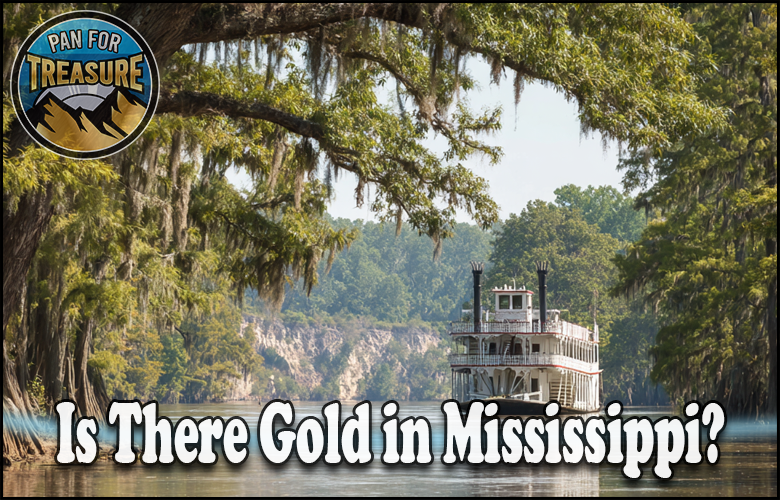
Is there gold in Mississippi? Technically, yes, but just barely. The Mississippi Geological Survey confirms that trace amounts of gold exist in the state, incorporated into sediments transported from the Appalachian Mountains and northern source rocks over millions of years. There are reliable reports of small amounts of gold particles being found by hobby panners. However, no commercial gold mining operation has ever existed in Mississippi, and the state’s geology is among the least favorable for gold of any state in the country.
The most scientifically documented gold finding in Mississippi came from drill hole samples of hydrothermally altered igneous rocks at the Jackson Dome, where Saunders (1993) detected as much as 503 parts per billion of gold. That is a detectable but extremely small amount, far below anything commercially viable. As far back as 1857, geologist Harper reported finding very small quantities of gold in pyrite samples from the state.
Mississippi sits entirely on Gulf Coastal Plain sediments, with no exposed igneous or metamorphic bedrock anywhere at the surface. The sedimentary layers that make up the state were deposited by rivers and shallow seas over tens of millions of years, and any gold particles they contain have been ground to flour sized dust during their long journey from distant source rocks. This is one of the most challenging states in the country for gold prospecting.
TL;DR
- Gold Present: Only in trace amounts. Gold particles exist in sediments transported from the Appalachians and northern bedrock, but concentrations are extremely low. The Mississippi Geological Survey has documented gold at 503 parts per billion in one drill hole sample.
- Best Region: Northeastern Mississippi (Tishomingo County area) where gravel deposits from eroded Appalachian source rocks are found. Gravel bearing streams in the Tombigbee River drainage. Southern Mississippi’s Citronelle Formation gravels.
- Gold Type: Exclusively flour sized particles (colors) so small they are nearly invisible. Any gold was transported long distances and ground to dust. No lode gold, no nuggets, no bedrock sources at the surface.
- Top Spot: There is no reliable top spot. The Big Black River, Black Creek in DeSoto National Forest, and gravel bearing streams in northeastern Mississippi are the most commonly cited, but expectations should be extremely low.
- Legal Note: No specific state gold panning regulations exist because gold prospecting is not a significant activity. Standard rules apply: get landowner permission on private land. DeSoto National Forest may allow casual prospecting on public land.
- Verdict: Mississippi is one of the weakest gold states in the country. Serious prospectors should consider traveling to neighboring Alabama, where genuine gold mining has occurred since 1830. Mississippi’s real treasures are its world class fossils and Gulf Coast metal detecting opportunities.
Commercial Production
Zero. No commercial gold mining operation has ever existed in Mississippi. No gold mines are listed in USGS records for the state. The most commonly listed mine commodities in Mississippi are iron, aluminum, and kaolin.
Geology
Entirely Gulf Coastal Plain sedimentary rocks. No exposed igneous or metamorphic bedrock at the surface. Sediments up to 45,000 feet thick beneath the coastal plain. Precambrian basement rocks known only from deep boreholes in the north of the state.
Best Scientific Evidence
Jackson Dome drill samples: 503 parts per billion gold in hydrothermally altered igneous rocks (Saunders, 1993). Harper (1857) reported trace gold in pyrite samples. Both represent detectable but non commercial quantities buried deep underground.
Gold Origin
Any gold in Mississippi sediments was transported from the Appalachian Mountains to the east or from northern source rocks. The greater the transport distance from source rocks, the smaller the gold particle size. Mississippi is hundreds of miles from the nearest gold belt.
Gravel Deposits
Gravel deposits from the Tuscaloosa Formation (Cretaceous), Citronelle Formation (Pliocene/Pleistocene), and Tombigbee River terraces contain rocks transported from the Alabama Piedmont. These are the most likely (though still very unlikely) places to find trace gold.
Alternative Treasures
Mississippi is exceptional for fossils (50 million year old whale skeletons, Cretaceous shark teeth, mosasaur bones) and Gulf Coast metal detecting (pirate era coins, shipwreck artifacts). These are far more rewarding than gold panning in the state.
Where Is There Gold in Mississippi?
Is there gold in Mississippi that a prospector can actually find? The honest answer is that while gold technically exists in trace amounts statewide, finding even a single visible speck is extremely difficult. The Mississippi Geological Survey’s own publication on the subject is remarkably candid, noting that the agency must “often disappoint people by identifying their treasures as pyrite, mica flakes, or even yellow paint.”
The survey also documented the pattern of unverifiable claims that has persisted for decades. As they put it, someone says their brother has a nugget from Claiborne County in the bank vault, but the nugget cannot be found, even if the brother is. Others claim jars full of nuggets from northeastern Mississippi but refuse to show them for identification.
That said, the geological survey does confirm that gold particles exist in the state’s sediments. Here are the areas with the best (though still very slim) potential.
Northeastern Mississippi (Tishomingo County and Tombigbee Drainage)
Northeastern Mississippi has the state’s oldest surface geology and the most diverse gravel deposits. Tishomingo County contains the only exposed Paleozoic bedrock in Mississippi, with rocks dating to the Devonian and Mississippian periods (roughly 320 to 409 million years old). The Tuscaloosa Formation, which runs from Tishomingo County south through Lowndes County along the Alabama border, contains gravels derived from the erosion of nearby Appalachian source rocks.
These Tuscaloosa gravels include quartzite and vein quartz transported from the Alabama Piedmont to the east. Since the Alabama Piedmont is part of the Appalachian gold belt, it is theoretically possible that tiny amounts of gold traveled with these sediments. The Tombigbee River and its tributaries have reworked these gravels over millions of years.
This is the closest Mississippi gets to genuine gold bearing geology, but expectations should remain very low. The transport distance from Appalachian gold sources is hundreds of miles, and any gold particles have been reduced to microscopic flour.
Western Mississippi (Mississippi River and Loess Belt)
A belt of Pleistocene age gravel underlies the loess belt of western Mississippi. These gravels were deposited by the ancient Mississippi River and its predecessors, carrying rocks and sediments from as far north as Minnesota and the Canadian Shield. Some of these northern source rocks are gold bearing, so trace gold particles may exist in the gravel.
The Big Black River, stretching 330 miles from Webster County to the Mississippi River south of Vicksburg, has been cited as a potential prospecting location. The river’s mix of gravel deposits and tributary confluences creates theoretical gold trapping conditions. However, any gold present would be extraordinarily fine.
When the Mississippi River’s water level drops, exposed gravel bars can be searched for minerals. Gravel from the Mississippi drainage includes rocks from distant sources: Sioux quartzite from southwestern Minnesota (1.7 billion years old, carried by glaciers to Kansas, then down the Missouri and Mississippi Rivers), geodes from Iowa, and igneous rocks from Missouri’s St. Francis Mountains. Gold could theoretically travel the same path, but in concentrations too low for practical recovery.
Southern Mississippi (Citronelle Formation and DeSoto National Forest)
The Citronelle Formation in southern Mississippi contains Pliocene to Pleistocene age gravel deposits. These gravels are the source material for many modern streams in the region. Black Creek in DeSoto National Forest (Mississippi’s only national wild and scenic river) flows through 518,587 acres of public forest land. Small amounts of placer gold have reportedly been found in stream beds and sand bars near confluence points.
DeSoto National Forest offers the most accessible public land for prospecting in the state, but reported gold finds are extremely small and not well documented.
Jackson Dome (Deep Subsurface Only)
The Jackson Dome is a buried volcanic feature beneath Jackson, Mississippi. Drill hole samples from hydrothermally altered igneous rocks at the dome contained up to 503 parts per billion of gold (Saunders, 1993). This is the best scientifically documented gold occurrence in the state. However, it is deep underground and completely inaccessible to prospectors. It simply confirms that gold bearing geological processes have affected Mississippi’s deep subsurface, even though none of that gold reaches the surface.
Best Places to Look for Gold in Mississippi
- Black Creek, DeSoto National Forest (Forrest/Perry Counties): Mississippi’s only wild and scenic river, flowing through extensive public forest land. Small amounts of placer gold have been reported near tributary confluences. The best option for public land access in the state.
- Streams in Tishomingo County: The closest geology to Appalachian gold sources. Tuscaloosa Formation gravels contain material from the Alabama Piedmont. Try streams that have reworked these ancient gravel deposits.
- Tombigbee River tributaries (northeastern Mississippi): Pleistocene gravel deposits of the Tombigbee contain material transported from eroded Appalachian source rocks.
- Big Black River (Webster to Warren Counties): A 330 mile river with varied gravel deposits. Focus on areas where tributaries join the main river and where gravel bars are exposed during low water.
- Mississippi River gravel bars: When water levels drop, gravel bars are exposed that contain rocks from thousands of miles upstream. Bring a metal detector for the best chance of finding something valuable (likely historical artifacts rather than natural gold).
- Citronelle Formation gravel exposures (southern Mississippi): Ancient gravel deposits in the Crystal Springs area of Copiah County and throughout southern Mississippi. These gravels are recycled into modern streams.
Why Mississippi Has Almost No Gold
Mississippi’s geology explains why the state is one of the poorest for gold in the country. Understanding the geology helps prospectors make informed decisions about where to spend their time.
Mississippi sits entirely on the Gulf Coastal Plain, a thick wedge of sedimentary deposits laid down by rivers, deltas, and shallow seas over the past 100+ million years. These sediments reach up to 45,000 feet thick beneath parts of the state. Every rock at the surface is sedimentary: sand, clay, silt, limestone, chalk, and gravel. There is no exposed igneous or metamorphic bedrock anywhere in Mississippi.
Gold deposits typically form in igneous and metamorphic environments where hot, mineral rich fluids migrate through fractures and deposit gold in quartz veins. States with productive gold districts, like Georgia, California, and Colorado, have exposed bedrock from these environments. Mississippi’s gold forming rocks are buried thousands of feet below the surface, known only from deep boreholes.
The Mississippi Geological Survey explains that as clays, sands, and gravels were transported to Mississippi and deposited over geologic time, these sediments certainly incorporated flakes of gold carried from source rocks far to the north or in the Appalachian Mountains to the east. But the key problem is distance. The greater the transport distance from source rocks, the smaller the gold particle size. Abrasion in carrying streams reduces particle sizes from flakes to dust to flour sized particles. By the time any gold reaches Mississippi, it has been ground to nearly invisible specks.
The one geological curiosity is the Jackson Dome, a buried volcanic feature where Cretaceous age magma intruded into the sedimentary sequence. The 503 ppb gold detected in drill samples there confirms that gold bearing igneous processes occurred in Mississippi’s deep subsurface, but this gold is inaccessible.
Mississippi lies a few hundred miles west of the Carolina Slate Belt, the nearest significant gold bearing region. Neighboring Alabama has genuine gold deposits where mining has occurred since 1830, with large nuggets found southeast of Birmingham. That gold belt does not extend into Mississippi.
Tips for Prospecting in Mississippi
- Manage your expectations. Mississippi is one of the weakest gold states in the country. If you pan for an entire day and find one microscopic speck of gold, that is a good day. Most prospectors will find nothing.
- Target gravel deposits, not sand or clay. Your best chance is in gravel bearing streams, especially in northeastern Mississippi where gravels contain material transported from the Alabama Piedmont. Avoid the thick clay and silt deposits that dominate much of the state.
- Consider Alabama instead. If your goal is finding gold, a drive to east central Alabama (southeast of Birmingham) will put you in an area where genuine gold mining has occurred since 1830. Placer and lode deposits have been found there, along with large nuggets. It is only a few hours from the Mississippi border.
- Try metal detecting on the Gulf Coast. The Gulf of Mexico was heavily trafficked by pirates, Spanish treasure fleets, and merchant ships for centuries. Valuable coins and artifacts are still found along Mississippi’s Gulf Coast beaches. Metal detecting is likely to be far more rewarding than gold panning in this state.
- Hunt fossils instead. Mississippi is world class for fossil collecting. Cretaceous shark teeth, 50 million year old whale skeletons, mosasaur bones, and abundant marine invertebrates can be found in exposed chalk and limestone across the state. A fossil hunting trip to Mississippi will almost certainly be more productive than a gold panning trip.
- Learn to identify fool’s gold. The Mississippi Geological Survey reports that most “gold” finds in the state turn out to be pyrite (iron sulfide), mica flakes, or even yellow paint. Real gold is soft and bendable. Pyrite is hard and brittle. Mica flakes apart in thin sheets. Learn the difference before getting excited about a find.
- Use the right equipment for flour gold. If you do attempt gold panning in Mississippi, the gold will be flour sized, the smallest possible particle. A standard gold pan may lose these tiny particles. A fine gold sluice box or spiral wheel will do a better job of capturing microscopic gold.
- Explore DeSoto National Forest. The 518,587 acre national forest in southern Mississippi offers the most accessible public land for prospecting. Black Creek and its tributaries flow through the forest and are open to recreation.
Resources
- Mississippi Geological Survey: Is There Gold in Mississippi? (PDF) for the official state geological assessment of gold in Mississippi, including the Jackson Dome findings.
- Gold Rush Nuggets: Gold Mining in Mississippi for a candid overview of prospecting prospects and the recommendation to try Alabama instead.
- Rare Gold Nuggets: Gold Panning and Prospecting in Mississippi for additional location information and fine gold recovery techniques.
Conclusion
Is there gold in Mississippi? In the strictest sense, yes. Trace amounts of gold particles exist in the state’s sedimentary deposits, transported from distant Appalachian and northern source rocks over millions of years. The Mississippi Geological Survey has documented gold at 503 parts per billion in deep drill samples, and hobby panners have occasionally reported finding fine gold particles.
But in any practical sense, Mississippi is one of the most difficult states in the country for gold prospecting. No commercial gold mine has ever operated here. The state’s entirely sedimentary geology, with no exposed igneous or metamorphic bedrock, means there are no local gold sources. Any gold present has been ground to flour during its long journey from distant source rocks.
If you live in Mississippi and want to find gold, the honest advice is to drive to Alabama, where genuine gold deposits have been mined since 1830. If you want to stay in state, try metal detecting on the Gulf Coast for pirate era artifacts, or explore Mississippi’s world class fossil deposits. And if you do bring a gold pan to a Mississippi stream, enjoy the experience for what it is: a day outdoors in a beautiful state, with an extremely small but nonzero chance of finding a microscopic speck of the real thing.
For states with better gold prospecting, see Is There Gold in Georgia?, Is There Gold in Colorado?, Is There Gold in Michigan?, and Is There Gold in Indiana?. Or browse the full state directory to find gold near you.
FAQ
Has gold ever been mined in Mississippi?
No. There has never been a commercial gold mining operation in Mississippi. The state’s entirely sedimentary geology does not support gold deposits of commercial value. The Mississippi Geological Survey has documented only trace amounts of gold in the state.
Can you find gold panning in Mississippi?
It is theoretically possible to find microscopic gold particles in Mississippi’s gravel bearing streams, but it is extremely unlikely. Any gold present has been transported hundreds of miles from Appalachian or northern source rocks and ground to flour sized particles. Most reported gold finds in Mississippi turn out to be pyrite, mica, or other materials.
Where is the best place to look for gold in Mississippi?
Northeastern Mississippi (Tishomingo County) has gravel deposits from eroded Appalachian source rocks. Black Creek in DeSoto National Forest offers public land access. The Big Black River and Mississippi River gravel bars are other options. However, expectations should be extremely low in all locations.
Why is Mississippi so poor for gold?
Mississippi sits entirely on Gulf Coastal Plain sediments with no exposed igneous or metamorphic bedrock at the surface. Gold deposits form in igneous and metamorphic environments. Mississippi’s gold forming rocks are buried thousands of feet underground. Any gold in surface sediments was transported from distant source rocks and reduced to microscopic flour during transport.
What about the Jackson Dome gold?
Drill samples from hydrothermally altered igneous rocks at the Jackson Dome (a buried volcanic feature) contained up to 503 parts per billion of gold. This is detectable but far below commercial value, and it is deep underground, completely inaccessible to prospectors. It simply confirms that gold bearing geological processes occurred in Mississippi’s deep subsurface.
What should I look for instead of gold in Mississippi?
Mississippi is excellent for fossil collecting (Cretaceous shark teeth, whale skeletons, mosasaur bones) and Gulf Coast metal detecting (pirate era coins, shipwreck artifacts). Neighboring Alabama has genuine gold deposits only a few hours from the Mississippi border. These alternatives are far more rewarding than gold panning in Mississippi.

⛏ Recommended Gear ⛏


* As an Amazon Associate I earn from qualifying purchases at no extra cost to you.
Subscribe to Our Newsletter

Ryan Conlon is the founder of Pan for Treasure.
A lifelong gold panning enthusiast, he created this site to help beginners learn the ropes and share practical tips from his own time on the creek. [email protected]