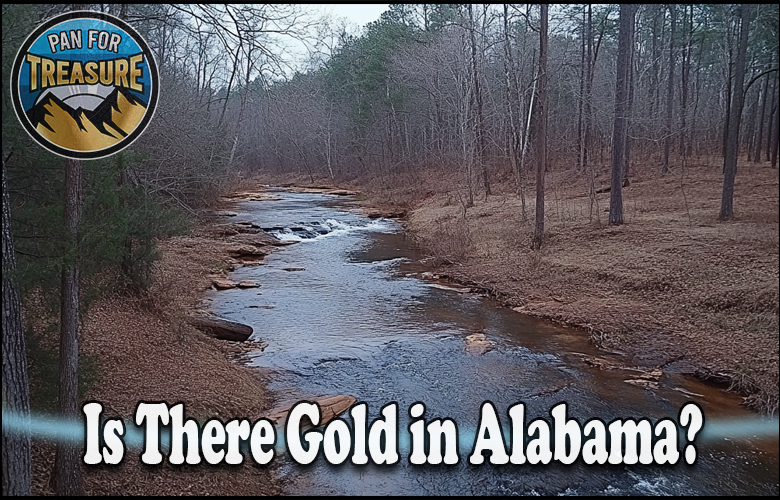
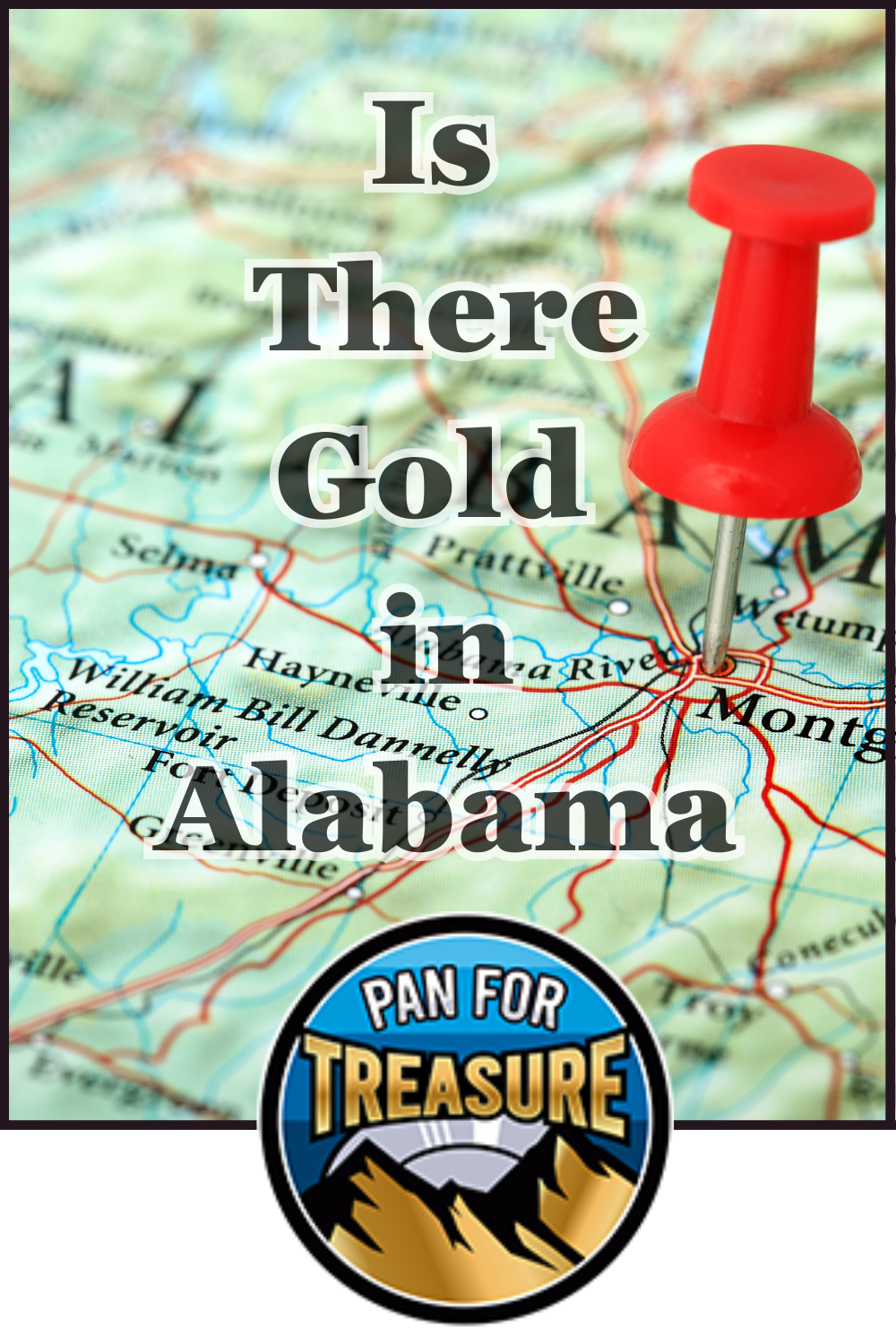
Is there gold in Alabama? Yes. Gold was discovered in east Alabama around 1830, making it one of the earliest gold-producing states in the country. Alabama’s gold belt stretches across a triangular region roughly 100 miles long and 60 miles wide in the east-central part of the state, covering parts of nine counties in the Piedmont Uplift region near the Georgia border.
Alabama’s total recorded gold production is approximately 50,000 troy ounces, with some estimates reaching as high as 80,000 ounces when unreported mining is included. That is modest compared to western gold states, but it was enough to spark a genuine gold rush in the 1830s and 1840s that built boom towns like Arbacoochee and Goldville. The Hog Mountain district alone produced about half the state’s total output.
Today there are no commercial gold mines operating in Alabama, but recreational prospecting is alive and well. Gold flakes and small nuggets can still be found in the creeks and streams of the Piedmont region. If you are interested in giving it a try, start with our getting started guide and make sure you understand the gold panning laws in Alabama before heading out.
TL;DR
- Gold Present: Yes, in a defined gold belt across east-central Alabama.
- Best Region: Cleburne, Tallapoosa, Coosa, Clay, and Randolph counties in the Piedmont Uplift.
- Gold Type: Mostly fine placer gold (flakes and small grains) in creeks and streams. Occasional small nuggets. Lode gold in quartz veins in schist.
- Top Spot: Creeks in and around the Talladega National Forest and the Alabama Gold Camp near Lineville.
- Legal Note: Most gold-bearing land is privately owned. Recreational panning with hand tools is generally allowed in the Talladega National Forest, but check with the local ranger district. State parks mostly prohibit mineral collection.
- Verdict: Alabama has real gold and genuine history, but quantities are small. Best suited for hobbyists who enjoy the hunt and don’t mind modest finds.
Geology
Appalachian Piedmont metamorphic rocks, including the gold-bearing Wedowee Schist and Hillabee Greenstone, host quartz vein gold deposits.
Historical Production
Approximately 50,000 to 80,000 troy ounces from the 1830s through the 1990s.
Best Area
Cleburne and Tallapoosa counties, home to the Arbacoochee and Hog Mountain mining districts.
Active Claims
Very few active federal mining claims. Most gold-bearing land is private property.
Primary Gold Type
Fine placer gold (flakes and grains) in creek beds. Lode gold in quartz veins in metamorphic schist.
Best Season
Year-round, but spring and fall offer the most comfortable conditions. Winter rains help expose new gold in creek gravels.
Featured
Where Is There Gold in Alabama?
Alabama ranks #32 of 50 for gold potential.
Quick reference below – details on each location follow, or jump to the Alabama map.
| Location / Area | River / Creek | County | Gold Type | Land Access |
|---|---|---|---|---|
| Alabama Gold Camp, near Lineville | Not listed | Clay, Randolph | Not listed | Not listed |
| Talladega National Forest | Shoal Creek | Cleburne, Clay, Tallapoosa | Not listed | Public land |
| Hatchett Creek | Hatchett Creek | Coosa | Not listed | Permission required |
| Crooked Creek and Wesobulga Creek | Crooked Creek, Wesobulga Creek | Clay | Fine gold | Not listed |
| Chulafinnee Creek area | Chulafinnee Creek | Cleburne | Not listed | Permission required |
| Goldville area | Tallapoosa River | Tallapoosa | Fine gold | Not listed |
| Arbacoochee area | Not listed | Cleburne | Not listed | Not listed |
| Blue Creek / Chestnut Creek tributaries | Blue Creek, Chestnut Creek | Chilton | Fine gold | Not listed |
Is there gold in Alabama spread across a wide area? Gold in Alabama is concentrated in a well-defined belt in the east-central part of the state. This gold belt follows a northeast-to-southwest trend that lines up with the southern Appalachian Mountains and the Piedmont Uplift. The belt covers roughly 3,500 square miles across nine counties: Cleburne, Talladega, Randolph, Tallapoosa, Chambers, Clay, Coosa, Elmore, and Chilton.
The Piedmont Gold Belt (East-Central Alabama)
Nearly all of Alabama’s gold comes from the Piedmont physiographic section. The underlying geology here consists of metamorphic rocks, primarily the Wedowee Schist, which formed during the building of the Appalachian Mountains roughly 300 million years ago. Gold occurs in quartz veins cutting through the schist and has been weathering out of these source rocks into creeks and streams for millions of years.
The gold belt enters Alabama from Georgia at the northeast corner of the state and trends southwest toward the center. The highest concentrations are in Cleburne County near the Georgia border and in Tallapoosa County around the historic Hog Mountain and Goldville districts.
Upper Gold Belt (Cleburne, Randolph, and Talladega Counties)
The upper portion of the gold belt, closest to the Georgia border, holds some of Alabama’s richest gold ground. The Arbacoochee district in Cleburne County was one of the most productive areas in the state during the 1830s and 1840s, employing up to 600 miners at its peak. The Chulafinnee Mining District is also in this area and is known for producing gold from rich creek gravels. Randolph County, particularly around Wedowee Creek, has a consistent history of placer gold finds.
Central Gold Belt (Tallapoosa, Clay, and Coosa Counties)
Tallapoosa County is the most historically productive gold county in Alabama. The Hog Mountain district produced roughly 24,000 to 25,000 ounces, about half the state’s total recorded output. The Goldville district and Eagle Creek district also contributed significantly. In Clay County, Crooked Creek, the Tallapoosa River, and Wesobulga Creek hold placer gold. Coosa County’s Hatchett Creek and Weogufka Creek are known for alluvial gold deposits as well.
Lower Gold Belt (Chilton and Elmore Counties)
The lower end of the gold belt extends into Chilton and Elmore counties. This is actually where gold was first found in Alabama, around 1830, along tributaries of Blue Creek and Chestnut Creek in Chilton County near the Coosa River. The Verbena area is known for gold-bearing streams. The gravels in this area extend about a mile through a narrow valley, and both fine gold and small nuggets have been reported.
Our Favorite Posts
- Is There Gold in Colorado? Top Locations and if It’s Worth the Trip
- Is There Gold in California? Top Locations and if It’s Worth the Trip
- Top States to Pan for Gold in the U. S.
- Is There Gold in Idaho? Top Locations and if It’s Worth the Trip
- Is There Gold in Arizona? Top Locations and if It’s Worth the Trip
Best Places to Find Gold in Alabama
Here are the top locations where is there gold in Alabama gets a real answer, ranked by gold potential and accessibility.
- Alabama Gold Camp, near Lineville (Clay/Randolph County border): A private recreational prospecting operation located in the heart of the gold belt. Offers day passes and overnight stays with access to miles of gold-bearing creek for panning, sluicing, dredging, and metal detecting. Equipment rentals are available. This is the easiest and most beginner-friendly way to prospect for gold in Alabama. Contact: 256-396-0389.
- Talladega National Forest (Cleburne, Clay, and Tallapoosa Counties): The largest block of public land in Alabama’s gold belt. Several gold-bearing streams run through the forest. Recreational panning with hand tools is generally permitted, though you should check with the Shoal Creek Ranger District for current rules and any required authorization. No motorized equipment is allowed without a permit.
- Hatchett Creek (Coosa County): A well-known gold-bearing waterway with a history of placer production. The creek runs through areas where the Gold Ridge Mine once operated. Access is limited since much of the surrounding land is private, so get permission before prospecting.
- Crooked Creek and Wesobulga Creek (Clay County): Both creeks have produced placer gold and are located in the gold belt. Smaller streams and feeder branches in Clay County can also yield fine gold. Land ownership is mostly private.
- Chulafinnee Creek area (Cleburne County): Part of the historic Chulafinnee Mining District, one of the richest placer areas in the state. Rich gravels have been documented throughout the area. Most land is private, so permission is required.
- Goldville area (Tallapoosa County): The town of Goldville was a mining boom town of 3,000 people in the 1840s with a dozen stores and a hotel. Creeks in the surrounding area still produce fine gold. The Tallapoosa River near Goldville is a popular spot.
- Arbacoochee area (Cleburne County): One of the earliest and richest gold districts in the state. At its peak, the district had a population of about 5,000. Remnants of old mining operations can still be found. Land is mostly private.
- Blue Creek / Chestnut Creek tributaries (Chilton County): Where Alabama’s first gold was found around 1830. The original creek beds are now partially underwater (Lake Mitchell), but the smaller tributaries feeding into the Blue Creek drainage still contain gold. Fine gold and occasional nuggets have been reported.
For full details on where you can legally prospect, read our gold panning laws in Alabama guide.
Alabama Gold Panning Map
Recommended Reading
Gold Mining History in Alabama
Gold was first discovered in Alabama around 1830 in Chilton County, along Chestnut Creek and Blue Creek near the Coosa River. Prospectors had already traced the Appalachian gold belt from the Carolinas through Georgia, and the discovery of gold in east Alabama was a natural extension of that southwestward push.
By 1836, the gold rush was in full swing. Thousands of miners poured into the region, and boom towns sprang up across the gold belt. Arbacoochee in Cleburne County grew to about 5,000 people and employed roughly 600 miners. Goldville in Tallapoosa County had 12 stores, three saloons, a hotel, a mining supply house, and a population of 3,000. The mining was difficult. Equipment had to be hauled by wagon over Indian trails through dense forest, and the Creek Indians still occupied much of the land, making access and land rights a constant challenge.
The Alabama gold rush ended abruptly in 1849 when the majority of miners left for the California Gold Rush. Many of these Alabama-trained prospectors became leaders in the western gold fields because of the experience they had gained in the Piedmont. Gold mining revived briefly in 1853 when Cornish miners from Tennessee arrived to search for copper and found gold as well. There were smaller revivals in the 1880s and early 1900s.
The Hog Mountain mine in Tallapoosa County was the most developed gold operation in the state, operating from 1904 to 1914 and again from 1934 to 1937. It produced about 24,000 ounces of gold, roughly half of Alabama’s total recorded output. From discovery in 1830 through the end of significant production, Alabama’s total recorded gold output reached approximately 50,000 troy ounces, with some estimates suggesting the true total (including unreported mining) may be closer to 80,000 ounces.
Best Locations
- Is There Gold in Rhode Island? Top Locations and if It’s Worth the Trip
- Is There Gold in Washington? Top Locations and if It’s Worth the Trip
- Is There Gold in Massachusetts? Top Locations and if It’s Worth the Trip
- Is There Gold in South Carolina? Top Locations and if It’s Worth the Trip
- Is There Gold in Oklahoma? Top Locations and if It’s Worth the Trip
What Type of Gold Can You Find in Alabama?
Most gold found in Alabama today is fine placer gold: small flakes and grains that have weathered out of quartz veins in the Wedowee Schist and other metamorphic rocks over millions of years. These tiny particles settle in creek beds, behind boulders, in bedrock cracks, and in gravel bars throughout the Piedmont gold belt.
Small nuggets have been found in Alabama, particularly in Cleburne County and the Chilton County area, but they are not common. Most of the gold in Alabama occurs as very small grains that were historically difficult to extract directly from rock. Early miners used mercury amalgamation and cyanide leaching to recover gold from ore, leaving behind the large vats, mine shafts, and trenches that can still be found in some counties today.
For modern recreational prospectors, a gold pan and patience are the primary tools. The gold is real but typically very fine. Black sand concentrates in your pan are a good sign that you are in the right spot.
Tips for Finding Gold in Alabama
- Start at the Alabama Gold Camp. If you are new to prospecting, the Gold Camp near Lineville is the easiest way to get started. You get guaranteed access to gold-bearing creeks, equipment rentals, and a supportive environment. It takes the guesswork out of land access.
- Focus on the Piedmont counties. Alabama’s gold belt covers nine counties: Cleburne, Talladega, Randolph, Tallapoosa, Chambers, Clay, Coosa, Elmore, and Chilton. Prospecting outside this belt is unlikely to produce results.
- Get permission on private land. The vast majority of gold-bearing land in Alabama is privately owned. Trespassing is illegal and can result in serious consequences. Always get written permission from the landowner before prospecting on private property.
- Check with the Forest Service. The Talladega National Forest is the best public land option in the gold belt. Contact the Shoal Creek Ranger District to confirm current regulations and whether you need a letter of authorization before panning. Phone: 256-463-2272.
- Pan slowly and carefully. Alabama gold is mostly very fine. If you rush your panning technique, you will wash the tiny flakes right out of your pan. Use a classifier to remove larger rocks first, and take your time with the final stages. Read our gold panning techniques guide for step-by-step instructions.
- Look for bedrock exposed in creeks. Gold settles into cracks and crevices in bedrock. If you can find exposed bedrock in a creek within the gold belt, use a crevicing tool to scrape out material and pan it. This is often more productive than sampling random gravel.
- Prospect after heavy rains. Alabama gets significant rainfall, and storms help expose new gold by washing away lighter sediment. Creek beds that have been freshly scoured by high water can be especially productive.
- Watch for black sand. Concentrations of black sand (magnetite) in your pan indicate that heavy minerals are settling, and gold often settles with them. If you are finding black sand, keep working that area. Learn to identify gold in your pan with our what does gold look like guide.
- Bring the right gear. A basic gold pan, classifier, snuffer bottle, and small vials are all you need to get started. A sluice box can help process more material if regulations allow it in your area. Check our best tools guide for recommendations.
- Set realistic expectations. Alabama is not California or Arizona. You are unlikely to find large nuggets or fill a vial in an afternoon. But gold is there, and the satisfaction of finding even a few flakes of genuine Alabama gold in your pan is worth the effort.
Resources
- Geological Survey of Alabama: The GSA has published detailed reports on gold deposits, including Bulletin 136 (“Gold Deposits of Alabama”) and Special Report 14 (“Gold Deposits of Alabama and Occurrences of Copper, Pyrite, Arsenic, and Tin”). Visit the Geological Survey of Alabama.
- Talladega National Forest (U.S. Forest Service): The primary public land option for gold prospecting in Alabama. Contact the Shoal Creek Ranger District for current regulations and authorization requirements. Visit National Forests in Alabama.
- Encyclopedia of Alabama: Excellent free articles on Alabama’s gold production history, geology, and mineral resources. Read Gold Production in Alabama.
- Gold Prospectors Association of America (GPAA): Holds leases in Alabama including the Cornhouse Creek and Curvins Cow Pasture claims. Membership gives access to these sites. Visit GPAA.
- Alabama Gold Camp: Private recreational prospecting operation near Lineville with day and overnight access to gold-bearing creeks. Equipment rentals available. Phone: 256-396-0389. Visit Alabama Gold Camp.
Conclusion
Is there gold in Alabama? Yes, and it has been there since long before the California Gold Rush. Alabama’s Piedmont gold belt holds real gold in its creeks, streams, and ancient metamorphic rocks, and recreational prospectors still find it today. While it is not one of the best places to pan for gold in America by volume, the history is rich, and there is enough gold left in the ground to keep hobbyists busy.
The biggest challenge in Alabama is access. Most gold-bearing land is privately owned, and public land options are limited mainly to the Talladega National Forest. The Alabama Gold Camp near Lineville is the best starting point for anyone new to the area. Set realistic expectations, bring the right tools, and enjoy the experience of prospecting in a state where miners were finding gold a full two decades before the ’49ers headed west.
Ready to explore more states? Check out our guides for neighboring states: Is There Gold in Georgia?, Is There Gold in Tennessee?, Is There Gold in Mississippi?, and Is There Gold in Florida?. Or browse the full state directory to find gold near you.
Frequently Asked Questions – Is There Gold in AL
Has gold ever been found in Alabama?
Yes. Gold was first discovered in Alabama around 1830 in Chilton County, a full decade before the California Gold Rush. The state has produced an estimated 50,000 to 80,000 troy ounces from mines and placer deposits across its Piedmont gold belt. The Hog Mountain district in Tallapoosa County was the single largest producer, accounting for about 24,000 ounces.
Can you pan for gold in Alabama?
Yes. Recreational gold panning with hand tools is legal on private land with the owner’s permission and is generally allowed in the Talladega National Forest. Contact the local ranger district (Shoal Creek Ranger District, 256-463-2272) to confirm current rules and whether you need authorization. The Alabama Gold Camp near Lineville also offers paid access to gold-bearing creeks.
Where is the most gold in Alabama?
Cleburne County and Tallapoosa County have produced the most gold in the state. The Arbacoochee district in Cleburne County was the richest placer area, while the Hog Mountain district in Tallapoosa County was the most developed lode mining operation. Gold-bearing creeks can be found across the entire nine-county Piedmont gold belt.
What kind of gold is found in Alabama?
Most Alabama gold is fine placer gold: tiny flakes and grains that have eroded from quartz veins in metamorphic schist. Small nuggets have been found, particularly in Cleburne and Chilton counties, but they are uncommon. The gold occurs in creek beds, gravel bars, and bedrock crevices throughout the Piedmont region. Lode gold is also present in quartz veins in the Wedowee Schist.
Do you need a permit to pan for gold in Alabama?
On private land, you need the landowner’s permission but no government permit for casual hand panning. In the Talladega National Forest, recreational panning with hand tools usually does not require formal authorization, but some districts may require a letter of authorization due to soil conditions. Motorized equipment and commercial operations require permits from the Forest Service and potentially the Alabama Department of Labor’s Surface Mining Division. Always check with the relevant ranger district before you go.
Is Alabama good for gold prospecting?
Alabama is a decent destination for recreational gold prospecting, but expectations should be realistic. The gold is real and the history is fascinating, but quantities are small compared to western gold states. Most gold-bearing land is private, which limits access. The Talladega National Forest and the Alabama Gold Camp are the best options for casual prospectors. If you enjoy the process and the outdoors, Alabama’s gold belt can provide a rewarding experience.
⛏ Recommended Gear ⛏


* As an Amazon Associate I earn from qualifying purchases at no extra cost to you.
Subscribe to Our Newsletter

Ryan Conlon is the founder of Pan for Treasure.
A lifelong gold panning enthusiast, he created this site to help beginners learn the ropes and share practical tips from his own time on the creek. [email protected]