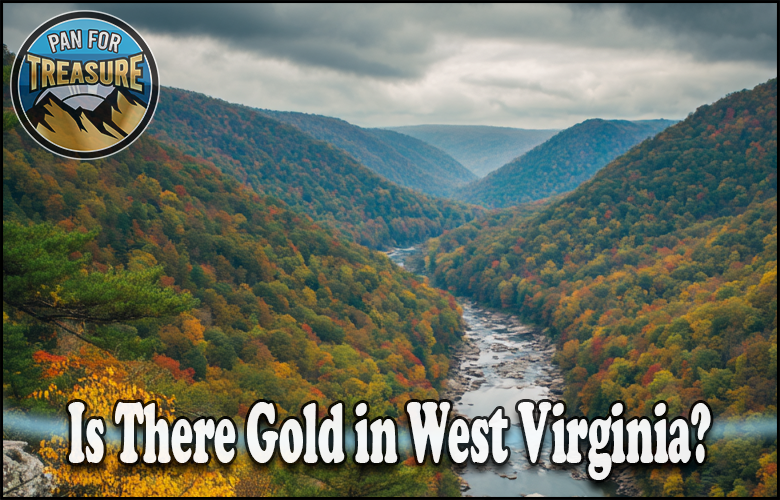
Is there gold in West Virginia? Barely. West Virginia has no commercial gold mines and no documented gold production of any significance. Gold was first reported in 1886 near Parkersburg, when miners from California discovered quartz veins that initially excited the area. However, further investigation revealed that the veins contained little to no gold worth recovering. That pattern has repeated ever since: initial excitement followed by disappointment.
Very tiny specks of gold have been reported in several creeks and rivers. The South Branch of the Potomac River at Smoke Hole Canyon is the most cited location. But the gold present is generally flyspeck sized, and even exhaustive mining is unlikely to produce more than a glimpse of color in a gold pan. West Virginia lies just west of the Virginia Gold Pyrite Belt and the Carolina Slate Belt, missing the geology that made its neighbors productive.
The state does have a GPAA chapter and some recreational prospectors enjoy panning in the Monongahela National Forest. For anyone seeking meaningful gold, nearby Virginia and North Carolina are dramatically better destinations.
TL;DR
- Gold Present: Barely. No commercial gold mines. No documented production. Quartz veins near Parkersburg (1886) contained negligible gold. Flyspeck gold reported in scattered streams and rivers. Best described as trace amounts.
- Best Region: South Branch Potomac River at Smoke Hole Canyon. Monongahela National Forest streams. Shavers Fork of the Cheat River near Parsons (Tucker County). Middle Fork River near Audra State Park.
- Gold Type: Extremely fine flour gold in river gravels. Possibly glacially transported or eroded from ancient formations. No documented lode gold deposits of commercial interest.
- Top Spot: Smoke Hole Canyon on the South Branch Potomac River. Monongahela National Forest provides 921,000 acres of public land with streams cutting through ancient formations.
- Legal Note: Monongahela National Forest allows recreational panning. Most other gold bearing areas are private property. Get written permission. Check DNR regulations for instream activities.
- Verdict: West Virginia is one of the weakest gold states. Recreational panning is possible as a fun outdoor activity, but expect only occasional specks. For real gold prospecting, drive a few hours east to Virginia’s Gold Pyrite Belt or North Carolina’s Slate Belt.
Production
No documented commercial gold production. No gold mines have operated commercially. The 1886 Parkersburg discovery created excitement but quartz veins contained negligible gold. All reported gold finds have been trace amounts in stream gravels.
Geology
West Virginia lies on the Appalachian Plateau, west of the gold bearing volcanic rocks that run through Virginia and the Carolinas. The bedrock is predominantly sedimentary (limestone, sandstone, shale) from the Paleozoic era. These rocks do not typically host gold deposits. Glacial Lake Monongahela covered parts of the state during the Pleistocene.
Why So Little Gold?
The Virginia Gold Pyrite Belt and Carolina Slate Belt, which produced most eastern U.S. gold, end at or near the Virginia/West Virginia border. West Virginia’s Appalachian Plateau lacks the volcanic and metamorphic rocks where gold typically forms. The state simply missed the geology.
Best Locations
Smoke Hole Canyon (South Branch Potomac River) is the most cited. Monongahela National Forest streams, particularly Shavers Fork near Parsons. Middle Fork River near Audra State Park. New River Gorge provides scenic panning opportunities. All yield only trace gold.
Featured
Where Is There Gold in West Virginia?
West Virginia ranks #27 of 50 for gold potential.
Quick reference below – details on each location follow, or jump to the West Virginia map.
| Location / Area | River / Creek | County | Gold Type | Land Access |
|---|---|---|---|---|
| Smoke Hole Canyon, South Branch Potomac River | South Branch Potomac River | Not listed | Fine gold | Not listed |
| Monongahela National Forest streams | Not listed | Not listed | Not listed | Public land |
| Shavers Fork, Cheat River | Shavers Fork, Cheat River | Tucker | Fine gold | Not listed |
| Middle Fork River near Audra State Park | Middle Fork River | Not listed | Not listed | Not listed |
| New River Gorge | New River | Not listed | Not listed | Not listed |
Is there gold in West Virginia that you can actually find? In the strictest sense, yes, as tiny specks have been reported in various waterways. But realistic expectations are essential. A full day of careful panning is unlikely to produce more than a few barely visible specks.
Eastern West Virginia
The Monongahela National Forest covers 921,000 acres with elevation changes from 900 to 4,863 feet at Spruce Knob. Streams cutting through ancient formations sometimes contain fine gold particles, particularly along the South Branch Potomac River. Smoke Hole Canyon, where the South Branch cuts through the mountains, is the most commonly mentioned prospecting location.
Central West Virginia
Shavers Fork of the Cheat River near Parsons (Tucker County) and the Middle Fork River near Audra State Park have been explored by prospectors. Gold bearing gravel bars are reported, though quantities are minimal.
Our Favorite Posts
Best Places to Look for Gold in West Virginia
- Smoke Hole Canyon, South Branch Potomac River: The most commonly cited gold location. Fine gold particles reported in river gravels. Scenic canyon setting.
- Monongahela National Forest streams: 921,000 acres of public land. Focus on streams where erosion has exposed bedrock and created gravel bars. The Allegheny Front geological boundary may concentrate minerals.
- Shavers Fork, Cheat River (Tucker County): Near Parsons. Fine gold in placer deposits. Scenic surroundings.
- Middle Fork River near Audra State Park: Gold bearing gravel bars reported. Beautiful natural setting with waterfalls and pools.
- New River Gorge: Picturesque setting for panning. Sandy riverbanks may contain trace gold.
Tips for Gold Prospecting in West Virginia
- Set expectations very low. West Virginia has no commercial gold history. Any gold found will be flyspeck sized. Enjoy the outdoor experience first, gold second.
- Join the West Virginia GPAA chapter. Local prospecting clubs provide the best guidance on where trace gold has been found. They also help navigate property access issues.
- Use the Monongahela National Forest. This is the most accessible public land for recreational prospecting. Focus on streams cutting through ancient geological formations.
- Pan very carefully for flour gold. Use a gold pan with extremely slow technique. Any gold will be almost invisible. Tweezers may be needed to pick specks from black sand.
- Consider Virginia instead. The Gold Pyrite Belt begins just across the border. Virginia has 250+ documented mines, over 98,600 ounces of production, and Lake Anna State Park for supervised panning. North Carolina is also within driving distance.
Recommended Reading
Resources
- Rare Gold Nuggets: Digging for Gold in West Virginia for an honest assessment of West Virginia’s limited gold potential and prospecting advice.
- Gold Rush Nuggets: Gold Prospecting in West Virginia for a realistic overview of gold occurrences and recommendation to focus on the Carolina Slate Belt.
- West Virginia Geological and Economic Survey: FAQ for information about the state’s geology including Glacial Lake Monongahela.
Best Locations
- Is There Gold in Rhode Island? Top Locations and if It’s Worth the Trip
- Is There Gold in Washington? Top Locations and if It’s Worth the Trip
- Best Places to Pan for Gold and Gemstones in America
- Is There Gold in Massachusetts? Top Locations and if It’s Worth the Trip
- Is There Gold in South Carolina? Top Locations and if It’s Worth the Trip
Conclusion
Is there gold in West Virginia? Technically yes, in trace amounts. But the state has no commercial gold history and no documented production. The geology simply does not support significant gold deposits. Recreational prospecting in the Monongahela National Forest and Smoke Hole Canyon can be enjoyable outdoor experiences, but expect only occasional flyspeck gold.
For real gold prospecting, head east to Virginia or North Carolina. Browse the full state directory to find gold near you.
Frequently Asked Questions – Is There Gold in WV
Where is the best place to find gold in West Virginia?
Smoke Hole Canyon on the South Branch Potomac River. Monongahela National Forest streams. Shavers Fork near Parsons. All yield only trace amounts of fine gold.
Has West Virginia ever produced gold commercially?
No. No commercial gold mines have ever operated in West Virginia. The 1886 discovery near Parkersburg proved unprofitable. Only flyspeck gold has been found in streams.
Why does West Virginia have so little gold?
The state lies on the Appalachian Plateau, west of the volcanic and metamorphic rocks that host gold in Virginia and the Carolinas. West Virginia’s sedimentary bedrock does not typically contain gold deposits.
⛏ Recommended Gear ⛏


* As an Amazon Associate I earn from qualifying purchases at no extra cost to you.
Subscribe to Our Newsletter

Ryan Conlon is the founder of Pan for Treasure.
A lifelong gold panning enthusiast, he created this site to help beginners learn the ropes and share practical tips from his own time on the creek. [email protected]