First Posted December 14, 2024 | 🕒 Last Updated on June 26, 2026 by Ryan Conlon
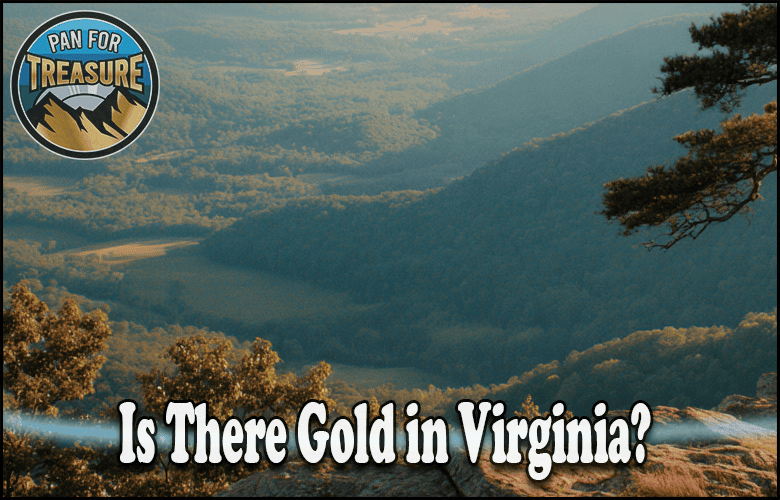
Is there gold in Virginia? Yes, and Virginia was once the third largest gold producing state in the country. The Virginia Gold Pyrite Belt, a 200 mile long zone running northeast to southwest through the Piedmont region, hosted over 250 mines that produced more than 98,600 documented troy ounces of gold. At its peak in the 1830s and 1840s, gold from Virginia, the Carolinas, and Georgia totaled $1 million per year. Much of Virginia’s gold was shipped to the U.S. Mint in Philadelphia, helping the young nation transition away from foreign coinage.
Thomas Jefferson made the first documented mention of Virginia gold in 1782, describing a lump of ore found near the Rappahannock River containing 17 pennyweight of gold. The first lode deposit was discovered at the Whitehall Mine in Spotsylvania County around 1804. By the 1830s, dozens of mines operated along the gold belt, and the Franklin Gold Mine in Fauquier County alone produced $1.2 million worth of gold before the Civil War.
The U.S. Bureau of Mines estimates that 378,000 troy ounces remain in lode deposits and 274,000 in placer deposits in Virginia. Modern exploration continues: in 2021, a Canadian company began investigating gold veins in Buckingham County, where quartz veins of ounce plus grade have been identified.
TL;DR
- Gold Present: Yes, significant. Over 98,600 documented ounces (some sources claim 600,000+). Bureau of Mines estimates 652,000 ounces still remaining. Virginia was once 3rd nationally. Peak year: 1849 (6,249 oz). Between 1829 and 1860, Virginia mines sent 74,865 ounces to the Mint.
- Best Region: The Gold Pyrite Belt through Fauquier, Spotsylvania, Orange, Louisa, Goochland, Fluvanna, Buckingham, and Culpeper Counties. Streams draining into the Rappahannock and Anna rivers. The Rapidan River is popular for panning.
- Gold Type: Both lode gold in quartz veins within metavolcanic rocks and placer gold in streams. The gold belt contains gold associated with pyrite in volcanic plutonic rocks. Fine flakes to small nuggets in stream gravels.
- Top Spot: Lake Anna State Park (Spotsylvania County) offers ranger guided gold panning. Monroe Park Gold Mining Museum in Goldvein (Fauquier County). The Rapidan River through Orange and Culpeper Counties. Streams throughout the Gold Pyrite Belt.
- Legal Note: Lake Anna State Park offers supervised panning. Most mine sites are on private property. The Monongahela National Forest in western Virginia has public land. Get permission before prospecting on private property. The Central Virginia Gold Prospectors club provides guidance and access.
- Verdict: Virginia offers genuine gold prospecting with historic significance. The state’s gold helped fund early American commerce. Modern explorers are investigating deposits that 19th century miners could not efficiently process. Lake Anna State Park is an excellent introduction for beginners.
Production
Over 98,600 documented ounces (Virginia Energy). Some sources claim 600,000+ ounces. Between 1829 and 1860, Virginia mines sent 74,865 ounces to the Philadelphia Mint, worth over $1.5 million. Peak year: 1849 (6,249 ounces). Last production: 1947, Spotsylvania County.
Gold Pyrite Belt
A 200 mile long, 15 to 25 mile wide volcanic plutonic belt extending from Fairfax County to Buckingham County. Contains over 250 mines. The belt runs through Fauquier, Stafford, Culpeper, Spotsylvania, Orange, Louisa, Fluvanna, Goochland, Cumberland, and Buckingham Counties. Place names like Goldvein, Mine Run, and Mineral reflect the mining heritage.
Franklin Gold Mine
The most successful mine in Fauquier County. Produced $1.2 million in gold from 1825 until the Civil War. Operated as an open cut mine initially, with gold plentiful enough to gather near the surface. One of 19 mines within a 5 mile radius of Goldvein.
Thomas Jefferson
In 1782, Jefferson wrote in “Notes on the State of Virginia” about a lump of ore found near the Rappahannock River containing 17 pennyweight of gold. This is the first documented mention of gold in Virginia, predating organized mining by two decades.
Remaining Gold
The U.S. Bureau of Mines estimates 378,000 ounces in lode deposits and 274,000 ounces in placer deposits still remain in Virginia. 19th century miners lost 50 to 60 percent of gold in tailings due to primitive mercury amalgamation recovery methods. Modern technology could recover gold from old waste piles.
Modern Exploration
Aston Bay Holdings (Canadian) is exploring quartz veins in Buckingham County where ounce plus grade gold has been identified. Big Dawg Resources is reprocessing old mine tailings in Goochland County, extracting gold that 19th century methods missed. Interest is renewed with gold prices above $2,000/oz.
Where Is There Gold in Virginia?
Is there gold in Virginia that you can find today? Yes. Gold remains in streams throughout the Gold Pyrite Belt, and recreational prospectors regularly find color. Lake Anna State Park offers supervised panning, and the Rapidan River is one of the most popular prospecting destinations in the state.
Gold Pyrite Belt (Piedmont Virginia)
The main gold zone runs through a dozen counties from Fairfax to Buckingham. The largest concentrations of historic mines are in Buckingham, Fluvanna, Louisa, Goochland, and Spotsylvania Counties. Mines clustered along small streams draining into the Rappahannock and Anna rivers. Modern prospectors focus on these same waterways. Fauquier County alone hosted at least 18 mines within the Goldvein and Morrisville area.
Rapidan River
The Rapidan River stretches over 88 miles through Orange, Culpeper, Madison, and Greene Counties. It flows through the heart of the gold belt and has been a prime prospecting location since the early 1800s. Multiple public access points make it one of the most accessible gold panning rivers in the state.
Lake Anna Area (Spotsylvania/Louisa Counties)
Lake Anna State Park, adjacent to the old Goodwin Gold Mine, offers ranger escorted gold panning programs. The Goodwin Mine site has extensive remains including shafts, mercury contamination, and tailings piles that still contain gold.
Best Places to Look for Gold in Virginia
- Lake Anna State Park (Spotsylvania County): Rangers escort visitors to a spot adjacent to the old Goodwin gold mine for supervised gold panning. Excellent for beginners and families.
- Rapidan River (Orange/Culpeper Counties): One of the most popular prospecting rivers. Multiple public access points. Fine gold flakes and occasional small nuggets in gravel bars. 88 miles of river through the gold belt.
- Rappahannock River and tributaries (Fauquier/Stafford Counties): Modern day prospectors still find gold in tributaries leading into the Rappahannock. The river itself contains placer gold washed from the belt.
- Monroe Park Gold Mining Museum, Goldvein (Fauquier County): Virginia’s official Gold Mining Interpretive Center. Sluicing available with purchased bags. Free museum with artifacts from 19 surrounding mines.
- Streams in Buckingham County: Active modern exploration by Aston Bay Holdings suggests significant undiscovered gold. Quartz veins with ounce plus grade identified. Streams draining the area contain placer gold.
- Goochland County streams: Site of mines that operated until 1936. Big Dawg Resources is reprocessing old tailings. Surrounding streams contain gold from historic operations.
- Contrary Creek area (Louisa County): Near Mineral, Virginia. Multiple historic mines. Streams contain gold though some areas have environmental contamination from historic mining.
History and Geology of Gold in Virginia
Virginia’s gold story begins with Thomas Jefferson’s 1782 note about gold found near the Rappahannock. The first lode deposit was discovered at the Whitehall Mine in western Spotsylvania County in 1806, and the first gold mining company (Virginia Mining Company of New York) was operating at Mine Run by 1831. By the 1830s, southern states including Virginia produced $1 million in gold annually, and Virginia was ranked third nationally.
The peak year was 1849, with 6,249 ounces produced, but ironically that same year California’s gold discovery drew serious miners west. The Civil War devastated Virginia’s mines, with Union troops systematically destroying the economic infrastructure of the South. Many mines were damaged beyond repair.
Mining resumed on a smaller scale after the war. English companies bought several properties in the 1850s, bringing new equipment including 12 stamp mills and 1,000 pound rolling ball mills. Production continued sporadically until 1947.
Geologically, the gold lies within the Virginia Gold Pyrite Belt, a 200 mile long volcanic plutonic belt along the eastern edge of the Appalachians. Gold occurs in quartz veins within metavolcanic rocks, associated with pyrite. The mineralization formed during ancient volcanic activity and was later concentrated by weathering and erosion into placer deposits in streams. The gold belt is part of the larger Appalachian gold system that extends from Maryland to Alabama.
Tips for Gold Prospecting in Virginia
- Start at Lake Anna State Park. The ranger led panning program provides hands on introduction to Virginia gold. You will learn technique while panning near a real historic mine site.
- Join the Central Virginia Gold Prospectors. This club provides access to private sites, education, and organized outings. Experienced members know the best spots and techniques for Virginia’s fine gold.
- Focus on the Rapidan River. This is the most accessible prospecting river in the gold belt. Use a gold pan and sluice box at gravel bars, especially after high water events.
- Look for black sand indicators. Virginia gold concentrates with magnetite and pyrite. When you see black sand accumulating in your pan, pay close attention. A metal detector can also be useful in dry gulches near old mine sites.
- Respect private property. Most historic mine sites are on private land. Always get written permission. Some landowners are understandably reluctant due to hazardous open shafts and mercury contamination at old mine sites.
- Visit the Goldvein Museum. The free Gold Mining Camp Museum at Monroe Park has artifacts, photos, and reconstructed buildings from the mining era. The staff can point you to accessible prospecting areas.
Resources
- Virginia Energy: Gold for official production figures, publications, and recreational mining regulations.
- Wikipedia: Gold Mining in Virginia for a county by county listing of mines with locations and coordinates.
- VOA: Virginia Again Takes a Shine to Gold for modern exploration efforts in Buckingham and Goochland Counties.
Conclusion
Is there gold in Virginia? Yes, and it is historically significant. Virginia’s Gold Pyrite Belt hosted over 250 mines, the state was once ranked third nationally, and the Bureau of Mines estimates over 650,000 ounces remain. Lake Anna State Park and the Rapidan River offer accessible recreational prospecting, while modern companies are exploring deposits with fresh eyes and better technology.
For more gold in the region, see Is There Gold in North Carolina?, Is There Gold in South Carolina?, and Is There Gold in Georgia?. Browse the full state directory to find gold near you.
FAQ
Where is the best place to find gold in Virginia?
Lake Anna State Park offers supervised panning for beginners. The Rapidan River through Orange and Culpeper Counties is the most popular prospecting river. Streams throughout the Gold Pyrite Belt from Fauquier to Buckingham Counties contain gold.
How much gold has Virginia produced?
Over 98,600 documented troy ounces (some sources claim 600,000+). Between 1829 and 1860, mines sent 74,865 ounces to the Philadelphia Mint. The Bureau of Mines estimates 652,000 ounces remain in the state.
Is gold panning legal in Virginia?
Yes, recreational panning is legal with landowner permission. Lake Anna State Park offers supervised programs. Public waterways are generally accessible. Most mine sites are on private property requiring permission.
What is the Virginia Gold Pyrite Belt?
A 200 mile long, 15 to 25 mile wide volcanic plutonic belt running from Fairfax County to Buckingham County. It hosted over 250 gold mines and is the source of nearly all Virginia’s gold production.

⛏ Recommended Gear ⛏


* As an Amazon Associate I earn from qualifying purchases at no extra cost to you.
Subscribe to Our Newsletter

Ryan Conlon is the founder of Pan for Treasure.
A lifelong gold panning enthusiast, he created this site to help beginners learn the ropes and share practical tips from his own time on the creek. [email protected]