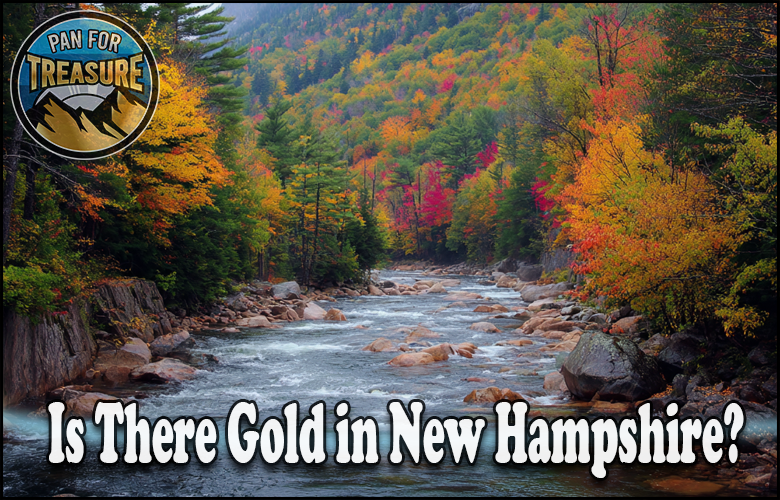
Is there gold in New Hampshire? Yes. The Granite State has both lode and placer gold, primarily concentrated in the Ammonoosuc Gold District of Grafton County in the western part of the state. The New Hampshire Geological Survey confirms that gold occurs in veins with sulfide minerals and as free gold in quartz veins, and that placer gold in streams ranges from very fine specks to pearl sized nuggets. In truth, hard work can probably produce traces of gold from many streams in the state.
New Hampshire’s gold story begins with the pioneering geological survey of Charles Hitchcock, published in his famous “Hitchcock Atlas of New Hampshire Geology.” He identified the Ammonoosuc Gold District centered on the towns of Lyman, Monroe, and Bath, including parts of Littleton and Landaff in Grafton County. Small scale mining operations around Bath extracted and processed gold bearing ores, and the Wild Ammonoosuc River has been the single most productive area for placer gold recovery in the state.
The gold here has two origins. Some comes from native lode deposits: gold bearing quartz veins in metamorphic rocks (originally volcanic) that are part of the northern Appalachian gold belt. The rest was transported by glaciers from the rich goldfields of Quebec, Canada, and deposited across New Hampshire when the ice melted. This dual origin means that gold can be found in streams even where no local bedrock source is obvious.
TL;DR
- Gold Present: Yes, both lode and placer gold. The Ammonoosuc Gold District in Grafton County is the primary gold area. Diamond Ledge in Ossipee produced smaller amounts. Gold occurs in quartz veins and as placer deposits in streams statewide.
- Best Region: Western New Hampshire, especially Grafton County. The Wild Ammonoosuc River near Bath is the most productive. Streams draining into the Connecticut River from the Ammonoosuc confluence at Woodsville north to the Connecticut Lakes are all favorable.
- Gold Type: Fine placer gold dominates, ranging from specks to pearl sized nuggets. Lode gold in quartz veins with sulfide minerals. Some coarser gold from local bedrock sources, plus fine glacial gold from Quebec.
- Top Spot: The Wild Ammonoosuc River near Bath/Swiftwater (Grafton County) is the single most productive area. The Baker River (accessible at Warren, Wentworth, and Rumney) and Salmon Hole Brook in Lisbon are also well documented.
- Legal Note: Stream beds are privately owned by adjacent landowners. Permission required. Scooping gravel with a gold pan is allowed, but shovels to dig into stream beds or banks are not. White Mountain National Forest requires a free annual permit. Only hand tools are permitted in the forest (no sluices, dredges, or motorized equipment). Dredging statewide requires a NHDES permit.
- Verdict: New Hampshire is a modest gold state with genuine lode and placer deposits. It is more productive than most New England states except Maine. The White Mountain National Forest provides excellent public land access, and the Ammonoosuc district has both historical mining and ongoing recreational prospecting.
Commercial Production
Very small. A few mines operated around Bath in the Ammonoosuc District and at Diamond Ledge in Ossipee, extracting ores that were crushed and processed. Overall gold production has been insignificant by national standards. The western gold camps of the 1800s drew miners away from New Hampshire’s modest deposits.
Ammonoosuc Gold District
The primary gold area, centered on Lyman, Monroe, and Bath in Grafton County. Identified by Charles Hitchcock in his Atlas of New Hampshire Geology. Gold in quartz veins with sulfide minerals and free gold. The most intense placer gold recovery in the state occurs here.
Gold Origins
Two sources: native lode deposits in metamorphic rocks (originally volcanic, part of the Appalachian gold belt) and glacial gold transported from Quebec’s goldfields. The Clough Formation on the western side of the state is a key geological unit for gold bearing rocks.
White Mountain National Forest
1,225 square miles with over 600 miles of rivers and streams. Gold panning allowed with a free annual permit from any district office. Only hand tools are permitted (no sluices, rocker boxes, dredges, or mechanized equipment per the 2005 Forest Plan). Many streams contain gold.
Placer Gold Size
Ranges from very fine specks to pearl sized nuggets according to the NH Geological Survey. Most is fine placer gold. The Ammonoosuc District produces the coarsest gold, likely sourced from nearby lode deposits. Glacial gold tends to be finer.
Geology
About 50% of New Hampshire’s rocks are metamorphic, many derived from original volcanic rocks. The state has abundant granitic rocks (hence “Granite State”). Gold is associated with quartz veins, faults with hydrothermal alteration, serpentinite (greenstone), and the Clough Formation metasediments.
Featured
Where Is There Gold in New Hampshire?
New Hampshire ranks #23 of 50 for gold potential.
Quick reference below – details on each location follow, or jump to the New Hampshire map.
| Location / Area | River / Creek | County | Gold Type | Land Access |
|---|---|---|---|---|
| Wild Ammonoosuc River near Bath/Swiftwater | Wild Ammonoosuc River | Grafton | Placer gold | Not listed |
| Ammonoosuc River and tributaries | Ammonoosuc River | Grafton | Placer gold | Not listed |
| Baker River (Warren to Rumney) | Baker River, Pemigewasset River | Not listed | Not listed | Not listed |
| Salmon Hole Brook, Lisbon | Salmon Hole Brook, Ammonoosuc River | Grafton | Placer gold | Not listed |
| Androscoggin River near Berlin | Androscoggin River, Swift River | Not listed | Not listed | Not listed |
| Connecticut River tributaries (western border) | Connecticut River | Not listed | Fine gold | Not listed |
| White Mountain National Forest streams | Not listed | Not listed | Not listed | Not listed |
| Diamond Ledge area, Ossipee | Not listed | Carroll | Lode gold | Not listed |
Is there gold in New Hampshire that a recreational prospector can actually find? Yes. New Hampshire has documented gold in multiple rivers and streams, with the best concentrations in the western part of the state. The NH Geological Survey’s own publication notes that hard work can produce traces of gold from many streams statewide, and the Ammonoosuc Gold District has been the focus of both historical mining and modern recreational prospecting.
Ammonoosuc Gold District (Grafton County)
The Ammonoosuc Gold District is New Hampshire’s premier gold area. Centered on the towns of Lyman, Monroe, and Bath, the district was first identified by state geologist Charles Hitchcock in the 19th century. Gold occurs here in two forms: in veins (mineral filled cracks in the bedrock) with sulfide minerals like pyrite, and as free gold in quartz veins.
The Wild Ammonoosuc River has been the single most productive stream for gold recovery in New Hampshire. Most of the richest historic mining took place around Bath, at the lower end of the Wild Ammonoosuc. Small mines operated here, extracting ores that were crushed and processed for gold. The placer deposits in the stream are sourced from these nearby lode deposits, which is why the gold here tends to be coarser than glacial gold found elsewhere in the state.
The main Ammonoosuc River is also popular among prospectors. Placer gold occurs along small tributaries that feed into it. Streams draining into the Connecticut River from the Ammonoosuc confluence at Woodsville north to the Connecticut Lakes are all considered favorable for placer gold by the NH Geological Survey.
The geological key is the metamorphic rocks of the district, many of which were originally volcanic in origin. These rocks are part of the northern Appalachian gold belt and contain the type of mineral assemblages that concentrate gold during metamorphism. Bull quartz (milky crystalline quartz in veins) is particularly associated with gold, which deposits on the interfaces between quartz crystals.
Baker River (Grafton County)
The Baker River runs through several towns in the White Mountains region, including Warren, Wentworth, and Rumney. Gold has been reported at all these locations. The point where the Baker River drains into the Pemigewasset River is considered particularly productive by experienced prospectors.
The Baker River is described as favorable for placer gold by the NH Geological Survey. Despite gold discoveries here dating back centuries, portions of the river remain relatively untouched. Dedicated prospectors often seek out these overlooked stretches for panning.
Androscoggin River and Northern Streams
The Androscoggin River begins in Errol, New Hampshire and flows 178 miles into Maine. Gold can be found throughout the river, with most New Hampshire prospectors focusing on the area around Berlin. The connection to Maine’s Swift River (a tributary of the Androscoggin, and New England’s premier gold panning destination at Coos Canyon) suggests that the Androscoggin system carries gold from multiple sources.
White Mountain National Forest
The White Mountain National Forest spans 1,225 square miles with over 600 miles of rivers and streams. Many of these waters contain gold. The forest provides the best public land access for prospecting in New Hampshire, though regulations are strict: only hand tools (gold pans) are permitted. Sluice boxes, rocker boxes, dredges, and any mechanized equipment are prohibited under the 2005 Forest Plan.
A free annual permit is required and is available at any district office. The western side of the forest, closest to the Ammonoosuc Gold District, is where nearly all historic mining took place and where prospectors are most likely to find gold.
Our Favorite Posts
Best Places to Look for Gold in New Hampshire
- Wild Ammonoosuc River near Bath/Swiftwater (Grafton County): The most productive gold stream in New Hampshire. Both lode and placer gold documented. Historic mining operations around Bath. Gold sourced from nearby quartz vein lode deposits.
- Ammonoosuc River and tributaries (Grafton County): Placer gold in small tributaries feeding into the main river. Part of the Ammonoosuc Gold District. The area from Woodsville north is favorable according to the NH Geological Survey.
- Baker River (Warren to Rumney): Gold reported at Warren, Wentworth, and Rumney. The confluence with the Pemigewasset River is particularly productive. Some stretches remain relatively unexplored. Panning in White Mountains requires a free permit.
- Salmon Hole Brook, Lisbon (Grafton County): A documented source of placer gold. Quartz rock in the stream suggests possible lode gold. Lisbon is also near a stretch of the Ammonoosuc River for additional prospecting.
- Androscoggin River near Berlin: Gold throughout the 178 mile river. Connected to Maine’s gold bearing Swift River system. Focus on gravel bars and tributary confluences.
- Connecticut River tributaries (western border): Streams draining into the Connecticut from the Ammonoosuc area are all favorable. The Connecticut itself may contain fine gold from multiple upstream sources including Vermont gold districts.
- White Mountain National Forest streams: Over 600 miles of streams, many gold bearing. Free permit required. Hand tools only. Focus on the western side of the forest nearest the Ammonoosuc District.
- Diamond Ledge area, Ossipee (Carroll County): A documented lode gold location east of the White Mountains. Smaller production than the Ammonoosuc District but confirms gold bearing geology extends into eastern New Hampshire.
History and Geology of Gold in New Hampshire
New Hampshire’s gold history is modest but genuine. Before the California Gold Rush drew prospectors west in 1849, New Englanders explored the hills and mountains of their home states for precious metals. They discovered that both lode and placer gold could be found in the northern Appalachians.
The state’s first geological survey, authorized by the legislature in 1839, was among the earliest in the nation. Charles Hitchcock’s comprehensive Atlas of New Hampshire Geology identified the Ammonoosuc Gold District and documented gold bearing rocks across the western part of the state. Small mining operations around Bath extracted and processed gold bearing ores, and placer prospecting occurred on multiple rivers.
The geology behind New Hampshire’s gold is tied to the state’s complex metamorphic history. About 50% of New Hampshire’s bedrock is metamorphic, much of it derived from originally volcanic rocks. When these volcanic rocks were subjected to the intense heat and pressure of mountain building events (the Acadian and Alleghenian orogenies), gold was mobilized by hot, salty brines and deposited in quartz veins along faults and fracture zones.
The Clough Formation on the western side of the state is a key geological unit. This metasedimentary formation contains rocks favorable for gold mineralization. The Ammonoosuc Volcanics, another important unit, are metamorphosed volcanic rocks that originally may have contained gold, which was then concentrated during later geological events.
The second source of New Hampshire’s gold is glacial. During the Pleistocene ice ages, massive glaciers advanced southward from Canada across New England. These ice sheets scraped across the gold bearing greenstone belts of Quebec (part of the Abitibi Gold Belt, one of the richest gold provinces in the world) and transported gold bearing material into New Hampshire. When the glaciers melted, this material was deposited across the state. Streams have since reworked these glacial deposits, concentrating the tiny gold particles in gravel bars and bends.
Recommended Reading
Tips for Gold Prospecting in New Hampshire
- Start with the Ammonoosuc District. The Wild Ammonoosuc River near Bath and Swiftwater is the most proven gold producing area in the state. If you can find only one place to prospect, make it here. Get landowner permission before accessing the stream.
- Get a White Mountain National Forest permit. The free annual permit is available at any forest district office. It covers the latest rules for gold panning and mineral collecting. Only hand tools (gold pans) are permitted. This is the most accessible public land for prospecting in the state.
- Understand the stream bed rules. In New Hampshire, every stream, brook, or river is “waters of the state,” but the stream bed is privately owned by adjacent landowners. You may not use a shovel to dig into the stream bottom or banks. Scooping gravel with a gold pan is allowed.
- Look for bull quartz. Milky white crystalline quartz veins (bull quartz) are strongly associated with gold in New Hampshire. If you see bull quartz in stream gravels or exposed bedrock, the surrounding area is worth prospecting. Gold deposits on the interfaces between quartz crystals.
- Target tributary confluences. Where smaller streams enter larger rivers, the change in current speed creates natural gold traps. The confluence of the Baker River with the Pemigewasset is one well documented example.
- Pan carefully for fine gold. Most New Hampshire gold is fine placer. A standard gold pan requires careful technique to retain these small particles. For better recovery on private land with permission, a sluice box is more effective (a NHDES dredging permit is required for motorized equipment statewide).
- Explore the Connecticut River tributaries. The NH Geological Survey identifies all streams draining into the Connecticut from the Ammonoosuc confluence north to the Connecticut Lakes as favorable for gold. Many of these smaller tributaries see very little prospecting pressure.
- Combine with a visit to Maine. Maine’s Coos Canyon on the Swift River (about 2 hours from the NH border) is New England’s premier gold panning destination with equipment rental and free demonstrations. A New Hampshire prospecting trip pairs well with a day at Coos Canyon.
Best Locations
- Is There Gold in Rhode Island? Top Locations and if It’s Worth the Trip
- Is There Gold in Washington? Top Locations and if It’s Worth the Trip
- Best Places to Pan for Gold and Gemstones in America
- Is There Gold in Massachusetts? Top Locations and if It’s Worth the Trip
- Is There Gold in South Carolina? Top Locations and if It’s Worth the Trip
Resources
- NH Geological Survey: Gold in New Hampshire (GEO-1 PDF) for the official state geological assessment including the Ammonoosuc District, regulations, and geology.
- How to Find Gold Nuggets: Gold in New Hampshire’s White Mountain National Forest for prospecting information on forest access and specific locations.
- Silver Recyclers: Gold Prospecting in New Hampshire for river by river prospecting information including the Baker River, Androscoggin, and Salmon Hole Brook.
Conclusion
Is there gold in New Hampshire? Yes. The Granite State has genuine lode and placer gold, primarily concentrated in the Ammonoosuc Gold District of Grafton County. The Wild Ammonoosuc River near Bath has been the most productive gold stream in the state, and gold has been found in many rivers and streams across western and northern New Hampshire. The NH Geological Survey confirms that hard work can produce traces of gold from many streams statewide.
New Hampshire will not make anyone rich from gold panning. The deposits are modest, the gold is mostly fine, and strict regulations (especially in the White Mountain National Forest) limit what equipment you can use. But the combination of real gold, beautiful mountain scenery, accessible public land in the national forest, and a genuine mining history centered on the Ammonoosuc District makes New Hampshire a worthwhile destination for recreational prospectors in the Northeast.
For better New England gold prospecting, see Is There Gold in Maine? (Coos Canyon is New England’s best panning spot). For top gold states nationally, see Is There Gold in California?, Is There Gold in Colorado?, and Is There Gold in Montana?. Or browse the full state directory to find gold near you.
Frequently Asked Questions – Is There Gold in NH
Where is the best place to find gold in New Hampshire?
The Wild Ammonoosuc River near Bath and Swiftwater in Grafton County is the most productive gold stream in the state. The Baker River (Warren to Rumney) and Salmon Hole Brook in Lisbon are also well documented. The White Mountain National Forest provides public access to many gold bearing streams with a free annual permit.
Is gold panning legal in New Hampshire?
Yes, but with restrictions. Stream beds are privately owned by adjacent landowners, so permission is needed. Scooping gravel with a gold pan is allowed, but digging with shovels into stream beds or banks is not. The White Mountain National Forest allows panning with hand tools only (free permit required). Motorized dredging statewide requires a NHDES permit.
What type of gold is found in New Hampshire?
Mostly fine placer gold ranging from specks to pearl sized nuggets. Lode gold also occurs in quartz veins with sulfide minerals, especially in the Ammonoosuc Gold District. Gold near known lode sources (Bath area) tends to be coarser. Glacial gold transported from Quebec is finer.
Where does New Hampshire’s gold come from?
Two sources: native lode deposits in metamorphic rocks (part of the Appalachian gold belt, especially the Clough Formation and Ammonoosuc Volcanics) and glacial gold transported from Quebec’s goldfields during the Pleistocene ice ages. Both contribute to placer gold found in streams.
Can I pan for gold in the White Mountain National Forest?
Yes, with a free annual permit from any forest district office. Only hand tools (gold pans) are permitted. Sluice boxes, rocker boxes, dredges, and any mechanized or motorized equipment are prohibited under the 2005 Forest Plan. The western side of the forest nearest the Ammonoosuc District has the best gold potential.
How does New Hampshire compare to other New England states for gold?
New Hampshire is second to Maine for gold prospecting in New England. Maine’s Coos Canyon on the Swift River is the region’s best panning destination. New Hampshire has more documented lode gold than most New England states and the Ammonoosuc District provides a genuine mining heritage. Massachusetts and Vermont also have modest gold potential.

⛏ Recommended Gear ⛏


* As an Amazon Associate I earn from qualifying purchases at no extra cost to you.
Subscribe to Our Newsletter

Ryan Conlon is the founder of Pan for Treasure.
A lifelong gold panning enthusiast, he created this site to help beginners learn the ropes and share practical tips from his own time on the creek. [email protected]