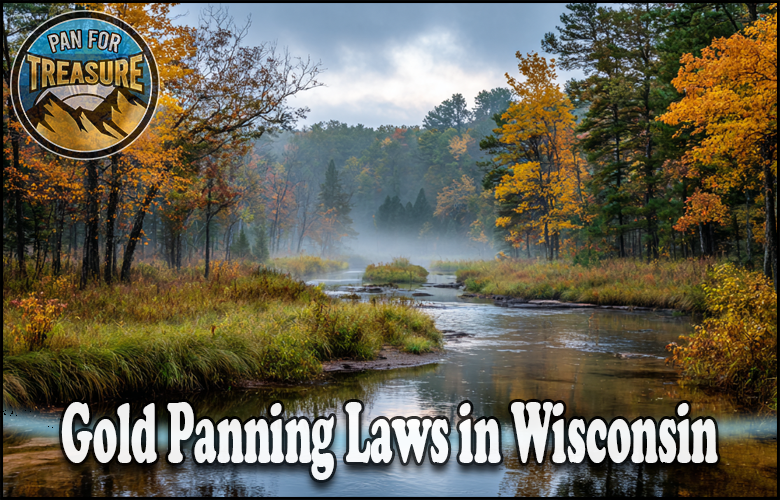
A quiet Wisconsin stream with gravel deposits where hobby prospectors occasionally search for fine placer gold.
The gold panning laws in Wisconsin allow recreational hand panning on public waterways and public land without a state mining permit. Wisconsin does not require a permit for recreational gold panning with hand tools.
The Chequamegon-Nicolet National Forest in northern Wisconsin provides public access to streams, and glacial gold deposits from the Pleistocene ice sheets are found across the northern and western parts of the state.
Wisconsin is not a major gold state, but gold does exist here. The Pleistocene Laurentide Ice Sheet transported gold-bearing material from the Canadian Shield and deposited it across roughly two-thirds of Wisconsin.
Fine placer gold has been documented in streams in Marathon, Taylor, Lincoln, Oneida, and several other northern counties. No commercial gold mining has been profitable in the state, but recreational prospectors regularly find fine flour gold and small flakes in the right locations.
This guide covers the current regulations, the best locations, and what is known about gold in Wisconsin. If you are new to panning, start with our getting started with gold panning guide.
TL;DR
- Hand panning: No state permit required for recreational hand panning. Wisconsin DNR does not regulate casual recreational panning.
- Public waterways: Wisconsin recognizes public trust rights on navigable waterways. You can wade and pan in navigable streams without landowner permission for the waterway itself.
- National forest: Chequamegon-Nicolet NF allows casual use hand panning. Contact the Ranger District for rules on larger equipment.
- Gold source: Glacial deposits from the Canadian Shield transported by the Laurentide Ice Sheet. No significant local lode sources.
- Motorized equipment: Suction dredges and motorized equipment in waterways require WDNR permits. Wisconsin has strict water quality regulations.
- Gold type: Very fine flour gold and small flakes. No nuggets expected. Patience and fine gold recovery techniques are necessary.
Glacial Deposits (Canadian Shield Origin)
No Commercial Production
Northern and Western Wisconsin (Glaciated Areas)
Marathon, Taylor, Lincoln, Oneida, Rusk
No (Recreational Hand Panning)
Chequamegon-Nicolet NF (1.5 Million Acres)
Featured
Gold Panning Laws in Wisconsin
Wisconsin does not have a state statute specifically governing recreational gold panning. The activity falls under general environmental and waterway regulations administered by the Wisconsin Department of Natural Resources (WDNR), the US Forest Service (Chequamegon-Nicolet National Forest), and county land departments.
Public Waterways and Navigable Streams
Wisconsin has a strong public trust doctrine for navigable waterways. Under Wisconsin law (Article IX of the State Constitution), the public has the right to use navigable waters for recreation, including wading and activities in the streambed. This means you can generally pan in navigable streams without needing landowner permission for the waterway itself, even where the stream flows through private land. However, you must access the stream from a public access point (road crossing, bridge, public land) and cannot cross private land to reach the stream.
Chequamegon-Nicolet National Forest
The Chequamegon-Nicolet National Forest covers approximately 1.5 million acres in northern Wisconsin. Recreational hand panning with hand tools is allowed as casual use on NF land. Non-motorized sluice boxes may be used in some areas, but check with the local Ranger District. Motorized equipment requires Forest Service authorization.
County Forests
Wisconsin has an extensive county forest system, particularly in the northern part of the state. County forests are public land and generally allow recreational activities including casual panning. Contact the specific county forestry department for rules on gold panning in their forests.
State Parks and Natural Areas
Wisconsin state parks and state natural areas generally prohibit mineral collection. Contact the WDNR or the specific park for current rules before attempting to prospect in any state park.
Private Land
While Wisconsin’s public trust doctrine allows wading and panning in navigable streams, the land adjacent to the stream is private property. Do not cross private land to access a stream, do not leave the stream channel onto private banks, and do not pan in non-navigable streams on private property without landowner permission.
Motorized Equipment
Suction dredges, highbankers, and other motorized equipment in waterways require WDNR permits. Wisconsin has strict water quality regulations, and any activity that disturbs streambeds or discharges material into waterways may trigger permit requirements. Contact the WDNR for guidance on specific equipment.
Equipment Restrictions
| Equipment | Chequamegon-Nicolet NF | County Forests / Public Land | Navigable Streams (Public Trust) |
|---|---|---|---|
| Gold Pan | Allowed (casual use) | Generally allowed | Allowed (access from public point) |
| Shovel/Hand Tools | Allowed (casual use) | Generally allowed | Minimal disturbance |
| Classifier/Screen | Allowed | Generally allowed | Allowed |
| Non-motorized Sluice | Check with Ranger District | Check with county | May require WDNR permit |
| Suction Dredge | Requires USFS + WDNR permits | Requires WDNR permit | Requires WDNR permit |
| Highbanker/Motorized | Requires USFS + WDNR permits | Requires WDNR permit | Requires WDNR permit |
Our Favorite Posts
- Is it Legal to Pan for Gold in the United States?
- Gold Panning Laws in North Carolina (NC) – What Prospectors Need to Know
- Gold Panning Laws in Georgia – What Prospectors Need to Know
- Prospecting in National Parks Federal Rules You Must Follow
- Gold Panning Laws in South Dakota – What Prospectors Need to Know
Best Gold Prospecting Locations in Wisconsin
Wisconsin’s gold comes from glacial deposits transported from the Canadian Shield by the Pleistocene Laurentide Ice Sheet. The ice sheets covered roughly the northern two-thirds of the state during the Wisconsin Glaciation (the most recent ice age, named after the state). Gold in Wisconsin streams is fine flour and small flakes eroded from glacial till and outwash. For more details, see our is there gold in Wisconsin page.
- Big Rib River and Tributaries (Marathon County) – Marathon County in central Wisconsin has some of the best documented glacial gold in the state. The Big Rib River and its tributaries carry fine gold from glacial deposits. Mix of county forest and private land. Fine flour gold and small flakes. Good starting point for Wisconsin prospecting.
- Plover River (Marathon, Portage Counties) – The Plover River flows through glaciated terrain in central Wisconsin. Fine gold in gravels from glacial deposits. Some county forest access. Mostly private farmland and forest. Access navigable sections from public road crossings.
- Black River (Taylor, Clark, Jackson Counties) – The Black River drains glaciated terrain in western Wisconsin. Fine gold reported in some sections. Mix of county forest, NF, and private land. The upper Black River has NF access in some areas. Fine flour gold.
- Wisconsin River and Tributaries (Multiple Counties) – The Wisconsin River is the longest river in the state and drains a vast glaciated watershed. Fine gold has been reported in gravel bars along the river, particularly in the central and northern sections. Some public access at parks, boat launches, and road crossings. Very fine flour gold.
- Chippewa River and Tributaries (Rusk, Chippewa, Taylor Counties) – The Chippewa River system drains the northwestern part of the state. Glacial deposits in the watershed contain trace gold. Some county forest and NF access. The Chippewa Flowage area in Rusk County has public land access. Fine gold.
- Spirit River / Lincoln County – The Spirit River in Lincoln County flows through glaciated terrain with documented fine gold. Lincoln County has county forest land that may provide access. Fine flour gold from glacial deposits. Worth sampling if you are in the area.
- Eau Claire River (Marathon, Langlade Counties) – The Eau Claire River drains the central Wisconsin highlands. Glacial deposits in the watershed. Fine gold reported in some sections. Some NF land in the upper reaches. Fine flour gold.
- Jump River (Taylor, Rusk Counties) – The Jump River flows through glaciated terrain in northwestern Wisconsin. Fine gold in some gravels. Mix of county forest and private land. Access navigable sections from road crossings and county forest access points.
- Chequamegon-Nicolet NF Streams (Multiple Counties) – Various streams within the national forest in northern Wisconsin. NF land provides hassle-free public access. The glaciated terrain means trace gold may be present in any stream draining glacial deposits. Good for exploring without land access issues.
- Wolf River (Langlade, Menominee, Shawano Counties) – The Wolf River in northeastern Wisconsin is a scenic river with some glacial deposits. Fine gold has been reported in some sections. The Menominee Indian Reservation borders the river (no trespassing on reservation land). Some county and NF access.
- Pecatonica River and Tributaries (Lafayette, Iowa Counties) – The Pecatonica River in southwestern Wisconsin drains the Driftless Area, which was not covered by the most recent glaciation. Gold is less likely here, but older glacial deposits or local rock sources may contribute trace amounts. The Driftless Area has unique geology compared to the rest of the state.
- Tomahawk River / Oneida County – The Tomahawk River in Oneida County flows through heavily glaciated terrain in northern Wisconsin. NF and county forest land provide access. Fine gold from glacial deposits. The area has numerous lakes and streams from glacial activity.
History of Gold Mining in Wisconsin
Wisconsin has no history of commercial gold mining. The state’s gold is entirely glacial in origin, deposited by the Pleistocene Laurentide Ice Sheet that covered the northern two-thirds of the state. The Wisconsin Glaciation (approximately 75,000 to 11,000 years ago) is actually named after the state because its deposits were first studied and described here by geologists in the 1800s.
The Laurentide Ice Sheet originated in northern Canada and advanced southward, scraping rock and mineral material from the Canadian Shield as it moved. The Canadian Shield contains Precambrian gold-bearing formations (greenstone belts) that have produced major gold mines in Ontario and Quebec. As the ice melted, it deposited till and outwash sediments containing trace gold across Wisconsin and other glaciated states. Streams subsequently reworked these deposits, concentrating heavy minerals including gold in their gravels.
Wisconsin’s mineral history is dominated by lead mining, not gold. The southwestern part of the state (the Lead Region around Galena and Mineral Point) produced massive quantities of lead and zinc from the 1820s through the early 1900s. The lead rush drew thousands of miners to Wisconsin before the California Gold Rush, and the state’s nickname, the Badger State, comes from the lead miners who dug temporary shelters in hillsides like badgers.
Recreational gold panning in Wisconsin became popular in the 1970s and 1980s as the hobby grew nationally. Prospectors discovered that fine flour gold could be found in streams across the glaciated portion of the state, particularly in Marathon, Taylor, Lincoln, and Rusk Counties. The GPAA and local clubs like the Midwest Gold Hunters organize outings in Wisconsin. While the gold is very fine and quantities are small, the outdoor experience and challenge of finding glacial gold attract dedicated prospectors.
Recommended Reading
Tips for Gold Panning in Wisconsin
- Expect very fine gold. All Wisconsin gold is glacially deposited flour gold and tiny flakes. Do not expect nuggets or coarse gold. Bring fine gold recovery gear: a snuffer bottle, spiral pan, magnifying glass, and patience. Pan very slowly and carefully.
- Focus on the glaciated zone. The northern and western two-thirds of Wisconsin were covered by the Laurentide Ice Sheet. Streams in Marathon, Taylor, Lincoln, Oneida, Rusk, and Chippewa Counties have the best documented glacial gold. The unglaciated Driftless Area in the southwest has less gold potential.
- Use public trust waterway access. Wisconsin’s public trust doctrine allows wading and panning in navigable streams without landowner permission. Access the stream from a public point (road crossing, bridge, public land) and stay in the stream channel. Do not cross private land to reach the water. See our techniques for beginners guide.
- Use Chequamegon-Nicolet NF for access. The 1.5-million-acre national forest in northern Wisconsin provides hassle-free public access to glaciated streams. Any stream within the NF draining glacial deposits is worth sampling. Contact the local Ranger District for current rules.
- Look for black sand concentrations. Magnetite (black sand) is a common heavy mineral in Wisconsin’s glacial deposits. Black sand concentrations indicate that other heavy minerals, including gold, may be present. Use a magnet to separate magnetite from your concentrate.
- Pan where glacial deposits meet bedrock. Gold concentrates where streams cut through glacial deposits down to bedrock. Look for areas where bedrock is exposed in the stream channel with glacial gravels sitting on top. Crevices in the bedrock trap gold. Central Wisconsin has good bedrock exposures in some streams.
- Try county forests. Wisconsin’s county forest system provides extensive public land, especially in northern counties. Contact the county forestry department for access maps and rules. County forests often have less traffic than NF land. Check our best gold panning kits for gear.
- Pan in summer and early fall. Wisconsin’s streams run high with snowmelt in spring. The best panning conditions are from June through October when water levels are lower and gravel bars are exposed. Summer temperatures are comfortable for wading.
- Join a Midwest prospecting club. The GPAA has Midwest chapters, and regional clubs organize outings in Wisconsin. Club membership provides shared knowledge and organized events. Experienced prospectors know which specific streams produce the best color.
- Enjoy the total outdoor experience. Wisconsin’s northern forests, rivers, and lakes offer excellent camping, fishing, hiking, and wildlife viewing. Combine gold panning with other outdoor activities for a rewarding trip regardless of gold results. Check the laws in Michigan and Minnesota for nearby glacial gold prospecting.
Rules
- Gold Panning Laws in Delaware – What Prospectors Need to Know
- Gold Panning Laws in Arkansas – What Prospectors Need to Know
- Gold Panning Laws in New Jersey – What Prospectors Need to Know
- Gold Panning Laws in South Dakota – What Prospectors Need to Know
- Gold Panning Laws in Maine – What Prospectors Need to Know
Resources for Wisconsin Prospectors
- USDA Forest Service – Chequamegon-Nicolet National Forest – Regulations, maps, and contact information for NF land in Wisconsin.
- Wisconsin Department of Natural Resources (WDNR) – Waterway regulations, public trust doctrine, and environmental compliance.
- Wisconsin Geological and Natural History Survey – Geological maps, glacial geology, and mineral resources publications.
- Gold Prospectors Association of America (GPAA) – Midwest chapters, membership, and prospecting education resources.
- Gold Panning Laws by State – Complete directory of gold panning regulations across all 50 states.
Learn About Other States Gold Panning Laws
Planning a trip or curious about the rules elsewhere? Explore the laws for these popular gold panning states.
Conclusion
The gold panning laws in Wisconsin are favorable for recreational prospectors, with no state permit required and strong public trust waterway access rights. The Chequamegon-Nicolet National Forest provides 1.5 million acres of public land in the glaciated north, and county forests add additional access. Wisconsin’s gold is entirely glacial, deposited by the Laurentide Ice Sheet from Canadian Shield sources, so expect very fine flour gold and tiny flakes.
Marathon, Taylor, Lincoln, Oneida, and Rusk Counties in central and northern Wisconsin have the best documented glacial gold. While quantities are small, the challenge of finding glacial gold and the outdoor experience make Wisconsin a rewarding destination for patient prospectors. Browse our gold panning near me page, our best places to pan guide, or see the full gold panning laws by state directory.
Frequently Asked Questions – WI Gold Panning Laws
Do I need a permit to pan for gold in Wisconsin?
No state permit is required for recreational hand panning. The Chequamegon-Nicolet National Forest allows casual use panning with hand tools. Motorized equipment in waterways requires WDNR permits. Wisconsin’s public trust doctrine allows wading and panning in navigable streams.
Where is the best place to pan for gold in Wisconsin?
Marathon, Taylor, Lincoln, Oneida, and Rusk Counties in central and northern Wisconsin have the best documented glacial gold. The Big Rib River (Marathon County), Plover River, Black River, and Chippewa River system are good starting points. The Chequamegon-Nicolet NF provides public access in northern Wisconsin.
Can I pan in any stream in Wisconsin?
Wisconsin’s public trust doctrine allows wading and panning in navigable streams, but you must access the stream from a public point (road crossing, bridge, public land). You cannot cross private land to reach a stream. Non-navigable streams on private property require landowner permission.
What kind of gold is found in Wisconsin?
All Wisconsin gold is glacially deposited. Expect very fine flour gold and tiny flakes transported from the Canadian Shield by the Pleistocene Laurentide Ice Sheet. No nuggets or coarse gold is found in Wisconsin. Fine gold recovery techniques and patience are necessary.
Is there gold in the Driftless Area of Wisconsin?
The Driftless Area in southwestern Wisconsin was not covered by the most recent glaciation, so glacial gold deposits are less likely. Older glacial deposits or local rock sources may contribute trace amounts in some locations, but the glaciated northern and western portions of the state are more productive for gold.
Why is the Wisconsin Glaciation named after Wisconsin?
The Wisconsin Glaciation (the most recent North American ice age, approximately 75,000 to 11,000 years ago) was named after the state because its glacial deposits were first studied and described by geologists in Wisconsin in the 1800s. The state has textbook examples of glacial features including moraines, drumlins, kettle lakes, and outwash plains.

⛏ Recommended Gear ⛏


* As an Amazon Associate I earn from qualifying purchases at no extra cost to you.
Subscribe to Our Newsletter

Ryan Conlon is the founder of Pan for Treasure.
A lifelong gold panning enthusiast, he created this site to help beginners learn the ropes and share practical tips from his own time on the creek. [email protected]