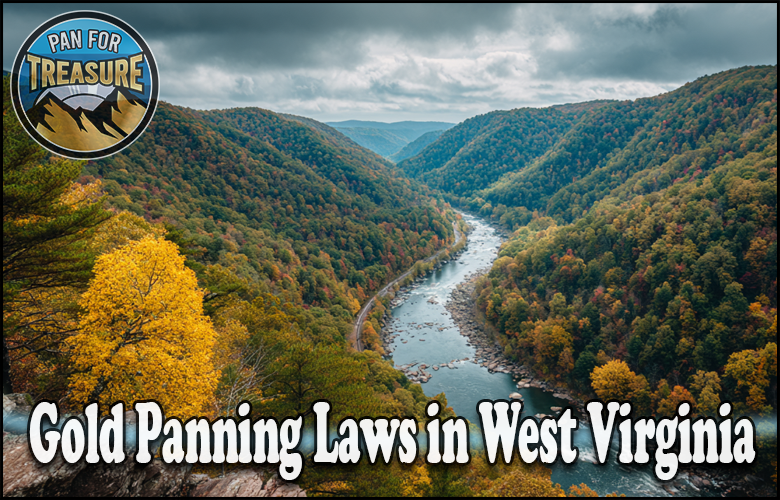
The gold panning laws in West Virginia allow recreational hand panning on public land and private land with the landowner’s permission. West Virginia does not require a state permit for recreational gold panning with hand tools. The Monongahela National Forest provides public access to streams in the Allegheny Mountains, and the state’s Appalachian geology supports trace gold occurrences in several counties.
West Virginia is not a major gold state. No significant commercial gold mining has ever occurred here, and gold occurrences are limited to trace amounts in a handful of locations. The state’s geology is dominated by Paleozoic sedimentary rocks (sandstone, shale, limestone) that are not typically gold-bearing. However, the eastern panhandle and southern border areas share some geological characteristics with the Virginia gold belt, and glacial deposits in the northern panhandle may contain trace gold from Canadian sources.
This guide covers the current regulations, what is known about gold in West Virginia, and practical tips for prospectors. If you are new to panning, start with our getting started with gold panning guide.
TL;DR
- Hand panning: No state permit required for recreational hand panning. West Virginia has no state-specific recreational mining statute.
- Monongahela National Forest: Recreational hand panning allowed as casual use on NF land. Contact the Ranger District for rules on larger equipment.
- Gold potential: Very limited. No commercial gold mining history. Trace gold reported in a few eastern and southern counties near the Virginia border.
- Private land: Landowner permission required. Most land is privately owned. Coal country culture means mineral rights are often separated from surface rights.
- Motorized equipment: Suction dredges and motorized equipment in waterways require WV DEP permits.
- Best approach: Set low expectations. Consider West Virginia as a recreational outdoor experience rather than a productive gold destination.
Very Limited (Trace Amounts Only)
No Documented Commercial Production
Paleozoic Sedimentary (Not Gold-Bearing)
Eastern Panhandle, Monroe/Greenbrier Counties
No (Recreational Hand Panning)
Monongahela National Forest (920,000 Acres)
Gold Panning Laws in West Virginia
West Virginia does not have a state statute specifically governing recreational gold panning. The activity is regulated through general environmental and waterway laws administered by the West Virginia Department of Environmental Protection (DEP), the US Forest Service (Monongahela National Forest), and local county ordinances.
Monongahela National Forest
The Monongahela National Forest covers approximately 920,000 acres in the Allegheny Mountains of eastern West Virginia. Recreational hand panning with hand tools is allowed as casual use on NF land. Non-motorized sluice boxes may require authorization from the Ranger District. Motorized equipment requires Forest Service authorization.
State Parks and State Forests
West Virginia state parks and state forests have varying rules on mineral collection. Most state parks do not allow mineral collection or gold panning without specific permission. Contact the WV State Parks office or the specific park before attempting to prospect.
Private Land
Most of West Virginia is privately owned. Written landowner permission is required for any prospecting on private property. West Virginia has a long history of separated mineral rights due to the coal industry. The mineral rights holder (often a coal company) may differ from the surface owner. For recreational hand panning in stream gravels, surface owner permission is generally sufficient.
Waterway Regulations
The West Virginia Department of Environmental Protection (DEP) regulates activities in state waterways. Activities that alter stream channels or disturb streambeds may require DEP permits. Recreational hand panning with minimal disturbance typically does not trigger permit requirements, but suction dredging or significant streambed disturbance likely requires authorization.
Equipment Restrictions
| Equipment | Monongahela National Forest | State Parks / Forests | Private Land (With Permission) |
|---|---|---|---|
| Gold Pan | Allowed (casual use) | Check individual rules | With landowner permission |
| Shovel/Hand Tools | Allowed (casual use) | Check individual rules | With permission |
| Classifier/Screen | Allowed | Check individual rules | With permission |
| Non-motorized Sluice | Check with Ranger District | Not typically allowed | With permission |
| Suction Dredge | Requires USFS + DEP permits | Not allowed | Requires DEP permit |
| Highbanker/Motorized | Requires USFS + DEP permits | Not allowed | Requires DEP permit |
Our Favorite Posts
Best Gold Prospecting Locations in West Virginia
West Virginia’s gold potential is very limited. The state is dominated by Paleozoic sedimentary rocks (Devonian, Carboniferous) that were deposited in ancient seas and do not typically host gold deposits. The best chances for finding trace gold are in the eastern panhandle and southern border areas where the geology begins to transition toward the Virginia gold belt, and in the northern panhandle where Pleistocene glacial deposits may contain transported gold. For more details, see our is there gold in West Virginia page.
- Potomac River and Tributaries / Eastern Panhandle (Jefferson, Berkeley, Morgan Counties) – The Potomac River and its West Virginia tributaries drain areas near the Virginia gold belt. Trace gold from Virginia lode sources may have been transported into these streams. The eastern panhandle has the closest geology to documented gold occurrences. Mix of public access and private land.
- South Branch Potomac River (Hardy, Grant, Pendleton Counties) – The South Branch flows through the Allegheny Mountains in the eastern part of the state. Some metamorphic and igneous rock exposures in the upper reaches. Trace gold is possible but not well documented. Monongahela NF provides some access in upper reaches.
- Greenbrier River / Greenbrier County – The Greenbrier River flows through a limestone valley in southeastern West Virginia. While limestone is not gold-bearing, tributaries draining higher metamorphic terrain may carry trace gold. Greenbrier State Forest and NF land provide some access. Very limited gold potential.
- New River / Fayette, Raleigh, Summers Counties – The New River (actually one of the oldest rivers in the world) flows through a gorge in southern West Virginia. The river drains areas near the Virginia border with metamorphic and igneous rocks. Some reports of trace gold in gravels. New River Gorge National Park and Preserve restricts mineral collection in park units. Check current rules.
- Bluestone River / Mercer County – The Bluestone River in southern West Virginia near the Virginia border drains geology that transitions toward the Virginia gold belt. Trace gold is possible in gravels. Bluestone State Park is nearby. Mostly private land. Very limited documentation.
- Ohio River Gravel Bars / Northern Panhandle (Hancock, Brooke, Ohio Counties) – The Ohio River carries material from its vast watershed, including glaciated regions. Fine flour gold may be present in some gravel bars. The northern panhandle was at the edge of Pleistocene glaciation, and some glacial deposits may contain transported gold from Canadian sources. Public access at some river parks.
- Cheat River / Monongahela NF (Tucker, Preston Counties) – The Cheat River flows through the Monongahela NF in the Allegheny Mountains. While the dominant geology is sedimentary, some tributaries drain areas with minor metamorphic rock. NF land provides good public access. Gold potential is very limited but the area is worth sampling for the outdoor experience.
- Monroe County Streams (Monroe County) – Monroe County in southeastern West Virginia borders Virginia near the gold belt. Some geological reports note minor metamorphic rock exposures. Streams draining these exposures may carry trace gold. Mostly private farmland. Very limited documentation.
History of Gold Mining in West Virginia
West Virginia has no documented history of commercial gold mining. The state’s geology is overwhelmingly Paleozoic sedimentary rock (sandstone, shale, limestone, coal measures) deposited in ancient shallow seas and swamps. These rock types do not typically contain gold. West Virginia’s mining history is instead dominated by coal, which has been the state’s primary mineral resource since the mid-1800s.
Some geological reports and mineral surveys mention trace gold in a few West Virginia locations, particularly near the Virginia border where the geology begins to transition toward the Precambrian and Paleozoic metamorphic rocks of the Virginia gold-pyrite belt. The eastern panhandle counties (Jefferson, Berkeley, Morgan) and southern border counties (Monroe, Mercer) have the most potential for trace gold based on geological proximity to documented Virginia occurrences.
The northern panhandle of West Virginia was at the southern margin of Pleistocene glaciation. Glacial deposits in Hancock and northern Brooke Counties may contain trace gold transported from Canadian Shield sources by the Laurentide Ice Sheet, similar to deposits found in Ohio and Pennsylvania. However, no documented gold finds from glacial sources in West Virginia have been published.
Despite the limited gold potential, West Virginia’s GPAA members and recreational prospectors occasionally pan the state’s streams, particularly in the eastern mountains. The Monongahela National Forest provides excellent public access for outdoor recreation, and combining panning with hiking, fishing, and camping makes for enjoyable trips even if gold finds are minimal. West Virginia’s appeal for prospectors is the outdoor experience and the challenge of finding gold in unexpected places.
Recommended Reading
Tips for Gold Panning in West Virginia
- Set very low expectations. West Virginia has no documented commercial gold production and very limited gold potential. Treat panning as an outdoor recreation activity combined with hiking and camping, not as a productive gold hunt. Any gold you find will be a bonus.
- Focus on the eastern panhandle. Jefferson, Berkeley, and Morgan Counties in the eastern panhandle have the closest geology to the Virginia gold belt. Potomac River tributaries in this area have the best theoretical potential for trace gold. See our techniques for beginners guide.
- Try southern border counties. Monroe, Mercer, and Summers Counties near the Virginia border have some geological connection to documented gold areas. Streams draining toward the Virginia gold belt may carry trace alluvial gold.
- Use Monongahela National Forest for access. The Monongahela NF provides 920,000 acres of public land in the Allegheny Mountains. While gold potential is very limited, the NF offers hassle-free access without private land complications. Contact the local Ranger District for current rules.
- Bring fine gold recovery gear. Any gold in West Virginia will be extremely fine. A snuffer bottle, spiral pan, magnifying glass, and patience are necessary. Pan very slowly and carefully.
- Look for unusual rock types. West Virginia is dominated by sedimentary rock. If you find quartz veins, metamorphic rock, or igneous rock in a stream, sample the gravels downstream. These unusual rock types are more likely to be associated with gold than the surrounding sedimentary formations.
- Pan associated minerals. Even if gold is scarce, West Virginia streams may contain garnet, magnetite, and other interesting heavy minerals. Practicing your panning technique and identifying heavy minerals builds skills for more productive locations. Check our best gold panning kits for gear.
- Be aware of coal mining impacts. Many West Virginia waterways are affected by acid mine drainage from coal mining. Orange-colored water, iron staining on rocks, and sulfur smell indicate affected streams. Avoid panning in heavily impacted waterways. The eastern mountains generally have better water quality than the coalfield counties.
- Consider a day trip to Virginia. The Virginia gold-pyrite belt is just across the border in the eastern panhandle area. If you are in the eastern panhandle, a day trip to Virginia’s gold country in Fauquier, Orange, or Louisa Counties is worthwhile for much better gold potential.
- Join a prospecting club. The GPAA and regional Appalachian prospecting clubs cover the West Virginia area. Club membership provides shared knowledge and organized outings. Check the laws in North Carolina for productive Appalachian gold.
Resources for West Virginia Prospectors
- USDA Forest Service – Monongahela National Forest – Regulations, maps, and contact information for NF land in West Virginia.
- West Virginia Department of Environmental Protection (DEP) – Waterway permits, mining regulations, and environmental compliance.
- West Virginia Geological and Economic Survey – Geological maps, mineral resources, and publications on West Virginia geology.
- Gold Prospectors Association of America (GPAA) – Membership, regional chapters, and prospecting education resources.
- Gold Panning Laws by State – Complete directory of gold panning regulations across all 50 states.
Conclusion
The gold panning laws in West Virginia allow recreational hand panning without a state permit, and the Monongahela National Forest provides 920,000 acres of public land in the Allegheny Mountains. However, gold potential in West Virginia is very limited due to the state’s Paleozoic sedimentary geology. The eastern panhandle and southern border counties near Virginia offer the best theoretical chances for trace gold.
West Virginia is best approached as an outdoor recreation destination where panning is one of many activities, rather than as a productive gold prospecting state. The mountain scenery, public land access, and Appalachian culture make for rewarding trips regardless of gold results. Browse our gold panning near me page, our best places to pan guide, or see the full gold panning laws by state directory.
Frequently Asked Questions – WV Gold Panning Laws
Do I need a permit to pan for gold in West Virginia?
No state permit is required for recreational hand panning. The Monongahela National Forest allows casual use panning with hand tools. Motorized equipment in waterways requires DEP permits and potentially Army Corps of Engineers authorization.
Is there really gold in West Virginia?
Gold in West Virginia is very limited. No commercial gold mining has ever occurred in the state. Trace gold may exist in the eastern panhandle near the Virginia gold belt, in southern border counties, and possibly in glacial deposits in the northern panhandle. Do not expect to find significant quantities.
Where are the best places to look for gold in West Virginia?
The eastern panhandle (Jefferson, Berkeley, Morgan Counties) and southern border counties (Monroe, Mercer, Summers) near Virginia have the best theoretical potential. Potomac River tributaries in the eastern panhandle are the most promising. The Monongahela National Forest provides public access in the eastern mountains.
Should I go to Virginia instead?
If gold is your primary goal, yes. Virginia’s gold-pyrite belt across 15 Piedmont counties has over 250 documented mines and documented placer gold in many streams. The Virginia gold belt is accessible from West Virginia’s eastern panhandle. West Virginia is better for prospectors who want an outdoor experience with panning as a secondary activity.
Can I pan for gold in Monongahela National Forest?
Yes. Recreational hand panning with hand tools is allowed as casual use on Monongahela NF land. Contact the local Ranger District for rules on sluice boxes and larger equipment. Gold potential in the NF is very limited, but the forest provides excellent public access.
Why is there so little gold in West Virginia?
West Virginia’s geology is dominated by Paleozoic sedimentary rocks (sandstone, shale, limestone, coal measures) deposited in ancient seas. These rock types do not typically host gold deposits. The gold-bearing metamorphic and igneous rocks of the Appalachian gold belt are found to the east in Virginia and the Carolinas, not in West Virginia’s portion of the mountains.

⛏ Recommended Gear ⛏


* As an Amazon Associate I earn from qualifying purchases at no extra cost to you.
Subscribe to Our Newsletter

Ryan Conlon is the founder of Pan for Treasure.
A lifelong gold panning enthusiast, he created this site to help beginners learn the ropes and share practical tips from his own time on the creek. [email protected]