
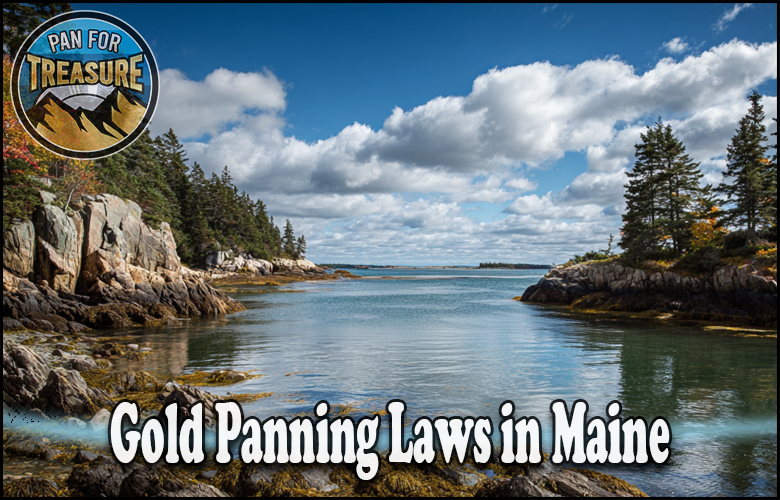
The gold panning laws in Maine are among the most clearly defined in New England. Maine uses a 4-class system for recreational gold prospecting, ranging from hand panning (Class 1, no permit, year-round) to motorized suction dredging (Class 4, seasonal, with extensive closed waterway lists). The state recognizes that stream bottoms and banks are private property, so landowner permission is required even though the water itself is under state jurisdiction.
Maine has genuine gold. Unlike the flat Midwestern states built on sedimentary rock, Maine sits on igneous and metamorphic bedrock with a history of gold mining. The Swift River, Sandy River, and streams in Oxford, Franklin, and Somerset counties have produced placer gold for over 150 years. The White Mountain National Forest in western Maine offers a free gold panning permit on federal land.
This guide covers the regulatory framework, where gold has been found, and how to prospect legally. If you are new to the hobby, start with our getting started with gold panning guide.
TL;DR
- Class 1 (hand panning/sluicing): No permit required. Year-round. Hand tools and sluice box up to 10 sq ft. Must not disturb stream banks or vegetation. Restore streambed at end of day. Landowner permission required.
- Class 2 (manual + electric/motorized pump up to 7 HP): Year-round. Landowner permission required.
- Class 3 (suction dredge up to 4 HP, 2.5″ nozzle): June 15 to September 15 only. Written landowner permission required.
- Class 4 (suction dredge up to 7 HP, 2.5″-4″ nozzle): June 15 to September 15 only. Written landowner permission. Many waterways closed.
- Closed waters: Class AA waters, critical Atlantic salmon habitat, high-value brook trout waters, and specific named rivers/streams are closed to motorized prospecting.
- Stream ownership: Water is state jurisdiction. Stream bottom, banks, and access are private property. Gold belongs to the landowner.
- White Mountain NF: Free permit required for gold panning. Mainly Pemigewasset Ranger District.
Igneous & Metamorphic Bedrock
4-Class System
Not Required (Year-Round)
June 15 – September 15
Oxford, Franklin, Somerset
White Mountain NF (Free Permit)
Gold Panning Laws and Regulations in Maine
Maine’s recreational gold prospecting regulations are codified in state law (38 MRSA §480-Q) and administered by two agencies depending on location: the Maine Department of Environmental Protection (DEP) for organized townships, and the Maine Land Use Planning Commission (LUPC) for unorganized territories. The Maine Geological Survey provides an excellent overview of gold panning rules and locations.
The 4-Class System
Maine defines four classes of recreational gold prospecting based on equipment:
| Class | Equipment Allowed | Season | Permit Needed |
|---|---|---|---|
| Class 1 | Gold pan, sluice box (up to 10 sq ft), rocker box, hand tools | Year-round (Jan 1 – Dec 31) | No permit required |
| Class 2 | Manual equipment + electric/motorized pump (up to 7 HP) | Year-round (Jan 1 – Dec 31) | No permit required |
| Class 3 | Motorized suction dredge (up to 4 HP, nozzle up to 2.5″) | June 15 – September 15 | Written landowner permission |
| Class 4 | Motorized suction dredge (up to 7 HP, nozzle 2.5″-4″) | June 15 – September 15 | Written landowner permission |
Rules That Apply to All Classes
- Landowner permission is required. Stream bottoms and banks are private property in Maine.
- Stream banks must not be disturbed, including digging into the bank, causing erosion or collapse
- Vegetation and woody debris (root wads, stumps, logs) in or near the stream must not be removed or damaged
- Streams cannot be diverted, dammed, or obstructed
- Soil, rocks, or materials from outside the channel cannot be deposited into the stream
- Stream bottom sediments cannot be deposited onto the bank or upland
- At the end of each day, disturbed streambed sediments must be replaced to approximately their original location and the natural shape of the streambed restored
- No mercury, nitric acid, or other chemicals for extraction
- No unlicensed discharge of pollutants
- No harm to endangered or threatened species or their habitat
Closed Waterways
Numerous waterways in Maine are closed to motorized prospecting (Class 3 and Class 4) to protect water quality and aquatic habitat. These include:
- Class AA waters (exceptional water quality designation)
- Critical Atlantic salmon habitat (designated under the Maine Endangered Species Act)
- High-value brook trout habitat
- Channels narrower than four feet
- Designated Essential Wildlife Habitat
- Specific named rivers including: Bemis Stream, Carrabassett River, Magalloway River, Rapid River, Sheepscot River, Spencer Stream, and others
Even in closed waterways, Class 1 gold panning with hand tools is still allowed with landowner permission. The closures apply to motorized equipment.
Organized vs. Unorganized Territories
Maine is split between organized townships (governed by the DEP) and unorganized territories (governed by the LUPC). The rules are similar but administered by different agencies. Before you start, determine which jurisdiction covers your prospecting location:
- Organized townships: Contact the Maine Department of Environmental Protection
- Unorganized territories: Contact the Maine Land Use Planning Commission (LUPC), (207) 287-2631
White Mountain National Forest
The White Mountain National Forest extends into western Maine. A free permit is required for gold panning on the forest. Gold panning occurs mainly on the Pemigewasset Ranger District (New Hampshire side), but the Maine portion of the forest is also available. The Ammonoosuc River basin, including the Wild Ammonoosuc River and Tunnel Brook, has a history of gold recovery.
State Parks and State Lands
The Maine Geological Survey states that mineral collecting or removal of “anything natural” is strictly prohibited in all State Parks. On other state lands (public lots, Bureau of Parks and Lands properties), casual mineral collecting for hobby purposes does not require permission from the Maine Geological Survey, as long as you observe normal standards and do not create significant damage. Contact the Bureau of Parks and Lands at (207) 287-3821 for specific state land access.
Stream Ownership – Critical Detail
In Maine, the water in a stream is under state jurisdiction, but the stream bottom, stream bank, and access across land to the stream are most likely private property. Gold found in the stream belongs to the landowner. Even if property is not posted, you may be subject to civil action if you cause damage. Always talk to the landowner first.
Best Places to Pan for Gold in Maine
Maine has real gold potential. The bedrock is igneous and metamorphic, with granitic intrusions, volcanic rocks, and glacial deposits. The Maine Geological Survey has published a list of streams from which gold has been reported. Western and central Maine, particularly Oxford, Franklin, and Somerset counties, are the most productive areas. For more detail on geology, see our page on whether there’s gold in Maine.
- Swift River (Oxford/Franklin Counties) – One of Maine’s best-known gold panning streams. The Swift River and its tributaries in the Byron/Roxbury area have produced placer gold for over a century. The gold originates from local bedrock sources. Accessible from Route 17. A popular destination for recreational prospectors. Much of the river runs through private land – get permission.
- Sandy River (Franklin County) – Another well-documented gold-bearing waterway. The Sandy River drainage in the Farmington/Phillips area has produced fine gold and occasional small flakes. Good access in several areas but landowner permission is required.
- Gold Brook / East Branch Swift River (Oxford County) – The name says it. Gold Brook is a tributary of the Swift River system. Fine gold reported in stream gravels. Located in the Byron area.
- Kibby Stream and Spencer Stream (Somerset/Franklin Counties) – Northern Maine streams that have produced gold. Note that Spencer Stream and tributaries are closed to motorized prospecting (Class 3/4) due to habitat protections. Hand panning (Class 1) is still allowed with permission.
- Wild Ammonoosuc River area (Oxford County, near NH border) – The White Mountain National Forest area has a documented history of gold recovery. The Wild Ammonoosuc River and Tunnel Brook (primarily on the NH side) are known producers. The Maine side of the forest offers similar geology.
- Moose River (Somerset County) – Some reports of gold in this northern Maine waterway. The area is largely in unorganized territory governed by the LUPC.
- Androscoggin River tributaries (Oxford County) – Tributaries draining the western Maine mountains carry material from gold-bearing bedrock. Several tributaries in the Rumford/Bethel area have been explored by prospectors.
- Penobscot River tributaries (Piscataquis/Penobscot Counties) – Central Maine streams have produced occasional gold reports. The geology in central Maine includes igneous intrusions that could be gold sources.
History of Gold in Maine
Gold has been known in Maine since at least the mid-1800s, when placer gold was discovered in the Swift River area of Oxford County. Small-scale mining operations worked several streams in western Maine, though none reached the scale of the major gold rushes out west.
The “Maine Mines and Minerals” volumes by Philip Morrill and William Hinckley document old gold mines in the state. C. J. Stevens wrote “The Next Bend in the River” (1989) specifically about gold mining in Maine, covering the history of prospecting operations and the characters who pursued gold in the Maine woods.
Maine’s gold comes from local bedrock, not glacial transport from Canada (though glaciers did redistribute some gold within the state). The igneous and metamorphic rocks of western Maine, particularly granitic intrusions and associated quartz veins, are the primary gold sources. This gives Maine an advantage over purely glacial gold states: the gold tends to be coarser and more concentrated in specific drainages.
Today there are no active gold mines in Maine, but recreational prospecting has grown significantly. The state has responded with increasingly detailed regulations, particularly around motorized equipment, to balance prospecting access with protection of Atlantic salmon, brook trout, and water quality.
Tips for Gold Panning in Maine
- Start with Class 1 hand panning. No permit required, year-round access, and it keeps you legal on virtually any waterway (with landowner permission). A gold pan, hand shovel, and classifier are all you need.
- Get landowner permission every time. In Maine, the streambed is private property. Gold belongs to the landowner. Even unposted land is private. Talk to landowners before you start. See our panning techniques guide for more.
- Check your jurisdiction. Organized township? Contact DEP. Unorganized territory? Contact LUPC. The rules are similar but the administering agencies differ.
- Restore the streambed. Maine law requires you to replace disturbed sediments to their approximate original location and restore the natural shape of the bed at the end of each day. This is not optional.
- Watch for closed waterways. If you plan to use any motorized equipment, check the lists of closed streams maintained by the DEP and LUPC. Class AA waters and salmon/trout habitat waters are off-limits for motorized gear.
- Focus on western Maine. Oxford, Franklin, and Somerset counties have the best gold geology. The Swift River area is the most proven. Start there before exploring more remote areas.
- Get the White Mountain NF permit. If you want to pan on federal land, pick up a free gold panning permit from the Pemigewasset Ranger District. The Wild Ammonoosuc drainage has documented gold.
- Watch for sulphide deposits. The Maine Gold Prospectors club warns that volcanic and sedimentary deposits across large areas of Maine contain sulphide minerals (copper, zinc, gold). Mining these can create serious pollution issues including sulphuric acid formation. Stick to stream gravels and placer deposits.
- Join a local club. The Central Maine Gold Prospectors and other clubs have compiled landowner information, location data, and regulatory knowledge that can save you significant time.
Resources for Maine Prospectors
- Maine Geological Survey – Gold in Maine – Official state page with gold panning rules, location list, property rights information, and book references. The best starting point for Maine prospectors.
- Maine Land Use Planning Commission (LUPC) – Governs prospecting in unorganized territories (roughly half of Maine). Application forms, rules, and contact information.
- White Mountain National Forest – Mineral Collecting and Gold Panning – USFS page with free gold panning permit information, designated mineral collecting sites, and geology overview.
- Maine Gold Prospectors Club – Local prospecting club with detailed information on regulations, rule changes, closed waterways, and prospecting locations.
- Gold Prospectors Association of America (GPAA) – National organization with resources for recreational prospectors.
Conclusion
The gold panning laws in Maine are well-documented and reasonably prospector-friendly for hand panning. Class 1 hand panning requires no permit and is allowed year-round on any waterway (with landowner permission and without disturbing banks). Motorized equipment (Class 3 and 4) is seasonal (June 15 to September 15) with extensive lists of closed waterways protecting Atlantic salmon, brook trout, and water quality.
Maine has genuine gold from igneous and metamorphic bedrock sources. Western Maine, particularly the Swift River and Sandy River drainages in Oxford and Franklin counties, has produced placer gold for over 150 years. The White Mountain National Forest offers federal land access with a free permit. Among New England states, Maine is one of the best options for recreational gold panning.
Check out the laws in New Hampshire, Vermont, Massachusetts, and Connecticut, or browse our full gold panning laws by state directory.
Frequently Asked Questions – Gold Panning in Maine
Is gold panning legal in Maine?
Yes. Maine allows recreational gold panning under a 4-class system. Class 1 hand panning (gold pan, sluice box up to 10 sq ft, hand tools) requires no permit and is allowed year-round. Motorized equipment (Class 3 and 4) is seasonal, June 15 to September 15. All classes require landowner permission because stream bottoms are private property in Maine.
Do you need a permit to pan for gold in Maine?
No permit is needed for Class 1 (hand panning) or Class 2 (manual equipment with a pump up to 7 HP) prospecting. You do need landowner permission. On the White Mountain National Forest, a free permit is required. Motorized dredging (Class 3 and 4) requires written landowner permission and is restricted to specific dates and waterways.
Where is the best place to pan for gold in Maine?
The Swift River in the Byron/Roxbury area (Oxford County) is Maine’s most well-known gold panning stream. The Sandy River (Franklin County) is also productive. Western Maine, particularly Oxford, Franklin, and Somerset counties, has the best gold geology due to igneous and metamorphic bedrock with granitic intrusions.
Who owns the gold in Maine streams?
In Maine, the stream bottom and bank are private property. Gold found in a stream belongs to the landowner. The water itself is under state jurisdiction, but the minerals in the streambed are not. Always get landowner permission before panning.
What waterways are closed to gold prospecting in Maine?
Class AA waters, critical Atlantic salmon habitat, high-value brook trout waters, channels narrower than four feet, and numerous specifically named rivers are closed to motorized prospecting (Class 3 and 4). Hand panning (Class 1) is still allowed on most closed waterways with landowner permission. Check with the DEP or LUPC for current closed waterway lists.
Is there real gold in Maine?
Yes. Maine has genuine placer gold from local igneous and metamorphic bedrock sources. The Swift River, Sandy River, and other streams in western Maine have produced gold for over 150 years. The gold is from local geology, not just glacial transport, which means concentrations can be better than in purely glacial gold states.

⛏ Recommended Gear ⛏


* As an Amazon Associate I earn from qualifying purchases at no extra cost to you.
Subscribe to Our Newsletter

Ryan Conlon is the founder of Pan for Treasure.
A lifelong gold panning enthusiast, he created this site to help beginners learn the ropes and share practical tips from his own time on the creek. [email protected]