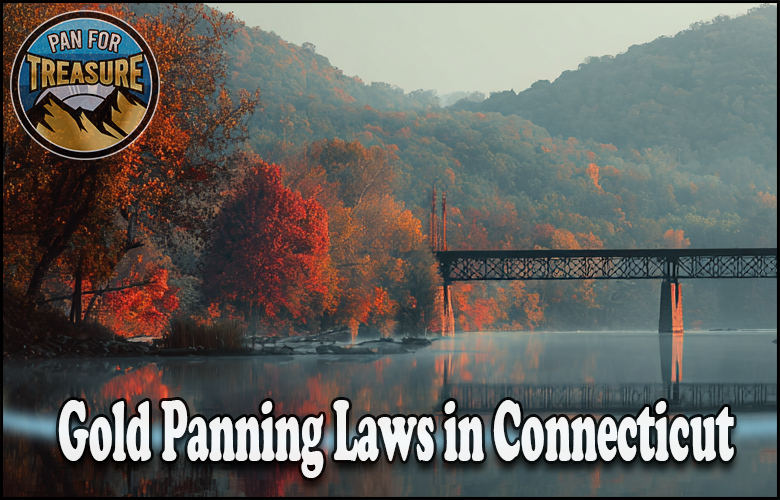
The gold panning laws in Connecticut are restrictive compared to western states, and the gold itself is scarce. Connecticut has no BLM land, no National Forest, and state-managed land is largely off-limits to mineral collecting without a special educational permit from the Department of Energy and Environmental Protection (DEEP).
Small amounts of glacial placer gold do exist in Connecticut’s streams, mostly in the northwestern part of the state. Recreational hand panning in public waterways with non-motorized equipment is generally tolerated, but the legal picture is murky. There is no state statute specifically authorizing or prohibiting recreational gold panning, which puts the burden on you to verify access and permissions before you go.
This guide covers what the regulations actually say, where gold has been found, and what you can realistically expect. If you’re new to the hobby, start with our getting started with gold panning guide.
TL;DR
- No state permit exists for recreational gold panning in Connecticut. There is no statewide prospecting license.
- State parks and state forests: Collecting rocks, minerals, or earth material is prohibited under DEEP regulations. Limited educational collecting permits are available to organized groups (mineral clubs, schools, museums).
- Public waterways: Casual hand panning in rivers and streams with non-motorized equipment is generally allowed, but the legal authority is not spelled out clearly. Check with DEEP or local authorities first.
- Private land: Written permission from the landowner is required. The landowner controls both access and mineral rights.
- Very limited gold: Nearly all gold is fine glacial dust and flakes deposited by Ice Age glaciers. Expect hours of panning for a few specks of color at best.
- No motorized equipment. Dredging, highbanking, and mechanized mining are not viable options in Connecticut.
Glacial Deposits
None Recorded
Fine Dust and Flakes
Litchfield County (NW)
Prohibited (Permit Only)
Not Practical
Featured
Gold Panning Laws in Connecticut
Connecticut does not have a specific statute that addresses recreational gold panning. The regulations that apply come from the Department of Energy and Environmental Protection (DEEP), local municipal rules, and general property law. This makes the legal picture less clear-cut than in states with BLM or National Forest land.
State Parks and State Forests – Off-Limits
Under DEEP regulations (Section 23-4-1(b) of the Regulations Concerning the Order, Safety, Sanitation and Protection of Property), no person shall “deface, destroy, alter, remove or otherwise injure in any manner, vegetation, earth or rock material” on state-controlled land. This means collecting rocks, minerals, or soil (including gold panning) is prohibited on all Connecticut state parks, state forests, and DEEP-managed properties.
The one exception: the DEEP Commissioner may grant educational mineral collecting permits to organized groups (mineral clubs, nature centers, schools, museums). These permits are site-specific, date-specific, and limited to one group per day. Individual recreational prospecting permits are not issued. You can find details on the DEEP Mineral Collecting page.
Public Waterways
Rivers and streams in Connecticut are considered Waters of the United States and the State. Casual hand panning in public waterways using a gold pan – standing in the water, not on private banks – falls into a gray area. No statute explicitly permits or prohibits it. In practice, low-impact hand panning with no motorized equipment and no significant disturbance is generally tolerated.
That said, “tolerated” is not the same as “authorized.” If you plan to pan in a stream, confirm with the local town office or DEEP that the specific waterway is open to public access and that no local restrictions apply. Some waterways have restrictions related to environmental protection or fish habitat.
Private Land
Most land in Connecticut is privately owned. Written permission from the landowner is required before any prospecting on private property. In Connecticut, the landowner controls both surface access and mineral rights. Gold found on private land belongs to the landowner unless you have an agreement stating otherwise.
Equipment Restrictions
Connecticut is not a state where heavy prospecting equipment makes sense. The limited gold, restricted access, and small waterways mean hand pans are the only practical tool.
| Equipment | Public Waterways | State Parks/Forests | Private Land |
|---|---|---|---|
| Gold Pan | Generally tolerated | Not allowed | With landowner permission |
| Hand Shovel / Trowel | Gray area – avoid bank digging | Not allowed | With landowner permission |
| Classifier / Screen | Generally tolerated | Not allowed | With landowner permission |
| Sluice Box | Check locally – likely restricted | Not allowed | With landowner permission |
| Metal Detector | Check local rules | Not allowed | With landowner permission |
| Suction Dredge | Not allowed | Not allowed | Would require permits |
| Motorized Equipment | Not allowed | Not allowed | Would require permits |
Keep it simple: a gold pan, a classifier, and a snuffer bottle. That’s all you need in Connecticut. For gear recommendations, see our best tools for gold panning roundup.
Our Favorite Posts
- Is it Legal to Pan for Gold in the United States?
- Gold Panning Laws in North Carolina (NC) – What Prospectors Need to Know
- Gold Panning Laws in Georgia – What Prospectors Need to Know
- Prospecting in National Parks Federal Rules You Must Follow
- Gold Panning Laws in Virginia – What Prospectors Need to Know
Best Gold Prospecting Locations in Connecticut
Gold in Connecticut comes from glacial deposits. During the Ice Ages, glaciers scraped gold-bearing rock from Canada and deposited it across New England as they retreated. The gold is fine dust and flakes – not nuggets. If you’re wondering about the state’s gold history, check our page on whether there’s gold in Connecticut.
Here are the locations where prospectors have reported finding at least trace amounts of gold:
- Leadmine Brook (Thomaston/Harwinton, Litchfield County) – The most documented gold-producing waterway in Connecticut. Located above the Thomaston Dam, this tributary of the Naugatuck River has a mining history that includes gold among other minerals. Gold is found in gravel beds and bedrock crevices. Access the upper reaches along Birge Park Road and Hill Road in Harwinton. Verify whether the specific stretch you plan to visit is public or private before panning.
- Spruce Brook (Litchfield County) – A small tributary of the Naugatuck River that caused brief excitement when gold was first discovered there. The deposits are minor, but fine gold has been reported in the stream gravels. Small and easily accessible, but verify land ownership.
- Farmington River (Hartford/Litchfield Counties) – A large tributary of the Connecticut River, northwest of Hartford. Known to contain very fine placer gold deposits. The river is popular for fishing and recreation, with some sections that have public access. Good water access but gold quantities are minimal.
- Litchfield County streams (general) – Northwestern Connecticut has the most reported gold occurrences in the state. The glacial geology here deposited the most gold-bearing material. Small unnamed creeks and tributaries in this region have yielded fine gold for patient prospectors. Always verify land ownership before panning.
- East Haddam / Connecticut River tributaries (Middlesex County) – The eastern banks of the Connecticut River near East Haddam have yielded small flakes and fine gold. Local glacial activity and geological formations contributed to minor gold deposits in the area’s tributaries.
- Glacial till and esker deposits (statewide) – Glacial till (unsorted rock and sediment left by glaciers) and eskers (ridges of gravel deposited by glacial meltwater) are found throughout Connecticut. These formations occasionally contain trace gold carried south from Canadian sources. Finding productive spots requires geological research and patience.
For a broader look at where to prospect, see our list of the best places to pan for gold and gemstones in America.
History of Gold in Connecticut
Connecticut has never had a gold rush or any commercial gold mining. The state’s gold deposits are entirely glacial in origin. During the last Ice Age, glaciers moving south from Canada scraped across gold-bearing rock in the Canadian Shield and carried the material into New England. When the glaciers melted roughly 10,000 to 15,000 years ago, they left behind glacial till, outwash plains, and eskers containing trace amounts of gold.
Small gold finds have been reported in Connecticut streams since at least the 1800s, particularly in Litchfield County. Leadmine Brook near Thomaston and Spruce Brook both generated local interest at various times. But the quantities were always too small for any commercial operation.
Connecticut is better known for its mineral collecting than for gold. The state has a long history of producing garnets, tourmaline, beryl, and other collector minerals from pegmatite deposits. The Bedrock Geological Map of Connecticut (1984) and the Bedrock Mines of Connecticut by Robert Altamura are useful references for anyone interested in the state’s mineral geology.
Recommended Reading
Tips for Gold Panning in Connecticut
- Set very low expectations. Most experienced prospectors who pan in Connecticut report finding only a few specks of color after hours of work. This is not a gold-rich state. Come for the outdoor experience, not the gold.
- Focus on Litchfield County. The northwestern corner of the state has the most reported gold occurrences. Leadmine Brook and the Farmington River are the best-documented locations.
- Check land ownership before every trip. Connecticut is densely populated and mostly private land. Many streams that look public flow through private property. Ask permission or stick to sections with confirmed public access.
- Stay in the water. If you’re panning in a public waterway, stay in the streambed itself. Digging into banks is more likely to cause problems with landowners and regulators. Use material from the stream bottom only.
- Learn to find fine gold. Connecticut gold is almost all flour-fine dust and flakes. Standard panning techniques work, but use slow, careful pan movements and a snuffer bottle to pick up tiny particles. A black plastic pan makes fine gold easier to see. See our panning techniques guide.
- Look for black sand concentrates. Black sand (magnetite) is a good indicator mineral. If you’re getting black sand in your pan, you’re working the right kind of material, even if visible gold is hard to spot.
- Consider joining a mineral club. Connecticut mineral clubs can arrange educational collecting permits from DEEP for state forest sites. Club members also share knowledge about local access and productive spots.
- Try neighboring states. If gold is your main goal, Vermont, Maine, and New Hampshire have more documented placer gold and more accessible public land for prospecting.
Rules
- Gold Panning Laws in Delaware – What Prospectors Need to Know
- Gold Panning Laws in Arkansas – What Prospectors Need to Know
- Gold Panning Laws in New Jersey – What Prospectors Need to Know
- Gold Panning Laws in Michigan – What Prospectors Need to Know
- Gold Panning Laws in South Dakota – What Prospectors Need to Know
Resources for Connecticut Prospectors
- CT DEEP – Mineral Collecting – Official rules for mineral collecting on state land, educational permit application process, and available collecting sites.
- Connecticut Department of Energy and Environmental Protection (DEEP) – General information on state-managed lands, waterway access, and environmental regulations.
- Gold Prospectors Association of America (GPAA) – National organization with resources for recreational prospectors in all states.
- Navigating the Gold Panning Permit Process – Our guide to understanding permit requirements for recreational prospecting.
Learn About Other States Gold Panning Laws
Planning a trip or curious about the rules elsewhere? Explore the laws for these popular gold panning states.
Conclusion
The gold panning laws in Connecticut are restrictive. State parks and forests are off-limits for mineral collecting without a DEEP educational permit, most land is privately owned, and there is no specific statute authorizing recreational gold panning. Casual hand panning in public waterways is generally tolerated but not formally authorized.
The gold situation is just as limited. All gold in Connecticut is glacial in origin – fine dust and flakes carried south by Ice Age glaciers. Expect to spend hours for a few specks of color at best. The state is better suited for mineral collecting than gold prospecting.
If you’re set on finding gold in the Northeast, neighboring states offer better options. Check out the laws in New York, Massachusetts, Vermont, and Rhode Island, or browse our full gold panning laws by state directory.
Frequently Asked Questions – CT Gold Panning Laws
Is gold panning legal in Connecticut?
It depends on where you are. Casual hand panning in public waterways with non-motorized equipment is generally tolerated but not formally authorized by any specific state law. Collecting minerals on state parks and state forests is prohibited without a DEEP educational permit. Private land requires written landowner permission.
Is there gold in Connecticut?
Yes, but very little. Connecticut has trace amounts of glacial placer gold deposited by Ice Age glaciers. The gold is almost all fine dust and flakes. Litchfield County in the northwest has the most reported occurrences. No commercial gold mining has ever taken place in Connecticut.
Where is the best place to pan for gold in Connecticut?
Leadmine Brook near Thomaston (Litchfield County) is the most documented gold-producing waterway in the state. The Farmington River northwest of Hartford and Spruce Brook in Litchfield County have also yielded fine gold. Always verify land ownership and public access before panning.
Do you need a permit to pan for gold in Connecticut?
There is no state prospecting permit for individuals in Connecticut. Collecting minerals on state land requires an educational group permit from DEEP. For casual hand panning in public waterways, no permit currently exists, but the activity is in a legal gray area. Check with DEEP or local town officials before going.
Can I prospect in Connecticut state parks?
No. DEEP regulations prohibit removing earth material, rock, or minerals from state parks and state forests. Educational mineral collecting permits are only issued to organized groups like mineral clubs, schools, and museums – not to individual prospectors.
What kind of gold is found in Connecticut?
Nearly all gold in Connecticut is extremely fine glacial dust and flakes – material transported south from Canada by Ice Age glaciers. Nuggets are essentially nonexistent. Panning for several hours in a known gold-bearing area might produce a few specks of color visible only with a magnifying loupe.

⛏ Recommended Gear ⛏


* As an Amazon Associate I earn from qualifying purchases at no extra cost to you.
Subscribe to Our Newsletter

Ryan Conlon is the founder of Pan for Treasure.
A lifelong gold panning enthusiast, he created this site to help beginners learn the ropes and share practical tips from his own time on the creek. [email protected]