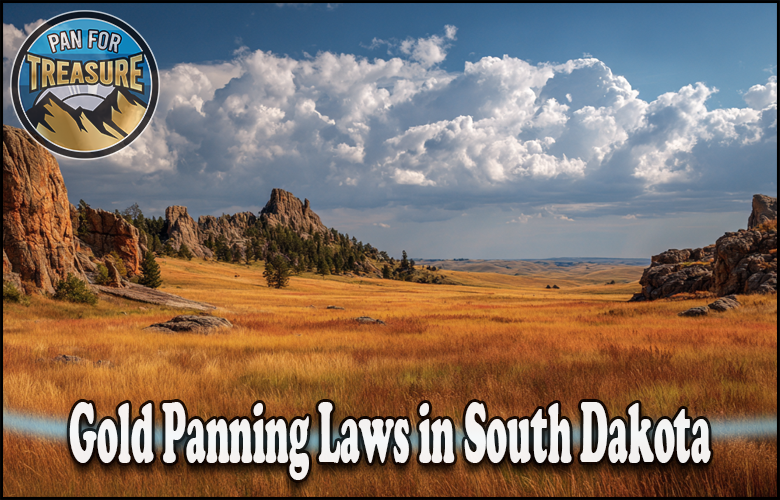
A South Dakota stream flowing through the Black Hills, a region known for historic gold discoveries and recreational prospecting.
The gold panning laws in South Dakota allow recreational hand panning on most public land without a state permit, but regulations vary by land management agency and location. The Black Hills National Forest permits recreational gold panning with hand tools, and BLM land in western South Dakota is open to casual use prospecting. South Dakota has one of the richest gold histories of any state, and the Homestake Mine in Lead produced more gold than any other mine in the Western Hemisphere.
Gold was first found in the Black Hills during the 1874 Custer Expedition, triggering one of the last great gold rushes in the American West. Total production from the Black Hills exceeds 40 million troy ounces, with the Homestake Mine alone accounting for over 39.8 million ounces during its 125 years of continuous operation (1876 to 2001). Today, recreational prospecting remains popular in the creeks and gulches of the Black Hills, and several commercial pay-to-pan operations offer guaranteed gold experiences.
This guide covers the current regulations, the best locations, and South Dakota’s gold history. If you are new to panning, start with our getting started with gold panning guide.
TL;DR
- Hand panning: No state permit required for recreational hand panning on public land. Black Hills National Forest and BLM land allow casual use panning.
- Homestake Mine: The Homestake Mine in Lead produced over 39.8 million ounces of gold from 1876 to 2001. The site is now the Sanford Underground Research Facility and is closed to prospecting.
- Mining claims: Active mining claims exist throughout the Black Hills. Verify claim status through BLM LR2000 before prospecting. Never pan on a claimed area without permission.
- State parks: Gold panning is allowed at Custer State Park in designated areas. Rules vary by park.
- Motorized equipment: Suction dredges and highbankers on public land require permits from the SD DENR and US Army Corps of Engineers. BLM and USFS may require additional authorization.
- Gold type: Fine placer gold in most creeks, with occasional small nuggets near lode sources. Crystalline and wire gold specimens have been found in the Black Hills.
Over 40 Million Troy Ounces (Black Hills)
Homestake Mine, Lead (39.8M oz, 1876-2001)
1874, Custer Expedition (French Creek)
Lawrence, Pennington, Custer
No (Recreational Hand Panning)
SD DENR Oversees Mining and Water Quality
Featured
Gold Panning Laws in South Dakota
South Dakota does not require a state permit for recreational hand panning. The key agencies are the South Dakota Department of Environment and Natural Resources (DENR), the US Forest Service (Black Hills National Forest), the Bureau of Land Management (BLM), and the National Park Service (which manages areas where prospecting is prohibited).
Black Hills National Forest
The Black Hills National Forest covers approximately 1.2 million acres across western South Dakota and northeastern Wyoming. Recreational gold panning with hand tools (pans, hand shovels, classifiers) is generally allowed as casual use on NF land that is not under an active mining claim. A sluice box and other non-motorized equipment may be used but could require authorization from the Ranger District depending on the scale of activity.
Many creeks in the Black Hills NF have active mining claims. Always verify claim status before panning. The BLM LR2000 database shows current mining claims on federal land. If a creek or gulch is claimed, you cannot pan there without the claim holder’s permission.
BLM Land
BLM manages scattered parcels of public land in western South Dakota. Casual use prospecting (hand panning, no significant surface disturbance, no motorized equipment) is allowed on open BLM land without a permit. Activities beyond casual use require a Notice of Intent or Plan of Operations filed with the BLM.
Custer State Park
Custer State Park allows gold panning in designated areas, particularly along French Creek where gold was first found in 1874 during the Custer Expedition. A park entrance fee is required. Only hand panning is allowed. No digging into stream banks or disturbing vegetation.
National Park Service Land
Gold prospecting is prohibited in all National Park Service units. This includes Wind Cave National Park, Badlands National Park, Mount Rushmore National Memorial, and Jewel Cave National Monument. No panning, collecting, or mineral extraction of any kind is allowed in these areas.
Private Land
Most productive gold-bearing land in the Black Hills is privately owned or under active mining claims. Written landowner permission is required for any prospecting on private property. South Dakota recognizes surface and mineral rights as separable, so the mineral rights holder may differ from the surface owner. Verify both before prospecting.
Motorized Equipment and Permits
Suction dredges, highbankers, and other motorized equipment used in or near waterways require permits from the SD DENR. A Section 404 permit from the US Army Corps of Engineers may also be required for any discharge of dredged material into waters of the United States. The USFS and BLM may require additional authorization for motorized activities on their land. Check with the local Ranger District or BLM field office before using motorized equipment.
Equipment Restrictions
| Equipment | Black Hills National Forest | Custer State Park | Private Land (With Permission) |
|---|---|---|---|
| Gold Pan | Allowed (casual use) | Allowed (designated areas) | With landowner permission |
| Shovel/Hand Tools | Allowed (casual use) | No bank digging | With permission |
| Classifier/Screen | Allowed | Allowed | With permission |
| Non-motorized Sluice | May require authorization | Not allowed | With permission |
| Suction Dredge | DENR + USFS permits required | Not allowed | DENR permit required |
| Highbanker/Motorized | DENR + USFS permits required | Not allowed | DENR permit required |
Our Favorite Posts
- Gold Panning Laws in California Permits, Rules and Best Spots
- Gold Panning Laws in Colorado – What Prospectors Need to Know
- Gold Panning Laws in Arizona – What Prospectors Need to Know
- Gold Panning Laws in Alaska – What Prospectors Need to Know
- Gold Panning Laws in Nevada – What Prospectors Need to Know
Best Gold Prospecting Locations in South Dakota
Nearly all of South Dakota’s gold is concentrated in the Black Hills of the western part of the state. The Black Hills are an isolated mountain range rising from the Great Plains, composed of a Precambrian crystalline core surrounded by younger sedimentary rocks. Gold occurs in Precambrian schist and associated quartz veins, with placer deposits in the creeks draining these formations. For a broader look at where gold exists in the state, see our is there gold in South Dakota page.
- French Creek (Custer County) – Site of the first gold discovery in the Black Hills during the 1874 Custer Expedition. Flows through Custer State Park where hand panning is allowed in designated areas. Fine to medium placer gold. Park entrance fee required. One of the few guaranteed public access panning spots.
- Spring Creek and Tributaries (Lawrence, Pennington Counties) – Drains the Rochford District, one of the early Black Hills mining areas. Fine placer gold in gravels. Mix of public (NF) and private land. Some areas have active claims. Tributaries near Rochford produced significant gold historically.
- Whitewood Creek (Lawrence County) – Flows through the Deadwood/Lead mining district, draining the richest gold-producing area in the Black Hills. Fine gold in gravels downstream of the Homestake Mine area. Mix of public and private land. Water quality affected by historical mining.
- Rapid Creek (Pennington County) – Flows from the Black Hills through Rapid City. Gold reported in upstream sections near Pactola Reservoir area. Fine placer gold. Mix of NF and private land. Active mining claims in some areas. Check claim status before panning.
- Castle Creek (Pennington County) – Flows through the central Black Hills. Gold in gravels associated with Precambrian schist exposures. Mix of NF land and private property. Less pressure from other prospectors than more famous creeks.
- Bear Butte Creek (Meade, Lawrence Counties) – Drains the northeastern Black Hills. Fine placer gold from the Precambrian core. Some BLM and state land access. Mostly private ranching land. Get permission before prospecting.
- Deadwood Gulch and Tributaries (Lawrence County) – Site of the 1876 Deadwood gold rush. Wild Bill Hickok and Calamity Jane were among the thousands who arrived. Placer gold was mined extensively. Most land is now private or town property. Some NF access on tributaries. Fine gold still present in gravels.
- Iron Creek / Keystone Area (Pennington County) – Iron Creek and nearby drainages in the Keystone area produced placer gold. The Keystone District was an early mining area. Some NF access. Holy Terror Mine was a significant lode mine near Keystone. Fine to medium gold.
- Elk Creek (Lawrence, Meade Counties) – Drains the northern Black Hills. Placer gold in some sections. Mix of NF and private land. Less prospected than southern Black Hills drainages. Good for exploring less crowded areas.
- Spearfish Creek (Lawrence County) – Scenic creek in the northern Black Hills. Gold reported in some sections, though quantities are modest compared to the Deadwood/Lead area. NF and private land. Spearfish Canyon is a popular recreation area.
- Hill City Area Creeks (Pennington County) – Several small creeks around Hill City in the central Black Hills produced gold during the early mining period. Fine placer gold. Mix of NF and private land. Hill City is a good base for Black Hills prospecting.
- Rochford Area (Pennington County) – The Rochford District was a productive placer and lode mining area in the central Black Hills. Slate Creek and other drainages produced good placer gold. Mix of NF and private land. Active mining claims exist. Some of the better gold-per-pan ratios in the Hills.
History of Gold Mining in South Dakota
Gold was first found in the Black Hills in 1874 when members of Lieutenant Colonel George Armstrong Custer’s military expedition found placer gold in French Creek near present-day Custer. The discovery violated the 1868 Fort Laramie Treaty, which had guaranteed the Black Hills to the Lakota Sioux, but the news triggered a massive gold rush. By 1876, thousands of miners had flooded into the Hills illegally, and the US government forced a new agreement that seized the Black Hills from the Lakota.
The Deadwood Gulch placer rush of 1876 was one of the most famous in American history. Miners swarmed into Deadwood, and the gulch’s rich gravels produced millions in gold within the first few years. Wild Bill Hickok was shot and killed in a Deadwood saloon in August 1876, and Calamity Jane became a legendary figure of the camp. The placers were quickly exhausted, and mining shifted to hard rock (lode) operations.
In 1876, Moses and Fred Manuel discovered a major gold-bearing lode on the hillside above the town of Lead. They named it the Homestake Mine. George Hearst (father of newspaper magnate William Randolph Hearst) purchased the claim in 1877 and developed it into the largest and deepest gold mine in North America. The Homestake Mine operated continuously for 125 years, from 1876 to 2001, and produced over 39.8 million troy ounces of gold at an average grade of approximately 0.3 ounces per ton. At its deepest, the mine reached 8,000 feet below the surface.
The Black Hills also produced gold from other significant mines including the Trojan, Golden Reward, Wasp No. 2, Holy Terror, and Bald Mountain operations. Total Black Hills gold production exceeds 40 million troy ounces, making the district one of the most productive in world history. After the Homestake closed in 2001, Barrick Gold donated the mine to the State of South Dakota, and it became the Sanford Underground Research Facility, which now hosts physics experiments including dark matter detection.
Recreational prospecting has continued throughout the Black Hills since the original rush. The creeks and gulches still produce fine placer gold, and several commercial operations (Big Thunder Gold Mine, Broken Boot Gold Mine) offer tourist panning experiences in the Deadwood and Keystone areas.
Recommended Reading
Tips for Gold Panning in South Dakota
- Check mining claims before panning. The Black Hills have hundreds of active mining claims. Use the BLM LR2000 database to verify claim status. Panning on someone’s claim without permission is illegal. Unclaimed NF and BLM land is your safest bet.
- Start at Custer State Park. French Creek in Custer State Park is one of the few guaranteed public access panning spots in the Black Hills. The park charges an entrance fee, but you can pan with hand tools in designated areas. It is a great spot for beginners and families.
- Pan downstream of lode sources. Black Hills gold originates from Precambrian schist and quartz veins. Look for creeks that drain exposed Precambrian rock. Placer gold concentrates in gravels downstream of these exposures, especially on inside bends and behind large boulders. See our techniques for beginners guide for panning basics.
- Look for black sand concentrations. Magnetite (black sand) is a common heavy mineral in Black Hills creeks and is a strong indicator that gold may be present. Gold settles in and below the black sand layer. Use a magnet to separate magnetite from your concentrate. Learn more about gold panning techniques to improve your recovery rate.
- Bring fine gold recovery gear. Most Black Hills placer gold is fine. A snuffer bottle, spiral pan, and magnifying glass are helpful for recovering and seeing small gold. Vials with water help store fine flakes without losing them to static.
- Try the Rochford District. The Rochford area in the central Black Hills is less crowded than Deadwood or Keystone and has historically produced good placer gold. Slate Creek and other drainages in the district are worth sampling if you can find unclaimed NF land.
- Avoid Homestake Mine and NPS land. The former Homestake Mine in Lead is now the Sanford Underground Research Facility and is closed to prospecting. All National Park Service units (Wind Cave, Badlands, Mount Rushmore, Jewel Cave) prohibit any mineral collection.
- Pan after spring runoff. Black Hills creeks experience significant spring runoff from snowmelt. Panning after the water drops in late spring or early summer can expose fresh gravels with new gold deposits. Summer and fall offer the best water levels for wading and panning.
- Join a prospecting club. The GPAA has claims and chapters in the Black Hills region. Membership provides access to claimed ground and connects you with experienced local prospectors. The Black Hills Prospectors Club is another resource.
- Visit Deadwood for history and panning. Deadwood is a living museum of Black Hills gold rush history. The town offers tourist panning experiences, mine tours, and access to the Adams Museum which houses significant gold specimens. Combine a panning trip with the area’s rich history. Check out our best gold panning kits for gear recommendations.
Rules
- Gold Panning Laws in Delaware – What Prospectors Need to Know
- Gold Panning Laws in New Jersey – What Prospectors Need to Know
- Gold Panning Laws in Michigan – What Prospectors Need to Know
- Gold Panning Laws in Colorado – What Prospectors Need to Know
- Gold Panning Laws in Maine – What Prospectors Need to Know
Resources for South Dakota Prospectors
- USDA Forest Service – Black Hills National Forest – Regulations, maps, and contact information for Ranger Districts in the Black Hills.
- South Dakota Department of Environment and Natural Resources (DENR) – State mining permits, water quality regulations, and environmental compliance.
- Custer State Park – SD Game, Fish and Parks – Park entrance fees, designated panning areas on French Creek, and recreation information.
- Gold Prospectors Association of America (GPAA) – Membership claims, chapters, and prospecting education resources.
- Sanford Underground Research Facility – History of the Homestake Mine and information about the research facility that now occupies the site.
Conclusion
The gold panning laws in South Dakota are straightforward for recreational hand panners: no state permit is needed, and the Black Hills National Forest and BLM land provide public access to gold-bearing creeks and gulches. The challenge is finding unclaimed ground, as many productive areas have active mining claims. Verify claim status through BLM LR2000 before panning, and always get landowner permission on private property.
South Dakota’s Black Hills are one of the most historically productive gold districts in the world, with over 40 million ounces extracted since 1874. The Homestake Mine’s 39.8 million ounces make it the most productive mine in the Western Hemisphere. Today, recreational prospectors can still find fine placer gold in the creeks and gulches that drain the Precambrian core. Check out the laws in Wyoming and Montana, browse our gold panning near me page, our best places to pan guide, or see the full gold panning laws by state directory.
Frequently Asked Questions – SD Gold Panning Laws
Do I need a permit to pan for gold in South Dakota?
No state permit is required for recreational hand panning on public land. Black Hills National Forest and BLM land allow casual use panning with hand tools. Custer State Park allows panning in designated areas with a park entrance fee. Motorized equipment requires permits from SD DENR and potentially the US Army Corps of Engineers.
Where is the best place to pan for gold in South Dakota?
French Creek in Custer State Park offers guaranteed public access for hand panning. The creeks and gulches of the Black Hills National Forest, particularly in the Rochford District, Spring Creek, and Castle Creek areas, produce fine placer gold on unclaimed NF land. The Deadwood/Lead area is the richest historically but has many active claims.
Can I pan for gold near the Homestake Mine?
No. The former Homestake Mine in Lead is now the Sanford Underground Research Facility and is closed to all prospecting. Whitewood Creek downstream of the Lead/Deadwood area carries some fine gold, but verify land ownership and claim status before panning.
What kind of gold will I find in the Black Hills?
Most Black Hills placer gold is fine to very fine flakes and flour gold. Occasional small pickers and nuggets are found near lode sources. The gold comes from Precambrian schist and quartz veins. Crystalline and wire gold specimens have been found in lode deposits but are rare in placer settings.
Are there active mining claims in the Black Hills?
Yes. Hundreds of active mining claims exist throughout the Black Hills. Always check the BLM LR2000 database before prospecting on public land. Panning on an active claim without the claim holder’s permission is illegal. Unclaimed National Forest and BLM land is open to casual use prospecting.
Can I pan for gold in South Dakota state parks?
Custer State Park allows hand panning in designated areas with a park entrance fee. Other state parks have different rules. Contact the specific park or SD Game, Fish and Parks for current regulations before visiting.
⛏ Recommended Gear ⛏


* As an Amazon Associate I earn from qualifying purchases at no extra cost to you.
Subscribe to Our Newsletter

Ryan Conlon is the founder of Pan for Treasure.
A lifelong gold panning enthusiast, he created this site to help beginners learn the ropes and share practical tips from his own time on the creek. [email protected]