Fine gold classification is the step where you sort your concentrates by size so the tiny gold actually stays in your pan instead of washing over the edge.
Sort your material first, then work it, and you’ll recover flour gold that most people lose without ever knowing it was there.
The whole idea is simple. Gold is heavy, but a flake the size of a pinhead behaves very differently in moving water than a pebble does, so mixing the two sizes in one pan fights against you.
Classify the sand and gravel into narrow size ranges, run each range on its own, and the gold has a fair chance to settle where you can see it.
TL;DR
- Classify before you pan. Screen your dirt down to consistent sizes so heavy gold isn’t buried under light gravel.
- Match mesh to your gold. A 20 mesh screen removes the big stuff, a 50 to 100 mesh catches most placer gold, and finer than that is flour gold territory.
- Run one size at a time. Panning mixed material lets fine gold ride out on top of larger rocks.
- Wet screening beats dry. Water carries fines through the mesh instead of letting them clump and blow away.
- Save every fraction. The pan-off from your finest screen holds the flour gold, so treat it gently.
- Check your work. A quick specific gravity or magnet test tells you whether you kept the gold or lost it.
Understanding Fine Gold Classification Methods
Fine gold classification means sorting your raw material into groups of similar particle size before you try to separate the gold from everything else.
The reason comes down to physics. In a pan or a sluice, particles of the same size sort by weight, and gold wins that contest every time because it’s about seven times denser than the quartz sand around it.
Throw different sizes into the same pan and that advantage disappears. A large light rock and a small heavy flake can move at the same speed in the water, so the flake never gets a clean chance to drop.
There are three practical ways to sort material at the creek. You can screen it through mesh classifiers, you can pan it in stages, or you can run it through a sluice with the right size screen on top.
Screening is the workhorse. A stack of classifiers, each a finer mesh than the one above, turns a shovel of mixed dirt into three or four neat size groups in about a minute.
Gold classifiers are just sieves built for this job, usually a plastic pan with a screen bottom that nests inside a five gallon bucket or sits on top of your gold pan.
Mesh Sizes and What They Catch
Mesh number tells you how many openings there are per linear inch, so a higher number means a finer screen and smaller holes.
Most placer gold falls in a fairly narrow band, and knowing that band saves you from screening finer than you need to.
| Classifier Mesh | Opening Size | What Passes Through | What It’s For |
|---|---|---|---|
| 1/2 inch | 12.5 mm | Coarse gravel and sand | First pass to pull out rocks |
| 4 mesh | 4.75 mm | Pea gravel and finer | Removing bulk gravel fast |
| 12 mesh | 1.7 mm | Coarse sand | Catching pickers and small nuggets above |
| 20 mesh | 0.85 mm | Medium sand | Concentrating most flake gold below |
| 50 mesh | 0.30 mm | Fine sand | Isolating fine flake and small flour gold |
| 100 mesh | 0.15 mm | Flour gold and silt | Final fraction for the smallest gold |
For everyday panning, a 20 mesh classifier does most of the heavy lifting. It drops nearly all of your gold into the bucket while holding back the gravel that makes panning slow and sloppy.
When you’re chasing fine gold specifically, add a 50 mesh screen. The material that passes it is where flour gold lives, and working that fraction on its own changes your recovery rate dramatically.
Screening finer than 100 mesh rarely pays off in the field. At that size you’re dealing with silt that stays suspended in the water column, and separating gold from it needs more than a pan.
Wet Screening Versus Dry Screening
You can classify material wet or dry, and the choice matters more than most people expect.
Wet screening means running water through the classifier as you work the material with your fingers. The water carries fine particles through the mesh and keeps clay from balling up and trapping gold.
Dry screening works for bulk sorting when water is scarce, but it fails on the fine end. Dry silt clumps, static holds tiny flakes to larger grains, and a puff of wind can carry flour gold right off the screen.
If you’re serious about fine gold, screen wet every time. Set the classifier in a tub of water, add a scoop of dirt, and swirl and shake until only oversize material stays on the screen.
Clay changes the game. Sticky clay wraps around gold and refuses to break up, so soak stubborn material in a bucket for an hour before screening and it will fall apart far more easily.
Cold water makes clay behave worse. At 40 degrees the same clay that crumbles in a warm summer creek turns into a paste that grips your fines, so give it extra soak time in early spring.
Recommended Reading
Working the Fine Fractions in the Pan
Once your material is screened, pan each size range separately, starting with the coarsest and working down.
The coarse fractions go fast. There’s little fine gold hiding in the larger material, so a quick pan confirms whether any pickers came through and lets you move on.
The fine fraction is where you slow down. This is the sand that passed your 50 mesh screen, and it holds most of your flour gold, so pan it with a light touch and shallow water.
Here’s the field sequence that works:
- Submerge the pan and let the material settle for a few seconds so gold can start sinking.
- Shake side to side underwater with a firm, even motion to stratify the load and drive gold to the bottom.
- Tilt the pan slightly forward and let the top layer of light sand wash off in small sweeps.
- Level the pan, shake again, and repeat the wash, taking off a little material at a time.
- Stop when you’re down to the heavy concentrate, then swirl gently to trail the black sand away from the gold.
The mistake almost everyone makes is rushing the fine fraction. Flour gold rides on the surface tension of the water and washes out with the black sand if you tip too fast, so patience here is what separates a good cleanup from an empty pan.
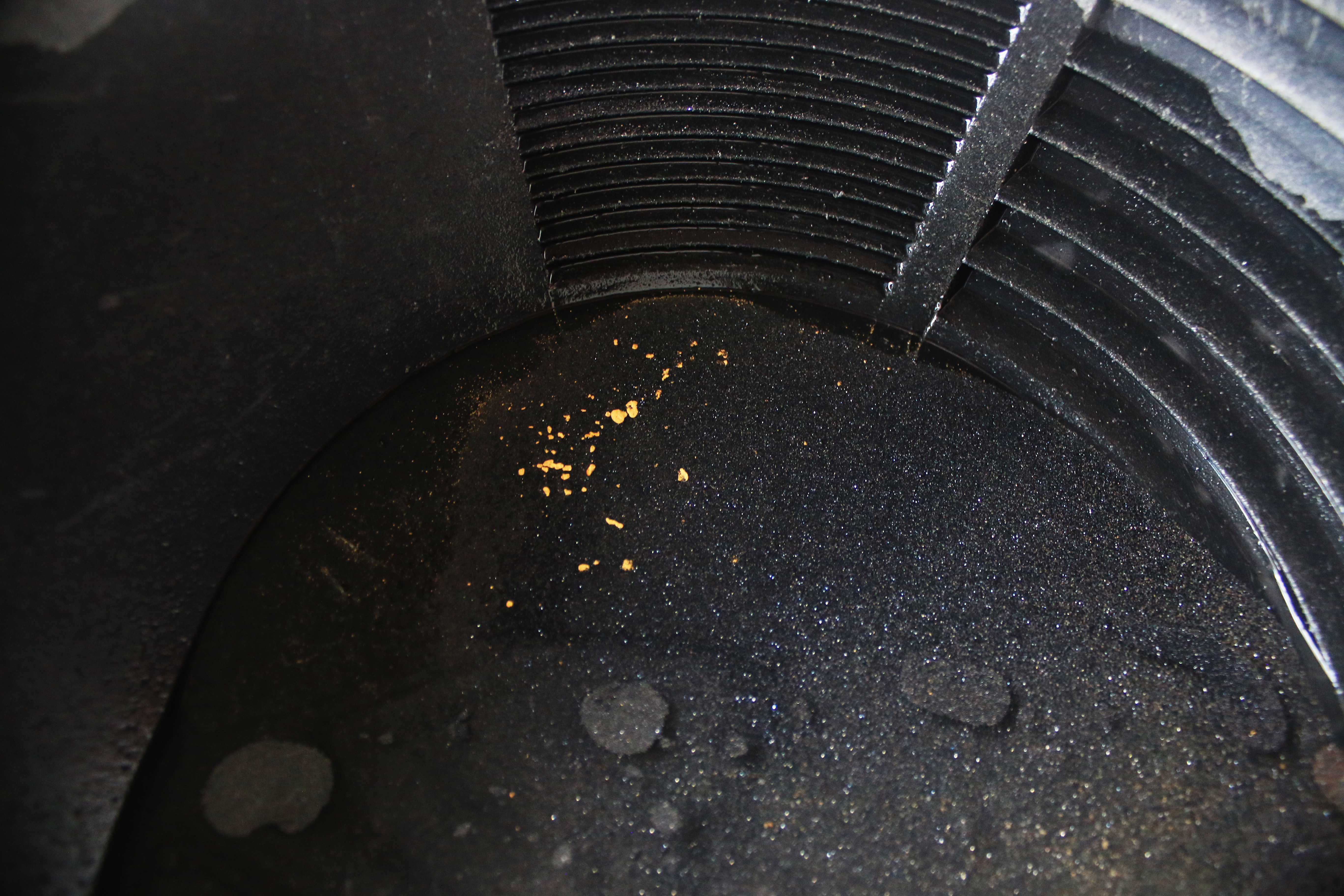
A finishing pan with a smooth, shallow bottom and micro riffles helps on this last stage. The riffles trap the smallest flakes while you trail off the black sand, and you can see the gold clearly against the dark pan surface.
Separating Gold From Black Sand
After classifying and panning, you’re left with black sand concentrate, and the fine gold is mixed right in with it.
Black sand is mostly magnetite and hematite, both iron minerals, and both heavier than quartz but lighter than gold. That weight difference is your final tool.
A strong magnet pulls the magnetite straight out. Run a magnet under the pan or use a magnetic separator wand, and the black sand lifts away while the gold and any non magnetic minerals stay behind.
Some black sand is hematite, which isn’t magnetic, so a magnet alone won’t clear it all. For that, a snuffer bottle lets you suck up the visible gold and leave the rest.
Dealing with black sand at the fine end is really about repeated, gentle panning combined with a magnet, and it’s the same problem whether you’re at a creek in California or a river in Georgia.
For a deeper look at squeezing out the smallest color, mastering fine gold recovery covers the finishing methods that take you from concentrate to clean gold in a vial.
Checking Whether You Kept the Gold
The only way to know your classification worked is to test the tailings you threw away.
Re pan a sample of your reject material. If gold shows up in the stuff you discarded, your screening or panning let it escape, and you can adjust before you lose a whole day’s worth.
Specific gravity is the honest test for a suspect flake. Gold sits near 19 grams per cubic centimeter, while pyrite, the classic fool’s gold, sits around 5, so real gold feels startlingly heavy for its size.
There’s also a simple visual check. Gold stays bright and metallic in shadow, keeps a soft yellow shine, and never sparkles like pyrite does when you tilt it toward the sun.
Resources for Fine Gold Classification
- U.S. Geological Survey (USGS) – Official data on placer gold deposits, particle size studies, and where fine gold concentrates in river systems.
- Bureau of Land Management (BLM) – Rules for recreational panning and mineral collection on public land, including equipment and disturbance limits.
- U.S. Forest Service (USFS) – Guidance on panning and classifying material within National Forests and along their waterways.
- Gold Prospectors Association of America (GPAA) – Club claims, member how-to material, and hands-on classification tips from experienced members.
- TreasureNet – Active prospecting forum where members compare classifier setups and fine gold recovery results.
Why Classification Beats Effort Every Time
The prospectors who bring home the most gold aren’t the ones who dig the most dirt, they’re the ones who sort it before they work it.
Screening your material into clean size ranges, running each range on its own, and finishing the fine fraction with patience is what turns a pan of gravel into a vial of color.
Buy a nested set of classifiers, screen wet, save every fraction, and test your tailings until you trust your process. Do those things and fine gold classification will quietly become the single biggest upgrade to your gold recovery.
Frequently Asked Questions – Fine Gold Classification
What mesh size is best for catching fine gold?
A 50 mesh screen catches most fine flake gold, and the material that passes through it holds the flour gold. For general panning a 20 mesh classifier is the everyday choice, and you only add finer screens when you’re specifically chasing the smallest color.
Do I really need to classify, or can I just pan everything together?
You can pan mixed material, but you’ll lose fine gold doing it. When large light gravel and small heavy flakes share a pan, the gold rides out with the top wash instead of settling, so classifying first raises your recovery noticeably.
Why is wet screening better than dry?
Water carries fine particles through the mesh and breaks up clay that would otherwise trap gold. Dry screening lets silt clump and static hold tiny flakes to larger grains, and even a light breeze can blow flour gold off the screen.
How do I separate fine gold from black sand?
Use a magnet to pull out the magnetite, which is most of the black sand, then use a snuffer bottle to lift the visible gold from what remains. Gentle repeated panning combined with the magnet clears almost all of it.
What is flour gold?
Flour gold is the finest placer gold, smaller than about 100 mesh, roughly the texture of powder. It floats on surface tension and washes away easily, which is why it needs slow panning and its own screened fraction to recover.
How do I know if my classification is working?
Re pan a sample of the material you discarded. If gold shows up in your rejects, some is escaping and you need to slow down or add a finer screen. Testing your tailings is the only reliable way to trust your process.
Can I make my own classifiers?
Yes. Hardware cloth or window screen stapled to a bucket lid frame works, though the mesh sizes are less precise than commercial classifiers. For fine gold work, the accuracy of a proper nested set is worth the small cost.
⛏ Recommended Gear ⛏


* As an Amazon Associate I earn from qualifying purchases at no extra cost to you.
Subscribe to Our Newsletter

Ryan Conlon is the founder of Pan for Treasure.
A lifelong gold panning enthusiast, he created this site to help beginners learn the ropes and share practical tips from his own time on the creek. [email protected]