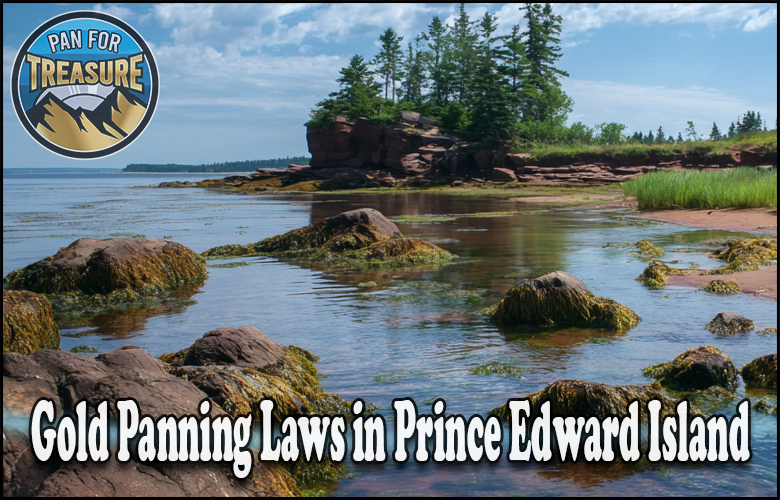
Here is the honest answer up front: the gold panning laws in Prince Edward Island matter far less than the geology, because PEI is not a gold-panning destination.
The whole island sits on soft red sandstone, shale, and conglomerate. That is not the kind of rock that produces gold, and there is no gold rush, no historic gold mining, and no placer streams to work.
If you have read articles describing PEI permit fees, designated gold rivers, or a local gold rush, those claims are simply wrong. None of it exists.
What PEI does have is a mineral tenure framework on paper, the same basic structure every province keeps, plus real natural attractions that draw visitors for reasons that have nothing to do with gold.
This guide sets the record straight on why PEI has no gold panning scene, what its mineral law actually says, and where in Atlantic Canada you should point the truck instead.
TL;DR
- No gold to pan: PEI is underlain entirely by Permian-age red sandstone and shale, geology that does not host gold deposits.
- No gold history: There was never a PEI gold rush or gold mine. Historic accounts state plainly there were no mines on the island.
- Mineral law exists on paper: The province has a Mineral Resources Act (Cap. M-7) with a claim-and-lease system, but it is not built around gold panning.
- No gold permits or fees: There is no recreational gold-panning permit, no designated gold river, and no fee schedule, because there is nothing to pan.
- Mining reality: Extraction on PEI has been limited to sand and gravel; even that is low quality and small scale.
- Go next door: Nova Scotia and New Brunswick have genuine gold and legal panning. PEI does not.
- Private land rules still apply: Trespass and landowner-permission rules apply to any activity on private property here, as everywhere.
Gold Panning Laws in Prince Edward Island
Gold panning depends entirely on gold being present in the local rock and washing into streams as placer deposits. On PEI, that starting ingredient is missing.
Geologically, Prince Edward Island is underlain entirely by rocks correlative with the Pictou Group of Nova Scotia and New Brunswick, informally called the Prince Edward Island Redbeds.
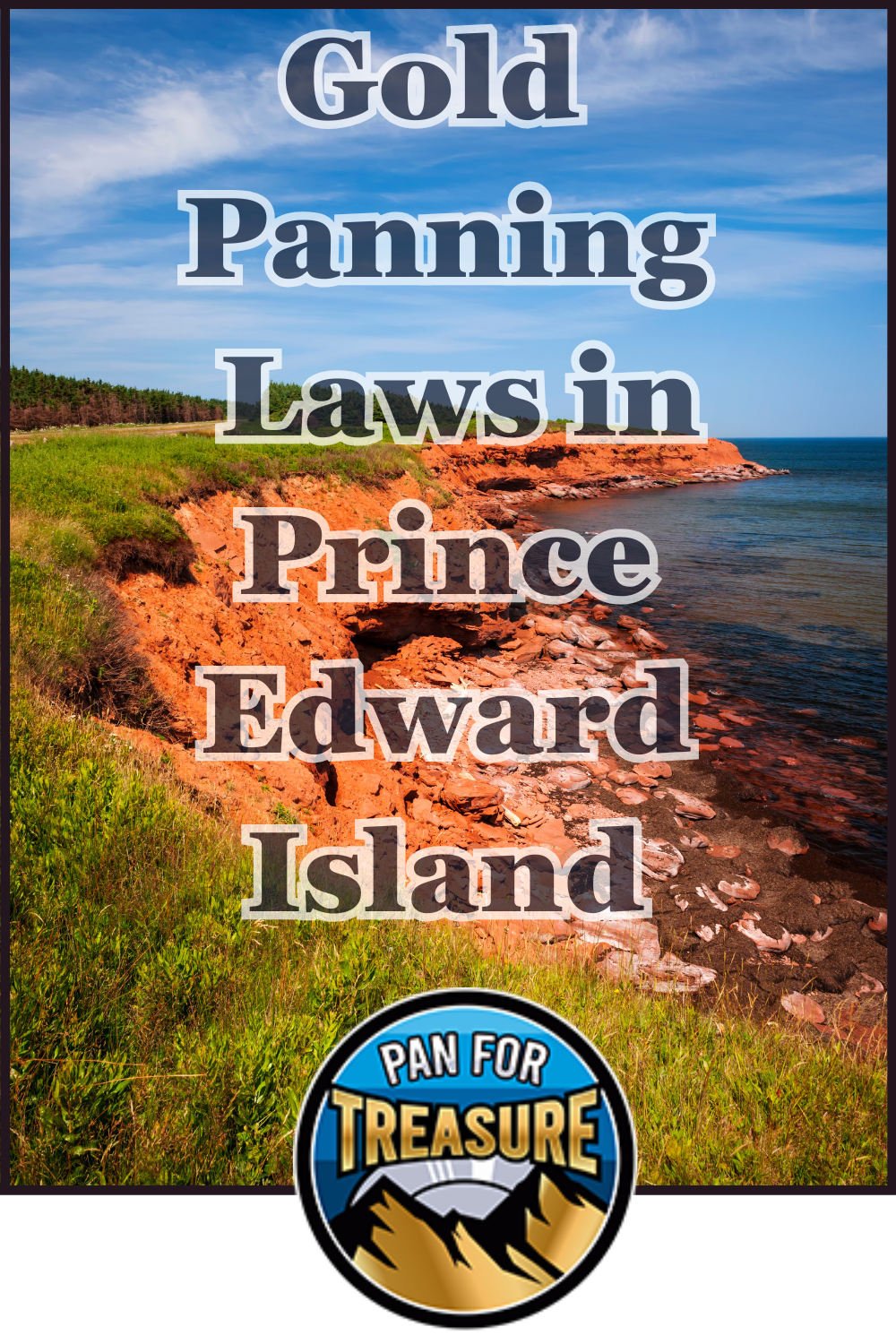
These are sandstones, shales, and conglomerates of Permian-Carboniferous age. They formed as river and floodplain sediments, the classic red beds that give the island its famous rust-coloured soil and cliffs.
That rock does not host gold. Gold concentrates in very different settings, hard-rock quartz veins and the ancient volcanic and metamorphic belts you find on the mainland, none of which exist beneath PEI.
The red beds themselves formed roughly 250 to 300 million years ago as sand and mud spread across ancient river plains, then stained rust-red by iron oxide over deep time. It is a sedimentary story with no volcanic or hydrothermal chapter, and hydrothermal activity is exactly what drives gold into rock elsewhere.
Provincial and federal geological surveys back this up. PEI has been described as Canada’s mineralogically poorest province, with only trace occurrences of a few minerals and nothing approaching an economic gold deposit.
Compare that with Nova Scotia’s Meguma belt just across the water, where folded, metamorphosed rock and quartz veins built a genuine gold industry. PEI’s flat-lying sandstone is the geological opposite, and geology, not law, is what settles the question.
What the Island Actually Has Underground
Drilling on and around PEI has turned up natural gas prospects offshore and trace amounts of coal, uranium, and vanadium, but nothing in commercial quantity.
Mining on the island has been limited to open-pit removal of sand and gravel, and even that material is low quality and thin on the ground.
There is simply no metal-mining industry here, and there never has been. The island’s real resources are its rich agricultural soil and the surrounding sea.
Was There Ever a Gold Rush in PEI?
No. This is worth stating flatly because some online content invents one.
There was no colonial-era gold rush on Prince Edward Island, no gold discovery timeline, and no historic gold mines. Nineteenth-century mining records for the region note plainly that there were no mines on Prince Edward Island at all.
While Nova Scotia was in the middle of a genuine gold rush in the 1860s and Newfoundland was shipping copper and nickel ore, PEI had nothing of the kind, because it had nothing to mine.
Any article that describes early-1800s PEI gold discoveries or several operating gold mines across the island is fabricating history. Treat those sources with real caution.
Why the Myth Persists
PEI’s dramatic red cliffs and iron-stained sandstone can look mineral-rich to an untrained eye, and low-quality web content sometimes copies gold-panning templates from province to province without checking the geology.
The result is a crop of articles that assign PEI a gold scene it never had. The province’s own natural-resource record is the corrective: soil and sea, not gold.
Prince Edward Island’s Mineral Law, on Paper
PEI does keep a mineral tenure system, like every province, even though it sees almost no use for metals.
The framework is the Mineral Resources Act (R.S.P.E.I. 1988, Cap. M-7), administered provincially. It defines minerals as vested in the Crown and sets out a licence-claim-lease structure for anyone who wanted to explore.
- Under the Act, a section of land is divided into mineral claims, and a licence application is made in writing on the prescribed form.
- A licence holder can be required to report proposed work, and leases run for a set term of years.
- Work requirements regulations spell out what counts as exploration work, from prospecting and surveys to mechanical equipment.
None of this is a recreational gold-panning regime. It is a standard provincial mineral-rights framework that exists in case exploration ever happens, not a system built for hobby panners, because there is no hobby-panning demand.
No Gold Permits, No Fee Schedule
Because there is no gold to pan, there is no recreational gold-panning permit for PEI, no designated gold river, and no published fee for one.
If a source lists specific PEI gold-panning permit costs or fine amounts for panning violations, that is invented. The province does not run such a program.
The only rules that reliably apply to poking around PEI streams and shorelines are the ordinary ones: respect private property, get landowner permission, and stay out of protected and ecologically sensitive areas.
Private Land, Trespass, and Protected Areas
Even though gold panning is a non-starter here, the general access rules are worth knowing if you plan any outdoor collecting or beach activity.
Most PEI land near the coast and along waterways is privately owned or managed, so assume you need permission before entering or digging.
- Get the landowner’s consent before entering private property or working any stream bank on it.
- Stay out of provincial parks, national park land, and ecologically sensitive dune and wetland areas.
- Do not disturb the coastal cliffs and dunes; they are fragile and, in places, legally protected.
- Leave no trace, fill any holes, and pack out what you bring in.
These are common-sense rules rather than gold-specific ones, but they keep you legal and welcome on an island where land access is taken seriously.
What to Do Instead: Real Panning Nearby
If you came to Atlantic Canada to pan for gold, the good news is that two of PEI’s neighbours deliver where the island cannot.
| Province | Gold Panning Reality | Key Rule |
|---|---|---|
| Prince Edward Island | No gold; sandstone geology | No panning regime exists |
| Nova Scotia | Real Meguma gold; open hand panning | Crown land panning generally allowed |
| New Brunswick | Fine river gold; licensed panning | $100 Prospecting Licence required |
| Newfoundland and Labrador | Gold mainly on the Island | Map-staked claim system |
Nova Scotia is the easiest choice. It has genuine gold in the Meguma belt, open hand panning on Crown land, and The Ovens near Lunenburg for a guided experience.
New Brunswick has fine gold in its rivers and a clear, if stricter, system built around a one-time $100 Prospecting Licence and a summer season.
Newfoundland and Labrador holds gold mostly on the Island of Newfoundland, worked through a map-staked claim system.
For the full regional comparison, our Atlantic Canada guide puts all four provinces side by side, and our national gold panning laws in Canada overview covers the rest of the country.
Enjoying PEI for What It Is
PEI is worth the trip for its beaches, red cliffs, seafood, and the gentle rhythm of the island, just not for gold.
If you love rocks and shorelines, beachcombing and photographing the iron-red sandstone formations is a genuine pleasure here. Just skip the pan and keep your expectations set to scenery, not colour in the bottom of a dish.
This is general legal education, not legal advice, and land status can change. For anything involving private property or protected areas, confirm the current rules with the provincial authority before you head out.
Resources for Understanding PEI’s Geology and Mineral Law
- Prince Edward Island Mineral Resources Act – The province’s mineral tenure statute, defining claims, licences, and leases.
- Natural Resources Canada: PEI Geology – Federal overview of the Prince Edward Island Redbeds and the island’s sandstone-and-shale bedrock.
- Mineral Resources Act (full text, PDF) – Complete legal text of PEI’s mineral legislation for anyone who wants the detail.
- Mindat: Prince Edward Island Minerals – Reference database confirming the island’s very limited mineral record.
- Gold Prospectors Association of America (GPAA) – For real panning elsewhere: technique guides, claims, and community resources.
Final Word on Gold Panning in Prince Edward Island
The plain truth about the gold panning laws in Prince Edward Island is that they barely come up, because there is no gold to pan and no history of it.
The island’s soft Permian sandstone never produced gold, there was never a gold rush, and the mineral framework on the books is a formality rather than a panning program.
If gold is what you are after in Atlantic Canada, cross to Nova Scotia or New Brunswick, where the geology and the law both cooperate. Enjoy PEI for its cliffs, beaches, and food, and leave the gold pan in the truck.
Frequently Asked Questions – Gold Panning Laws in Prince Edward Island
Can you pan for gold in Prince Edward Island?
Not in any meaningful way. PEI’s bedrock is Permian sandstone and shale, which does not host gold, so there are no gold-bearing streams to pan.
Is there a gold-panning permit for PEI?
No. There is no recreational gold-panning permit, designated gold river, or fee schedule on Prince Edward Island, because there is no gold to pan.
Was there ever a gold rush on Prince Edward Island?
No. There was never a PEI gold rush or gold mine. Historic mining records state plainly that there were no mines on the island.
Does PEI have any mineral law at all?
Yes. The province keeps a Mineral Resources Act (Cap. M-7) with a claim-and-lease framework, but it is a standard tenure system, not a gold-panning regime.
Why do some websites describe PEI gold panning?
Some low-quality content copies gold-panning templates from other provinces without checking PEI’s geology. Those descriptions of island gold rushes, permits, and fees are fabricated.
Where should I go to pan for gold near PEI?
Nova Scotia and New Brunswick both have real gold and legal panning. Nova Scotia allows open hand panning on Crown land; New Brunswick requires a one-time $100 Prospecting Licence.
Can I collect rocks or beachcomb on PEI?
Yes, with common sense. Get permission on private land, stay out of protected dunes and parks, avoid damaging the cliffs, and leave no trace.
What minerals does PEI actually have?
Only trace amounts of coal, uranium, and vanadium, plus some offshore natural gas prospects. Actual extraction has been limited to low-quality sand and gravel.
Keep Exploring
For the bigger picture, start with our Gold Panning Laws in Canada guide.
⛏ Recommended Gear ⛏


* As an Amazon Associate I earn from qualifying purchases at no extra cost to you.
Subscribe to Our Newsletter

Ryan Conlon is the founder of Pan for Treasure.
A lifelong gold panning enthusiast, he created this site to help beginners learn the ropes and share practical tips from his own time on the creek. [email protected]