
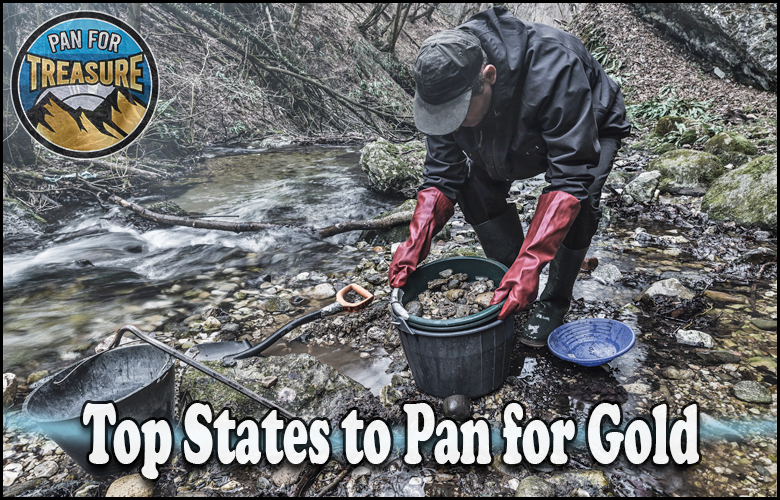
The top states to pan for gold in the United States are not just the states that produce the most gold commercially. The best state for a recreational panner depends on three things: proven gold in the streams, public land you can actually access, and regulations that allow you to pan without jumping through hoops.
A state like Nevada produces 78% of all US gold, but almost all of it comes from industrial mines processing microscopic gold that cannot be recovered with a pan. Meanwhile, a state like Idaho produces far less commercially but has world-class placer streams and 30 million acres of public land open to prospecting.
This guide ranks the top 15 states for recreational gold panning based on what actually matters to someone holding a gold pan: documented placer gold, public land access, historical production from hand-minable deposits, regulations, and what you can realistically expect to find. If you are new to panning, start with our getting started with gold panning guide.
TL;DR
- Best overall: California. Unmatched placer history, public land access, year-round panning at lower elevations, and thousands of documented gold locations.
- Best public land access: Idaho. Over 30 million acres of federal land, productive placer streams, and casual use panning allowed.
- Best for nuggets: Alaska. Remote but produces the largest placer nuggets in the country. Nome beaches still produce gold.
- Best in the East: Georgia and North Carolina. The Appalachian gold belt has proven placer gold and national forest access.
- Best year-round: Arizona. Desert climate allows prospecting 365 days (best October through April). Lynx Creek is one of the most accessible public panning spots in the country.
- Check laws first: Every state has different rules. See our gold panning laws by state directory.
The 15 Top States to Pan for Gold, Ranked
1. California
No state in the country matches California for recreational gold panning. The Mother Lode region alone stretches 120 miles through the Sierra Nevada foothills with over 10,000 documented gold locations. The California Gold Rush of 1848-1855 produced the modern equivalent of billions of dollars in gold, and the streams that fed that rush still produce placer gold today. The American, Yuba, Feather, Merced, Kern, and Klamath Rivers are all productive.
California’s gold comes from quartz veins in Mesozoic metamorphic rocks (the Mother Lode belt) and Tertiary gravels (ancient riverbeds buried under volcanic deposits). The state has 20 million acres of national forest and significant BLM land. Auburn State Recreation Area offers free hand panning. The Keyesville Recreational Mining Area near Bakersfield allows sluicing and dredging in designated areas. Highway 49 connects dozens of gold rush towns with nearby panning access.
The downside: California has the most restrictive suction dredge regulations in the West. Motorized suction dredging has been effectively banned since 2009. Hand panning, non-motorized sluicing, and highbanking (away from waterways) remain legal on public land. Despite the dredge ban, California is still the top state for recreational hand panners. See our California gold panning laws.
2. Alaska
Alaska is the dream destination for gold panners willing to deal with remote locations and a short season. The state has produced over 40 million troy ounces of gold, and placer deposits across the Interior, the Seward Peninsula (Nome), and the Kenai Peninsula still yield gold for recreational panners. Alaska’s gold is often coarser than what you find in the Lower 48, and genuine nuggets are still found.
BLM manages over 70 million acres in Alaska, and state land adds millions more. Recreational hand panning is allowed as casual use on most public land. The Fairbanks area (Chena River, Pedro Creek, Goldstream Creek) is the most accessible. Nome’s beaches produce gold year after year. The Dalton Highway provides access to remote creeks in the Brooks Range foothills.
The downside: the panning season is short (June through September), locations are remote, and logistics are expensive. Getting to Nome requires a flight. Mosquitoes and bears are real considerations. But for sheer gold-finding potential and wild adventure, Alaska is hard to beat. See our Alaska gold panning laws.
3. Idaho
Idaho is the sleeper pick that experienced prospectors know well. The Boise Basin produced an estimated 2.9 million ounces of placer gold, making it one of the richest single placer districts in America. Total state production approaches 10 million ounces. Idaho has over 30 million acres of federal public land (nearly 62% of the state), providing exceptional access to gold-bearing streams.
Grimes Creek, Mores Creek, and Elk Creek near Idaho City are productive and accessible on Boise National Forest land. The South Fork Clearwater River corridor, the Salmon River, and the Gold Fork River also produce placer gold. The Idaho Batholith (a massive granitic intrusion) is the geological source for most of the state’s gold.
Idaho allows casual use hand panning on NF and BLM land without a permit. Suction dredge regulations are more permissive than California or Oregon, though seasonal restrictions apply on some waterways. Active mining claims are common in productive areas, so verify claim status through BLM LR2000 before panning. See our Idaho gold panning laws.
4. Colorado
Colorado produced over 45 million troy ounces of gold, making it one of the top gold states historically. The Cripple Creek District alone produced 21 million ounces from lode mines. For recreational panners, the placer deposits along Clear Creek, the Arkansas River, the South Platte, and their tributaries are the primary targets.
Clear Creek Canyon west of Denver is one of the most accessible panning locations near a major city in the country. The Arapahoe Bar area allows panning and sluicing. Cache Creek near Granite (BLM land) is a popular public panning area. National forest land across the Rockies provides additional access. Breckenridge, Idaho Springs, and Fairplay all have historical placer production.
Colorado’s combination of proximity to Denver (making weekend trips easy), well-documented gold areas, and extensive national forest land makes it a top state for recreational panners. The panning season runs June through September at higher elevations and extends longer at lower elevations like Clear Creek. See our Colorado gold panning laws.
5. Oregon
Oregon has 31 gold locations per 1,000 square miles, ranking third nationally in gold density. Southern Oregon’s Josephine and Jackson Counties were among the richest placer districts in the Pacific Northwest, producing over 1 million ounces between 1852 and 1900. The Rogue River, Illinois River, and their tributaries are the primary targets.
Gold Nugget Wayside and Hellgate Recreation Area near Grants Pass are open to public hand panning. The Siskiyou and Rogue River-Siskiyou National Forests and BLM land provide extensive access. Eastern Oregon’s Malheur County (Mormon Basin, Rye Valley) also has gold potential on BLM land.
Oregon requires a Department of State Lands (DSL) permit for some mining activities, and suction dredge regulations are strict. Hand panning and non-motorized equipment are less restricted. See our Oregon gold panning laws.
6. Montana
Montana produced an estimated 18 million ounces of gold from lode and placer deposits across the western part of the state. Alder Gulch near Virginia City was one of the richest placer strikes in the West. The Helena area, Butte, the Missouri River headwaters (Prickly Pear Creek, Last Chance Gulch), and the Yellowstone tributaries all have gold.
Montana has extensive national forest and BLM land in the western mountains. Libby Creek near Libby has a designated recreational panning area. The Helena and Beaverhead-Deerlodge National Forests provide access to gold-bearing drainages. Fine to coarse placer gold is found depending on the district.
Montana allows casual use hand panning on public land. Suction dredge permits (310 permits) are required from the Montana DEQ for motorized in-stream work. See our Montana gold panning laws.
7. Arizona
Arizona ranks fifth nationally in gold production and offers something no other top gold state can match: year-round prospecting. Winter temperatures in the 50-70 degree range at desert elevations make October through April the prime season, while the rest of the West is frozen. Lynx Creek in Prescott National Forest is one of the most accessible and popular public panning sites in the country, with a 4.5-mile withdrawn mineral area open to hand panning and metal detecting.
The Bradshaw Mountains, Wickenburg area, and Rich Hill are historically productive districts. Arizona’s vast BLM land provides access across the state. Dry washing (no water needed) works in many desert locations where traditional wet panning is impractical. Metal detecting for gold nuggets is also highly productive in Arizona.
Arizona’s combination of year-round access, BLM land, and proven gold makes it a top pick, especially for prospectors who live in southern states or want to avoid frozen northern streams. See our Arizona gold panning laws.
8. Washington
Washington has 34 gold locations per 1,000 square miles, ranking second nationally in gold density (behind only California). Total production exceeds 3 million ounces. Swauk Creek near Liberty in Kittitas County is the state’s most popular recreational panning destination and produces coarser gold than most Washington locations. The Peshastin/Blewett District in Chelan County and the Republic District in Ferry County are also productive.
The Okanogan-Wenatchee National Forest covers the most productive gold areas. GPAA claims at Swauk Creek provide member access. Washington’s WDFW Hydraulic Project Approval (HPA) is required for suction dredging, with seasonal windows typically July through mid-September. Hand panning is casual use on NF land. See our Washington gold panning laws.
9. Georgia
Georgia hosted America’s first major gold rush (1828-1829) and has the richest gold deposits east of the Mississippi. The Dahlonega area in Lumpkin County was productive enough to warrant a US branch mint from 1838 to 1861. The Appalachian gold belt runs through north Georgia’s Lumpkin, White, Dawson, and Cherokee Counties with documented placer gold in dozens of streams.
The Chattahoochee National Forest provides public access to gold-bearing streams. Consolidated Gold Mine and Crisson Gold Mine in Dahlonega offer pay-to-pan experiences. The Chestatee, Etowah, and Yahoola Rivers produce fine to medium placer gold. Georgia’s mild climate allows year-round panning on milder days, with fall being the best season.
Georgia is the top state for gold panning east of the Rockies, combining proven deposits, national forest access, tourist-friendly panning operations, and a long season. See our Georgia gold panning laws.
10. North Carolina
North Carolina claims the first documented gold find in the US (Conrad Reed’s 17-pound nugget in 1799) and was the leading gold-producing state until the 1830s. The Carolina Slate Belt runs through the Piedmont with hundreds of documented mines. Uwharrie National Forest provides public access. Reed Gold Mine State Historic Site offers guaranteed panning with native ore.
The Piedmont streams and the mountain region’s creeks both produce placer gold. North Carolina allows recreational hand panning without a state permit. The gold is fine to medium, with occasional small nuggets reported from some locations. See our North Carolina gold panning laws.
11. South Dakota
The Black Hills produced over 40 million troy ounces of gold, with the Homestake Mine alone accounting for 39.8 million ounces. That makes the Black Hills one of the most productive gold districts on Earth. The gold that made it into streams as placer deposits is a tiny fraction of the total, but it is there, and recreational panners find it in Black Hills creeks and gulches.
Black Hills National Forest and BLM land provide public access. Custer State Park has designated panning areas near French Creek. Broken Boot Gold Mine in Deadwood offers tourist panning. The combination of incredible gold history, public land access, and the Deadwood tourist experience makes South Dakota a strong destination. See our South Dakota gold panning laws.
12. Wyoming
Wyoming’s South Pass area produced over 2 million ounces from Precambrian greenstone belt rocks at the southern end of the Wind River Range. BLM manages 18.4 million acres in the state, providing extensive public access. The Sweetwater River, Rock Creek, and Willow Creek produce fine to coarse placer gold with occasional nuggets. South Pass City State Historic Site preserves the 1867 gold rush town.
Wyoming’s wide-open BLM land and lack of crowds make it appealing for prospectors who want solitude. The panning season is short (July through September at 7,500 feet elevation), and the area is remote. But the gold is real and the access is excellent. See our Wyoming gold panning laws.
13. Nevada
Nevada produces 78% of all US gold (over 5 million ounces per year), but almost all of it comes from industrial operations mining microscopic Carlin-type gold that cannot be recovered with a pan. For recreational panners, focus on the historic placer districts: Unionville, Manhattan, Tuscarora, Gold Canyon, and Rye Patch. Nevada has over 48 million acres of BLM land (84% of the state).
The challenge is that Nevada has over 180,000 active mining claims, and the best ground is often claimed. Rye Patch State Recreation Area near Lovelock is a popular metal detecting and dry washing destination. Gold nuggets with distinctive chevron patterns have been found there. Check claim status carefully before prospecting anywhere in Nevada. See our Nevada gold panning laws.
14. Virginia
Virginia was America’s leading gold-producing state in the 1830s, with over 50 mines operating across the Piedmont. The gold-pyrite belt stretches across 15 counties from Fauquier to Halifax with over 250 documented mines. The first documented US gold find occurred in Virginia around 1782. Streams draining the gold belt (Rappahannock, Rapidan, North Anna, Rivanna, James) carry placer gold.
Most productive land is private, which is the main access challenge. The George Washington and Jefferson National Forests provide some public access on the western edge. The gold belt’s proximity to Washington, DC, and Richmond makes it one of the most accessible gold regions for east coast prospectors. See our Virginia gold panning laws.
15. New Mexico
New Mexico produced an estimated 2.2 million ounces of gold, primarily from lode mines in the Mogollon, Elizabethtown, and Hillsboro Districts. Placer gold occurs in the Ortiz Mountains (south of Santa Fe), the Jicarilla Mountains, and along the Rio Grande tributaries. The state has extensive BLM and national forest land, and regulations are straightforward for casual use panning.
New Mexico’s best panning areas are in the southern Rockies and the ranges south of Santa Fe. The climate allows extended-season panning (similar to Arizona at lower elevations). The Old Placers and New Placers districts south of Santa Fe have documented placer gold. See our New Mexico gold panning laws.
What Makes a State Great for Recreational Gold Panning
The ranking above is based on five factors that matter to recreational panners. Not all states score well on all five, but the best states score high across the board.
- Proven placer gold. The state has documented placer deposits where gold has been found with hand tools, not just industrial lode mines. Historical placer production is the best indicator of what a recreational panner can expect to find.
- Public land access. National forest, BLM, and state land where you can legally pan without needing private landowner permission. States with 50%+ federal land (Idaho, Wyoming, Nevada, Alaska) have a huge advantage.
- Favorable regulations. States that allow casual use hand panning without permits score higher. States with strict dredge bans (California) score lower for motorized equipment but remain top-tier for hand panners. See our guide to permits and access.
- Accessibility. States with gold near population centers or with good road access to gold areas score higher. Clear Creek in Colorado (45 minutes from Denver) is more accessible than remote Alaska creeks.
- Season length. Year-round states (Arizona, Georgia) score higher than states with 3-4 month seasons (Alaska, Wyoming at high elevation).
Tips for Choosing the Right State
- If you live in the West, you have the best options. California, Idaho, Colorado, Oregon, Montana, and Arizona all have productive placer gold within a day’s drive of most western cities. Pick the state closest to you and start there.
- If you live in the East, Georgia and North Carolina are your best bets. Virginia has great geology but private land access is the challenge. Tennessee’s Coker Creek area in the Cherokee National Forest is also productive. See our Georgia and North Carolina guides.
- If you want an adventure, Alaska delivers. The combination of wild scenery, large gold, and frontier atmosphere is unmatched. Plan for a summer trip and budget for the higher costs of remote Alaska travel.
- If you want year-round panning, Arizona is the pick. Lynx Creek is accessible, productive, and open 365 days. Southern California and Georgia also allow winter panning.
- If you want solitude, Wyoming’s South Pass area, Idaho’s backcountry, and Montana’s remote drainages offer panning without crowds. These states have vast public land and fewer recreational panners than California or Colorado.
- Bring the right gear. A quality gold pan, classifier, snuffer bottle, and crevicing tool are the basics. A non-motorized sluice box increases your recovery rate. See our best gold panning kits for complete setups.
- Learn techniques before you go. The best state in the world will not produce gold if you do not know how to read a stream, find bedrock, or work a pan properly. Practice at home before heading to the field.
Resources
- Pan for Treasure – Gold Panning Laws by State – Complete directory of gold panning regulations for all 50 states.
- Pan for Treasure – Best Places to Pan for Gold in America – Detailed guide to the best prospecting locations across the country.
- Gold Prospectors Association of America (GPAA) – Membership claims, chapters across the US, and prospecting education.
- Bureau of Land Management – Public land access, LR2000 mining claims database, and casual use rules.
- USGS National Minerals Information Center – Mineral production data and geological reports for all states.
Conclusion
The top states to pan for gold combine proven placer deposits, public land access, and favorable regulations for recreational prospectors. California leads overall with unmatched gold history and thousands of documented locations. Alaska offers the biggest gold and wildest adventure. Idaho is the best-kept secret with world-class placer streams and vast public land. For east coast prospectors, Georgia and North Carolina provide the Appalachian gold belt with national forest access. Arizona delivers year-round prospecting that no other top gold state can match.
Every state has different rules, so check the laws before you go. Browse our gold panning near me page, see the full gold panning laws by state directory, or read our gold rush hotspots guide for the most famous sites.
Frequently Asked Questions – Top States to Pan for Gold
What is the number one state for recreational gold panning?
California. It has the most documented gold locations in the country (over 10,000), a 120-mile Mother Lode belt with productive streams, extensive national forest and BLM land, and year-round panning at lower elevations. The American River, Yuba River, and Feather River are among the richest gold-bearing rivers in the US.
Which state has the most gold in the ground?
Nevada produces 78% of all US gold, but almost all of it is microscopic Carlin-type gold that requires industrial processing. For gold you can actually find with a pan, California, Alaska, and Idaho have the most proven placer deposits. Alaska has produced over 40 million ounces total, with significant placer production still ongoing.
What is the best state for gold panning on the East Coast?
Georgia. The Dahlonega area hosted America’s first major gold rush in 1828, and the north Georgia mountains still produce fine to medium placer gold. The Chattahoochee National Forest provides public access. North Carolina is a close second, with the Carolina Slate Belt and Reed Gold Mine State Historic Site.
Can you still find gold nuggets in the United States?
Yes. Alaska is the best state for finding genuine nuggets with hand tools. Arizona and Nevada are productive for nugget hunting with metal detectors. Some California, Oregon, and Idaho streams also produce coarser gold and small nuggets. Most recreational panners find fine to medium flakes rather than nuggets, but nuggets are still found regularly in productive areas.
Do I need a permit to pan for gold?
In most states, recreational hand panning on BLM and national forest land does not require a permit (it falls under casual use). Some states require permits for specific activities or locations. Suction dredging almost always requires permits. Check our gold panning laws by state directory for each state’s specific rules before heading out.
What is the best state for a beginner gold panner?
Colorado or Georgia. Colorado’s Clear Creek area near Denver is highly accessible with documented gold and easy logistics. Georgia’s Dahlonega area has tourist-friendly pay-to-pan operations (Consolidated Gold Mine, Crisson Gold Mine) where beginners can learn with guaranteed gold in the material. Both states allow a natural progression from tourist panning to independent prospecting on public land.

⛏ Recommended Gear ⛏


* As an Amazon Associate I earn from qualifying purchases at no extra cost to you.
Subscribe to Our Newsletter

Ryan Conlon is the founder of Pan for Treasure.
A lifelong gold panning enthusiast, he created this site to help beginners learn the ropes and share practical tips from his own time on the creek. [email protected]