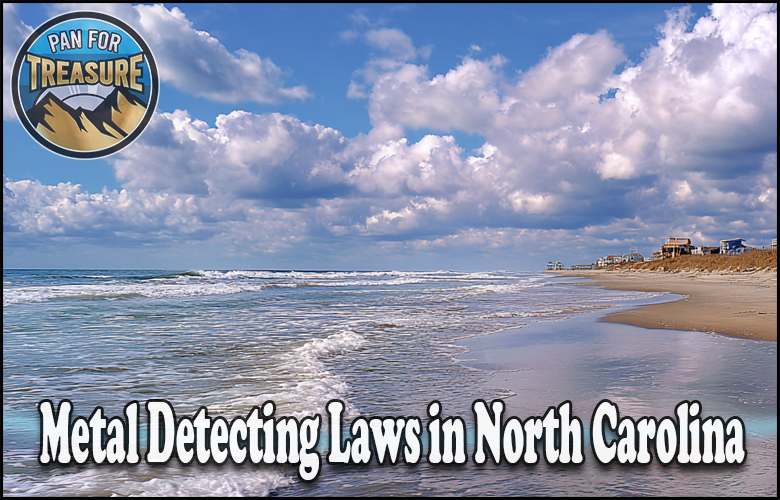
Metal detecting laws in North Carolina are restrictive on state-managed land. State parks are generally listed as prohibited for metal detecting, with some park managers potentially granting limited permission to search for lost personal items only.
Treasure hunting or recreational detecting in state parks is not permitted. Some beaches allow metal detecting, but rules vary by community, and notable locations like Nags Head explicitly ban the activity.
North Carolina’s Civil War history, colonial heritage (Roanoke Colony, 1587), and 300+ miles of Outer Banks coastline make the state productive for detectorists who focus on private land and accessible beaches.
Like Georgia and Kentucky, North Carolina’s public land restrictions push serious detecting onto private property.
New to the hobby? Start with our beginner’s guide to gold panning and prospecting.
TL;DR
- State Parks: Generally prohibited; some park managers may allow limited searching for lost personal items only; recreational treasure hunting not permitted
- Beaches: Some NC beaches permit metal detecting; Nags Head beaches explicitly ban it; rules vary by community; check locally
- Cape Hatteras/Cape Lookout: National Seashore (NPS) beaches are completely off-limits
- Civil War Sites: NPS battlefields prohibited; private land near battlefields is primary option for relic hunting
- Gold Belt: North Carolina’s Piedmont gold belt (first US gold rush, 1799) offers prospecting on private land
- Private Land: Best option; colonial (1587+), Civil War, and gold mining history; written landowner permission required
Generally prohibited; lost items only with manager permission
300+ miles of Outer Banks and mainland coast
First US gold rush (1799); Reed Gold Mine; Piedmont gold belt
Bentonville, Fort Fisher, Averasboro; extensive camp and supply sites
Metal detecting explicitly banned
Private land for relics; accessible beaches for modern finds
Featured
Metal Detecting Laws in North Carolina
Metal detecting laws in North Carolina present a restrictive public land environment with some beach exceptions. Here is the breakdown.
State Parks (Generally Prohibited)
North Carolina state parks are listed among the states that prohibit metal detecting. Some park managers may grant limited permission to search for lost personal items, but searching for treasure or recreational detecting is generally not permitted. Contact the specific park before visiting if you want to search for a lost item.
Beaches
Some North Carolina beaches permit metal detecting. The state’s 300+ miles of coastline include both permissive and restrictive communities. Beach detecting is popular on portions of the Outer Banks, Crystal Coast, and southern coast.
However, Nags Head beaches explicitly ban metal detecting. Cape Hatteras National Seashore (NPS) and Cape Lookout National Seashore (NPS) are completely off-limits. Fort Macon State Park beach may have restrictions. Rules vary significantly by community, so check with the local town or beach management before detecting at any specific location.
Wrightsville Beach, Carolina Beach, Kure Beach, and Ocean Isle Beach are among the beaches where detecting may be allowed. Always verify current local rules.
National Forests
North Carolina has four national forests: Pisgah, Nantahala, Uwharrie, and Croatan. General USFS policy allows recreational detecting in developed areas. ARPA restrictions apply. The Uwharrie National Forest (Piedmont region) overlaps with the historic gold belt. Contact the forest supervisor for current policy.
NPS Sites (Prohibited)
All NPS sites are off-limits: Cape Hatteras National Seashore, Cape Lookout National Seashore, Blue Ridge Parkway, Great Smoky Mountains National Park (partially in NC), Guilford Courthouse National Military Park, Moores Creek National Battlefield, Fort Raleigh National Historic Site, Carl Sandburg Home, and others.
Gold Belt
North Carolina hosted America’s first gold rush in 1799 when 12-year-old Conrad Reed found a 17-pound gold nugget in Cabarrus County. The Piedmont gold belt stretches from Virginia through North Carolina. Reed Gold Mine State Historic Site is off-limits (state historic site), but private land in the gold belt offers prospecting opportunities. The Uwharrie National Forest area has gold history. See our gold panning laws in North Carolina page for more.
Private Land
Private land with written landowner permission is the best option. ARPA does not apply. North Carolina has extensive private farmland, and the state’s colonial, Civil War, and gold mining history makes private land detecting highly productive.
Rules Summary
| Land Type | Detecting Allowed? | Permit/Permission | Artifacts |
|---|---|---|---|
| State Parks | Generally no; lost items only possibly | Park manager for lost items | State property on public land |
| Some Beaches | Varies by community | Check local rules | Modern items kept |
| Nags Head / NPS Seashores | No | N/A (prohibited) | N/A |
| National Forests | Developed areas possibly | Check with Forest Supervisor | ARPA restrictions |
| NPS Sites | No | N/A (prohibited) | N/A |
| Private Land | Yes | Written landowner permission | Finder keeps (per agreement) |
For state parks, visit NC Division of Parks and Recreation. For archaeology, see NC Office of State Archaeology.
Our Favorite Posts
- Metal Detecting Laws and Regulations
- Metal Detecting Laws in Pennsylvania – Public Land, Parks, and Beach Rules
- Metal Detecting Laws in Connecticut – Public Land, Parks, and Beach Rules
- Metal Detecting Laws in Wyoming – Public Land, Parks, and Beach Rules
- Metal Detecting Laws in Montana – Public Land, Parks, and Beach Rules
Best Metal Detecting Locations in North Carolina
- Piedmont gold belt private land (Cabarrus, Stanly, Montgomery, Rowan Counties) – America’s first gold rush (1799-1830s). Private land near old mine sites and stream placers offers gold prospecting. Contact the Uwharrie National Forest for federal land gold detecting policy.
- Southern Outer Banks beaches (various communities) – Beach communities south of the national seashores may allow detecting. Check each town individually. Hurricane and storm activity shifts sand and exposes items along the barrier islands.
- Bentonville area private land (Johnston County) – The Battle of Bentonville (March 1865) was the last major Confederate offensive. The NPS battlefield site is off-limits, but private farmland surrounding the area produces Civil War artifacts.
- Fort Fisher area (New Hanover County) – The battles of Fort Fisher (December 1864, January 1865) were critical Civil War engagements. Fort Fisher State Historic Site is off-limits, but nearby beaches and private land may produce Civil War and maritime items.
- Wrightsville Beach / Carolina Beach area (New Hanover County) – Popular tourist beaches that may allow detecting. Heavy summer traffic produces modern jewelry and coins. Check current local ordinances.
- Charlotte / Mecklenburg area (Mecklenburg County) – The state’s largest city has history dating to the 1750s. Private yards and properties (with homeowner permission) in older neighborhoods produce old coins. The Mecklenburg gold district surrounds the city.
- Western NC mountains private land (various counties) – Cherokee heritage, frontier settlement (1770s+), and Civil War guerrilla activity in the mountains. Private land near old homesteads and settlement sites produces frontier-era items.
- Uwharrie National Forest (Montgomery, Randolph, Davidson Counties) – Overlaps the Piedmont gold belt. Developed recreation areas may allow detecting. Gold and mining-era history dating to the early 1800s.
See our best locations to find gold guide and gold prospecting with metal detectors guide.
North Carolina’s History and What You Might Find
North Carolina’s European history begins with Sir Walter Raleigh’s Roanoke Colony in 1587, the famous “Lost Colony.” Permanent English settlement followed in the 1650s. The state was one of the original 13 colonies and hosted the first gold rush in American history when Conrad Reed found a 17-pound nugget in 1799. North Carolina was the nation’s leading gold producer until the California Gold Rush of 1849.
The Civil War brought significant action to North Carolina, particularly in the final months of the war. The battles of Fort Fisher, Bentonville, and Averasboro occurred in late 1864 and early 1865. The state also had extensive Confederate camp and supply infrastructure throughout the war.
Common finds include colonial-era coins, Civil War buttons, buckles, and Minie balls on private land near battlefields, gold (fine gold and nuggets in the Piedmont belt), maritime and shipwreck items on Outer Banks beaches, and personal items from colonial and frontier homesteads. North Carolina’s combination of gold prospecting and Civil War relic hunting is unique on the East Coast.
Recommended Reading
Tips for Metal Detecting in North Carolina
- Check each beach community individually. North Carolina beach rules vary dramatically. Some communities welcome detecting; Nags Head bans it; NPS seashores are off-limits. A phone call before driving to any beach is essential.
- Focus on private land for Civil War relics. North Carolina’s battlefields and camp sites on private land produce outstanding Civil War artifacts. Historical societies and battle maps identify specific locations.
- Explore the gold belt on private land. The Piedmont gold belt offers genuine gold prospecting on private land. Stream placers and old mine tailings on private property can produce gold with a metal detector.
- Detect beaches after hurricanes. North Carolina’s coastline is hurricane-prone. Major storms shift enormous amounts of sand on the Outer Banks and southern beaches. Post-storm detecting on accessible beaches can produce both modern and historic items.
- Respect Cherokee and Native American sites. Western North Carolina has significant Cherokee heritage. Never detect on tribal land, burial mounds, or cultural sites.
- Stay off all NPS property. North Carolina has extensive NPS land (two national seashores, Blue Ridge Parkway, Great Smokies, battlefields). Know the boundaries.
- Build landowner relationships in rural areas. North Carolina’s rural farmland, particularly in the Piedmont and eastern coastal plain, has deep history. Farmers often welcome respectful detectorists.
- Use a gold detector in the Piedmont. The mineralized soils of the gold belt require a machine that handles ground interference. Pulse induction or high-frequency VLF detectors work best.
For technique help, see our techniques guide and tools and equipment guide.
Metal Detecting Laws
- Metal Detecting Laws in Wyoming – Public Land, Parks, and Beach Rules
- Metal Detecting Laws in Wisconsin – Public Land, Parks, and Beach Rules
- Metal Detecting Laws in West Virginia – Public Land, Parks, and Beach Rules
- Metal Detecting Laws in Washington – Public Land, Parks, and Beach Rules
- Metal Detecting Laws in Vermont – Public Land, Parks, and Beach Rules
Resources
- NC Division of Parks and Recreation – State park information and contact details.
- NC Office of State Archaeology – Archaeological site protections and cultural resource information.
- National Park Service – North Carolina – NPS sites where detecting is prohibited.
- NC Geological Survey – Gold belt information, mineral occurrence maps, and geological resources.
Conclusion
Metal detecting laws in North Carolina restrict state park detecting but leave beaches (community by community) and private land accessible. The state’s unique combination of America’s first gold rush, Civil War battlefields, colonial heritage (1587), and 300+ miles of coastline creates diverse detecting opportunities.
Focus on private land for relics and gold, check beach rules individually, and respect the extensive NPS property in the state. North Carolina rewards research and landowner relationships with finds spanning from the Roanoke Colony through the Civil War.
Explore nearby state guides: metal detecting laws in Virginia, metal detecting laws in South Carolina, metal detecting laws in Georgia, and metal detecting laws in Tennessee. See the full state-by-state metal detecting laws directory.
Frequently Asked Questions – NC Metal Detecting Laws
Can I metal detect in North Carolina state parks?
Generally no. State parks are listed as prohibited. Some park managers may allow limited searching for lost personal items. Recreational treasure hunting is not permitted.
Can I detect on North Carolina beaches?
Some beaches allow detecting; rules vary by community. Nags Head explicitly bans it. Cape Hatteras and Cape Lookout national seashores (NPS) are off-limits. Check each beach community’s rules individually before visiting.
Is there gold in North Carolina?
Yes. North Carolina hosted America’s first gold rush in 1799. The Piedmont gold belt produces placer gold and nuggets. Private land near old mine sites and the Uwharrie National Forest area offer prospecting opportunities. See our gold panning laws in North Carolina page.
What about Civil War detecting in North Carolina?
NPS battlefields are off-limits. Private land surrounding battlefield areas (Bentonville, Fort Fisher, Averasboro) produces outstanding Civil War artifacts with landowner permission. Camp sites and supply routes across the state also yield military relics.
What can I find metal detecting in North Carolina?
Gold in the Piedmont belt. Civil War buttons, buckles, and Minie balls on private land. Colonial-era coins and items from 1650s+ settlements. Maritime and shipwreck items on Outer Banks beaches. Modern jewelry at tourist beaches.
How does North Carolina compare to neighboring states?
Virginia has similar Civil War detecting opportunities with its own restrictions. South Carolina allows detecting in some state parks. Georgia bans all state park detecting. North Carolina’s unique advantage is combining East Coast gold prospecting with Civil War relic hunting.
⛏ Recommended Gear ⛏


* As an Amazon Associate I earn from qualifying purchases at no extra cost to you.
Subscribe to Our Newsletter

Ryan Conlon is the founder of Pan for Treasure.
A lifelong gold panning enthusiast, he created this site to help beginners learn the ropes and share practical tips from his own time on the creek. [email protected]