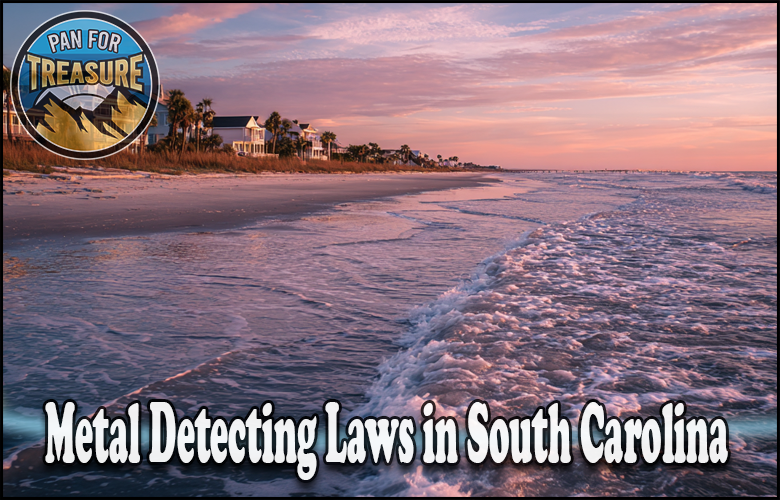
Metal detecting laws in South Carolina provide good beach access along the Grand Strand and other coastal areas while requiring strict permits for state parks.
Metal detecting is not permitted on any SCDNR (Department of Natural Resources) property including wildlife management areas and heritage preserves.
State parks managed by SC State Parks allow detecting with a signed permit from the park manager, limited to non-sensitive areas.
South Carolina’s 187-mile coastline, Civil War history (Fort Sumter fired the war’s first shots), and colonial heritage (Charleston, 1670) make the state productive for both beach and private land detecting.
The Myrtle Beach / Grand Strand area has over 60 miles of beach where detecting is generally permitted. Unlike Georgia (state parks completely banned) or North Carolina (state parks generally prohibited), South Carolina’s beach-friendly approach gives detectorists legal coastal access.
New to the hobby? Start with our beginner’s guide to gold panning and prospecting.
TL;DR
- Beaches: Metal detecting permitted on most public beaches including Myrtle Beach, Grand Strand, and other coastal areas; dunes always off-limits
- State Parks: Strict permit from park manager required; non-sensitive areas only; historic sites within parks off-limits
- SCDNR Property: Metal detecting is NOT permitted on any SCDNR property (wildlife management areas, heritage preserves)
- Dunes: Walking on, disturbing, or digging in dunes is prohibited statewide; sea oats and sand fencing protected
- Underwater Antiquities: SC Underwater Antiquities Act requires a hobby license for underwater detecting in state waters
- Private Land: Best for relics; Civil War (Fort Sumter), colonial (Charleston 1670), plantation history; written permission required
Permitted on most public beaches; dunes off-limits
Strict park manager permit; non-sensitive areas only
Prohibited on all SCDNR property
Charleston (1670), Revolutionary War, Civil War (Fort Sumter), plantation
60+ miles of beach; Myrtle Beach, Surfside, Pawleys Island
SC Underwater Antiquities Act hobby license for state waters
Featured
Metal Detecting Laws in South Carolina
Metal detecting laws in South Carolina distinguish between beaches (generally accessible), state parks (permit required), and SCDNR property (prohibited). Here is the breakdown.
Beaches
Metal detecting is permitted on most public beaches in South Carolina, making the state’s 187-mile coastline a primary detecting resource. The Grand Strand area (Myrtle Beach through Pawleys Island) has over 60 miles of beach where detecting is generally allowed day or night. Key beach rules: never disturb dunes, sea oats, or sand fencing. Stay off the dunes entirely. City parks adjacent to beaches are typically off-limits.
Individual beach communities may have specific rules. Myrtle Beach, North Myrtle Beach, Surfside Beach, Garden City Beach, Pawleys Island, and Litchfield by the Sea all generally permit beach detecting. Huntington Beach State Park requires specific park authorization for beach detecting. Ocean Isle Beach and other Carolinas border communities also allow detecting.
Some municipalities have elected to prohibit metal detecting on their beaches. Check with the specific beach town before detecting.
State Parks (Strict Permit)
South Carolina State Parks allow detecting with a signed permit from the park manager. Detecting is restricted to non-sensitive areas only. Prohibitions include: historic or delicate buildings, land formations and sand dunes, areas with rare/endangered vegetation or habitats, forested and landscaped areas, erosion-prone locations, and places with buried utilities. Historic and prehistoric artifacts must be left in place and park staff notified upon discovery.
SCDNR Property (Prohibited)
Metal detecting is not permitted on any SCDNR property. This includes wildlife management areas, heritage preserves, and other SCDNR-managed lands. Violations should be reported to 1-800-922-5431.
Underwater Antiquities
South Carolina’s Underwater Antiquities Act of 1991 (SC Code 54-7-610) provides for a hobby license for underwater detecting in state waters. Contact the SC Institute of Archaeology and Anthropology for hobby license information.
NPS Sites (Prohibited)
Fort Sumter and Fort Moultrie National Historical Park, Congaree National Park, Kings Mountain National Military Park, Cowpens National Battlefield, Charles Pinckney National Historic Site, and all other NPS sites are off-limits.
National Forests
Francis Marion and Sumter National Forests follow general USFS policy. Developed areas may allow casual detecting. ARPA restrictions apply. Francis Marion National Forest near Charleston has Revolutionary War and colonial history.
Private Land
Private land with written landowner permission is the best option for relic hunting. ARPA does not apply. South Carolina’s colonial, Revolutionary War, Civil War, and plantation history makes private land detecting exceptionally productive.
Rules Summary
| Land Type | Detecting Allowed? | Permit/Permission | Restrictions |
|---|---|---|---|
| Public Beaches | Yes (most) | Check local community rules | Dunes off-limits; no city parks |
| State Parks | With park manager permit | Signed permit required | Non-sensitive areas only; artifacts left in place |
| SCDNR Property | No | N/A (prohibited) | All SCDNR land off-limits |
| Underwater (state waters) | With hobby license | SC Underwater Antiquities Act license | Contact SC Institute of Archaeology |
| NPS Sites | No | N/A (prohibited) | N/A |
| National Forests | Developed areas possibly | Check with Forest Supervisor | ARPA restrictions |
| Private Land | Yes | Written landowner permission | Finder keeps (per agreement) |
For state park permits, visit South Carolina State Parks. For archaeology, see SC Institute of Archaeology and Anthropology.
Our Favorite Posts
- Metal Detecting Laws in Kentucky – Public Land, Parks, and Beach Rules
- Metal Detecting Laws and Regulations
- Metal Detecting Laws in Colorado – Public Land, Parks, and Beach Rules
- Metal Detecting Laws in Pennsylvania – Public Land, Parks, and Beach Rules
- Metal Detecting Laws in Connecticut – Public Land, Parks, and Beach Rules
Best Metal Detecting Locations in South Carolina
- Myrtle Beach / Grand Strand (Horry, Georgetown Counties) – Over 60 miles of beach detecting. Heavy tourist traffic produces enormous quantities of modern jewelry and coins. Detect early morning or evening during summer. Off-season is most productive.
- Charleston area private land (Charleston County) – Founded in 1670, Charleston is one of the oldest and wealthiest colonial cities. Private land near old plantation sites, colonial settlements, and Civil War fortifications produces extraordinary finds.
- Fort Sumter area private land (Charleston County) – Fort Sumter NPS is off-limits, but private land on surrounding islands and the mainland near Civil War military installations produces Civil War artifacts.
- Huntington Beach State Park (Georgetown County) – Beach detecting with park authorization. The park has both beach and Atalaya castle history. Strict permit requirements.
- Beaufort / Port Royal area (Beaufort County) – One of the earliest European settlements in the Southeast (1562, French Huguenots). Civil War, colonial, and plantation history. Private land near old settlement sites is productive.
- Kings Mountain / Cowpens area private land (Cherokee, York Counties) – Two significant Revolutionary War battlefields. NPS sites are off-limits, but private land in the surrounding areas produces Revolutionary War artifacts.
- Hilton Head Island beaches (Beaufort County) – Upscale resort island with heavy tourist traffic. Beach detecting produces high-end modern jewelry finds. Check local ordinances for specific rules.
- Francis Marion National Forest (Berkeley, Charleston Counties) – Developed recreation areas may allow detecting. Revolutionary War and colonial history in the forest area (Francis Marion, the “Swamp Fox,” operated here).
See our best locations to find gold guide and state-by-state directory.
South Carolina’s History and What You Might Find
South Carolina’s history begins with early Spanish and French exploration in the 1500s. The English founded Charles Town (Charleston) in 1670, and the colony became one of the wealthiest in colonial America through rice, indigo, and later cotton plantation agriculture. The Revolutionary War saw major battles at Kings Mountain (1780), Cowpens (1781), and numerous guerrilla engagements led by Francis Marion.
The Civil War began at Fort Sumter in Charleston Harbor on April 12, 1861. South Carolina was the first state to secede. The state saw extensive military activity throughout the war, including Sherman’s March through the state in early 1865.
Common finds include colonial-era coins (Spanish silver, King George coppers), Revolutionary War buttons and buckles, Civil War relics (buttons, buckles, Minie balls, cartridge casings), plantation-era items (tools, hardware, personal items), maritime artifacts along the coast, and modern jewelry at tourist beaches. South Carolina’s combination of beach detecting and deep relic history is hard to match.
South Carolina has minor gold occurrences in the Piedmont but is not a significant gold prospecting state.
Recommended Reading
Tips for Metal Detecting in South Carolina
- Detect Grand Strand beaches freely. Myrtle Beach and surrounding communities generally allow beach detecting. Stay off dunes. Detect early morning or off-season for best results.
- Get strict park permits before detecting in state parks. The permit must be signed by the park manager. Non-sensitive areas only. Leave all historic or prehistoric artifacts in place.
- Stay off all SCDNR property. Wildlife management areas and heritage preserves are completely off-limits. Know the land management agency before detecting.
- Never touch the dunes. Dune disturbance is prohibited statewide. Sea oats and sand fencing are protected. Stick to the beach below the dune line.
- Focus on private land for Civil War relics. South Carolina’s Civil War history is dense. Private land near Fort Sumter, along Sherman’s March route, and near Revolutionary War battlefields produces the best relic finds.
- Consider the hobby license for underwater detecting. The SC Underwater Antiquities Act provides a legal framework for underwater detecting in state waters. Contact the SC Institute of Archaeology and Anthropology.
- Detect after hurricanes. South Carolina’s coast is hurricane-prone. Major storms shift sand and expose items. Post-storm beach detecting can be extremely productive.
- Be prepared for heat and humidity. South Carolina summers are hot and humid. Spring and fall offer the best detecting weather. Carry water and watch for venomous snakes, particularly cottonmouths near waterways.
For technique help, see our techniques guide and tools and equipment guide.
Metal Detecting Laws
- Metal Detecting Laws in Wyoming – Public Land, Parks, and Beach Rules
- Metal Detecting Laws in Wisconsin – Public Land, Parks, and Beach Rules
- Metal Detecting Laws in West Virginia – Public Land, Parks, and Beach Rules
- Metal Detecting Laws in Washington – Public Land, Parks, and Beach Rules
- Metal Detecting Laws in Vermont – Public Land, Parks, and Beach Rules
Resources
- South Carolina State Parks – State park permit procedures, metal detecting policy, and park manager contacts.
- SC Institute of Archaeology and Anthropology – Underwater Antiquities Act hobby license, archaeological protections, and cultural resource information.
- SC Heritage Trust – SCDNR property information confirming metal detecting prohibition on all DNR land.
- National Park Service – South Carolina – NPS sites (Fort Sumter, Kings Mountain, Cowpens) where detecting is prohibited.
Conclusion
Metal detecting laws in South Carolina provide good beach access (Grand Strand, Hilton Head, and other coastal areas), structured state park permits, and outstanding private land relic hunting potential. The state’s combination of accessible beaches and deep Civil War and colonial history makes it one of the best southern states for the hobby.
Detect the Grand Strand beaches freely, get your state park permits, and build private landowner relationships near Charleston, the Civil War corridors, and Revolutionary War sites. South Carolina rewards the prepared detectorist with finds spanning from the colonial era through the Civil War.
Explore nearby state guides: metal detecting laws in North Carolina, metal detecting laws in Georgia, metal detecting laws in Virginia, and metal detecting laws in Florida. See the full state-by-state metal detecting laws directory.
Frequently Asked Questions – SC Metal Detecting Laws
Can I metal detect on South Carolina beaches?
Yes. Most public beaches including Myrtle Beach and the Grand Strand allow detecting. Dunes are always off-limits. Some municipalities may have specific restrictions. Check locally before detecting.
Can I detect in South Carolina state parks?
Yes, with a signed permit from the park manager. Detecting is limited to non-sensitive areas. Historic and prehistoric artifacts must be left in place. Forested, landscaped, and erosion-prone areas are off-limits.
What about SCDNR property?
Metal detecting is not permitted on any SCDNR property. This includes all wildlife management areas, heritage preserves, and other DNR-managed lands.
What about underwater detecting?
The SC Underwater Antiquities Act of 1991 provides a hobby license for underwater detecting in state waters. Contact the SC Institute of Archaeology and Anthropology for license information and requirements.
What can I find in South Carolina?
Colonial-era coins (Charleston 1670), Revolutionary War items near Kings Mountain and Cowpens, Civil War relics (Fort Sumter, Sherman’s March), plantation-era artifacts, maritime items along the coast, and modern jewelry at Grand Strand beaches.
How does South Carolina compare to neighboring states?
Georgia bans all state park detecting and restricts beach detecting. North Carolina generally prohibits state park detecting and some beaches. Florida allows most public beaches. South Carolina’s combination of open beaches and state park permits makes it more accessible than Georgia or North Carolina.
⛏ Recommended Gear ⛏


* As an Amazon Associate I earn from qualifying purchases at no extra cost to you.
Subscribe to Our Newsletter

Ryan Conlon is the founder of Pan for Treasure.
A lifelong gold panning enthusiast, he created this site to help beginners learn the ropes and share practical tips from his own time on the creek. [email protected]