Metal detecting laws in Florida make the Sunshine State one of the best places in America to swing a detector. With 1,350 miles of coastline, most public saltwater beaches allow detecting without a permit. Coastal state parks permit detecting between the toe of the dune and the high water line.
The main rule to remember is that any object over 50 years old found on public land is considered state property under Florida law.
Florida’s combination of heavy beach tourism, Spanish colonial treasure history, and year-round warm weather make it a magnet for detectorists from across the country.
From the Treasure Coast (named for the 1715 Spanish fleet that wrecked offshore) to the Panhandle’s white sand beaches, every stretch of Florida coast has detecting potential.
New to the hobby? Start with our beginner’s guide to gold panning and prospecting before you hit the sand.
TL;DR
- Public Beaches: Metal detecting is generally allowed on most public saltwater beaches without a permit; check local ordinances for specific rules
- Coastal State Parks: Detecting is allowed between the toe of the dune and the high water line, as designated by the park manager (Florida Administrative Code)
- 50-Year Rule: Objects over 50 years old found on public land are state property under Florida law and may not be kept; title is vested in the Division of Historical Resources
- No Submerged Detecting: Disturbing bottom sediments in state waters is illegal; detecting in submerged locations within state parks is not permitted
- National Parks: All National Park Service sites in Florida are completely off-limits, including adjacent beaches and waters
- County Permits: Some counties (Orange, Marion, St. Johns) require permits; most coastal counties do not
1,350 miles; Atlantic coast, Gulf coast, and Keys; some of the most heavily visited beaches in America
Toe of dune to high water line at coastal parks; park manager may further restrict; no inland park detecting
Treasure Coast (Indian River, St. Lucie, Martin counties), Emerald Coast (Panhandle), Space Coast, Southwest Gulf beaches
No statewide permit; most beach towns require none; Orange County and Marion County require free/low-cost permits
Objects 50+ years old on public land are state property (Chapter 267, Florida Statutes); Isolated Finds program ended June 2005
Disturbing bottom sediments in state waters is illegal; no detecting in submerged areas of state parks; treasure salvage leases off-limits
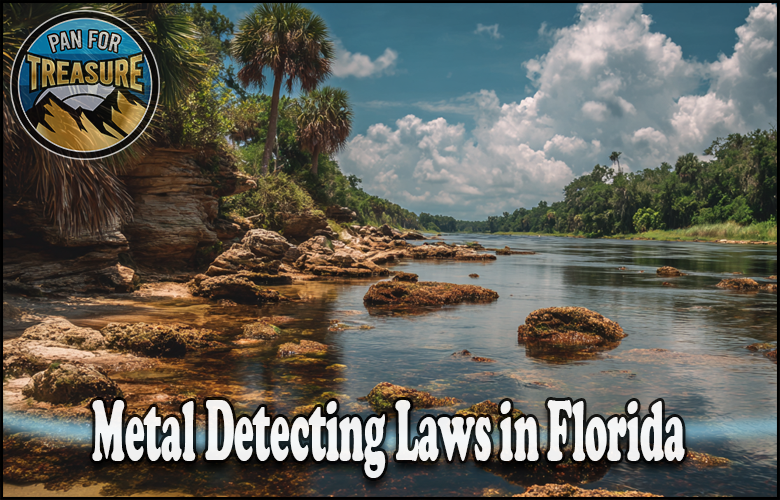
Metal Detecting Laws in Florida
Metal detecting laws in Florida involve state park rules, state ownership of historical artifacts, and a patchwork of county and city ordinances. Here is the breakdown by land type.
State Parks
The Florida Administrative Code states that metal detecting is prohibited on all state park lands, except for coastal parks. At coastal parks, detecting may occur within certain beach areas located between the toe of the dune and the high water line, as designated by the park manager. Metal detecting in submerged locations within state parks is not permitted.
Park managers have the authority to further restrict detecting and can prohibit it entirely at specific coastal parks. Always call ahead to the park you plan to visit to confirm: (1) whether detecting is currently allowed, (2) the exact boundaries of the permitted zone, and (3) whether digging to retrieve items is allowed.
Inland state parks (those with lake, river, or spring beaches) are not coastal parks, and metal detecting is not allowed at these locations.
Items with historic association (anything over 50 years old) found even in approved detecting zones may not be kept. Title to such objects is vested in the Florida Department of State’s Division of Historical Resources.
A metal detector may be used to recover a specifically identified lost personal item with the supervision of a park staff member.
Public Beaches (Non-State Park)
Most public saltwater beaches in Florida that are not part of state or federal parks allow metal detecting without a permit. This covers the vast majority of Florida’s beach detecting opportunities. However, local ordinances vary. Some things to know:
Most coastal counties and cities in Florida allow beach detecting. The Emerald Coast (Pensacola, Destin, Panama City Beach), Space Coast (Cocoa Beach, Melbourne), Treasure Coast (Vero Beach, Fort Pierce, Stuart), Gold Coast (Fort Lauderdale, Palm Beach area), and Southwest Gulf (Sarasota, Fort Myers, Naples) are all generally open.
Some cities restrict detecting near lifeguard towers, on manicured beach areas near hotels, or on sports turf adjacent to the beach. A few beach communities prohibit detecting by local ordinance; check for posted signs.
County Permits and Rules
Orange County (Orlando area) requires a metal detecting permit for county parks. The county issues a lifetime permit. Anything found must be reported to park staff, and historical or stolen items will be confiscated.
Marion County (Ocala area) requires a permit for metal detecting in county parks.
St. Johns County (St. Augustine area) has ordinances that prohibit removal of historical objects from county lands. Metal detecting is allowed on St. Johns County beaches, but not in Anastasia State Park, Fort Matanzas National Park, or the Guana Tolomato Matanzas National Estuarine Research Reserve.
Pinellas County prohibits metal detecting in county parks except on the beach. Clearwater Beach public beaches allow detecting.
Tallahassee area: Metal detecting is technically permitted in Leon County parks, but you cannot disturb the ground, which effectively prohibits recovery of finds.
Federal Lands
All National Park Service sites in Florida are completely off-limits, including beaches and waters adjacent to the park. This includes Canaveral National Seashore, Dry Tortugas, Biscayne, Everglades, Fort Caroline, Fort Matanzas, Castillo de San Marcos, De Soto, and Gulf Islands National Seashore (federal sections).
Military installations (Eglin, Patrick Space Force Base, Tyndall, etc.) have their own regulations and generally prohibit detecting. Contact the base public affairs office if you want to inquire.
State Waters and Submerged Land
All lands below the mean high water line in Florida are considered state sovereignty submerged lands. While possessing a metal detector in the water is not illegal, it IS illegal to disturb the bottom sediments. If you detect an item below the waterline, digging for it is technically a violation.
The Isolated Finds program, which previously allowed treasure hunters to keep individual finds from state waters, was ended on June 1, 2005. It is now against the law to recover anything in state waters more than 50 years old. Florida state waters extend 3 miles out on the East Coast, 9 miles on the Gulf Coast, and 12 miles from Key West.
Treasure salvage lease sites (such as those associated with the 1715 Spanish fleet) are off-limits to individual detectorists. You must stay at least 300 feet from active salvage dive boats and avoid the GPS coordinates of active leases.
Private Land
Metal detecting on private property requires explicit permission from the landowner. Unauthorized detecting on private property can result in trespassing charges. With permission, you can keep what you find per your agreement with the landowner. Note that Florida law (Chapter 267) technically claims state ownership of historical artifacts even on private land, though enforcement on private property is rare for individual hobbyists.
Turtle Nesting Season
From May through October, sea turtle nesting season restricts nighttime beach activities along much of Florida’s Atlantic coast, particularly in Brevard and Indian River counties. Artificial lighting is forbidden on the beach during this period. Plan your detecting sessions for daylight hours during these months.
Equipment and Rules Summary
| Land Type | Metal Detector Allowed? | Digging Allowed? | Permit/Permission | 50-Year Rule |
|---|---|---|---|---|
| Coastal State Park Beaches | Yes (toe of dune to high water line) | Check with park manager | Call park office first | Items 50+ years old are state property |
| Inland State Parks | No | No | N/A (prohibited) | N/A |
| Public Saltwater Beaches | Yes (most locations) | Yes (fill holes; no metal shovels in some areas) | Check local ordinances | Items 50+ years old are state property |
| County/City Parks | Varies by county | Varies; some prohibit ground disturbance | Some counties require permits | Items 50+ years old are state property |
| Federal Land (NPS) | No | No | N/A (prohibited) | N/A |
| State Waters (submerged land) | Detector possession OK; digging prohibited | No (disturbing sediments illegal) | N/A | Items 50+ years old may not be recovered |
| Private Land | Yes | Yes | Written landowner permission | Technically applies but rarely enforced |
For official state park rules, visit Florida State Parks FAQ. For historical resources law, see Florida Statutes Chapter 267.
Our Favorite Posts
Best Metal Detecting Locations in Florida
Florida’s massive coastline and tourism industry make it one of the top beach detecting destinations in the world.
- Treasure Coast beaches (Indian River, St. Lucie, Martin Counties) – Named for the 1715 Spanish Plate Fleet that wrecked offshore in a hurricane. After storms, Spanish silver coins (reales and escudos) and ship hardware still wash onto these beaches. The area between Sebastian Inlet and Fort Pierce is the most famous stretch. Stay off active salvage lease coordinates.
- Pensacola Beach (Escambia County) – No permit required. The Panhandle’s white sand beaches see heavy tourist traffic and produce steady jewelry and coin finds. Be aware of Gulf Islands National Seashore boundaries (federal land, no detecting).
- Panama City Beach (Bay County) – No permit required. No metal shovels allowed, and no holes bigger than two feet. One of the most heavily visited beaches in the Panhandle, producing reliable modern finds.
- Cocoa Beach and Melbourne Beach (Brevard County) – Space Coast beaches with heavy visitor traffic. Open to detecting. Watch for turtle nesting restrictions May through October. Cape Canaveral National Seashore is off-limits (federal).
- Clearwater Beach (Pinellas County) – Public beaches allow detecting. One of the Gulf Coast’s busiest beaches. Pinellas County parks prohibit detecting except on the beach itself.
- Jacksonville Beach and Amelia Island (Duval and Nassau Counties) – Permitted on public beaches. Jacksonville has miles of beach with moderate visitor traffic. Amelia Island has both a resort area and quieter stretches for less competition.
- Fort Lauderdale and Hollywood Beach (Broward County) – Heavily visited Gold Coast beaches. The high volume of beachgoers means consistent jewelry and coin drops. Early morning sessions before the crowds are most productive.
- Flagler County beaches (Flagler County) – No restrictions on metal detecting. Less crowded than beaches to the south, offering a balance of visitor-dropped finds and less competition.
- Sanibel Island and Fort Myers Beach (Lee County) – Gulf coast beaches with shell-rich sand. Good for jewelry and coin hunting. Sanibel draws both tourists and shell collectors, creating regular opportunities for finds.
- St. Augustine area beaches (St. Johns County) – Detecting is allowed on St. Johns County beaches, but local ordinances restrict removal of historical objects from county land. Stay out of Anastasia State Park and Fort Matanzas. The area’s 450+ years of Spanish colonial history make historical finds possible.
Visit our best locations to find gold guide and our gold prospecting with metal detectors guide for more locations.
Florida’s Treasure History and What You Might Find
Florida’s treasure history is legendary. In 1715, a fleet of 11 Spanish treasure ships loaded with gold, silver, and jewels was caught in a hurricane off Florida’s east coast. The fleet sank between modern-day Sebastian Inlet and Fort Pierce, scattering millions of dollars worth of treasure across the ocean floor. Pieces of eight, gold escudos, and ship fittings still wash ashore after strong storms. Licensed salvage operations continue to recover items from the wreck sites.
The state’s tourist beaches are among the most productive detecting environments in the country. Florida beaches see an estimated 100+ million visitors per year, and a percentage of those visitors lose rings, chains, earrings, watches, and coins in the sand and surf. The sheer volume of lost items makes Florida a consistent producer for beach detectorists.
Beyond the beaches, Florida has a long colonial history. St. Augustine, founded by the Spanish in 1565, is the oldest continuously occupied European settlement in the United States. Pensacola was settled by the Spanish in 1559. Seminole War sites, Civil War encampments, and old Florida Cracker homesteads are scattered across the state’s interior.
Florida’s freshwater systems also have detecting potential, though the laws are stricter. Old river crossings, ferry sites, and springs where people gathered for centuries can produce finds on private land with permission.
Recommended Reading
Tips for Metal Detecting in Florida
- Detect at low tide for the best results. Florida’s tidal beaches reveal more detectable targets at low tide, especially in the wet sand zone between the high and low tide lines. Check tide charts and plan your sessions around low tide.
- Hunt after storms. Hurricanes, tropical storms, and strong northeasters strip sand from beaches and expose items that were previously out of reach. The first calm day after a major storm is prime time. The Treasure Coast is especially productive post-storm.
- Go early. Florida’s busiest beaches have a community of regular detectorists. The early bird gets the finds. Sunrise sessions before the beach fills up are standard practice for serious Florida detectorists.
- Watch for turtle nesting season. May through October on most Atlantic beaches. Artificial light is prohibited on the beach at night in many counties. Daytime detecting is fine, but night hunting is restricted in turtle nesting areas.
- Use a waterproof detector. Florida beach detecting often involves working the wet sand and shallow surf zone, which is where the best targets accumulate. A fully waterproof machine lets you follow the targets into the water.
- Know the 50-year rule. Any item over 50 years old found on public land in Florida is legally state property. If you find something clearly old (a Spanish coin, a Civil War buckle, an old ship fitting), photograph it, note the location, and contact the Division of Historical Resources. On private land, the practical enforcement is different, but the law technically applies.
- Avoid treasure salvage lease zones. The 1715 fleet salvage sites along the Treasure Coast are actively leased. Detecting within 300 feet of a dive boat or within the GPS coordinates of a lease site can result in serious legal trouble. Know where the lease boundaries are.
- Stay off federal beaches. National Parks, National Seashores, and military installation beaches are off-limits. The boundary between a public city beach and a national park beach is not always obvious. Know exactly where the federal boundary starts.
- Fill every hole and leave no trace. Florida beach communities are generally welcoming to detectorists because most follow good etiquette. Leaving holes on the beach is the fastest way to get detecting banned at a specific location.
- Check local ordinances before every new beach. Florida’s patchwork of county and city rules means the regulations can change from one stretch of beach to the next. A quick call to the local parks department or visitor center takes five minutes and can save you a fine.
For technique guidance, see our techniques guide, our tools and equipment guide, and our tips and tricks page.
Resources
- Florida State Parks FAQ – Official rules on metal detecting in state parks, beach zone definitions, and contact information for individual parks.
- Florida Division of Historical Resources, Bureau of Archaeological Research – Information on the 50-year rule, artifact reporting, and state waters regulations.
- Visit Florida – The state’s official tourism website maintains a metal detecting guide with county-by-county contact information and rules.
- FWC Sea Turtle Conservation – Turtle nesting season dates, beach lighting rules, and county-specific restrictions that affect nighttime detecting.
- Florida Statutes Chapter 267 – Historical Resources – Full text of the law governing ownership of historical artifacts found in Florida.
Conclusion
Metal detecting laws in Florida are more permissive than most states when it comes to beach detecting. The combination of massive coastline, heavy tourism, warm weather, and Spanish treasure history makes Florida arguably the best beach detecting state in America. Just remember the 50-year rule, stay off federal land, and check local ordinances at each new beach.
The Treasure Coast lives up to its name after storms, and the state’s resort beaches produce a steady supply of modern jewelry and coins year-round. Florida rewards detectorists who put in the time to learn the rules and show up early.
Explore nearby state guides: metal detecting laws in Georgia, metal detecting laws in Alabama, and metal detecting laws in South Carolina. See the full state-by-state metal detecting laws directory.
Frequently Asked Questions – FL Metal Detecting Laws
Can I metal detect on Florida beaches without a permit?
Yes, most public saltwater beaches in Florida allow metal detecting without a permit. Local ordinances vary, so check with the city or county parks department for your specific beach. Some counties (Orange, Marion) require permits for county parks. State park beaches are a special case: detecting is allowed between the toe of the dune and the high water line at coastal parks, but call the park office first to confirm.
What is the 50-year rule in Florida?
Under Florida Statutes Chapter 267, any object with historic association (defined as anything over 50 years old) found on public land is considered state property. Title to such items is vested in the Florida Department of State’s Division of Historical Resources. The Isolated Finds program, which previously allowed hobbyists to keep individual finds, was ended on June 1, 2005. If you find something clearly old on public land, do not keep it. Report it to the appropriate authorities.
Can I metal detect in the water on Florida beaches?
Possessing a metal detector in Florida waters is not illegal. However, disturbing bottom sediments in state waters (which include all submerged land) is against the law. This creates a gray area: you can detect in the water, but digging to recover a find from below the sediment line is technically a violation. Within state parks, detecting in submerged locations is explicitly prohibited. Many beach detectorists work the shallow surf zone where wave action naturally uncovers items.
Can I keep Spanish treasure coins found on Florida beaches?
Items over 50 years old found on public land in Florida are state property under Chapter 267. Spanish coins from the 1715 fleet wreck are well over 50 years old and are claimed by the state. If you find a Spanish coin on a public beach, you should report it to the Division of Historical Resources. On private land with owner permission, the legal situation is less clear, but the state technically claims ownership of historical artifacts regardless of where they are found.
Where can I NOT metal detect in Florida?
Metal detecting is prohibited in all National Park Service sites (Canaveral National Seashore, Dry Tortugas, Biscayne, Everglades, Fort Matanzas, Castillo de San Marcos, and others), including adjacent beaches and waters. Inland state parks are off-limits. Treasure salvage lease zones along the Treasure Coast are restricted. Some county parks prohibit detecting or ground disturbance. Always verify before detecting at any new location.
What is the best time of year to metal detect in Florida?
Florida can be detected year-round, which is one of its biggest advantages. The most productive periods are right after tropical storms or hurricanes (typically August through November) when storm surge strips beach sand and exposes buried items. Winter months (December through March) bring snowbird tourists who lose items on the beach, plus fewer competing detectorists. Summer is busy and hot but produces steady finds due to peak tourist season. Avoid nighttime beach detecting May through October in turtle nesting areas.
⛏ Recommended Gear ⛏


* As an Amazon Associate I earn from qualifying purchases at no extra cost to you.
Subscribe to Our Newsletter

Ryan Conlon is the founder of Pan for Treasure.
A lifelong gold panning enthusiast, he created this site to help beginners learn the ropes and share practical tips from his own time on the creek. [email protected]