Understanding Alabama’s metal detecting rules
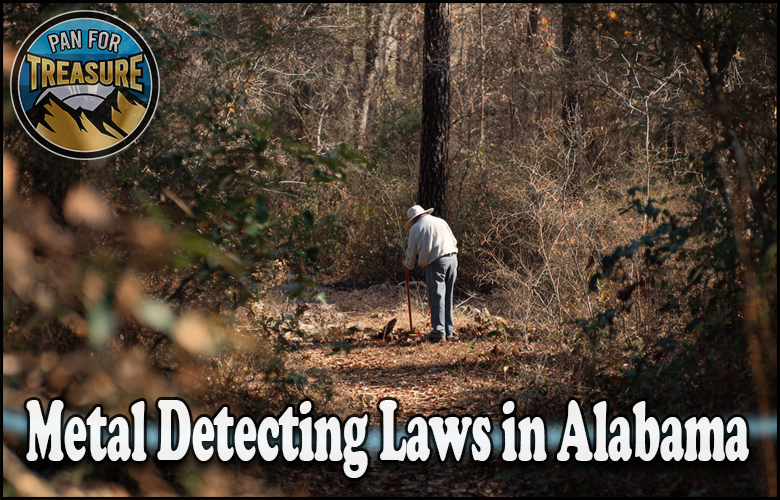
Metal detecting laws in Alabama can be tricky to sort out, but once you understand the rules, the Yellowhammer State offers some exciting opportunities for treasure hunters. Alabama has a layered set of regulations that vary depending on whether you’re searching on state parkland, federal property, beaches, or private land.
Alabama’s rich history as the birthplace of the Confederacy, combined with its Gulf Coast beaches and hundreds of ghost towns, makes it a magnet for detectorists. Civil War relics, lost jewelry, old coins, and even gold nuggets have all been pulled from Alabama soil over the years. But before you start swinging your detector, you need to know where you can legally hunt and what permits you might need.
If you’re brand new to the hobby, check out our getting started with metal detecting guide before heading out. Knowing the basics of equipment, technique, and etiquette will save you time and keep you out of trouble.
TL;DR
- State Parks: Metal detecting is prohibited without written permission from the Park Manager (Alabama Admin Code 220-5-.08)
- Federal Land: Banned on all National Parks, Monuments, and NPS sites under the Archaeological Resources Protection Act (ARPA)
- Beaches: Public Gulf Coast beaches like Gulf Shores and Orange Beach are generally open for detecting
- Private Land: Legal with written landowner permission; you keep what you find (subject to any agreement)
- Aboriginal Sites: Strictly off-limits under Alabama Code Title 41, Chapter 3; violations carry fines up to $1,000
- Best Strategy: Focus on public beaches, private land with permission, and areas near (but not on) historic sites
Birthplace of the Confederacy; major Civil War battle sites throughout the state
60 miles of Gulf Coast beaches across Baldwin and Mobile counties
Gulf Shores / Baldwin County coast for jewelry and coins
Written Park Manager approval for state parks; none for most public beaches
Prohibited without permission; some swimming beaches may allow it on request
Aboriginal mounds and earthworks fully protected; $1,000 fine per offense (Code of Alabama 41-3-6)
Featured
Metal Detecting Laws in Alabama
Understanding metal detecting laws in Alabama means looking at several layers of regulation. Federal law, state law, and local ordinances all play a role in where and how you can use your detector. Here is the breakdown by land type.
State Parks
Alabama’s state park rules are spelled out in the Alabama Administrative Code (Rule 220-5-.08, Section 4). The regulation states that it is unlawful for any person to use any metal detection device in any State Park for the purpose of finding and removing items that are not personal possessions without permission from the Park Manager.
In practice, this means metal detecting is effectively banned in all Alabama state parks unless you obtain written permission first. Some parks, particularly those with swimming beaches, have been known to grant permission for beach-only detecting. However, parks designated as historic (such as DeSoto State Park and Tannehill Ironworks Historical State Park) are much less likely to allow any detecting at all.
Always call ahead or visit the park office in person before bringing your detector. Permission is granted at the Park Manager’s discretion, and it can vary from park to park.
Federal Land
The Archaeological Resources Protection Act (ARPA) of 1979 (16 U.S.C. 470aa-470mm) prohibits the excavation, removal, or damage of archaeological resources on federal and Native American lands. This law applies across the entire United States, and Alabama is no exception.
You cannot metal detect in any National Park, National Monument, National Recreation Area, or any site managed by the National Park Service. In Alabama, this includes places like Horseshoe Bend National Military Park and the Tuskegee Airmen National Historic Site.
On U.S. Forest Service land (like the Talladega National Forest), recreational metal detecting may be allowed in some cases, but removing artifacts over 100 years old is strictly prohibited. Check with the local ranger district before detecting on any national forest land.
Bureau of Land Management (BLM) land in Alabama is extremely limited, but the same federal rules apply. The U.S. Army Corps of Engineers allows metal detectors on designated beaches and previously disturbed areas unless the District Commander has posted otherwise (36 CFR 327.14).
Private Land
Private land is where Alabama detectorists have the most freedom. With written permission from the landowner, you are free to detect and keep whatever you find (unless your agreement with the landowner says otherwise). ARPA does not apply to private property.
Get your permission in writing. A simple written agreement that spells out who keeps what and any conditions (like filling holes and not damaging landscaping) protects both you and the landowner.
Many of Alabama’s best Civil War relic hunting spots are on private land near historic battle sites. Areas around former plantations and old homesteads can also be productive, as families often buried valuables during the war.
Beaches
Alabama’s Gulf Coast beaches are among the most popular detecting spots in the state. Public beaches in Gulf Shores, Orange Beach, Dauphin Island, and Fort Morgan are generally open to metal detecting without a permit, though you should always check with local authorities first.
If a beach is within a state park boundary (like Gulf State Park), you need Park Manager permission. Beaches managed by the U.S. Army Corps of Engineers allow detecting on designated beach areas unless specifically posted as off-limits.
Aboriginal and Archaeological Sites
Alabama law (Code of Alabama Title 41, Chapter 3, Sections 41-3-1 through 41-3-6) reserves the exclusive right to the state to explore and excavate aboriginal mounds, earthworks, and other antiquities. Violating this law is a misdemeanor with fines up to $1,000 per offense.
Any objects removed from aboriginal sites must remain in state custody. This is a firm line. Do not detect on or near known Native American sites, burial grounds, or any land with archaeological significance.
Equipment Rules
| Land Type | Metal Detector Allowed? | Digging Allowed? | Permit/Permission Required? | Artifacts (100+ Years) |
|---|---|---|---|---|
| Public Beaches (non-park) | Yes | Yes (fill holes) | Check local rules | Report to authorities |
| State Parks | Only with Park Manager permission | Limited; at manager’s discretion | Yes, written permission | Must be reported; may be retained by state |
| National Parks / NPS Sites | No | No | N/A (prohibited) | N/A (prohibited) |
| National Forests (USFS) | Possibly; check with ranger district | Surface collecting may be okay | Contact local ranger district | Removal prohibited under ARPA |
| Private Land | Yes | Yes (with landowner agreement) | Written landowner permission | Finder keeps (per agreement) |
For official information on Alabama state park rules, contact the Alabama State Parks Division. For federal land questions, reach out to the USDA Forest Service, National Forests in Alabama.
Our Favorite Posts
- Metal Detecting Laws in Kentucky – Public Land, Parks, and Beach Rules
- Metal Detecting Laws and Regulations
- Metal Detecting Laws in Colorado – Public Land, Parks, and Beach Rules
- Metal Detecting Laws in Pennsylvania – Public Land, Parks, and Beach Rules
- Metal Detecting Laws in Wyoming – Public Land, Parks, and Beach Rules
Best Metal Detecting Locations in Alabama
Alabama has no shortage of places to swing a detector. Here are the top spots, ranked by what detectorists consistently report finding.
- Gulf Shores Public Beach (Baldwin County) – The busiest tourist beach in Alabama. High foot traffic means plenty of lost jewelry, coins, and sunglasses. Detecting is generally allowed on the public beach areas. Best after storms and at low tide.
- Orange Beach (Baldwin County) – Another heavily visited Gulf Coast destination with over 27 miles of white sand. The towel line area, where beachgoers set up for the day, is especially productive for finding dropped items.
- Dauphin Island Public Beach (Mobile County) – A barrier island off Alabama’s coast with a long history. Fort Gaines, a Civil War-era fort, is nearby. The beach itself can produce coins, relics, and Civil War-era items.
- Fort Morgan Beach (Baldwin County) – Located at the western tip of the Fort Morgan peninsula. The area’s history tied to the Battle of Mobile Bay makes it exciting for relic hunters, though the fort grounds themselves are off-limits.
- Cotton Bayou Beach (Baldwin County) – A quieter stretch of Orange Beach that sees less competition from other detectorists. The fine white sand is easy to dig, and the area produces modern coins and jewelry.
- Alabama Point Beach / Perdido Pass (Baldwin County) – Where Mobile Bay meets the Gulf of Mexico. Strong currents churn up items, especially after storms. Permits may be required; check with local officials.
- Private Land near Civil War Sites (Various Counties) – Areas surrounding (not on) battlefields like the Battle of Mobile Bay, Battle of Selma, and the many skirmishes across north Alabama produce buttons, buckles, musket balls, and other military relics. Always get written landowner permission.
- Old Ghost Towns (Various Counties) – Alabama has hundreds of abandoned towns from the mining era and other periods. Bullock County, Clarke County, and St. Clair County all have documented ghost town sites. Permission from the current landowner is required.
- Rivers and Creeks (Various Counties) – The Tennessee River in Lawrence County, Sipsey Fork of the Black Warrior River, and smaller creeks across the state can produce old coins, relics, and even small gold. Use a waterproof detector.
- Old Homesteads and Plantation Sites (Various Counties) – During the Civil War, many Alabama families buried their valuables to hide them from Union troops. Former plantation fields and old homestead locations on private land can be extremely productive.
For more great spots across the country, visit our best places to metal detect in America guide.
Alabama’s History and What You Might Find
Alabama has been inhabited for thousands of years, beginning with Native American peoples long before European contact. Spanish explorers arrived in the early 1500s, followed by French and British colonists. The state became the 22nd state in 1819 and played a major role in the Civil War as the original capital of the Confederacy.
That layered history is exactly what makes Alabama so appealing to detectorists. Civil War relics are the state’s biggest draw. Belt buckles, uniform buttons, bayonets, musket balls, canteens, and artillery fragments have all been found on private land near battle sites. Some hobbyists have even reported finding complete rifles and swords.
Alabama’s Gulf Coast has its own treasure hunting history. The state’s coastline was once frequented by pirates, and local legends speak of buried treasure from that era. While most pirate treasure stories lack solid evidence, the area’s history of shipwrecks and maritime activity means that old coins and artifacts do turn up on the beaches.
Gold prospecting is also possible in Alabama. The state’s gold belt runs from Chilton County northeast to the Georgia state line, passing through Cleburne, Clay, Randolph, and Tallapoosa counties. While gold finds are modest compared to western states, small nuggets and flakes have been found using metal detectors in this region. Check out our page on gold panning laws in Alabama for more details. Our gold prospecting with metal detectors guide covers equipment and technique for nugget hunting.
Buried treasure legends abound in Alabama. One of the more plausible stories involves Confederate soldiers who allegedly buried around $100,000 in two metal boxes near Athens in Limestone County in 1865. Another tale centers on Henry Nunez, a ferry operator who supposedly buried a large sum of cash near the Perdido River during the Civil War.
Recommended Reading
Tips for Metal Detecting in Alabama
- Hunt after storms. Hurricanes and tropical storms churn up the Gulf Coast seabed and deposit items on the beach that have been buried for years. The period right after a storm passes is prime detecting time.
- Use a saltwater-capable detector on beaches. Alabama’s Gulf Coast salt water causes false signals on many standard detectors. Multi-frequency machines like the Minelab Equinox series handle salt mineralization well.
- Get permission in writing, always. Whether it’s a state park manager or a private landowner, having written permission protects you if questions come up later. A simple handwritten note with both signatures works.
- Focus on the towel line at beaches. The strip of sand where beachgoers lay out their towels and chairs is where most items are lost. Rings slip off sunscreened fingers, coins fall out of pockets, and earrings drop into the sand.
- Research Civil War troop movements. Not every battle site is a designated historic area. Soldiers camped, marched, and skirmished across wide areas. Private land adjacent to documented battle sites can be just as productive as the battlefields themselves.
- Join a local club. Alabama has active metal detecting clubs across the state, including groups in Birmingham, Huntsville, Mobile, and Dothan. Club members share location tips, help identify finds, and some clubs even assist law enforcement with evidence searches.
- Fill your holes. This is the number one rule of detecting etiquette. Unfilled holes on public land are the fastest way to get detecting banned at a location. Leave the ground better than you found it.
- Check for city and county ordinances. Metal detecting rules can vary from one city to the next. Some municipalities require permits, others ban detecting in certain parks, and a few have no restrictions at all. A quick call to the local parks department can save you a lot of hassle.
- Bring a pinpointer. Alabama’s red clay soil and beach sand can make target recovery slow without a pinpointer. A good one will cut your dig time in half.
- Learn your detector’s tones for the area. Alabama soil conditions vary widely, from heavy red clay in the Piedmont region to sandy loam on the coast. Spend time at a test site learning how your detector responds to different targets in the local ground.
For a deeper look at recovery methods, see our metal detecting techniques guide.
Metal Detecting Laws
- Metal Detecting Laws in Wyoming – Public Land, Parks, and Beach Rules
- Metal Detecting Laws in Wisconsin – Public Land, Parks, and Beach Rules
- Metal Detecting Laws in West Virginia – Public Land, Parks, and Beach Rules
- Metal Detecting Laws in Washington – Public Land, Parks, and Beach Rules
- Metal Detecting Laws in Virginia – Public Land, Parks, and Beach Rules
Resources
- Alabama State Parks – Contact individual parks for metal detecting permission requests. Each park manager makes their own decision on whether to allow detecting.
- Geological Survey of Alabama – Geology maps, mineral resources, and information about Alabama’s gold belt and soil types that affect detecting conditions.
- National Forests in Alabama (USFS) – Rules and contact information for the Talladega, Conecuh, Tuskegee, and William B. Bankhead National Forests.
- Gold Prospectors Association of America (GPAA) – Membership gives access to claims and outings, including some in the southeastern U.S. A good resource for detectorists interested in gold hunting.
- Federation of Metal Detector and Archaeological Clubs (FMDAC) – National organization that tracks state regulations and advocates for hobby detectorists’ rights.
Conclusion
Metal detecting laws in Alabama require some homework, but the payoff is worth it. The state’s Civil War history, Gulf Coast beaches, ghost towns, and buried treasure legends give detectorists a wide range of targets and locations to explore. The key is knowing which land you’re standing on and what rules apply.
Stick to public beaches where detecting is allowed, get written permission for private land, and always check with park managers before bringing your detector into any state park. Avoid aboriginal sites, historic designations, and all National Park Service property.
Ready to explore neighboring states? Check out our guides for metal detecting laws in Mississippi, metal detecting laws in Tennessee, metal detecting laws in Georgia, and metal detecting laws in Florida. You can also browse our complete state-by-state metal detecting laws directory.
Frequently Asked Questions – AL Metal Detecting Laws
Is metal detecting legal in Alabama?
Yes, metal detecting is legal in Alabama, but it comes with restrictions depending on where you detect. Public beaches are generally open, private land requires landowner permission, and state parks require written approval from the Park Manager. Federal land managed by the National Park Service is off-limits under ARPA. Always check local city and county ordinances before heading out, as rules can vary by municipality.
Can I metal detect in Alabama state parks?
Metal detecting in Alabama state parks is prohibited unless you receive written permission from the Park Manager (Alabama Admin Code 220-5-.08). Some parks with swimming beaches have been known to grant permission for beach-area detecting only. Parks designated as historic sites are unlikely to grant any permission. Call the specific park office before your visit to ask about their policy.
Do I need a permit to metal detect on Alabama beaches?
Most public beaches along Alabama’s Gulf Coast do not require a formal permit for metal detecting. However, if the beach falls within a state park boundary (like Gulf State Park), you do need Park Manager permission. Beaches on U.S. Army Corps of Engineers land are open to detecting unless specifically posted otherwise. Always check with local authorities, as some municipalities may have their own permit requirements.
What happens if I find something old while metal detecting in Alabama?
On federal or state land, artifacts over 100 years old are protected by ARPA and state antiquities laws. Removing them without authorization is a criminal offense. On private land, the laws are more relaxed. Items found on private property generally belong to the landowner (or to you, depending on your agreement). If you find anything that appears to be of archaeological significance, report it to the Alabama Historical Commission at (334) 242-3184.
Where are the best places to metal detect in Alabama?
The Gulf Coast beaches (Gulf Shores, Orange Beach, Dauphin Island, Fort Morgan) are consistently the most popular and productive public detecting spots. For Civil War relics, private land near documented battle sites across north and central Alabama offers the best chances. Old ghost towns, river banks, and former plantation sites on private property are also worth investigating. Research your target area’s history before you go.
Can I keep what I find metal detecting in Alabama?
On private land with the owner’s permission, yes. Whatever you find is generally yours to keep (or the landowner’s, depending on your agreement). On public land, the rules are stricter. Items found in state parks may need to be reviewed by park staff and could be retained by the state, especially if they appear to be personal belongings or have historical value. On federal land, removing artifacts is prohibited. Modern items like recent coins found on public beaches are yours to keep in most cases.
⛏ Recommended Gear ⛏


* As an Amazon Associate I earn from qualifying purchases at no extra cost to you.
Subscribe to Our Newsletter

Ryan Conlon is the founder of Pan for Treasure.
A lifelong gold panning enthusiast, he created this site to help beginners learn the ropes and share practical tips from his own time on the creek. [email protected]