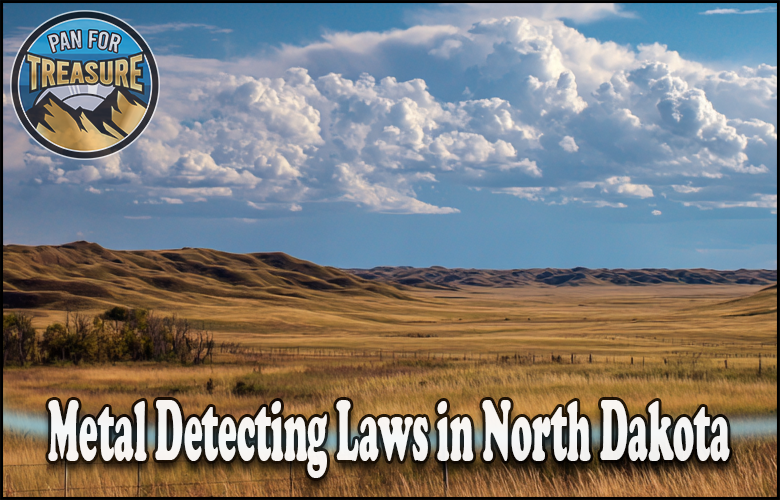
Metal detecting laws in North Dakota are restrictive on public land. As a general rule, metal detectors are not allowed in state parks, although some park managers may grant limited permission to use them.
The state prohibits recreational treasure hunting on public land, and digging is typically not permitted even where limited detecting access is granted.
North Dakota’s frontier fur trade, military history (frontier forts along the Missouri River), and homestead settlement era make private land detecting productive.
Like neighboring Nebraska (cannot even carry a detector in most state parks) and Minnesota (lost items only with supervision), North Dakota pushes the hobby onto private property.
New to the hobby? Start with our beginner’s guide to gold panning and prospecting.
TL;DR
- State Parks: Generally prohibited; some park managers may grant limited permission; recreational treasure hunting not allowed
- Digging: Typically prohibited on public land even where limited detecting permission is granted
- National Grasslands: Little Missouri and other national grasslands may allow casual detecting in developed areas; check with Forest Service
- NPS Sites: Theodore Roosevelt National Park, Knife River Indian Villages, and Fort Union Trading Post all off-limits
- Private Land: Primary option; fur trade, military, and homestead history; written landowner permission required
- History: Lewis and Clark, fur trade, frontier forts, Custer’s trail, homesteaders, Bonanza farms
Generally prohibited; limited manager discretion
Recreational detecting effectively prohibited
Private land with written permission
Lewis & Clark, fur trade (1800s), frontier forts, homesteaders
Little Missouri, Sheyenne, and others (casual detecting possible)
Fort Abraham Lincoln, Fort Mandan, Fort Union, Fort Buford
Metal Detecting Laws in North Dakota
Metal detecting laws in North Dakota are straightforwardly restrictive on public land. Here is the breakdown.
State Parks (Generally Prohibited)
As a general rule, metal detectors are not allowed in North Dakota state parks. Some park managers may grant limited permission, typically for searching for a lost personal item rather than recreational treasure hunting. Contact the specific park before visiting if you have a specific need. Do not assume any state park is open to detecting.
National Grasslands
North Dakota has several national grasslands managed by the USFS: Little Missouri, Sheyenne, and portions of others. General Forest Service policy allows recreational detecting in developed areas. ARPA restrictions apply. Contact the Dakota Prairie Grasslands office for current policy. These federal lands may represent the best public detecting option in North Dakota.
NPS Sites (Prohibited)
All NPS sites are off-limits: Theodore Roosevelt National Park (North and South Units), Knife River Indian Villages National Historic Site, and Fort Union Trading Post National Historic Site.
Army Corps of Engineers Land
North Dakota has several Army Corps reservoir projects along the Missouri River (Lake Sakakawea, Lake Oahe, Lake Darling). Corps land policies vary by project. Contact the specific Corps office for metal detecting rules.
Private Land
Private land with written landowner permission is the primary option. ARPA does not apply. North Dakota is predominantly private agricultural land. The state’s Lewis and Clark, fur trade, frontier military, and homestead history makes private land detecting productive.
North Dakota’s Bonanza farms of the 1870s-1890s (massive wheat operations) left domestic items across the Red River Valley. Old homestead sites, frontier stage stops, and military road corridors on private land are productive detecting locations.
Rules Summary
| Land Type | Detecting Allowed? | Permit/Permission | Artifacts |
|---|---|---|---|
| State Parks | Generally no; limited manager discretion | Contact park manager | State property on public land |
| National Grasslands | Developed areas possibly | Check with Dakota Prairie office | ARPA restrictions |
| NPS Sites | No | N/A (prohibited) | N/A |
| Corps of Engineers Land | Varies by project | Contact specific Corps office | Varies |
| Private Land | Yes | Written landowner permission | Finder keeps (per agreement) |
For state parks, visit ND Parks and Recreation. For archaeology, see the ND State Archaeologist.
Our Favorite Posts
Best Metal Detecting Locations in North Dakota
- Fort Abraham Lincoln area private land (Morton County) – Custer’s last post before the Little Bighorn expedition (1876). The state park is likely off-limits, but private land near the fort and along military roads produces frontier military artifacts.
- Missouri River corridor private land (various counties) – The Lewis and Clark expedition traveled the Missouri in 1804-1806. Fur trade posts, military forts, and steamboat landings lined the river. Private land near old river sites is productive.
- Red River Valley farmland (Cass, Richland, Grand Forks Counties) – The Bonanza farm era (1870s-1890s) created massive wheat operations. Old farm sites and early settlement communities on private land produce homestead-era items.
- Bismarck / Mandan area (Burleigh, Morton Counties) – The state capital area has deep frontier and railroad history. Private yards and properties (with permission) in older neighborhoods produce late 1800s items.
- Little Missouri National Grassland (various western counties) – Over 1 million acres of USFS-managed grassland. Developed recreation areas may allow casual detecting. Frontier ranching and Teddy Roosevelt-era history in the badlands.
- Old Crossing Treaty area (Polk County) – Site of the 1863 treaty between the US and Red Lake and Pembina Ojibwe. Private land near old treaty and trading sites has frontier-era history. Respect Native American cultural sensitivity.
- Fargo / Moorhead area (Cass County) – The state’s largest city has settlement history from the 1870s. City parks (check local rules) and private properties in older neighborhoods produce coins and personal items.
- Stage road corridors (various counties) – Pre-railroad stage routes crossed North Dakota. Old stage stops, river crossings, and military road corridors on private land produce frontier-era items. County historical societies identify specific routes.
See our best locations to find gold guide and state-by-state directory.
North Dakota’s History and What You Might Find
North Dakota’s European history begins with French-Canadian fur traders in the 1700s. The Lewis and Clark expedition wintered at Fort Mandan (near present-day Washburn) in 1804-1805. The fur trade established posts along the Missouri River, including Fort Union (1828) and Fort Buford (1866).
The military frontier brought forts along the Missouri (Fort Abraham Lincoln, 1872, from which Custer departed for the Little Bighorn in 1876). The railroad arrived in the 1870s, triggering rapid settlement. The Bonanza farm era (1870s-1890s) saw massive wheat operations across the Red River Valley. Statehood came in 1889.
Common private land finds include frontier military buttons and cartridge casings, fur trade-era items (buttons, buckles, trade goods), homestead-era coins and domestic items, railroad-era artifacts, and Bonanza farm-era personal items. Indian Head pennies and early silver coins are found on old homestead sites. North Dakota has no significant gold deposits.
Recommended Reading
Tips for Metal Detecting in North Dakota
- Focus on private land. Public land options are extremely limited. Build relationships with farmers and ranchers, especially along the Missouri River corridor and in the Red River Valley.
- Research frontier fort locations. The documented locations of frontier forts, supply routes, and military roads on private land are prime detecting targets. State historical society resources identify these sites.
- Detect in summer and early fall. North Dakota’s harsh winters (November through March) and late spring thaws limit the detecting season to roughly May through October. Summer provides the longest days.
- Try national grasslands with Forest Service approval. The Little Missouri National Grassland and other USFS grasslands may allow casual detecting in developed areas. Contact the Dakota Prairie Grasslands office.
- Target Bonanza farm sites in the Red River Valley. The massive farm operations of the 1870s-1890s left domestic items across the valley. Old plat maps and county histories identify farm headquarters and worker housing sites.
- Respect Native American sites. North Dakota has significant Mandan, Hidatsa, Arikara, Lakota, and Ojibwe cultural heritage. Never detect on or near Native American sites, even on private land.
- Watch for extreme weather. North Dakota has hot summers and severe thunderstorms. Carry water, sun protection, and have a plan for sudden weather changes.
- Join a local club. Given the restrictive public land rules, the North Dakota detecting community shares private land access and productive locations through club networks.
For technique help, see our techniques guide and tips and tricks.
Resources
- ND Parks and Recreation Department – State park information and contact details.
- State Historical Society of North Dakota – Historical resources, frontier fort records, and archaeological site information.
- Dakota Prairie Grasslands (USFS) – National grassland information and supervisor contacts.
- National Park Service – North Dakota – NPS sites where detecting is prohibited.
Conclusion
Metal detecting laws in North Dakota restrict the hobby on public land but leave private property accessible. The state’s Lewis and Clark heritage, fur trade posts, frontier military forts, and Bonanza farm era create a unique detecting landscape focused entirely on private landowner relationships.
Build those relationships, research the Missouri River corridor and Red River Valley, and respect the cultural heritage. North Dakota rewards patient, research-driven detectorists with frontier-era finds.
Explore nearby state guides: metal detecting laws in South Dakota, metal detecting laws in Montana, metal detecting laws in Minnesota, and metal detecting laws in Nebraska. See the full state-by-state metal detecting laws directory.
Frequently Asked Questions – ND Metal Detecting Laws
Can I metal detect in North Dakota state parks?
Generally no. Metal detectors are not allowed in state parks as a rule. Some park managers may grant limited permission, typically for lost items rather than treasure hunting. Always contact the specific park before visiting.
Where can I legally detect in North Dakota?
Private land with written landowner permission is the primary option. National grasslands may allow casual detecting in developed areas. State parks are generally prohibited. NPS sites are off-limits.
What can I find metal detecting in North Dakota?
Frontier military artifacts near fort sites, fur trade items, homestead-era coins and domestic items, Bonanza farm-era artifacts, and railroad-era items. All on private land with permission. North Dakota has no gold deposits.
Can I detect near frontier forts?
Fort Abraham Lincoln is a state park (likely off-limits). Fort Union and Knife River are NPS (off-limits). Private land near fort sites and along military roads is where frontier military finds come from.
How does North Dakota compare to neighboring states?
Minnesota is similarly restrictive (lost items only). Nebraska is even stricter (no carrying detectors in parks). South Dakota and Montana offer more federal land options. North Dakota’s best asset is its frontier military and fur trade history on private land.
Is there gold in North Dakota?
North Dakota has no significant gold deposits. Detecting focuses on coins, relics, and historical artifacts from the frontier and homestead eras.
⛏ Recommended Gear ⛏


* As an Amazon Associate I earn from qualifying purchases at no extra cost to you.
Subscribe to Our Newsletter

Ryan Conlon is the founder of Pan for Treasure.
A lifelong gold panning enthusiast, he created this site to help beginners learn the ropes and share practical tips from his own time on the creek. [email protected]