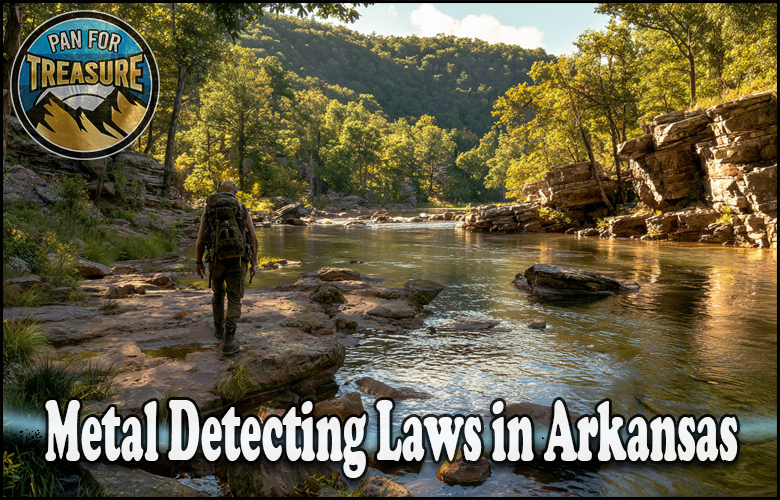
Metal detecting laws in Arkansas are friendlier than many states, with several state parks actively allowing detecting on their public swimming beaches during the off-season.
Arkansas is a landlocked state with a deep Civil War history, Ozark Mountain ghost towns, and some surprisingly productive hunting grounds for detectorists of all experience levels.
The Natural State has clear rules for state park detecting laid out in State Park Directive 3225, including specific parks, hours, seasons, digging tool limits, and found property procedures.
Outside the parks, private land with permission, BLM land, and national forest areas offer additional opportunities. Civil War relics, old coins, and lost jewelry are the primary targets.
Just getting into the hobby? Start with our getting started with metal detecting guide to learn the basics before you head to the field.
TL;DR
- State Parks: Allowed on designated public swimming beaches at 9 specific parks, off-season only (day after Labor Day through weekend before Memorial Day), 8 AM to 5 PM
- Registration Required: Detectorists must complete a registration form and carry it while detecting in state parks
- Digging Limits: Tools limited to probes no wider than 2 inches and sand scoops no wider than 6 inches; holes must be 6 inches or less and immediately refilled
- Found Property: Valuables left at park office for 30 days per Arkansas Lost and Found laws; coins in circulation are exempt
- Federal Land: National Parks and battlefields are off-limits; BLM land allows detecting with no artifact removal
- Private Land: Legal with written landowner permission; most productive option for Civil War relic hunting
Major Civil War battlefields (Pea Ridge, Prairie Grove); Trail of Tears route; frontier settlement era
Ozark Mountains, river valleys, delta lowlands; varied soil from rocky uplands to sandy bottomlands
Northwest Arkansas (Civil War sites); Village Creek State Park; Gulf Coast-style lake beaches
Free registration form at state parks; local permits may be required for city/county parks
9 designated parks allow beach detecting off-season with registration (Directive 3225)
Historical/archaeological items may not be removed from state parks; park staff must be notified immediately of significant finds
Featured
Metal Detecting Laws in Arkansas
Metal detecting laws in Arkansas are spelled out in more detail than many states, particularly for state park use. Here is the breakdown by land type.
State Parks
Arkansas State Park Directive 3225 lays out the rules clearly. Metal detecting is allowed at designated public swimming beaches at the following nine state parks: Crowleys Ridge, Daisy, DeGray Lake Resort, Lake Catherine, Lake Charles, Lake Dardanelle, Lake Ouachita, Village Creek, and Woolly Hollow.
The detecting season runs from the day after Labor Day through the weekend before Memorial Day (the off-season when beaches are not in active swim use). Hours are 8:00 AM to 5:00 PM, Sunday through Saturday.
Before detecting, you must complete a registration form and keep it on your person while in the field. Registration forms are available at the park office. There is no fee for the registration.
Digging tools are strictly regulated. You may use screwdrivers, ice picks, and probes no wider than 2 inches, along with sand scoops no wider than 6 inches and no longer than 8 inches. All holes must be 6 inches deep or less and must be refilled immediately. All trash must be disposed of properly.
Items of historical or archaeological significance may not be removed. If you find something that appears significant, leave it in place and notify park staff right away. Valuables (excluding coins currently in circulation) must be left at the park office for 30 days so the original owner can claim them, per Arkansas Lost and Found laws. You must complete a found property report before leaving the park. If no claim is made within 30 days, you may collect the item.
State parks not on the approved list do not allow metal detecting. Do not assume detecting is permitted at any Arkansas state park not named above.
Federal Land
National Parks and National Military Parks in Arkansas are completely off-limits to metal detecting. This includes Pea Ridge National Military Park, Fort Smith National Historic Site, Hot Springs National Park, and the Buffalo National River. ARPA (Archaeological Resources Protection Act) applies, and violations carry serious penalties.
National Forest land in Arkansas (primarily the Ozark-St. Francis National Forests and the Ouachita National Forest) generally allows recreational metal detecting, but you cannot remove artifacts over 100 years old. Contact the local ranger district for area-specific rules.
BLM land in Arkansas is limited, but where it exists, the standard BLM casual use rules apply: no artifact removal, small holes filled, and hand tools only.
U.S. Army Corps of Engineers land and reservoirs are common in Arkansas. Metal detecting is allowed on designated beaches and previously disturbed areas at Corps sites unless prohibited by the District Commander. Check with the local Corps office for specific lake and beach policies. Items found on Corps land must be handled per federal lost and found procedures.
Private Land
Private land is where Arkansas detectorists do most of their serious relic hunting. With written permission from the landowner, you can detect and keep what you find (per your agreement with the owner). ARPA does not apply to private property.
Arkansas has rich Civil War history, and many significant encampments, skirmish sites, and troop movement routes cross private land. Landowners near battlefields like Prairie Grove, Pea Ridge, and the Fort Smith area are often familiar with detectorists and may grant permission if you ask respectfully and offer to share finds or information.
Always get permission in writing, fill every hole, and report back to the landowner about what you find. Building a good relationship with landowners leads to repeat access and word-of-mouth referrals to other properties.
City and County Parks
Municipal rules vary across Arkansas. Many city and county parks allow metal detecting with a permit or registration. Check with the local parks and recreation department before detecting in any municipal park. Some cities may have no formal policy, while others may require a free or low-cost permit.
Equipment Rules
| Land Type | Metal Detector Allowed? | Digging Allowed? | Permit/Permission Required? | Artifacts (100+ Years) |
|---|---|---|---|---|
| State Parks (designated beaches) | Yes (9 parks, off-season only) | Yes (6-inch max depth; regulated tools) | Free registration form required | May not be removed; notify park staff |
| State Parks (non-designated areas) | No | No | N/A (prohibited) | N/A (prohibited) |
| National Parks / Military Parks | No | No | N/A (prohibited) | N/A (prohibited) |
| National Forest (USFS) | Yes (most areas) | Yes (hand tools) | Check with ranger district | Removal prohibited under ARPA |
| Army Corps of Engineers land | Yes (designated areas) | Yes (designated beaches/disturbed areas) | Check with local Corps office | Follow federal procedures |
| Private Land | Yes | Yes (with landowner agreement) | Written landowner permission | Finder keeps (per agreement) |
For complete state park rules, contact the Arkansas Department of Parks, Heritage, and Tourism. For national forest information, see the Ozark-St. Francis National Forests and Ouachita National Forest websites.
Our Favorite Posts
- Metal Detecting Laws in Kentucky – Public Land, Parks, and Beach Rules
- Metal Detecting Laws and Regulations
- Metal Detecting Laws in Colorado – Public Land, Parks, and Beach Rules
- Metal Detecting Laws in Pennsylvania – Public Land, Parks, and Beach Rules
- Metal Detecting Laws in Georgia – Public Land, Parks, and Beach Rules
Best Metal Detecting Locations in Arkansas
Arkansas offers a good mix of state park beach detecting, Civil War sites on private land, ghost towns, and waterway spots. Here are the top locations.
- Village Creek State Park (Cross County) – One of the largest state parks in Arkansas at nearly 7,000 acres. The Lake Austell swimming beach is on the approved detecting list. Old Military Road runs through the park, and detectorists have found Native American-era items and modern lost property near the lake.
- DeGray Lake Resort State Park (Clark County) – A popular lake resort park with an approved swimming beach for detecting. The lake attracts heavy tourist traffic, which means more lost jewelry and coins in the sand.
- Lake Ouachita State Park (Garland County) – Another approved detecting park on one of Arkansas’s largest lakes. The beach area is productive for modern coins and jewelry during the off-season detecting window.
- Prairie Grove Battlefield area (Washington County) – The battlefield itself (a state park) is off-limits, but private land surrounding the battlefield has produced Civil War bullets, buckles, buttons, artillery fragments, and coins. This was the site of a major 1862 battle. Always get written landowner permission.
- Fort Smith area (Sebastian County) – A major Civil War encampment that held up to 65,000 troops. The fort itself is a National Historic Site (off-limits), but private land in the surrounding area yields military relics. The city also has old parks and neighborhoods worth detecting with permission.
- Monte Ne Ghost Town (Benton County) – An abandoned health resort in the Ozark Mountains, founded in the 1900s and later flooded by Beaver Lake. Some structures remain accessible above the waterline. Check land ownership and water levels before visiting.
- Petit Jean State Park area (Conway County) – Recognized as one of the best campgrounds in Arkansas. While the park itself is not on the approved beach detecting list, the surrounding area and nearby private land have historical potential from early settlement periods.
- Crowleys Ridge State Park (Greene County) – On the approved detecting list with a designated swimming beach. Crowleys Ridge itself is a unique geological formation running through the delta, and the area has a long human habitation history.
- Pea Ridge area (Benton County) – Site of one of the most significant Civil War battles west of the Mississippi. The National Military Park is off-limits, but private land in the surrounding area has produced Confederate and Union relics. The battle covered a wide area, and troop movements extended well beyond the park boundaries.
- Old Town Sites along the Arkansas River (Various counties) – The Arkansas River valley was a major settlement and transportation corridor. Old ferry crossings, steamboat landings, and abandoned town sites along the river on private land can produce coins, buttons, and 19th-century artifacts.
For more spots, see our best locations to find gold guide, our gold panning laws in Arkansas page, and our metal detecting for gold guide.
Arkansas History and What You Might Find
Arkansas was admitted as the 25th state in 1836, but human habitation in the region goes back thousands of years. The Trail of Tears passed through Arkansas in the 1830s, as thousands of Native Americans were forcibly relocated from the southeastern states through Arkansas territory. Old Military Road, which runs through Village Creek State Park, was part of this route.
The Civil War hit Arkansas hard. Major battles at Pea Ridge (1862), Prairie Grove (1862), and Helena (1863) left behind a trail of military artifacts across the state. Camps, skirmish sites, and troop movements extended far beyond the formal battlefield boundaries. Detectorists on private land near these sites regularly find bullets (including the distinctive Arkansas “Hog” bullets), uniform buttons, belt buckles, bayonets, and artillery fragments.
Arkansas also has a frontier and outlaw history. Fort Smith was the gateway to Indian Territory, and the region’s lawless reputation in the 1800s means that old homesteads and town sites can produce coins, tokens, and personal items from the settlement era.
The Ozark Mountains contain numerous ghost towns from the lead and zinc mining era of the late 1800s and early 1900s. These abandoned settlements are scattered across Benton, Carroll, Madison, and Newton counties, and they can produce mining-era coins, tools, and household items.
While Arkansas is not known as a major gold state, small amounts of placer gold have been found in some Ouachita Mountain streams. The state is better known for its quartz crystals and diamond deposits (Crater of Diamonds State Park), though metal detecting is not the primary tool for these pursuits.
Recommended Reading
Tips for Metal Detecting in Arkansas
- Hit the approved state park beaches right after Labor Day. The detecting season opens the day after Labor Day. Months of summer swimmers, picnickers, and campers will have left behind coins, jewelry, and personal items in the sand. The first few weeks of the season are the most productive.
- Carry your registration form at all times in state parks. Park rangers may ask to see it. Not having your form on you could result in being asked to leave or receiving a citation.
- Bring the right digging tools for state parks. Probes wider than 2 inches and scoops wider than 6 inches are not allowed. A sturdy screwdriver and a small sand scoop that meets the size requirements will get the job done.
- Research Civil War troop movements beyond the battlefields. Soldiers marched, camped, and foraged across wide areas. Private land along known march routes, river crossings, and supply lines can be just as productive as areas near the formal battle sites.
- Ask permission at farms near battlefields. Many Arkansas farmers near Civil War sites are used to detectorists asking for access. Be polite, offer to share interesting finds or photographs, and always leave the property in better condition than you found it.
- Detect after lake drawdowns. Arkansas’s Army Corps lakes sometimes have water level fluctuations that expose new beach areas. After a drawdown, previously submerged areas can be loaded with items that washed in over the years.
- Watch for chiggers and ticks. Arkansas is notorious for both, especially in tall grass and wooded areas during warm months. Tuck pants into boots, use permethrin on clothing, and check yourself thoroughly after every hunt.
- Join the Ozarks Detector Club or other local groups. Arkansas has active detecting clubs, particularly in the northwest region. Members share hunting locations, help identify finds, and organize group hunts on permitted properties.
- Target old ferry crossings and fords. Before bridges, river crossings were gathering points where travelers stopped, camped, and inevitably lost items. Old maps showing ferry locations can lead you to productive private land detecting sites.
- Use a mid-frequency all-purpose detector. Arkansas soil conditions vary from rocky Ozark ground to soft delta sand. A versatile multi-frequency or mid-range VLF detector handles the range of conditions well.
For more technique advice, see our metal detecting techniques guide.
Metal Detecting Laws
- Metal Detecting Laws in Wyoming – Public Land, Parks, and Beach Rules
- Metal Detecting Laws in Wisconsin – Public Land, Parks, and Beach Rules
- Metal Detecting Laws in West Virginia – Public Land, Parks, and Beach Rules
- Metal Detecting Laws in Washington – Public Land, Parks, and Beach Rules
- Metal Detecting Laws in Virginia – Public Land, Parks, and Beach Rules
Resources
- Arkansas State Parks – Official park information, registration forms, and Directive 3225 details for metal detecting on approved beaches.
- Arkansas Department of Heritage – Information on archaeological sites, historic preservation, and the state’s cultural resource protection laws.
- Ozark-St. Francis National Forests (USFS) – Rules and contact details for metal detecting on national forest land in Arkansas.
- Gold Prospectors Association of America (GPAA) – Membership benefits and prospecting information, including any southeastern claims or outings.
- Federation of Metal Detector and Archaeological Clubs (FMDAC) – National organization tracking state regulations and advocating for hobby detectorists.
Conclusion
Metal detecting laws in Arkansas are among the more clearly written in the country, especially for state park use. The nine approved swimming beaches with their defined seasons, hours, and tool limits give detectorists a straightforward framework to follow. Add in Arkansas’s Civil War history, Ozark ghost towns, and productive private land, and the Natural State is a solid destination for any level of detectorist.
Follow the state park directive closely, get written permission for private land, and stay off National Park Service property. Do that, and Arkansas will keep you busy season after season.
Explore neighboring state guides: metal detecting laws in Missouri, metal detecting laws in Oklahoma, metal detecting laws in Tennessee, metal detecting laws in Mississippi, and metal detecting laws in Louisiana. See the full state-by-state metal detecting laws directory.
Frequently Asked Questions – AR Metal Detecting Laws
Is metal detecting legal in Arkansas?
Yes, metal detecting is legal in Arkansas. The state allows detecting on designated swimming beaches at nine state parks during the off-season, on private land with owner permission, and on some federal land (excluding National Parks and Military Parks). Local city and county rules may also apply. Always check the specific rules for the land type you plan to detect on.
Which Arkansas state parks allow metal detecting?
Under State Park Directive 3225, metal detecting is allowed on the public swimming beaches at Crowleys Ridge, Daisy, DeGray Lake Resort, Lake Catherine, Lake Charles, Lake Dardanelle, Lake Ouachita, Village Creek, and Woolly Hollow state parks. Detecting is limited to the off-season (day after Labor Day through the weekend before Memorial Day), from 8 AM to 5 PM. A registration form must be completed and carried.
What tools can I use for digging in Arkansas state parks?
State Park Directive 3225 limits digging tools to screwdrivers, ice picks, and probes no wider than 2 inches, plus sand scoops no wider than 6 inches and no longer than 8 inches. All holes must be 6 inches deep or less and must be refilled immediately. No shovels or large digging tools are permitted on state park beaches.
Can I keep what I find in Arkansas state parks?
Modern coins currently in circulation are yours to keep. Other items of value must be turned in to the park office and held for 30 days under Arkansas Lost and Found laws so the original owner can claim them. If unclaimed after 30 days, you may collect the item. Items of historical or archaeological significance may not be removed at all and must be reported to park staff immediately.
Where are the best places to find Civil War relics in Arkansas?
The best Civil War relic hunting in Arkansas is on private land near documented battlefields and encampment areas. The Prairie Grove, Pea Ridge, Fort Smith, and Helena areas are all known to produce military artifacts. The battlefields themselves (National Military Parks and state historic sites) are off-limits. Focus on private land along troop movement routes, river crossings, and camp sites. Always get written landowner permission before detecting.
Do I need a permit to metal detect in Arkansas?
For state parks, you need to complete a free registration form at the park office. There is no fee. For private land, you need written landowner permission but no government permit. City and county parks may require their own permits depending on the municipality. National forest land generally does not require a permit for casual detecting, but check with the local ranger district. There is no single statewide detecting permit in Arkansas.
⛏ Recommended Gear ⛏


* As an Amazon Associate I earn from qualifying purchases at no extra cost to you.
Subscribe to Our Newsletter

Ryan Conlon is the founder of Pan for Treasure.
A lifelong gold panning enthusiast, he created this site to help beginners learn the ropes and share practical tips from his own time on the creek. [email protected]