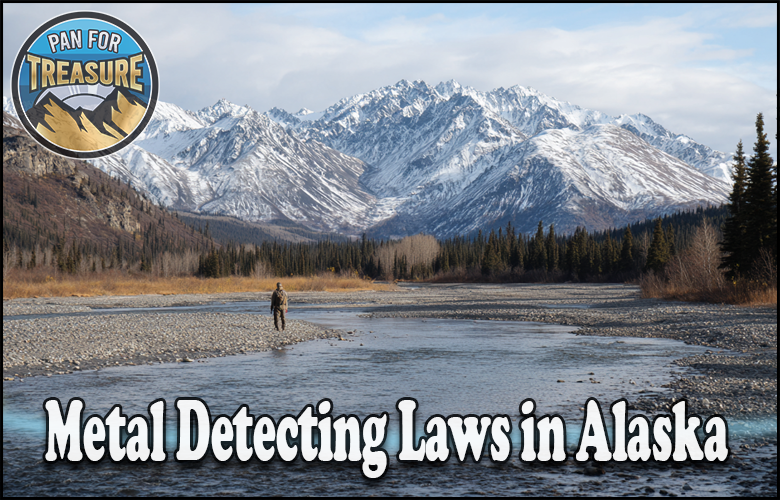
Metal detecting laws in Alaska are relatively relaxed compared to many other states, but the Last Frontier still has firm boundaries around protected sites, federal land, and Native lands that every detectorist must respect.
Alaska’s vast wilderness, gold rush history, and sparse population make it one of the most exciting states in the country for treasure hunting.
Alaska’s gold prospecting heritage stretches back to the Klondike Gold Rush of the 1890s, and gold is still found across the state today. Beyond gold, detectorists in Alaska search ghost towns, old mining camps, rivers, and remote homestead sites for coins, relics, and artifacts.
But Alaska’s extreme terrain, wildlife, and land ownership complexities (including massive Alaska Native Corporation holdings) mean you need to do your homework before heading out.
If you’re new to the hobby, start with our getting started with metal detecting guide to learn the basics of equipment and field technique.
TL;DR
- State Parks: Generally permitted in recreational areas, but historic parks like Independence Mine are off-limits; check with each park before detecting
- Federal Land: Prohibited in all National Parks, Monuments, and NPS sites under ARPA; limited detecting may be allowed on BLM and USFS land with restrictions
- Gold Prospecting: Alaska is one of the top gold states in the U.S.; metal detectors can be used on active mining claims and open prospecting areas
- Private and Native Land: Written permission required; Alaska Native Corporations control over 45 million acres, so verify ownership before detecting
- Artifacts: Items over 100 years old on public land are protected under ARPA; unauthorized removal carries heavy penalties
- Best Strategy: Focus on gold prospecting areas, BLM open land, ghost towns with permission, and private land with written consent
Major gold rushes in the 1890s-1900s; Alaska still produces commercial gold today
Over 60% federal; significant Alaska Native Corporation holdings under ANCSA
Fairbanks mining district and Kenai Peninsula for gold; ghost towns statewide
No statewide permit; individual parks and agencies may require permission
Generally allowed in recreational areas; historic parks are off-limits; check each park individually
All National Parks strictly off-limits; possessing a metal detector inside NPS boundaries can be a violation
Metal Detecting Laws in Alaska
Understanding metal detecting laws in Alaska requires looking at federal, state, and local rules, plus the unique land ownership situation created by the Alaska Native Claims Settlement Act (ANCSA). Here is the breakdown by land type.
State Parks
Alaska’s state parks generally allow metal detecting in recreational areas, but each park can set its own rules. There is no blanket statewide permit for metal detecting in state parks. You should contact the specific park office or check the Alaska Department of Natural Resources, Division of Parks and Outdoor Recreation website before visiting.
Parks designated as historic sites are off-limits. Independence Mine State Historic Park near Hatcher Pass, for example, prohibits metal detecting entirely. Any park with a “historic” designation should be treated as a no-go zone unless you receive specific written permission.
One notable restriction: Alaska state park regulations technically limit gold recovery equipment to gold pans only. While this rule has rarely been enforced against casual metal detector users, it does exist. If your primary goal is gold prospecting in a state park, a gold pan is the safe choice. For general metal detecting in non-historic recreational areas, most parks are more accommodating.
Federal Land
The Archaeological Resources Protection Act (ARPA) of 1979 prohibits metal detecting in all National Parks, National Monuments, and sites managed by the National Park Service. In Alaska, this covers Denali National Park, Glacier Bay, Wrangell-St. Elias, Katmai, and many others. Merely possessing a metal detector inside NPS boundaries can result in a citation.
Bureau of Land Management (BLM) land in Alaska is extensive. Recreational metal detecting and gold prospecting are generally allowed on open BLM land, but you cannot remove artifacts over 100 years old. For gold prospecting with a metal detector on BLM land, casual use (hand tools, gold pans, small detectors) is typically permitted without a permit. Larger-scale operations require a Plan of Operations.
U.S. Forest Service land (Tongass and Chugach National Forests) allows recreational prospecting and detecting in most areas, but the same ARPA artifact restrictions apply. Check with the local ranger district for any area-specific closures.
Private and Alaska Native Corporation Land
Written permission from the landowner is required before detecting on any private property. Alaska Native Corporations control approximately 45.5 million acres across the state, land that was granted through ANCSA. These lands are private property, and trespassing is taken seriously. Contact the relevant corporation before detecting on any land that might be Native-owned.
For private land owned by individuals, the same rules apply as in most states: get written permission, agree on who keeps any finds, fill your holes, and respect the property.
Gold Prospecting with a Metal Detector
Alaska remains one of the best states in the country for finding gold with a metal detector. The Fairbanks mining district, Kenai Peninsula, Nome coastal areas, and countless creeks throughout Interior Alaska produce gold. You can prospect on open BLM land, staked claims you own or have permission to work, and state lands designated for mineral entry.
Before prospecting on any state or federal land, verify the claim status. Alaska’s mining claim records are available through the BLM LR2000 system and the Alaska Department of Natural Resources. Detecting on someone else’s active mining claim without permission is trespassing.
Archaeological and Historic Sites
Alaska has a deep history of human habitation stretching back thousands of years. All archaeological sites on public land are protected by ARPA and the National Historic Preservation Act. Removing artifacts over 100 years old from public land is a federal crime with penalties including fines up to $100,000 and imprisonment.
If you find something that appears to be an artifact of historical significance, leave it in place and report it to the Alaska Office of History and Archaeology at (907) 269-8721.
Equipment Rules
| Land Type | Metal Detector Allowed? | Digging Allowed? | Permit/Permission Required? | Artifacts (100+ Years) |
|---|---|---|---|---|
| State Parks (recreational areas) | Generally yes | Small holes; restore ground | Check with park office | Report to park authorities |
| State Historic Parks | No | No | N/A (prohibited) | N/A (prohibited) |
| National Parks / NPS Sites | No (possession may be cited) | No | N/A (prohibited) | N/A (prohibited) |
| BLM Land (open) | Yes | Yes (casual use; hand tools) | No permit for casual use | Removal prohibited under ARPA |
| National Forest (USFS) | Yes (most areas) | Yes (casual prospecting) | Check with ranger district | Removal prohibited under ARPA |
| Private / Native Corporation Land | Yes | Yes (with landowner agreement) | Written permission required | Per agreement with landowner |
For official land status information, contact the Alaska Division of Parks and Outdoor Recreation or the BLM Alaska State Office.
Our Favorite Posts
Best Metal Detecting Locations in Alaska
Alaska offers a wide variety of detecting opportunities, though access and remoteness are bigger factors here than in most states. Here are the top spots.
- Fairbanks Mining District (Fairbanks North Star Borough) – The heart of Alaska’s gold country. Creeks like Goldstream, Cleary, and Ester have produced gold for over a century. Open BLM areas and some recreational mining sites allow detector use. Gold nuggets are the primary target.
- Resurrection Creek (Kenai Peninsula Borough) – A well-known recreational gold panning site on the Chugach National Forest. Metal detectors can be used for prospecting. The creek has a documented history of gold production and is accessible by road from Hope.
- Nome Beaches (Nome Census Area) – Nome’s coastal areas are famous for beach gold. Metal detectors are used extensively along the shoreline and in shallow water. The beach is public land, but verify local regulations before detecting. Summer months are the only practical window.
- Crow Creek Mine (Municipality of Anchorage) – A historic gold mine near Girdwood that operates as a pay-to-dig tourist site. Metal detectors are allowed with paid admission. The site has produced gold continuously since 1896.
- Chicken, Alaska area (Southeast Fairbanks Census Area) – An old mining town along the Taylor Highway. Surrounding creeks and BLM land offer gold detecting opportunities. The area is remote and only accessible in summer months.
- Ghost Towns and Old Mining Camps (Various locations) – Alaska has thousands of abandoned mining camps and settlements. Many are on public land and can be detected legally, though access is often by bush plane, boat, or ATV. Bring bear spray and a satellite communicator.
- Hatcher Pass area (Matanuska-Susitna Borough) – Gold-bearing creeks in the Talkeetna Mountains near Palmer. Note that Independence Mine State Historic Park itself is off-limits, but surrounding public land may be open for prospecting.
- Kenai River and tributaries (Kenai Peninsula Borough) – Placer gold has been found along the Kenai River system. Public access points along the river can be good detecting spots, particularly after high water events move material around.
- Livengood area (Yukon-Koyukuk Census Area) – A historic placer mining area north of Fairbanks along the Elliott Highway. Old workings and tailing piles on open land can produce gold with a detector.
- Valdez area creeks (Valdez-Cordova Census Area) – Multiple gold-bearing creeks near Valdez, including areas accessible from the road system. The combination of glacial geology and historic mining activity makes this a productive region.
For more detecting destinations, visit our best places to metal detect in America guide. Also check our gold panning laws in Alaska page and our gold prospecting with metal detectors guide for more.
Alaska’s Gold Rush History and What You Might Find
Alaska’s detecting appeal is deeply tied to its gold history. The state’s first major gold discovery was at Juneau in 1880, followed by the massive Klondike Gold Rush of 1896-1899 (centered in neighboring Yukon but drawing thousands through Alaska). The Nome Gold Rush of 1899 and the Fairbanks Gold Rush of 1902 brought waves of miners to Interior and Western Alaska.
Those miners left behind a trail of artifacts. Old camps, cabin sites, and mining operations scattered across the state hold coins, tools, buttons, buckles, and personal items from the late 1800s and early 1900s. Ghost towns like Kennecott (copper mining), Dyea (Klondike trail), and dozens of smaller settlements are scattered across the landscape.
Gold itself remains the top target for Alaska detectorists. The state still produces significant quantities of placer gold. Nuggets ranging from small pickers to multi-ounce specimens are found every year by prospectors using metal detectors. A pulse induction (PI) detector or a high-frequency gold machine is recommended for hunting nuggets in Alaska’s mineralized ground.
Beyond gold, Alaska’s waterways and old settlement sites can produce Russian-era coins and artifacts (Russia owned Alaska until 1867), Native trade items, and early American territorial relics. The state’s military history from World War II, particularly the Aleutian Islands campaign, also left behind recoverable items in some areas, though military sites may be restricted.
Recommended Reading
Tips for Metal Detecting in Alaska
- Plan for remoteness. Many of Alaska’s best detecting areas are far from roads, cell service, and medical help. Carry a satellite communicator (like a Garmin inReach), first aid kit, and tell someone your plans before heading out.
- Bear safety is not optional. Grizzly bears and black bears are common throughout Alaska’s gold country. Carry bear spray and know how to use it. Make noise while detecting, and store food properly.
- Use a gold-specific detector for nugget hunting. Alaska’s mineralized soils cause problems for many standard detectors. Pulse induction machines like the Minelab GPX series or high-frequency VLF detectors designed for gold handle the ground conditions better.
- Summer is your window. Most Alaska detecting happens between May and September. Snow, frozen ground, and limited daylight make winter detecting impractical in most areas. The long summer days (up to 22 hours of daylight near the solstice) work in your favor.
- Verify land ownership before you go. Alaska’s land ownership is a patchwork of federal, state, Native corporation, and private holdings. Use the BLM’s land status maps or Alaska Mapper (dnr.alaska.gov/mapper) to check who owns the ground you plan to detect.
- Check mining claim status. Before prospecting for gold on public land, verify there are no active mining claims on the area. The BLM LR2000 database and Alaska DNR mining records are the primary sources.
- Bring extra batteries and gear. Cold temperatures (even in summer at higher elevations) drain batteries fast. Bring spare rechargeable batteries for your detector and keep them warm in your pockets.
- Hunt old tailing piles. Historic dredge tailing piles often contain gold that the old dredges missed, as well as lost tools and personal items from miners. Many tailing areas on open BLM land are fair game.
- Be prepared for mosquitoes. Alaska’s summer mosquitoes are legendary. A head net and DEET-based repellent will make your detecting trip far more enjoyable.
- Join the Alaska Gold Prospectors Association. Local clubs can help you find open detecting areas, connect with claim owners willing to grant access, and share tips on productive locations.
For recovery techniques, see our metal detecting techniques guide.
Resources
- Alaska Division of Parks and Outdoor Recreation – Contact for state park rules, historic site boundaries, and detecting permission questions.
- Bureau of Land Management, Alaska State Office – Land status maps, mining claim records, and information on open land for prospecting and detecting.
- Alaska Division of Geological and Geophysical Surveys – Geologic maps, mineral resource reports, and gold occurrence data for planning prospecting trips.
- Gold Prospectors Association of America (GPAA) – Membership includes access to claims in Alaska and other states, plus organized group outings.
- Federation of Metal Detector and Archaeological Clubs (FMDAC) – National advocacy organization that tracks state-by-state metal detecting regulations.
Conclusion
Metal detecting laws in Alaska give hobbyists more freedom than many other states, but the sheer size and wildness of the state add challenges you won’t face elsewhere. The combination of gold rush history, vast public lands, and thousands of ghost towns makes Alaska a dream destination for detectorists willing to put in the extra planning.
Stay off National Park Service land, verify ownership before detecting anywhere, and respect archaeological sites. With proper preparation and a good understanding of the rules, Alaska can deliver some of the most rewarding detecting experiences in the country.
Check out our guides for neighboring and related states: metal detecting laws in Washington, metal detecting laws in Oregon, metal detecting laws in Hawaii, and metal detecting laws in California. Browse the full state-by-state metal detecting laws directory for all 50 states.
Frequently Asked Questions – AK Metal Detecting Laws
Is metal detecting legal in Alaska?
Yes, metal detecting is legal in Alaska. The state has no blanket prohibition on the hobby. You can detect on open BLM land, many state park recreational areas, and private land with permission. The main restrictions are on National Park Service land (completely off-limits), historic sites, and archaeological areas. Always verify land ownership and check for area-specific rules before heading out.
Do I need a permit to metal detect in Alaska?
There is no single statewide metal detecting permit in Alaska. However, some state parks may require you to check in with the park office before detecting. Gold prospecting on BLM land under casual use rules generally does not require a permit, but larger operations need a Plan of Operations. If you plan to prospect on state land, contact the Alaska Department of Natural Resources for current requirements.
Can I metal detect in Alaska state parks?
Most Alaska state parks allow metal detecting in general recreational areas, but each park has its own rules. State historic parks like Independence Mine are completely off-limits. Contact the specific park office before bringing your detector. Note that state park gold prospecting regulations technically limit equipment to gold pans, though this is not always strictly enforced for casual metal detector use.
Can I keep gold I find while metal detecting in Alaska?
On open BLM land where no mining claims exist, you can generally keep small amounts of gold found through casual prospecting. On active mining claims, the gold belongs to the claim holder. On private land, your agreement with the landowner determines who keeps what. On state land, the rules depend on the specific area and mineral entry status. Always check claim status and land ownership before assuming you can keep gold you find.
What are the best areas for gold detecting in Alaska?
The Fairbanks mining district is widely considered the top gold detecting area, with productive creeks like Goldstream, Cleary, and Ester. The Kenai Peninsula (particularly around Resurrection Creek and Hope), Nome’s beaches, and the Chicken area along the Taylor Highway are also proven gold producers. Each area has different access requirements and seasonal windows, so plan accordingly.
Is it safe to metal detect alone in remote Alaska?
Detecting alone in remote Alaska carries real risks, including encounters with grizzly bears, river crossings, extreme weather, and being far from medical help. Always carry bear spray, a satellite communicator, and a well-stocked first aid kit. Tell someone your exact plans and expected return time. Detecting with a partner is strongly recommended in backcountry areas. Stick to road-accessible sites if you are unfamiliar with Alaska’s wilderness.
⛏ Recommended Gear ⛏


* As an Amazon Associate I earn from qualifying purchases at no extra cost to you.
Subscribe to Our Newsletter

Ryan Conlon is the founder of Pan for Treasure.
A lifelong gold panning enthusiast, he created this site to help beginners learn the ropes and share practical tips from his own time on the creek. [email protected]