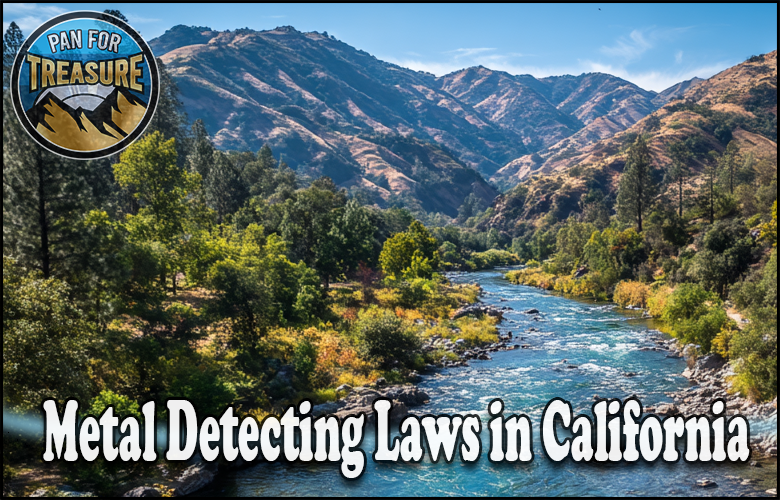
Metal detecting laws in California are among the most complex in the country, with overlapping state, federal, and local regulations that change depending on whether you’re on a beach, in a state park, on BLM land, or in the Gold Country foothills.
California’s massive coastline, Gold Rush history, and millions of acres of public land create huge opportunities, but the rules require close attention.
The Golden State is where American treasure hunting was born. The 1848 gold discovery at Sutter’s Mill triggered the California Gold Rush and changed the state forever.
Today, gold nuggets are still found with metal detectors in the Sierra Nevada foothills and Mojave Desert. Meanwhile, California’s 840 miles of coastline pull in beachcombers hunting for lost jewelry, coins, and relics along some of the busiest beaches in the world.
New to the hobby? Start with our getting started with metal detecting guide before heading out.
TL;DR
- State Parks: Metal detecting is generally prohibited in California State Parks under the California Code of Regulations (CCR Title 14, Section 4326); limited exceptions may exist with district superintendent permission
- Beaches: Most public city and county beaches allow metal detecting; state beaches have more restrictions, especially near dune grass and protected areas
- BLM Land: Allowed for hobby detecting and gold prospecting; artifacts may not be removed; report discoveries to the nearest field office
- National Forests: Recreational prospecting generally allowed; ARPA artifact restrictions apply; check with the local ranger district
- Gold Prospecting: California remains a top gold state; detectors widely used on BLM, National Forest, and private claims throughout the Mother Lode and Mojave Desert
- Key Restriction: Destroying vegetation or disturbing the ground in state parks is prohibited; removing artifacts over 100 years old from public land is a federal crime under ARPA
1848 Gold Rush at Sutter’s Mill; California produced over 100 million ounces of gold historically
840 miles of Pacific coast with hundreds of public beaches
Southern California beaches for jewelry; Mother Lode / Sierra foothills for gold; Mojave Desert for nuggets
Some city/county parks require free permits; state parks generally prohibit detecting; BLM casual use needs no permit
Generally prohibited (CCR Title 14, Section 4326); district superintendent may grant exceptions in limited cases
No destruction of vegetation or ground disturbance in state parks; ARPA protects artifacts 100+ years old on all public land
Featured
Metal Detecting Laws in California
Metal detecting laws in California involve a patchwork of state, federal, and local rules. The type of land you’re standing on determines what’s allowed. Here is the full breakdown.
State Parks
California State Parks generally prohibit metal detecting. The California Code of Regulations (CCR Title 14, Section 4326) restricts metal detecting to designated areas and bars it entirely within archaeological or historic sites. In practice, most state park units treat this as a blanket ban on recreational metal detecting.
There is a narrow exception: the park’s district superintendent has the authority to grant permission for detecting in specific areas. Getting that permission is difficult and uncommon, but it’s not impossible. Some detectorists report success by visiting the park in person, explaining their intent, and asking politely. Calling ahead almost always results in a flat “no.”
California State Parks also has a specific page on their website titled “Possession of Metal Detectors” at parks.ca.gov, which confirms the restrictive policy. If you plan to detect anywhere within the California State Park system, contact the district superintendent’s office first.
State beaches managed by California State Parks fall under the same rules. However, enforcement varies, and some rangers at state beaches allow detecting in sandy areas away from dune grass and sensitive habitats. This is not guaranteed, and you should not assume it’s permitted.
City and County Beaches
Public beaches managed by cities and counties are where most California beach detecting happens. The majority of city and county beaches along the coast allow metal detecting without a formal permit, though you should always check with local authorities.
Southern California beaches like Santa Monica, Huntington Beach, Newport Beach, and San Diego area beaches see heavy tourist traffic and are popular with detectorists hunting for lost jewelry and coins. Northern California beaches like Seacliff, Rockaway (Pacifica), and Half Moon Bay are less crowded but still productive.
Some local ordinances require you to turn in found items of value per California Penal Code Section 485, which states that finders of lost property must make reasonable efforts to locate the owner. Modern coins are generally yours to keep. Jewelry and valuables found on public land should technically be reported.
Federal Land: BLM
California has millions of acres of Bureau of Land Management (BLM) land, much of it in the desert regions and Gold Country foothills. The BLM generally allows hobby metal detecting and gold prospecting on open BLM land under casual use rules.
You may use hand tools to dig small holes (which you must fill) and recover non-archaeological items like gold nuggets and modern coins. Removing artifacts is strictly prohibited. The BLM website for California states that visitors must report artifact discoveries to the nearest field office rather than removing them.
Check for active mining claims before prospecting on BLM land. California’s BLM field offices in Sacramento, Redding, Bishop, Barstow, and Palm Springs can provide land status maps and current information on restricted areas.
Federal Land: National Forests
California’s national forests (including the Tahoe, Eldorado, Stanislaus, Plumas, Sierra, Sequoia, Angeles, Cleveland, San Bernardino, and others) generally allow recreational prospecting and metal detecting. Gold prospecting with a detector is considered casual use in most forest areas.
ARPA restrictions apply: no removal of artifacts over 100 years old. Coin shooting for modern items is typically fine. Gold nugget hunting on open forest land is widely practiced, especially in the Mother Lode region forests.
Some forests have area-specific restrictions. Contact the local ranger district before detecting. The Whiskeytown and Shasta National Recreation Areas, for example, prohibit metal detecting.
National Parks and Monuments
All National Parks, Monuments, and NPS sites in California are off-limits. This includes Yosemite, Sequoia and Kings Canyon, Death Valley, Joshua Tree, Redwood, Channel Islands, Pinnacles, and Lassen Volcanic. Even possessing a metal detector inside NPS boundaries can draw a citation. There are no exceptions for recreational detecting.
Private Land
Private land with written owner permission is the most unrestricted option in California. ARPA does not apply to private property. Whatever you find belongs to you or the landowner per your agreement.
Many of California’s best gold prospecting opportunities are on private mining claims. Joining a prospecting club like the Gold Prospectors Association of America (GPAA) provides access to private claims across the Gold Country. Some landowners in the Sierra foothills and Mojave Desert also grant detecting access to respectful hobbyists who ask.
Equipment Rules
| Land Type | Metal Detector Allowed? | Digging Allowed? | Permit/Permission Required? | Artifacts (100+ Years) |
|---|---|---|---|---|
| State Parks | Generally no (CCR 14-4326) | No ground disturbance | District superintendent exception only | Protected; may not be removed |
| City/County Beaches | Yes (most locations) | Yes (fill holes) | Check local ordinances | Report per CA Penal Code 485 |
| BLM Land (open) | Yes | Yes (small holes; refill) | No permit for casual use | Removal prohibited; report to field office |
| National Forest (USFS) | Yes (most areas) | Yes (hand tools; casual use) | Check with ranger district | Removal prohibited under ARPA |
| National Parks / NPS Sites | No | No | N/A (prohibited) | N/A (prohibited) |
| Private Land | Yes | Yes (with landowner agreement) | Written landowner permission | Finder keeps (per agreement) |
For state park rules, see the California State Parks metal detector policy page. For BLM land information, visit the BLM California State Office.
Our Favorite Posts
- Metal Detecting Laws in Kentucky – Public Land, Parks, and Beach Rules
- Metal Detecting Laws and Regulations
- Metal Detecting Laws in Colorado – Public Land, Parks, and Beach Rules
- Metal Detecting Laws in Pennsylvania – Public Land, Parks, and Beach Rules
- Metal Detecting Laws in Georgia – Public Land, Parks, and Beach Rules
Best Metal Detecting Locations in California
California’s size and variety mean there’s a detecting spot for every interest, from gold nuggets to beach jewelry to Gold Rush ghost towns.
- Santa Monica State Beach (Los Angeles County) – One of the busiest beaches in the world. 3.5 miles of soft sand near the iconic Santa Monica Pier. Heavy tourist traffic means a constant supply of lost rings, earrings, coins, and watches. Detect early morning or after big events for the best results.
- Huntington Beach (Orange County) – “Surf City USA” draws massive crowds year-round. The wide, sandy beach is a top producing spot for Southern California detectorists. Detecting is allowed on the public city beach areas.
- American River / Auburn State Recreation Area (Placer and El Dorado Counties) – The heart of the original Gold Rush. The American River still produces placer gold. The Auburn SRA allows recreational gold panning and prospecting in designated areas. Check current regulations at the park office before using a metal detector.
- Mojave Desert / Dale District (San Bernardino County) – One of the top gold nugget detecting areas in Southern California. BLM land in the Dale District and surrounding desert has produced gold since the 1800s. The dry climate makes pulse induction detectors effective here. Verify claim status before prospecting.
- Seacliff State Beach area (Santa Cruz County) – A Northern California beach with a cement ship (the SS Palo Alto) and productive sand. While the state beach itself has state park restrictions, the surrounding public beach areas are popular with detectorists. Call ahead to confirm rules.
- Rockaway Beach (San Mateo County, Pacifica) – A popular beach near San Francisco with hotels, restaurants, and hiking trails nearby. The combination of foot traffic and scenic setting means lost items accumulate in the sand. Trails near Mori Point are also worth exploring.
- Fort Ord Dunes State Park area (Monterey County) – Six beaches along the former Fort Ord military base. The military history adds an extra layer of interest. Contact the park office to confirm current detecting policy, as state park rules apply.
- Mother Lode Ghost Towns (Amador, Calaveras, Tuolumne, Mariposa Counties) – Hundreds of abandoned mining camps and ghost towns dot the Sierra Nevada foothills. Many sit on BLM or private land. Gold, old coins, mining tokens, and 19th-century relics are common finds. Verify land ownership before detecting.
- Imperial Beach (San Diego County) – The southernmost beach in California, just north of the Mexican border. Less crowded than other San Diego beaches but close enough to urban areas that lost items accumulate. Detecting is permitted on the public beach.
- Lynx Creek / Randsburg area (Kern County) – An old gold mining district in the western Mojave Desert. Randsburg is a semi-ghost town with a long mining history. Surrounding BLM land is open for gold prospecting with a detector. The area has produced significant nuggets.
For more locations, see our best locations to find gold guide, our gold panning laws in California page, and our gold prospecting with metal detectors guide.
California’s Gold Rush History and What You Might Find
California’s detecting history begins with the Gold Rush. On January 24, 1848, James Marshall spotted gold flakes in the tailrace of Sutter’s Mill on the American River near Coloma. Within a year, over 300,000 people poured into California from around the world. The Gold Rush transformed the state and left behind a landscape littered with mining camps, abandoned towns, and gold-bearing ground.
Gold is still the top target for many California detectorists. Modern geological estimates suggest that the original 49ers recovered only a fraction of the state’s total gold. A 6-pound gold nugget was found with a metal detector in California as recently as 2014. The Mother Lode region running through the Sierra Nevada foothills from Mariposa County to El Dorado County remains the most productive gold detecting area. The Mojave Desert in Southern California is another proven producer, particularly in the Dale District and Randsburg areas.
Beyond gold, California’s beaches are among the most productive in the country for jewelry and coin hunting. The state’s population of nearly 40 million people, combined with heavy beach tourism, means that enormous quantities of valuables are lost in the sand every year. Gold rings, diamond earrings, vintage coins, and high-end watches are all found regularly on California beaches.
Ghost towns and old mining camps across the Gold Country produce coins, mining tokens, buttons, tools, bottles, and personal items from the 1850s through the early 1900s. California also has Spanish colonial history stretching back to the 1700s, and areas near old missions and ranchos have the potential for early California artifacts.
In 2013, a couple walking their dog on their property in Northern California discovered a cache of gold coins valued at over $10 million. While finds of that magnitude are extraordinarily rare, the story illustrates that California’s soil still holds surprises.
Recommended Reading
Tips for Metal Detecting in California
- Focus on city and county beaches, not state beaches. The state park system’s restrictions make city and county managed beaches your best legal option. Check the beach’s managing agency before you go. A quick Google search for “[beach name] managed by” will usually tell you.
- Detect Southern California beaches early morning. SoCal beaches see millions of visitors. Arriving at sunrise before the crowds lets you cover ground that was trafficked heavily the day before. The towel line zone and volleyball court areas are the most productive.
- Use a multi-frequency or PI detector on the beach. California’s saltwater mineralization causes problems for single-frequency VLF machines. A multi-frequency detector like the Minelab Equinox or a pulse induction machine will handle the salt ground better and find deeper targets in wet sand.
- Join GPAA or a local prospecting club for claim access. Much of California’s best gold ground is on private mining claims. The Gold Prospectors Association of America has claims across the Gold Country that members can access. Local clubs like the Sacramento Valley Detecting Buffs, Gold Coast Treasure Hunters, and East Bay Prospectors also offer group access and organized hunts.
- Target old hydraulic mining areas for gold. Historical hydraulic mining operations in the Sierra foothills left behind vast gravel deposits. These tailings still contain gold that the old methods missed. BLM and National Forest land in the Gold Country often includes accessible tailing areas.
- Research ghost town land ownership carefully. California ghost towns can sit on BLM land, National Forest land, private property, or state land. Each has different rules. Use BLM land status maps or CalTopo to check ownership before driving out to a remote site.
- Be careful with California Penal Code Section 485. This law requires finders of lost property to make a reasonable effort to return it to the owner. While this is rarely enforced against casual beach detectorists finding old coins, be aware that high-value jewelry found on public land could technically fall under this statute.
- Detect after winter storms on Northern California beaches. Pacific storms shift sand and expose new material. The period right after a big winter storm is the best time to hit NorCal beaches. Strong currents and wave action can uncover items that have been buried for decades.
- Carry a sand scoop, not a shovel, on the beach. Beach detecting in California is less likely to draw attention if you use a sand scoop rather than a full-size shovel. Scoops are faster for sand recovery anyway and look less aggressive to beachgoers and rangers.
- Stay out of dune grass and protected habitat. California beaches often have protected dune areas where digging is prohibited to protect plants and wildlife habitat. These areas are usually roped off or signed. Stick to open sand and wet sand zones.
For more on technique, visit our metal detecting techniques guide and our best tools for metal detecting page.
Metal Detecting Laws
- Metal Detecting Laws in Wyoming – Public Land, Parks, and Beach Rules
- Metal Detecting Laws in Wisconsin – Public Land, Parks, and Beach Rules
- Metal Detecting Laws in West Virginia – Public Land, Parks, and Beach Rules
- Metal Detecting Laws in Washington – Public Land, Parks, and Beach Rules
- Metal Detecting Laws in Virginia – Public Land, Parks, and Beach Rules
Resources
- California State Parks – Metal Detector Policy – Official state parks page on metal detector possession and use rules within the California State Park system.
- Bureau of Land Management, California State Office – Land status maps, field office contacts, mining claim records, and casual use rules for BLM land in California.
- California Geological Survey – Geology maps, mineral resource reports, and gold occurrence data for planning prospecting trips across the state.
- Gold Prospectors Association of America (GPAA) – Claim access throughout California’s Gold Country, organized outings, and member resources for prospectors and detectorists.
- Federation of Metal Detector and Archaeological Clubs (FMDAC) – Tracks state-by-state regulations and advocates for hobbyist detectorists’ access rights.
Conclusion
Metal detecting laws in California require more homework than most states, but the rewards match the effort. The state park restrictions push most detectorists toward public city and county beaches, BLM land, and private property, and all three of those categories offer world-class opportunities. From beach jewelry hunting in Southern California to gold nugget detecting in the Mother Lode and Mojave Desert, the Golden State lives up to its name.
Know the managing agency of every piece of ground you detect on, respect the vegetation and wildlife restrictions, and never remove artifacts from public land. California has enough detecting opportunities to last a lifetime.
Ready to explore nearby states? Check out our guides for metal detecting laws in Oregon, metal detecting laws in Nevada, metal detecting laws in Arizona, and metal detecting laws in Hawaii. Browse the full state-by-state metal detecting laws directory.
Frequently Asked Questions – CA Metal Detecting Laws
Can I metal detect on California beaches?
Yes, most public city and county beaches in California allow metal detecting. Beaches managed by California State Parks have stricter rules and may prohibit detecting under CCR Title 14, Section 4326. Before heading to any beach, check whether it’s managed by the city, county, or state parks system. City and county beaches are generally your best option for legal, hassle-free detecting along California’s coast.
Is metal detecting allowed in California state parks?
Metal detecting is generally prohibited in California State Parks under the California Code of Regulations. The park’s district superintendent has the authority to grant exceptions for specific areas, but this is uncommon for recreational detecting. Some detectorists have had success asking in person at individual parks, but you should not assume permission will be granted. The California State Parks website has a specific page on metal detector possession that confirms the restrictive policy.
Can I prospect for gold with a metal detector in California?
Yes. Gold prospecting with a metal detector is allowed on open BLM land and in most National Forest areas under casual use rules. The Mother Lode region in the Sierra Nevada foothills and the Mojave Desert in Southern California are the most popular gold detecting areas. Check for active mining claims before prospecting, and do not remove artifacts. Joining a prospecting club like GPAA can provide access to private claims where gold detecting is freely permitted.
Do I need a permit to metal detect in California?
There is no single statewide metal detecting permit in California. BLM land casual use does not require a permit. Some city and county parks require free permits (East Bay Regional Park District, for example, issues metal detector permits). State parks require district superintendent permission, which is hard to get. National forest detecting generally does not need a permit for casual use, but check with the local ranger district. Always verify rules for your specific location.
What can I find metal detecting in California?
California detectorists find gold nuggets in the Sierra foothills and Mojave Desert, lost jewelry (rings, earrings, watches, chains) on beaches, modern and vintage coins at parks and beaches, Gold Rush era relics at ghost town sites, and mining tokens and tools at old mining camps. A 6-pound gold nugget was found with a detector in California as recently as 2014, and a cache of gold coins worth over $10 million was discovered on private property in Northern California in 2013.
Where are the best beaches to metal detect in California?
Santa Monica Beach, Huntington Beach, and Newport Beach in Southern California are consistently productive due to massive tourist traffic. In Northern California, Seacliff (Santa Cruz), Rockaway Beach (Pacifica), and Half Moon Bay are popular with detectorists. Imperial Beach near San Diego is a good option with less competition from other hunters. Focus on city and county managed beaches rather than state park beaches to stay within the rules.
⛏ Recommended Gear ⛏


* As an Amazon Associate I earn from qualifying purchases at no extra cost to you.
Subscribe to Our Newsletter

Ryan Conlon is the founder of Pan for Treasure.
A lifelong gold panning enthusiast, he created this site to help beginners learn the ropes and share practical tips from his own time on the creek. [email protected]