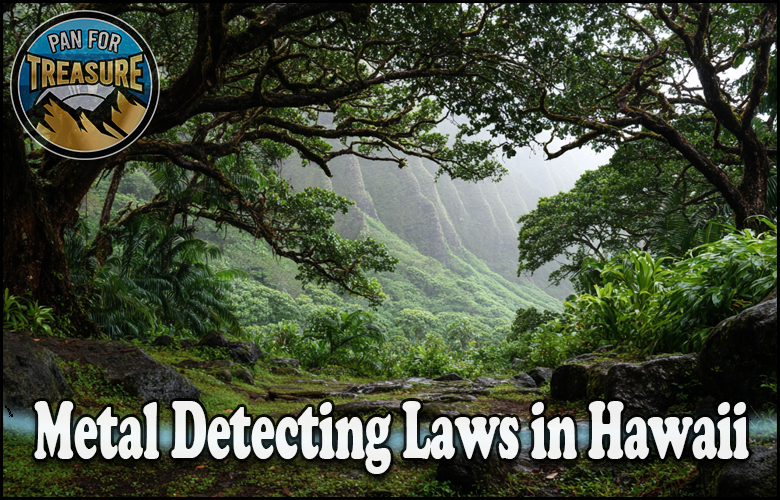
Metal detecting laws in Hawaii limit the hobby almost entirely to sand beaches. The Hawaii Division of State Parks rule is straightforward: metal detecting devices are allowed on sand beaches only.
Beyond the beach, the state’s strong protections for Native Hawaiian cultural sites, archaeological resources, and natural areas create significant restrictions that detectorists must respect.
Hawaii’s tourist-heavy beaches see millions of visitors per year, making the islands productive for finding lost jewelry, coins, and personal items in the sand. From Waikiki on Oahu to Kaanapali on Maui, the combination of upscale tourism and sandy beaches creates good beach detecting conditions.
But Hawaii is not a state where you can wander inland with a detector. Know the beach rule and stick to it.
New to the hobby? Check out our beginner’s guide to gold panning and prospecting for the basics.
TL;DR
- Sand Beaches Only: Metal detecting devices are allowed on sand beaches only per Hawaii Division of State Parks rules; no detecting in parks, forests, or inland areas
- Lost and Found Law: Found articles must be deposited at the nearest police station per Hawaii law
- Cultural Sites Protected: All historical, archaeological, and geological features must be left undisturbed; Native Hawaiian cultural sites are strictly off-limits
- No Permit Needed: No state permit is required for beach detecting; no fee charged
- Off-Limits Beaches: Hanauma Bay (Oahu), the four lagoons at Ko Olina (Oahu), and Bellows Beach (military) are closed to detecting
- National Parks: All NPS sites (Haleakala, Hawaii Volcanoes, Pearl Harbor, Pu’uhonua o Honaunau) are completely off-limits
Sand beaches only
No (for beach detecting)
Oahu, Maui, Big Island, Kauai
Waikiki, Kaanapali, Kailua, Poipu
Cultural and archaeological sites strictly protected
Must be deposited at nearest police station
Featured
Metal Detecting Laws in Hawaii
Metal detecting laws in Hawaii are shaped by the state’s strong commitment to protecting Native Hawaiian cultural resources and natural features. Here is the breakdown by land type.
State Parks: Sand Beaches Only
The Hawaii Division of State Parks (under the Department of Land and Natural Resources, DLNR) states in its park rules that metal detecting devices are allowed on sand beaches only. All plants, geological, historical, and archaeological features must be left undisturbed.
This means you can use a metal detector on the sandy portion of a state park beach, from the vegetation line down to the water. You may not detect on park grounds, trails, grassy areas, campsites, or any non-beach area within a state park. Digging in the sand to recover targets is generally accepted, but you must stop once you hit the natural soil or rock layer beneath the sand.
State parks, recreational areas, and natural preserves beyond the beach zone are off-limits for detecting. There is no permit or waiver available for inland detecting on state park land.
Lost and Found Law
Hawaii law requires that lost and found articles be deposited by the finder at the nearest police station. This applies to items found while metal detecting on public beaches. If you find identifiable personal property (a ring with an inscription, a wallet, a phone), you are legally required to turn it over to the police. Modern coins are generally considered abandoned property and do not need to be reported.
Public Beaches (Non-State Park)
Most public sand beaches in Hawaii allow metal detecting without a permit. Hawaii’s beaches are generally public below the high water mark, and detecting on the sand is accepted practice on most islands.
However, some specific beaches are off-limits. On Oahu, Hanauma Bay Nature Preserve prohibits metal detecting due to its protected status. The four lagoons at Ko Olina are also restricted. Bellows Beach (a military installation beach that is open to the public on weekends) has its own rules. Always check for posted restrictions before detecting at any beach.
Cultural and Archaeological Sites
Hawaii has some of the strongest cultural resource protections in the country. Native Hawaiian heiau (temples), burial sites, fishponds, petroglyphs, and other cultural features are strictly protected under state law. Metal detecting on or near these sites is prohibited and can result in serious legal consequences.
The State Historic Preservation Division (SHPD) under DLNR oversees archaeological resources. Contact SHPD at (808) 692-8015 for questions about specific locations.
Aboriginal lands and areas of cultural significance are off-limits without exception. Hawaii takes violations in this area very seriously.
National Parks and Federal Land
All National Park Service sites in Hawaii are completely off-limits to metal detecting. This includes Haleakala National Park (Maui), Hawaii Volcanoes National Park (Big Island), the World War II Valor in the Pacific National Monument (Pearl Harbor, Oahu), Pu’uhonua o Honaunau National Historical Park (Big Island), and Kalaupapa National Historical Park (Molokai).
Military installations (Pearl Harbor, Schofield Barracks, Bellows, Kaneohe Bay MCAS) are federal land with their own rules. Do not bring a detector onto any military installation without explicit authorization.
Private Land
Private land with written landowner permission allows metal detecting. In Hawaii, this includes ranch land, private estates, and private beach areas (which are uncommon, as most Hawaiian beaches are public). Always get written permission and respect the landowner’s rules.
Underwater Detecting
Underwater metal detecting in Hawaii’s coastal waters is practiced by some detectorists, particularly at popular snorkeling and swimming spots. State waters rules apply. Do not disturb coral reefs, marine protected areas, or any underwater cultural resources. Hawaiian coral reefs are protected by state and federal law.
Rules Summary
| Land Type | Metal Detector Allowed? | Digging Allowed? | Permit/Permission | Found Items |
|---|---|---|---|---|
| Sand Beaches (public/state park) | Yes | Sand only; stop at soil/rock layer | No permit needed | Must deposit lost items at police station |
| State Parks (non-beach areas) | No | No | N/A (prohibited) | N/A |
| Cultural/Archaeological Sites | No | No | N/A (strictly prohibited) | N/A |
| National Parks (NPS) | No | No | N/A (prohibited) | N/A |
| Military Installations | No (unless authorized) | No | Requires military authorization | N/A |
| Private Land | Yes | Yes | Written landowner permission | Per agreement with landowner |
For official park rules, visit the Hawaii Division of State Parks. For cultural resource questions, contact the State Historic Preservation Division.
Our Favorite Posts
- Metal Detecting Laws in Kentucky – Public Land, Parks, and Beach Rules
- Metal Detecting Laws and Regulations
- Metal Detecting Laws in Colorado – Public Land, Parks, and Beach Rules
- Metal Detecting Laws in Georgia – Public Land, Parks, and Beach Rules
- Metal Detecting Laws in Wyoming – Public Land, Parks, and Beach Rules
Best Metal Detecting Locations in Hawaii
Hawaii’s beach detecting is driven by tourism. The busiest beaches produce the most finds.
- Waikiki Beach (Oahu, Honolulu County) – One of the most visited beaches in the world. Millions of tourists lose rings, chains, earrings, and coins in the sand and surf every year. Detect early morning before the crowds arrive. The stretch from the Royal Hawaiian to the Sheraton is particularly productive.
- Kaanapali Beach (Maui, Maui County) – Three miles of upscale resort beach. High-end tourists lose expensive jewelry here. The beach is open to detecting and produces gold rings and chains regularly. Best hunted early morning or late evening.
- Kailua Beach (Oahu, Honolulu County) – A popular local and tourist beach on the windward side of Oahu. Detectorists have found both modern items and older artifacts in the sand. Less crowded than Waikiki, offering a more relaxed detecting experience.
- Poipu Beach (Kauai, Kauai County) – Kauai’s most popular tourist beach. Resort area with steady visitor traffic. Good for jewelry and coin finds in the sand.
- Hapuna Beach (Big Island, Hawaii County) – One of the Big Island’s most popular white sand beaches. Steady tourist traffic creates regular detecting opportunities.
- North Shore beaches (Oahu, Honolulu County) – The famous surf beaches of the North Shore (Sunset Beach, Pipeline area, Waimea Bay) see heavy winter surf season crowds. After big surf events and busy weekends, the sand can produce interesting finds.
- Lahaina area beaches (Maui, Maui County) – The historic whaling town of Lahaina (devastated by the 2023 wildfire) and its surrounding beaches have centuries of maritime and commercial history. Beach detecting in the area may produce both modern and historical items.
- Punalu’u Black Sand Beach (Big Island, Hawaii County) – A unique volcanic black sand beach. Detecting on black sand requires a machine that handles high mineralization well. Tourist traffic provides modern targets.
See our best locations to find gold guide and our gold prospecting with metal detectors guide for more.
Hawaii’s History and What You Might Find
Hawaii’s human history begins with Polynesian voyagers who arrived around 1,000-1,200 AD. The Hawaiian Kingdom was established by Kamehameha I in the late 1700s, and European and American contact brought missionaries, whalers, and traders starting in the 1770s. The islands became a U.S. territory in 1898 and the 50th state in 1959.
The most common metal detecting finds on Hawaiian beaches are modern jewelry (gold and silver rings, chains, earrings, watches), coins, and personal items lost by the millions of annual tourists. Hawaii’s upscale resort beaches produce a disproportionate number of gold and platinum jewelry finds compared to mainland beaches.
Older finds are possible but less common. The whaling era (1820s-1870s) brought thousands of sailors through Hawaiian ports, and coins and personal items from that period occasionally surface. World War II-era items (military insignia, dog tags, equipment fragments) can be found on beaches near former military areas, though active military beaches are off-limits.
Hawaiian volcanic soil and basalt rock create challenging ground conditions for inland detecting. Beach sand, particularly the white coral sand beaches, is more detector-friendly than the volcanic black sand beaches, which have extremely high mineral content.
Recommended Reading
Tips for Metal Detecting in Hawaii
- Stick to the sand. The rule is absolute: sand beaches only. Do not detect on park grounds, trails, grass, or any area beyond the sand. Do not detect near any cultural site, heiau, or archaeological feature.
- Detect at sunrise. Hawaii’s popular beaches fill up fast. An early morning session from first light to about 8 AM gives you the best window before crowds arrive. Many detectorists start before dawn.
- Use a saltwater-capable machine. Hawaii’s beaches are high-mineralization saltwater environments. A pulse induction (PI) detector or a multi-frequency VLF handles Hawaii’s salt sand better than a single-frequency machine. The Minelab Equinox series and Garrett AT Pro are popular choices for Hawaiian beaches.
- Detect the waterline and wet sand zone. Heavy items like gold rings sink through dry sand and accumulate in the wet sand zone near the waterline. Low tide exposes more of this productive zone.
- Respect Hawaiian culture. Hawaii’s indigenous cultural heritage is deeply important to local residents. Never detect near heiau, burial sites, or areas of cultural significance. If you are unsure whether an area is culturally sensitive, do not detect there. Ask locals or contact DLNR.
- Turn in lost property. Hawaii law requires depositing found articles at the nearest police station. Compliance is both a legal requirement and good community relations.
- Check specific beach restrictions. Hanauma Bay, Ko Olina lagoons, and military beaches are off-limits. Other beaches may have seasonal or situational restrictions. When in doubt, ask a lifeguard or park ranger.
- Bring sun and reef protection. Hawaii’s sun is intense, and dehydration is a real risk. Use reef-safe sunscreen, drink plenty of water, and wear a hat. If detecting in the water, wear reef-safe sun protection to protect Hawaii’s coral.
- Be aware of local customs. Some local residents may view metal detecting as disrespectful to the land (aina). Be courteous, explain the hobby if asked, fill all holes, and leave the beach cleaner than you found it.
For technique help, see our techniques guide, tools and equipment guide, and tips and tricks.
Metal Detecting Laws
- Metal Detecting Laws in Wyoming – Public Land, Parks, and Beach Rules
- Metal Detecting Laws in Wisconsin – Public Land, Parks, and Beach Rules
- Metal Detecting Laws in West Virginia – Public Land, Parks, and Beach Rules
- Metal Detecting Laws in Washington – Public Land, Parks, and Beach Rules
- Metal Detecting Laws in Virginia – Public Land, Parks, and Beach Rules
Resources
- Hawaii Division of State Parks – Park Rules – Official park rules including the sand beach-only metal detecting rule and cultural resource protections.
- State Historic Preservation Division (SHPD) – Information on archaeological sites, cultural resource protections, and contact information for site-specific questions.
- Office of Conservation and Coastal Lands – Beach access information, coastal land management, and regulations for activities on Hawaii’s shorelines.
- National Park Service – Hawaii – List of all NPS sites in Hawaii where metal detecting is prohibited.
Conclusion
Metal detecting laws in Hawaii keep the hobby on the sand and out of culturally sensitive areas. The sand beach-only rule is simple to follow, and Hawaii’s tourist-heavy beaches offer excellent conditions for finding lost jewelry and coins. Respect for Hawaiian culture and the environment is not optional here. It is both a legal requirement and the right thing to do.
If you are visiting Hawaii and want to bring your detector, focus on the resort beaches at sunrise and you will likely have a productive session. Just remember to turn in identifiable lost property and leave the beach in better condition than you found it.
Explore related state guides: metal detecting laws in California, metal detecting laws in Alaska, and metal detecting laws in Oregon. See the full state-by-state metal detecting laws directory.
Frequently Asked Questions – HI Metal Detecting Laws
Can I metal detect on Hawaii beaches?
Yes. Hawaii Division of State Parks rules allow metal detecting devices on sand beaches only. Most public beaches across all islands are open to detecting without a permit. Some specific beaches are off-limits, including Hanauma Bay on Oahu and the Ko Olina lagoons. Always check for posted restrictions at each beach.
Do I need a permit to metal detect in Hawaii?
No state permit is required for metal detecting on sand beaches in Hawaii. There is no fee. However, you must comply with the sand beach-only rule and all cultural resource protections. Some municipalities may have local rules, so check with the county parks department if you have questions about a specific location.
Can I keep what I find on Hawaii beaches?
Hawaii law requires that lost and found articles be deposited at the nearest police station. If you find identifiable personal property (jewelry with engravings, electronics, wallets), you are legally required to turn it in. Modern coins and unidentifiable items are generally kept by the finder, but the legal requirement to report found property should be taken seriously.
Can I metal detect in Hawaii state parks?
Only on the sand beach portions of coastal state parks. All other areas of state parks (trails, campsites, grass areas, forests, inland areas) are off-limits to metal detecting. Cultural and archaeological sites within parks are strictly protected. If a state park does not have a sand beach, detecting is not allowed anywhere in that park.
What about metal detecting near Hawaiian cultural sites?
Absolutely prohibited. Native Hawaiian heiau (temples), burial sites, fishponds, petroglyphs, and other cultural features are protected under state law. Metal detecting on or near these sites can result in serious legal consequences. Hawaii enforces cultural resource protections aggressively. If you are unsure whether an area has cultural significance, do not detect there.
What is the best metal detector for Hawaii beaches?
Hawaii’s saltwater sand beaches have high mineral content, especially the black volcanic sand beaches. A pulse induction (PI) detector or a multi-frequency VLF detector handles these conditions best. Single-frequency machines tend to struggle with the mineralization. The wet sand zone and shallow surf are the most productive areas, so a waterproof or water-resistant machine is strongly recommended.
⛏ Recommended Gear ⛏


* As an Amazon Associate I earn from qualifying purchases at no extra cost to you.
Subscribe to Our Newsletter

Ryan Conlon is the founder of Pan for Treasure.
A lifelong gold panning enthusiast, he created this site to help beginners learn the ropes and share practical tips from his own time on the creek. [email protected]