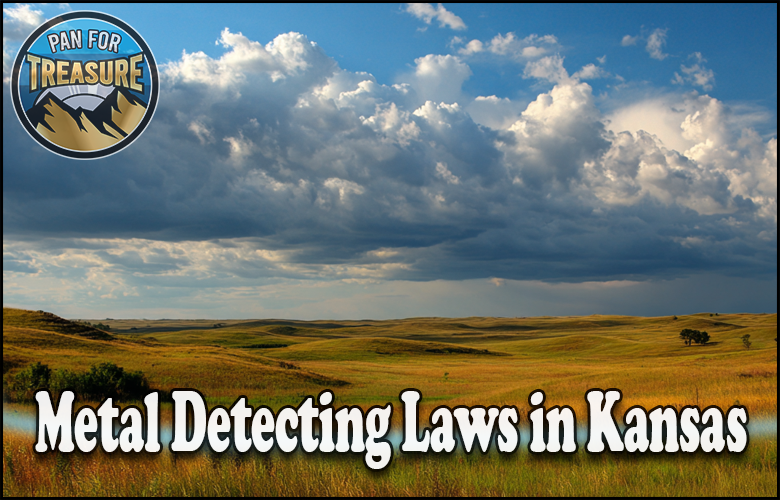
Metal detecting laws in Kansas are among the more relaxed in the Midwest. There is no statewide law prohibiting the use of metal detectors on public land. You can carry and use a detector in Kansas state parks without a permit.
However, the catch is that digging holes in state parks is prohibited without specific permission. This means you can scan but cannot recover targets in most state park areas unless you have a digging permit from the park.
Kansas makes up for its state park digging restriction with excellent private land opportunities. The state’s Wild West history, cattle drive heritage, ghost towns, and frontier settlement period make private land detecting extremely productive.
Unlike neighboring states such as Iowa (strict hourly restrictions) or Missouri (13 parks with permits), Kansas keeps things simple: detect anywhere, but get permission before you dig.
New to the hobby? Start with our beginner’s guide to gold panning and prospecting.
TL;DR
- No Statewide Ban: Kansas has no law prohibiting metal detector use on public land; you can scan freely in state parks
- No Digging in State Parks: Digging holes or pits in state parks is prohibited without specific park permission
- County Parks: Johnson County (Shawnee Mission Park) allows full detecting with a permit (~$10); Overland Park requires a free permit
- Ghost Towns: Kansas has dozens of abandoned frontier and mining towns; verify land ownership before detecting
- ARPA/NHPA: Both federal laws are enforced; no artifacts over 100 years old removed from public land; historical sites off-limits
- Private Land: Best option for digging and keeping finds; written landowner permission required
Detecting allowed; digging prohibited without permission
No state permit; county permits vary ($0-$10)
Cattle trails, frontier forts, Bleeding Kansas, Dust Bowl ghost towns
Flint Hills, southeast mining towns, Santa Fe Trail corridor
Dozens statewide including Treece, Diamond Springs, and others
No digging in state parks; ARPA protects artifacts on all public land
Metal Detecting Laws in Kansas
Metal detecting laws in Kansas are simpler than many states but still have important distinctions between scanning, digging, and land types. Here is the breakdown.
State Parks
Kansas does not have a law specifically prohibiting the use of metal detectors in state parks. You can carry and operate a detector in state park grounds without needing a permit. The key restriction is digging: creating holes or pits in state park ground is not allowed without specific permission from park staff.
Most state park beaches limit detecting to the beach area. Milford State Park (Geary County), one of the state’s largest, allows detecting on its beach areas. Other state parks with beach areas may have similar allowances. Contact the specific state park office to ask about their current digging policy before visiting.
Some state parks may be more accommodating than others regarding digging permissions. Park officials in Kansas are generally familiar with the hobby and may grant informal permission if you explain your intentions and agree to fill all holes neatly. But do not assume permission is granted. Ask first.
County and City Parks
County and city park regulations vary across Kansas, but the state is generally permissive. According to MDHTALK, no Kansas cities or counties are currently listed as requiring metal detecting permits or prohibiting the activity. However, some notable exceptions and local rules exist:
Johnson County’s Shawnee Mission Park is one of the best detecting locations in Kansas. Unlike most state parks, Shawnee Mission Park allows detecting throughout the park (not just beaches) with a permit from the Johnson County Parks and Recreation Department. The permit costs approximately $10.
Overland Park requires a free permit for metal detecting in city parks. Contact the Overland Park Parks and Recreation Department.
Most Kansas cities have no specific regulation, meaning detecting is generally allowed unless posted otherwise. Always fill holes and remove trash.
Federal Land
Kansas has limited federal land compared to western states, but ARPA and NHPA apply to all federal property. This includes Army Corps of Engineers land along the state’s rivers and reservoirs, Cimarron National Grassland (Morton County), and any National Park Service sites.
Fort Larned National Historic Site and Fort Scott National Historic Site are completely off-limits to metal detecting under NPS rules. The Tallgrass Prairie National Preserve (Chase County) is also off-limits.
Private Land
Private land with written landowner permission is the best option in Kansas. ARPA does not apply to private property. Kansas is predominantly private agricultural land, and the state’s frontier, ranching, and settlement history makes old farmsteads, ghost town sites, and trail corridors on private land extremely productive. Get written permission and agree on terms regarding finds.
Ghost Towns
Kansas has dozens of abandoned towns from the frontier era, cattle drive period, mining boom, railroad expansion, and Dust Bowl. Many ghost town sites are on private land. Some may be on public land. Verify ownership and get permission before detecting. Ghost towns that have been designated as historic sites are off-limits under NHPA.
Rules Summary
| Land Type | Detecting Allowed? | Digging Allowed? | Permit/Permission | Artifacts (100+ Years) |
|---|---|---|---|---|
| State Parks | Yes (no permit needed to scan) | No (without park permission) | Ask park staff for digging | Removal prohibited under ARPA |
| County Parks (Johnson Co.) | Yes, with permit | Yes (fill holes) | ~$10 permit | Report significant finds |
| City Parks | Generally yes | Varies | Some require free permit | Varies |
| Federal Land / NPS | No (NPS); varies (Corps) | No | N/A for NPS sites | ARPA strictly enforced |
| Private Land | Yes | Yes | Written landowner permission | Finder keeps (per agreement) |
For state park information, visit the Kansas Department of Wildlife and Parks. For the Kansas State Historical Society, see kshs.org.
Our Favorite Posts
Best Metal Detecting Locations in Kansas
Kansas’s frontier history and ghost towns create outstanding detecting opportunities.
- Shawnee Mission Park (Johnson County) – One of the few Kansas parks allowing full-park detecting with a permit (~$10). High visitor traffic produces modern coins and jewelry. The area’s pre-Civil War history (Bleeding Kansas era) adds historical potential.
- Milford State Park beach (Geary County) – Kansas’s largest state park, adjacent to Milford Reservoir. Beach areas allow detecting. Modern coins and jewelry from beachgoers are the primary targets. Contact park staff about current digging policy on the beach.
- Treece ghost town area (Cherokee County) – A zinc mining town that boomed in the early 1900s and was finally evacuated in 2012 due to environmental contamination. The ghost town site and surrounding area may produce mining-era items on accessible land. Verify current access rules due to the EPA superfund status.
- Santa Fe Trail corridor (various counties) – The historic Santa Fe Trail crossed Kansas from northeast to southwest. Trail ruts, camping spots, and historic stops like Diamond Springs (Morris County) and Council Grove (Morris County) are documented. Private land along the trail corridor produces frontier-era items from the 1820s-1870s.
- Dodge City area (Ford County) – The quintessential Wild West cattle town. Private land near the old town site and along cattle trail routes can produce late 1800s items. Boot Hill Museum grounds are off-limits, but surrounding private land with permission is productive.
- Abilene area (Dickinson County) – Another famous cattle town and Eisenhower’s boyhood home. The town dates to 1857 and was a major cattle trail terminus. Private land near old town sites and along the Chisholm Trail produces frontier-era relics.
- Wichita area parks (Sedgwick County) – Kansas’s largest city with parks dating to the late 1800s. Check with Wichita Parks and Recreation for current detecting policies. Older neighborhoods and parks near downtown are most productive for old coins.
- Southeast Kansas mining towns (Cherokee, Crawford Counties) – The tri-state mining district (Kansas, Missouri, Oklahoma) produced lead and zinc from the 1870s through the 1960s. Mining-era ghost towns and company towns on private land produce domestic items, coins, and mining-related artifacts.
- Fort Riley area (Geary, Riley Counties) – One of the oldest active Army posts in the country (1853). Private land near the fort and along old military roads may produce military and frontier items. The fort itself is a military installation with restricted access.
See our best locations to find gold guide and our metal detecting for gold guide for more.
Kansas History and What You Might Find
Kansas entered the national story violently in the 1850s as “Bleeding Kansas,” when pro-slavery and free-state forces fought over the territory’s future. Statehood came in 1861, just before the Civil War. The state saw limited direct combat but served as a staging area for Union forces and suffered from Confederate guerrilla raids, most notably Quantrill’s Raid on Lawrence in 1863.
After the Civil War, Kansas became the endpoint of the great cattle drives. Abilene, Dodge City, Wichita, and Caldwell served as railhead cattle towns where Texas cowboys delivered herds for eastern markets. This era (1867-1885) left artifacts across the trail corridors and town sites.
The frontier military presence was significant. Fort Riley (1853), Fort Leavenworth (1827), Fort Larned (1859), and Fort Scott (1842) anchored the military’s western expansion. Private land near these forts and along military roads produces military buttons, buckles, cartridge casings, and personal items.
Common detecting finds in Kansas include Indian Head and Wheat pennies, Barber and Mercury dimes, military buttons and insignia near forts, horseshoes and tack hardware along cattle trails, mining tools and domestic items in the southeast mining district, and personal effects from frontier homesteads. Civil War-era finds (including Quantrill’s Raid artifacts) are found on private land in eastern Kansas.
Kansas is not a significant gold state, though minor placer gold has been reported in the Arkansas River and tributaries.
Recommended Reading
Tips for Metal Detecting in Kansas
- Ask before you dig in state parks. You can scan freely, but digging requires permission. Park staff are generally approachable. Explain the hobby and your commitment to filling holes. You may get informal approval, but do not dig without it.
- Get the Johnson County permit. Shawnee Mission Park with a $10 permit is one of the best legal detecting locations in Kansas. Worth the small investment for access to the full park.
- Focus on private land for relics. Kansas’s cattle trail, frontier fort, and ghost town history makes private land the most productive detecting ground. Older farmers and ranchers often welcome detectorists who are respectful and share their finds.
- Research the Santa Fe and Chisholm trails. The documented camping spots and river crossings along these historic routes are prime detecting locations on private land. County historical societies and Kansas State Historical Society resources help pinpoint exact locations.
- Be aware of Dust Bowl era ghost towns. Many Kansas towns were abandoned during the 1930s Dust Bowl. These relatively recent ghost towns on private land produce early 20th-century domestic items and coins. Homestead sites in western Kansas are abundant but often remote.
- Avoid EPA superfund sites. Some mining-era ghost towns in southeast Kansas (like Treece) are contaminated superfund sites with restricted access. Check EPA status before visiting any former mining town.
- Detect river gravel bars. Kansas rivers (Kansas River, Arkansas River, Smoky Hill River, Big Blue River) bring items downstream from upstream settlements. Gravel bars accessible on public land or with permission can produce coins, buttons, and other items.
- Watch for extreme heat in summer. Western Kansas gets very hot and dry in summer. Bring plenty of water, sun protection, and be aware of rattlesnakes in grassland and rocky areas. Spring and fall are the best detecting seasons.
For technique guidance, see our techniques guide and tips and tricks.
Resources
- Kansas Department of Wildlife and Parks – State park information, maps, and contact details for individual parks.
- Kansas State Historical Society – Historical site information, archaeology resources, and cultural preservation guidelines.
- National Park Service – Kansas – List of all NPS sites in Kansas where metal detecting is prohibited, including Fort Larned and Fort Scott.
- Johnson County Parks and Recreation – Permit information for Shawnee Mission Park and other Johnson County parks.
Conclusion
Metal detecting laws in Kansas are straightforward: no ban on using detectors, but get permission before you dig on public land. The state’s Wild West history, cattle trail heritage, and dozens of ghost towns make Kansas a rewarding state for detectorists who focus on private land with landowner permission.
Kansas rewards research. The detectorists who study the cattle trail corridors, map the old fort locations, and identify ghost town sites on private land consistently pull the best finds. Pair that research with the accessible county park permits, and Kansas offers a complete detecting experience.
Explore nearby state guides: metal detecting laws in Missouri, metal detecting laws in Nebraska, metal detecting laws in Oklahoma, metal detecting laws in Colorado, and metal detecting laws in Iowa. See the full state-by-state metal detecting laws directory.
Frequently Asked Questions – KS Metal Detecting Laws
Can I metal detect in Kansas state parks?
You can use a metal detector in Kansas state parks without a specific permit. However, digging holes or pits in state parks is prohibited without permission from park staff. Most parks limit detecting to beach areas for practical recovery. Contact the park office before visiting to ask about their current digging policy.
Do I need a permit to metal detect in Kansas?
No statewide permit is required. For county parks like Johnson County’s Shawnee Mission Park, a permit (~$10) is needed. Overland Park requires a free city permit. Most Kansas cities have no specific permit requirement. Private land requires only written landowner permission.
Where are the best places to metal detect in Kansas?
Shawnee Mission Park (Johnson County) with a permit is the best public option. Private land along the Santa Fe Trail and Chisholm Trail corridors, near Dodge City and Abilene, in the southeast mining district, and at ghost town sites offers the best finds. Old farmsteads and homestead sites across the state are productive with landowner permission.
Can I metal detect at Kansas ghost towns?
It depends on land ownership and historic site status. Many Kansas ghost towns are on private land and require landowner permission. Some may be designated historic sites (off-limits under NHPA). EPA superfund ghost towns like Treece have restricted access. Always verify ownership, historic status, and access rules before visiting any ghost town.
Is there gold in Kansas?
Kansas has very minor placer gold reported in the Arkansas River and some tributaries, but it is not a practical gold prospecting state. Metal detecting in Kansas focuses on coins, relics, jewelry, and historical artifacts from the state’s rich frontier and cattle drive history.
How does Kansas compare to neighboring states for metal detecting?
Kansas is more permissive than Iowa (which restricts to beach areas with strict hours), less restrictive than Nebraska (where you cannot carry a detector in most state parks), and comparable to Oklahoma. The main limitation is the no-digging rule in state parks, which pushes serious detecting onto private land.

⛏ Recommended Gear ⛏


* As an Amazon Associate I earn from qualifying purchases at no extra cost to you.
Subscribe to Our Newsletter

Ryan Conlon is the founder of Pan for Treasure.
A lifelong gold panning enthusiast, he created this site to help beginners learn the ropes and share practical tips from his own time on the creek. [email protected]