First Posted March 4, 2026 | 🕒 Last Updated on June 27, 2026 by Ryan Conlon
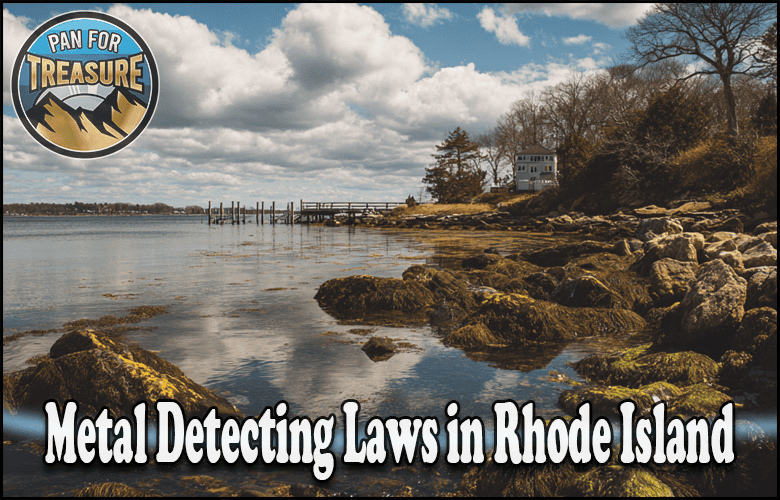
Metal detecting laws in Rhode Island are among the more relaxed in New England. There is no law expressly prohibiting metal detecting in Rhode Island state parks.
Some parks may require a permit, and designated times and locations may apply. Archaeological sites are the only firm restriction.
This makes Rhode Island more accessible than Massachusetts (supervisor permission required) or New York (complex regional permits).
Despite being the smallest state by area, Rhode Island played a vital role in the Revolutionary War and has deep colonial history dating to Roger Williams’ 1636 founding of Providence.
The state’s beaches are popular detecting locations, and the combination of accessible parks, productive beaches, and colonial-era private land makes Rhode Island a compact but rewarding detecting destination.
New to the hobby? Start with our beginner’s guide to gold panning and prospecting.
TL;DR
- State Parks: No express prohibition; some parks may require permits; check with park superintendent for specific rules and designated areas/times
- Beaches: Popular and generally open for detecting; Narragansett, Misquamicut, Scarborough, and other beaches are productive
- Archaeological Sites: The only firm restriction; sites of archaeological importance are off-limits
- BLM Land: Detecting allowed; artifacts must be left alone and reported to BLM field officer
- National Forests: Campgrounds and picnic areas generally allowed; no known archaeological remains must be present
- Private Land: Excellent; colonial (1636), Revolutionary War history; written landowner permission required
No express prohibition; some parks may require permits
Popular and generally open; Narragansett Bay and Atlantic coast
Roger Williams (1636), colonial, Revolutionary War, maritime
Smallest state; 1,214 square miles; dense history per square mile
Lincoln Woods SP, Fort Adams SP, Brenton Point SP, Goddard Memorial SP
Archaeological sites off-limits; everything else generally accessible
Metal Detecting Laws and Regulations in Rhode Island
Metal detecting laws in Rhode Island are straightforward. Here is the breakdown.
State Parks
There is no law expressly prohibiting metal detecting in Rhode Island state parks. Metal detecting is permitted in state parks across the state, though some parks may require a permit from the park superintendent and may designate specific areas or times for detecting. Check with the park superintendent about any specific rules before detecting. Lincoln Woods State Park, Fort Adams State Park, Brenton Point State Park, and Goddard Memorial State Park are among the parks where detecting is reported to be allowed.
Beaches
Rhode Island’s beaches are popular detecting locations. The state has productive beaches along both the Narragansett Bay and the Atlantic coast. Notable detecting beaches include Narragansett Town Beach, Misquamicut State Beach, Scarborough State Beach, and East Matunuck State Beach. Beach detecting is generally permitted. Check for any seasonal or local restrictions.
Archaeological Sites (Off-Limits)
The only firm restriction is that sites of archaeological importance are off-limits. If you are unsure whether a location has archaeological significance, contact the site’s authorities or the Rhode Island Historical Preservation and Heritage Commission.
Federal Land
BLM land in Rhode Island allows detecting, but artifacts must be left alone and reported to the BLM field officer. National forests allow detecting in campgrounds and picnic areas where no known archaeological remains exist. ARPA restrictions apply on all federal land.
NPS Sites (Prohibited)
Roger Williams National Memorial and Touro Synagogue National Historic Site are off-limits.
Private Land
Private land with written landowner permission is excellent. Rhode Island’s colonial history (1636) and Revolutionary War heritage make private land detecting productive despite the state’s small size.
Rules Summary
| Land Type | Detecting Allowed? | Permit/Permission | Artifacts |
|---|---|---|---|
| State Parks | Yes (no express prohibition) | Some may require permit; check with superintendent | Archaeological sites off-limits |
| Beaches | Generally yes | Check local rules | Modern items kept |
| Archaeological Sites | No | N/A (prohibited) | N/A |
| NPS Sites | No | N/A (prohibited) | N/A |
| Private Land | Yes | Written landowner permission | Finder keeps (per agreement) |
For state park information, visit Rhode Island State Parks. For archaeology, see RI Historical Preservation and Heritage Commission.
Best Metal Detecting Locations in Rhode Island
- Narragansett Town Beach (Washington County) – One of Rhode Island’s most popular beaches. Heavy summer traffic produces modern finds. Off-season detecting after tourist crowds leave is most productive.
- Misquamicut State Beach (Washington County) – A busy state beach with heavy summer use. Modern coins, jewelry, and personal items. Check with park staff for detecting rules.
- Fort Adams State Park (Newport County) – A state park with a massive 19th-century fort (the fort itself may be restricted). The surrounding park area has military history from the 1700s through the Cold War.
- Lincoln Woods State Park (Providence County) – A popular inland state park near Providence. Campground and picnic areas may be open for detecting.
- Newport area private land (Newport County) – Newport was founded in 1639 and has extraordinary colonial and Gilded Age history. Private land near old estates and colonial settlements is productive.
- Providence area (Providence County) – Founded by Roger Williams in 1636. One of the oldest cities in America. Private land and city parks (check local rules) in older neighborhoods produce colonial-era items.
- Scarborough State Beach (Washington County) – Another popular state beach. Tourist traffic produces modern finds. Check for seasonal detecting restrictions.
- Ghost towns and old mill sites (various counties) – Rhode Island’s industrial history left abandoned mill villages and factory sites. Private land near old mill sites produces industrial-era artifacts.
See our best locations to find gold guide and state-by-state directory.
Rhode Island’s History and What You Might Find
Rhode Island was founded by Roger Williams in 1636 after he was expelled from Massachusetts Bay Colony. Newport became a major colonial port and one of the wealthiest cities in pre-Revolutionary America. The state fired some of the first shots of the Revolution (the burning of the Gaspee in 1772) and saw significant Revolutionary War activity, including the French alliance’s presence at Newport.
The state’s maritime history includes shipbuilding, whaling, and the triangle trade. Rhode Island industrialized early, with Samuel Slater’s mill in Pawtucket (1793) often called the birthplace of the American Industrial Revolution. The Gilded Age brought extraordinary wealth to Newport’s mansion district.
Common finds include colonial-era coins (King George coppers, Spanish silver), Revolutionary War buttons and buckles, maritime items (ship hardware, fishing weights), industrial-era coins and artifacts, Gilded Age items near Newport, and modern jewelry at beaches. Rhode Island’s dense history per square mile makes it one of the most productive small states for detecting.
Rhode Island has no significant gold deposits.
Tips for Metal Detecting in Rhode Island
- Check with park superintendents. While there is no express prohibition, some state parks may require permits or have designated detecting areas. A quick check prevents problems.
- Detect beaches in the off-season. Rhode Island’s tourist beaches accumulate modern finds all summer. Fall and spring detecting after the crowds leave is most productive.
- Stay away from archaeological sites. This is the only firm restriction. If unsure about a site’s status, contact the RI Historical Preservation Commission.
- Research colonial-era sites on private land. Rhode Island’s history dates to 1636. County records and historical societies identify early settlements, tavern sites, and gathering places on private land.
- Detect Newport-area private land for Gilded Age finds. The mansions and estates of Newport’s Gilded Age (1870s-1900s) left artifacts across the area. Private land near old service roads and estate grounds can produce high-end personal items.
- Target maritime sites. Rhode Island’s extensive coastline and maritime heritage make coastal private land and accessible beaches productive for maritime items.
- Take advantage of Rhode Island’s small size. You can reach any detecting location in the state within an hour’s drive. This makes it easy to explore multiple sites in a single day.
- Join a local club. Rhode Island has active detecting groups that share knowledge about productive locations and park policies.
For technique help, see our techniques guide and tips and tricks.
Resources
- Rhode Island Division of Parks and Recreation – State park information and superintendent contacts.
- RI Historical Preservation and Heritage Commission – Archaeological site protections and cultural resource information.
- National Park Service – Rhode Island – NPS sites where detecting is prohibited.
- Rhode Island Historical Society – Historical research resources for colonial and Revolutionary War detecting.
Conclusion
Metal detecting laws in Rhode Island are among the most relaxed in New England. No express state park prohibition, generally accessible beaches, and the only restriction being archaeological sites make Rhode Island easy to navigate. The state’s deep colonial and Revolutionary War history, packed into the smallest state in America, means extraordinary history per square mile.
Explore nearby state guides: metal detecting laws in Massachusetts, metal detecting laws in Connecticut, and metal detecting laws in New York. See the full state-by-state metal detecting laws directory.
Frequently Asked Questions
Can I metal detect in Rhode Island state parks?
Yes. There is no law expressly prohibiting metal detecting in state parks. Some parks may require permits or have designated areas/times. Check with the park superintendent before detecting.
Can I detect on Rhode Island beaches?
Yes. Rhode Island beaches are generally open for detecting. Narragansett, Misquamicut, and Scarborough are among the most popular. Check for any local or seasonal restrictions.
What is off-limits in Rhode Island?
Sites of archaeological importance are the only firm restriction. NPS sites (Roger Williams National Memorial, Touro Synagogue) are off-limits. If unsure about a site’s archaeological status, check with the RI Historical Preservation Commission.
What can I find in Rhode Island?
Colonial-era coins (1636+), Revolutionary War buttons and buckles, maritime items, industrial-era artifacts, Gilded Age items near Newport, and modern jewelry at beaches. Dense history per square mile makes Rhode Island highly productive.
How does Rhode Island compare to other New England states?
Rhode Island is more relaxed than Massachusetts (supervisor permission required) and comparable to Connecticut (DEEP land open without permits). New Hampshire has more specific designated zones. Rhode Island’s lack of express prohibition makes it the easiest New England state for park access.
Is there gold in Rhode Island?
Rhode Island has no significant gold deposits. Detecting focuses on colonial-era coins, Revolutionary War relics, maritime items, and modern jewelry at beaches.

⛏ Recommended Gear ⛏


* As an Amazon Associate I earn from qualifying purchases at no extra cost to you.
Subscribe to Our Newsletter

Ryan Conlon is the founder of Pan for Treasure.
A lifelong gold panning enthusiast, he created this site to help beginners learn the ropes and share practical tips from his own time on the creek. [email protected]